- Study Abroad
- / ielts
- / the mpemba effect reading answers
The Mpemba Effect Reading Answers


Author
17-09-2025

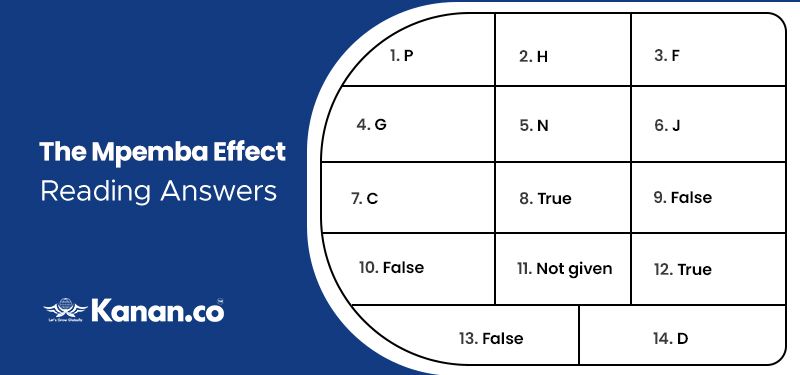
Here, we have given “The Mpemba Effect” reading answers along with questions, answers and explanations. The given passage has 14 questions in 3 different types namely- 7 questions as multiple choice, 6 questions as true, false or not given and 1 questions as multiple choice questions.
Check out our YouTube Channel to Practice Full-Length IELTS Reading Tests Daily

Table of contents:
- Solution for The Mpemba Effect
- The Mpemba Effect IELTS reading practice test
- Passage
- Questions
- Answers with explanation
Solution for The Mpemba Effect
Below, we have given the answers for The Mpemba Effect Reading Answers in table form.

Answers Table
| 1. P | 4. G | 7. C | 10. False | 13. False |
| 2. H | 5. N | 8. True | 11. Not given | 14. D |
| 3. F | 6. J | 9. False | 12. True |
The Mpemba Effect IELTS Reading Practice Test - Exam Review
Here we have given The Mpemba Effect IELTS reading answers, as a sample article for the IELTS reading practice test. This article will help you to crack your exam with band scores. Scrutinize the given passage to answer the questions.
Passage
We have given The Mpemba Effect reading answers with location. Be careful while reading the passage and answer the questions.
The Mpemba Effect reading answers
- In 300 BC, the famous philosopher Aristotle wrote about a strange phenomenon that he had observed: “Many people, when they want to cool water quickly, begin by putting it in the sun.” Other philosophers over the ages noted the same result, but were unable to explain it.
- In 1963, a young Tanzanian student named Erasto Mpemba noticed that the ice cream he was making froze faster if the mix was placed in the freezer while warm than if it were at room temperature. He persisted in questioning why this occurred, and eventually physicist Denis Osborne began a serious investigation into what is now known as the Mpemba Effect. He and Mpemba co-authored a paper in New Scientist in 1969, which produced scientific descriptions of some of the many factors at work in freezing water.
- It was initially hypothesised that the warm bowl melted itself a place in the ice on the freezer shelf, thus embedding its base in a ‘nest’ of ice, which would accelerate freezing. The hypothesis was tested by comparing the result when bowls of warm water were placed on ice and on a dry wire shelf; this demonstrated that the ice nest actually had little effect. A second suggestion was that the warmer water would be evaporating at its surface, thus reducing the volume needing to be frozen, but this idea was also shown to be insignificant.
- The thermometer placed in the water showed that the cooler water drooped to freezing temperature well before the warmer bowlful, and yet the latter always froze solid first. Experiments at different temperatures showed that water at 50C took longest to freeze in a conventional freezer, while water initially at 350C was quickest. On further examination, an explanation for this paradox began to emerge. Losing heat from the water occurs at the points where it is in touch with the colder atmosphere of the freezer, namely the sides of the bowl and the water surface.
- A warm surface will lose heat faster than a cold one because of the contrast between temperature ; but of course there is more heat to lose from one bowl than the other! If the surface can be kept at a higher temperature, the higher rate of heat loss will continue. As long as the water remains liquid, the cooling portion on top will sink to the bottom of the bowl as the warmer water below rises to take its place. The early freezing that may occur on the sides and base of the container will amplify the effect.
- The bowl that is more uniformly cold will have far less temperature difference so the water flow will be minimal. Another inhibiting factor for this container is that ice will also form quite quickly on the surface. This not only acts as insulation, but will virtually stop the helpful effects of the water circulating inside the bowl.
- Ultimately, the rate of cooling of the core of this body of water becomes so slow that the other warmer one is always fully frozen first. While there are limitations to this comparison (for example, we would not see such a result if one quantity were at 10C and another at 990C) this counter-intuitive result does hold true within the 5–350C range of temperatures indicated previously.
- Since this paper was published, the validity of the research findings has been not clearly defined; for example,the researchers needed to decide on exactly what constituted freezing the water. They also state that the rate at which water freezes depends on a large number of variables.
- Container size is one of these; for the Mpemba Effect to be noticed, the container must be large enough to allow a free circulation of water to take place, yet small enough for the freezing areas of the side and base to be effective at extracting heat too. Secondly, research at a University in St Louis, Missouri, suggests that the Mpemba Effect may be affected by water purity, or by dissolved gas in the water.
- Distilled water is totally free of particles that are common in normal drinking water or mineral water. When suspended in water, these particles may have a small effect on the speed of cooling, especially as ice molecules tend to expel them into the surrounding water, where they become more concentrated. Just as salt dissolved in water will raise the boiling point and lower the temperature at which it freezes, the researchers found that the final portion of ordinary water needed extra cooling, below zero, before all was frozen solid.
- One more factor that can distort the effect is observed if the bowls are not placed simultaneously into the same freezer. In this case, the freezer thermostat is more likely to register the presence of a hotter bowl than a colder one, and therefore the change in internal temperature causes a boost of freezing power as the motor is activated.
- The Mpemba Effect is still not fully understood, and researchers continue to delve into its underlying physics. Physicists cannot reach consensus. Some suggest that supercooling1 is involved; others that the molecular bonds in the water molecules affect the rate of cooling and freezing of water. A 2013 competition to explain the phenomenon run by the Royal Society of Chemistry attracted more than 22,000 entries, with the winning one suggesting supercooling as an important factor so it seems the question and its underlying explanation continue to fascinate.
Questions
Questions 1-7
- Write the correct letter, A–O, in boxes 1-7 on your answer sheet.
For more than 2000 years people have wondered why raising the 1___________ of cold water before cooling results in more rapid cooling. At first researchers thought that a warm container created its own icy 2___________ which made the water freeze faster, but comparisons with containers resting on a dry 3__________ indicated that this was inaccurate. Evaporation of water proved not to be a 4________ .
Temperature measurements showed that, although the water in the cooler container reached 00C before the warmer one, it took longer to actually solidify. The water temperature drops the most at the top and sides of the container. Provided there is a temperature 5____________ , the water will continue to circulate and to cool down. Cooler water will have less water 6____________ , and thus a slower rate of freezing. If ice forms on the top of the water, this will further slow the 7____________ of freezing, but if it forms on the bottom and the sides of the container, this will increase the rate of cooling.
A. melt
B. element
C. process
D. center
E. acceleration
F. surface
G. factor
H. hollow
I. matter
J. circulation
K. limit
L. significance
M. Theory
N. difference
O. result
P. temperature
Questions 8-13
- Do the following statements agree with the information given in the Reading Passage? In boxes 8-13 on your answer sheet, write
- TRUE – if the statement agrees with the information
- FALSE – if the statement contradicts the information
- NOT GIVEN – if there is no information on this
8. The Mpemba Effect cannot be seen when comparing liquids with an extreme temperature difference.
9. Osborne and Mpemba’s results are still widely accepted today.
10. The size of the container does not alter the Mpemba Effect.
11. Osborne and Mpemba experimented on both pure and impure water.
12. One variable is the timing of containers in a freezer.
13. Physicists now agree that supercooling accounts for the Mpemba Effect.
Question 14
- Choose the correct letter, A, B, C or D.
14. The Mpemba Effect is best summed up as the observation that
A Ice cream freezes at different temperatures.
B Different sources of heat result in water cooling at different rates.
C Salt water freezes at a lower temperature than ordinary water.
D Warmer water can freeze faster than colder water.
Answers for The Mpemba Effect with Explanation
Answers for The Mpemba Effect reading answers with Explanation is given here, this section will help you to identify your mistakes.
1. Answer: P
Explanation: “In 300 BC, the famous philosopher Aristotle wrote about a strange phenomenon that he had observed: “Many people, when they want to cool water quickly, begin by putting it in the sun.” Other philosophers over the ages noted the same result, but were unable to explain it” and “In 1963, a young Tanzanian student named Erasto Mpemba noticed that the ice cream he was making froze faster if the mix was placed in the freezer while warm than if it were at room temperature”. With this line it is clear that for more than 2000 years people have wondered why raising the temperature of cold water before cooling it results in more rapid cooling. Hence the given answer is located in paragraph 1 and 1-3 lines of paragraph 2.
2. Answer: H
Explanation: “It was initially hypothesised that the warm bowl melted itself a place in the ice on the freezer shelf, thus embedding its base in a ‘nest’ of ice, which would accelerate freezing”. With this line it is clear that researchers thought that a warm container created its own icy hollow which made the water freeze faster. Hence the given answer is located in the 1-3 lines of paragraph 3.
3. Answer: F
Explanation: “The hypothesis was tested by comparing the result when bowls of warm water were placed on ice and on a dry wire shelf; this demonstrated that the ice nest actually had little effect”. With this line it is clear that comparisons with containers resting on a dry surface indicated that this was inaccurate. Hence the given answer is located in the 3-5 lines of paragraph 3.
4. Answer: G
Explanation: “A second suggestion was that the warmer water would be evaporating at its surface, thus reducing the volume needing to be frozen, but this idea was also shown to be insignificant”. With this line it is clear that evaporation of water proved not to be a factor. Hence the given answer is located in the last 3 lines of paragraph 3.
5. Answer: N
Explanation: “A warm surface will lose heat faster than a cold one because of the contrast between the temperatures; but of course there is more heat to be lost from one bowl than the other! If the surface can be kept at a higher temperature, the higher rate of heat loss will continue. As long as the water remains liquid, the cooling portion on top will sink to the bottom of the bowl as the warmer water below rises to take its place”. With this line it is clear that the water temperature drops the most at the top and sides of the container. Provided there is a temperature difference. Hence the given answer is located in paragraph 5.
6. Answer: J
Explanation: “Another inhibiting factor for this container is that ice will also form quite quickly on the surface. This not only acts as insulation, but will virtually stop the helpful effects of the water circulating inside the bowl”. With this line it is clear that the water will continue to circulate and to cool down. Cooler water will have less water circulation, and thus a slower rate of freezing. Hence the given answer is located in the last 3 lines of paragraph 6.
7. Answer: C
Explanation: “Another inhibiting factor for this container is that ice will also form quite quickly on the surface. This not only acts as insulation, but will virtually stop the helpful effects of the water circulating inside the bowl” and “Ultimately, the rate of cooling the core of this body of water becomes so slow that the other warmer one is always fully frozen first”. With this line it is clear that if ice forms on the top of the water, this will further slow the process of freezing, but if it forms on the bottom and the sides of the container, this will increase the rate of cooling. Hence the given answer is located in the last 3 lines of paragraph 6 and first 2 lines of paragraph 7.
8. Answer: True
Explanation: “Ultimately, the rate of cooling the core of this body of water becomes so slow that the other warmer one is always fully frozen first. While there are limitations to this comparison (for example, we would not see such a result if one quantity were at 10C and another at 990C) this counter-intuitive result does hold true within the 5–350C range of temperatures indicated previously”. With this line it is clear that the Mpemba Effect cannot be seen when comparing liquids with an extreme temperature difference. Hence the given answer is located in paragraph 7.
9. Answer: False
Explanation: “Since this paper was published, the validity of the research findings has been questioned by a number of reviewers. They point out that the initial experimental question was not clearly defined; for example, the researchers needed to decide on exactly what constituted freezing the water”. With this line it is clear that give statement contradicts the given information. Hence the given answer is located in 1-4 paragraph 8.
10. Answer: False
Explanation: “Container size is one of these; for the Mpemba Effect to be noticed, the container must be large enough to allow a free circulation of water to take place, yet small enough for the freezing areas of the side and base to be effective at extracting heat too”. With this line it is clear that give statement contradicts the given information. Hence the given answer is located in 1-4 paragraph 9.
11. Answer: Not given
12. Answer: True
Explanation: “One more factor that can distort the effect is observed if the bowls are not placed simultaneously into the same freezer”. With this line it is clear that one variable is the timing of containers in a freezer. Hence the given answer is located in 1- paragraph 11.
13. Answer: False
Explanation: “The Mpemba Effect is still not fully understood, and researchers continue to delve into its underlying physics. Physicists cannot reach consensus. Some suggest that supercooling is involved; others that the molecular bonds in the water molecules affect the rate of cooling and freezing of water”. With this line it is clear that the given statement contradicts the given information. Hence the given answer is located in 1-4 paragraph 12.
14. Answer: D
Explanation: “that the ice cream he was making froze faster if the mix was placed in the freezer while warmer than if it were at room temperature”. With this line it is clear that the Mpemba Effect is best summed up as the observation that warmer water can freeze faster than colder water. Hence the given answer is located in 1-3 paragraph 2.
Other reading answers

About Author Gayathri Nagarajan
Gayathri, a trusted study-abroad expert, with expertise in standardized tests like IELTS, TOEFL, PTE, GRE, and GMAT. With a strong tech background from SASTRA University, she excels in software testing and has a passion for content writing and digital marketing. She aids students in finding the perfect academic fit, offering guidance on course selection, LOR and SOP writing. She remains up-to-date with the latest trends in higher education, delivering credible, accurate information on international education, including courses and test prep materials. As a trusted Study abroad expert at Kanan International, explore her latest blogs and articles for comprehensive insights into studying abroad and realizing your academic aspirations.
Kanan.co is a trusted study abroad consultancy offering comprehensive services, resources, and solutions for students and education institutions. We support students at every stage of their global education journey, ensuring a smooth and guided experience. Along with test preparation for IELTS, GRE, TOEFL, and SAT, we provide expert services such as SOP writing, visa guidance, accommodation support, scholarship assistance, and education loan support. Our expertise and commitment to excellence make us a reliable partner for students pursuing international education.
Free Online Mock Test 2026
Practice our mock test worth Rs. 25000 for Free and know your IELTS score!








Global Headquarters
Kanan Int EdTech Inc
320 Bay Street, Suite 321 (Spaces), Toronto ON, Canada M5B 1N9
Indian Headquarters
Kanan International Pvt. Ltd.
D-wing, 2nd Floor, Trident Complex, Ellora Park Vadiwadi Road, Vadodara, Gujarat 390007
IT/ Digital Campus
Kanan International Pvt. Ltd
Old, New No 3, 2nd Floor, 1A, Dr Sadasivam Rd, T. Nagar, Chennai, Tamil Nadu 600017
Our branches
- Bardoli
- Bharuch
- Chennai
- Dehradun
- Gurugram
- Himatnagar
- Karnal
- Nadiad
- Navsari
- Palanpur
- Rajkot
- Vadodara
- Valsad
- Vallabh Vidyanagar
- Vapi
Study Abroad
Test Prep
Top Universities
Consultants
IELTS Centers
GRE Centers
TOEFL Centers
SAT Centers
Language Courses in Vadodara
Study Abroad Calculators
Featured Blogs
Study Abroad Consultants in Chennai
Study Abroad Consultants in Surat
Study Abroad Consultants in Navsari
Study Abroad Consultants in Bardoli
Study Abroad Consultants in Ahmedabad
Study Abroad Consultants in Anand
Study Abroad Consultants in Khanna
Study Abroad Consultants in Nadiad
Study Abroad Consultants in Vadodara
Study abroad consultants in Valsad
Copyright © 2026 KANAN.CO All rights reserved.