- Study Abroad
- / ielts
- / the step pyramid of djoser reading answers
The Step Pyramid Of Djoser Reading Answers - Cambridge 16 Test 1


Author
19-09-2025
Answers Verified By
Senior IELTS Trainer | Content Creator

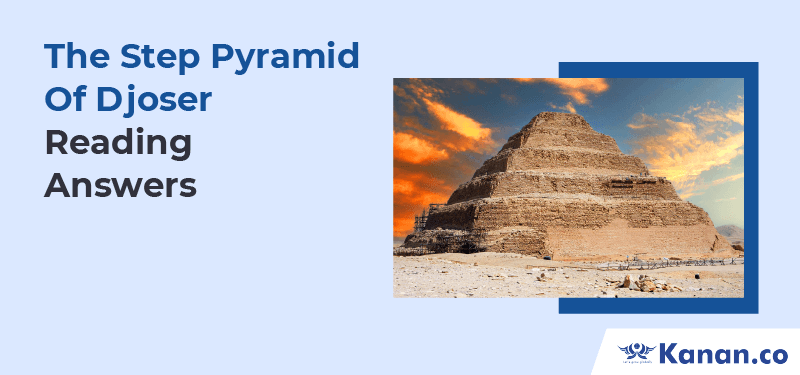
Below, you will find the step pyramid of djoser reading answers in the table. Evaluate your answers and check the answers with location and explanation to enhance your understanding about your answering skills.
Solution for: The Pyramid Of Djoser
| 14. iv | 19. viii | 24. location |
| 15. vii | 20. vi | 25 & 26: B and D |
| 16. ii | 21. city | |
| 17. v | 22. priests | |
| 18. i | 23. trench |

In this IELTS Reading Article, you will get the practice test and the step pyramid of djoser reading answers. If you already did the test, check your answers and understand it with the help of the step pyramid of djoser reading answers with location and explanation. It prepares you to get a good band score in the IELTS reading test.
The passage of the step pyramid of djoser reading answers talks about the first king of the third dynasty of Egypt, Djosera. You are required to solve the matching headings, note completion and multiple choice questions. These are all considered to be important IELTS reading question types.
The Step Pyramid Of Djoser reading answers with location
Check out our YouTube Channel to Practice Full-Length IELTS Reading Tests Daily

In the following reading passage, you will notice the step pyramid of djoser reading answers with location. Locate the appropriate portion of the passage related to the answers.
The Step Pyramid of Djoser
- The pyramids are the most famous monuments of ancient Egypt and still hold enormous interest for people in the present day. These grand, impressive tributes to the memory of the Egyptian kings have become linked with the country even though other cultures, such as the Chinese and Mayan, also built pyramids. A14: The evolution of the pyramid form has been written and argued about for centuries. However, there is no question that, as far as Egypt is concerned, it began with one monument to one king designed by one brilliant architect: the Step Pyramid of Djoser at Saqqara.
- Djoser was the first king of the Third Dynasty of Egypt and the first to build in stone. A15: Prior to Djoser’s reign, tombs were rectangular monuments made of dried clay brick, which covered underground passages where the deceased person was buried. For reasons which remain unclear, Djoser’s main official, whose name was Imhotep, conceived of building a taller, more impressive tomb for his king by stacking stone slabs on top of one another, progressively making them smaller, to form the shape now known as the Step Pyramid. A25: Djoser is thought to have reigned for 19 years, but some historians and scholars attribute a much longer time for his rule, owing to the number and size of the monuments he built.
- The Step Pyramid has been thoroughly examined and investigated over the last century, and it is now known that the building process went through many different stages. Historian Marc Van de Mieroop comments on this, writing ‘Much experimentation was involved, which is especially clear in the construction of the pyramid in the center of the complex. It had several plans … before it became the first Step Pyramid in history, piling six levels on top of one another …A16: The weight of the enormous mass was a challenge for the builders, who placed the stones at an inward incline in order to prevent the monument breaking up.’
- When finally completed, the Step Pyramid rose 62 meters high and was the tallest structure of its time. A17 & A21 & A22: The complex in which it was built was the size of a city in ancient Egypt and included a temple, courtyards, shrines, and living quarters for the priests. It covered a region of 16 hectares and was surrounded by a wall 10.5 meters high. The wall had 13 false doors cut into it with only one true entrance cut into the south-east corner; A23: the entire wall was then ringed by a trench 750 meters long and 40 meters wide. The false doors and the trench were incorporated into the complex to discourage unwanted visitors. A24: If someone wished to enter, he or she would have needed to know in advance how to find the location of the true opening in the wall. Djoser was so proud of his accomplishment that he broke the tradition of having only his own name on the monument and had Imhotep’s name carved on it as well.
- The burial chamber of the tomb, where the king’s body was laid to rest, was dug beneath the base of the pyramid, surrounded by a vast maze of long tunnels that had rooms off them to discourage robbers. A18: One of the most mysterious discoveries found inside the pyramid was a large number of stone vessels. Over 40,000 of these vessels, of various forms and shapes, were discovered in storerooms off the pyramid’s underground passages. They are inscribed with the names of rulers from the First and Second Dynasties of Egypt and made from different kinds of stone. There is no agreement among scholars and archaeologists on why the vessels were placed in the tomb of Djoser or what they were supposed to represent. The archaeologist Jean-Philippe Lauer, who excavated most of the pyramid and complex, believes they were originally stored and then give a ‘proper burial’ by Djoser in his pyramid to honor his predecessors. There are other historians, however, who claim the vessels were dumped into the shafts as yet another attempt to prevent grave robbers from getting to the king’s burial chamber.
- Unfortunately, all of the precautions and intricate design of the underground network did not prevent ancient robbers from finding a way in. A19 & A26: Djoser’s grave goods, and even his body, were stolen at some point in the past and all archaeologists found were a small number of his valuables overlooked by the thieves. There was enough left throughout the pyramid and its complex, however, to astonish and amaze the archaeologists who excavated it.
- Egyptologist Miroslav Verner writes, ‘Few monuments hold a place in human history as significant as that of the Step Pyramid in Saqqara … It can be said without exaggeration that this pyramid complex constitutes a milestone in the evolution of monumental stone architecture in Egypt and in the world as a whole.’ A20: The Step Pyramid was a revolutionary advance in architecture and became the archetype which all the other great pyramid builders of Egypt would follow.
Check out IELTS reading tips
The Step Pyramid Of Djoser reading questions
Questions 14-20
The Step of Pyramid Djoser Reading Passage has seven paragraphs, A-G.
Choose the correct heading for each paragraph from the list of headings below.
Write the correct number, i-ix, for the questions 14-20 on your answer sheet.
List of Headings
- i. The areas and artefacts within the pyramid itself
- ii. A difficult task for those involved
- iii. A king who saved his people
- iv. A single certainty among other less definite facts
- v. An overview of the external buildings and areas
- vi. A pyramid design that others copied
- vii. An idea for changing the design of burial structures
- viii. An incredible experience despite the few remains
- ix. The answers to some unexpected questions
14. Paragraph A = iv Locate
15. Paragraph B = viiLocate
16. Paragraph C = ii Locate
17. Paragraph D = v Locate
18. Paragraph E = i Locate
19. Paragraph F = viii Locate
20. Paragraph G = vi Locate
Read IELTS reading matching headings to understand the question type
Questions 21-24
Complete the notes below.
Choose ONE WORD ONLY from the passage for each answer.
Write your answers for the questions 21-24 on your answer sheet.
The Step Pyramid of Djoser
The complex that includes the Step Pyramid and its surroundings is considered to be as big as an Egyptian 21 __________ of the past. The area outside the pyramid included accommodation that was occupied by 22 __________ along with many other buildings and features.
A wall ran around the outside of the complex and a number of false entrances were built into this. In addition, a long 23 __________ encircled the wall. As a result, any visitors who had not been invited were cleverly prevented from entering the pyramid grounds unless they knew the 24 __________ of the real entrance.
21. City Locate
22. Priests Locate
23. Trench Locate
24. Location Locate
Check out IELTS reading summary completion
Questions 25-26
Choose TWO letters, A-E.
Write the correct letters for questions 25 and 26 on your answer sheet.
Which TWO of the following points does the writer make about King Djoser?
A. Initially he had to be persuaded to build in stone rather than clay.
B. There is disagreement concerning the length of his reign.
C. He failed to appreciate Imhotep’s part in the design of the Step Pyramid.
D. A few of his possessions were still in his tomb when archaeologists found it.
E. He criticised the design and construction of other pyramids in Egypt.
25: B Locate
26: D Locate
Read IELTS reading matching features to develop your skills on this question type
The Step Pyramid Of Djoser reading answers with explanation
Find below the step pyramid of djoser reading answers with explanation. It will help you to understand your answers in a detailed manner.
14. Answer: Paragraph A = iv
Explanation: In this line ‘…it began with one monument to one king designed by one brilliant architect: the Step Pyramid of Djoser at Saqqara’. Here, a single certainty is one monument to the King, who is Djoser.
15. Answer: Paragraph B = vii
Explanation: Following line ‘Prior to Djoser’s reign, tombs were rectangular monuments made of dried clay brick, which covered underground passages where the deceased person was buried. For reasons which remain unclear, Djoser’s main official, whose name was Imhotep, conceived of building a taller, more impressive tomb’ clearly exemplifies the shift in the design of burial buildings.
16. Answer: Paragraph C = ii
Explanation: ‘The weight of the enormous mass was a challenge for the builders, who placed the stones at an inward incline in order to prevent the monument breaking up’. The word challenge denotes that the task is difficult for those who are involved.
17. Answer: Paragraph D = v
Explanation: ‘The complex in which it was built was the size of a city in ancient Egypt and included a temple, courtyards, shrines, and living quarters for the priests’. This line contains the overview of all the buildings and areas.
18. Answer: Paragraph E = i
Explanation: ‘One of the most mysterious discoveries found inside the pyramid was a large number of stone vessels’. Here, the stone vessels refer to artefacts which are found inside the pyramid.
19. Answer: Paragraph F = viii
Explanation: ‘Djoser’s grave goods, and even his body, were stolen at some point in the past and all archaeologists found were a small number of his valuables overlooked by the thieves’
20. Answer: Paragraph G = vi
Explanation: ‘The Step Pyramid was a revolutionary advance in architecture and became the archetype which all the other great pyramid builders of Egypt would follow’. The key information here is that the architecture of the step pyramid is followed by other great pyramid builders.
21. Answer: city
Explanation: ‘The complex in which it was built was the size of a city in ancient Egypt and included a temple, courtyards, shrines, and living quarters for the priests’. In this line itself, you can understand that the building is compared to an Egyptian city.
22. Answer: priests
Explanation: ‘The complex in which it was built was the size of a city in ancient Egypt and included a temple, courtyards, shrines, and living quarters for the priests’. Living quarters is an accommodation which is occupied by priests.
23. Answer: trench
Explanation: ‘the entire wall was then ringed by a trench 750 meters long and 40 meters wide’. Ringed = encircled. Hence, the trench encircled the wall.
24. Answer: location
Explanation: ‘If someone wished to enter, he or she would have needed to know in advance how to find the location of the true opening in the wall.’ This line precisely explains that whoever wants to enter the pyramid grounds should know the location of the real entrance (true opening in the wall).
25 & 26. Answer: B. There is disagreement concerning the length of his reign and D. A few of his possessions were still in his tomb when archaeologists found it.
Explanation: The following line relates to the option B ‘Djoser is thought to have reigned for 19 years, but some historians and scholars attribute a much longer time for his rule, owing to the number and size of the monuments he built’
And, ‘Djoser’s grave goods, and even his body, were stolen at some point in the past and all archaeologists found were a small number of his valuables overlooked by the thieves’. This line justifies the option D.
Check out other reading answers:
- The development of museums reading answers
- Greying population stays in the pink reading answers
- Why we need to protect polar bears reading answers
Conclusion
We hope you would have gained benefit from “the step pyramid of djoser reading answers”. And, our reading answers location and explanation could have enhanced your understanding of your answering capabilities.

About Author Dinesh Pandiyan
Dinesh is a highly experienced content writer who specializes in language proficiency tests like IELTS, GRE, PTE, TOEFL, and study abroad. He provides valuable insights and tips to students on various modules of these tests, including reading, writing, speaking, and listening. His articles are well-researched, informative, and engaging, offering practical guidance to students looking to succeed in their academic pursuits. Additionally, Dinesh has coordinated with IELTS trainers to prepare test preparation materials, guides, practice tests, and mock tests, and worked closely with counsellors for study abroad consultancy, providing guidance on choosing the right institution, preparing for interviews, and writing effective statements of purpose (SOP) and letters of recommendation (LOR). Students can benefit from Dinesh's comprehensive knowledge and experience by checking out his articles.
Kanan International is a study abroad consultancy that offers reliable services, products, and solutions for students and education institutions. We support students throughout their study abroad journey, ensuring a hassle-free experience. Our expertise and commitment to excellence make us the go-to partner for expanding global horizons. The company provides coaching for IELTS, GRE, TOEFL, and SAT exams and services like visa consultation, accommodation, scholarship assistance, and education loans.
Free Online Mock Test 2026
Practice our mock test worth Rs. 25000 for Free and know your IELTS score!








Global Headquarters
Kanan Int EdTech Inc
320 Bay Street, Suite 321 (Spaces), Toronto ON, Canada M5B 1N9
Indian Headquarters
Kanan International Pvt. Ltd.
D-wing, 2nd Floor, Trident Complex, Ellora Park Vadiwadi Road, Vadodara, Gujarat 390007
IT/ Digital Campus
Kanan International Pvt. Ltd
Old, New No 3, 2nd Floor, 1A, Dr Sadasivam Rd, T. Nagar, Chennai, Tamil Nadu 600017
Our branches
- Bardoli
- Bharuch
- Chennai
- Dehradun
- Gurugram
- Himatnagar
- Karnal
- Nadiad
- Navsari
- Palanpur
- Rajkot
- Vadodara
- Valsad
- Vallabh Vidyanagar
- Vapi
Study Abroad
Test Prep
Top Universities
Consultants
IELTS Centers
GRE Centers
TOEFL Centers
SAT Centers
Language Courses in Vadodara
Study Abroad Calculators
Featured Blogs
Study Abroad Consultants in Chennai
Study Abroad Consultants in Surat
Study Abroad Consultants in Navsari
Study Abroad Consultants in Bardoli
Study Abroad Consultants in Ahmedabad
Study Abroad Consultants in Anand
Study Abroad Consultants in Khanna
Study Abroad Consultants in Nadiad
Study Abroad Consultants in Vadodara
Study abroad consultants in Valsad
Copyright © 2026 KANAN.CO All rights reserved.