- Study Abroad
- / ielts
- / the white horse of uffington reading answers
The White Horse of Uffington Reading Answers


Author
16-09-2025

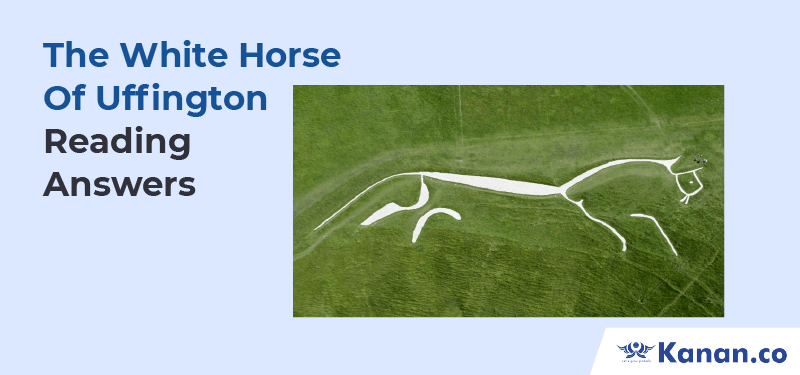
The White Horse of Uffington reading answers are provided in a table format below. Check the accuracy of your responses and spot any mistakes.
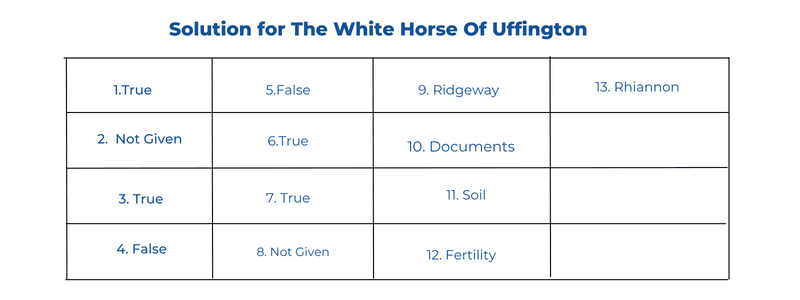
To facilitate your practice, we've provided the entire passage along with a variety of question styles and The White Horse of Uffington reading answers. This test will evaluate your comprehension, reading skills, and time management abilities. It can also be used to prepare for the IELTS reading section.
Even though this Cambridge 16 test 2 -The White Horse of Uffington reading answers comprises 3 primary question kinds, it is vital to also practice with others. As there are 14 various sorts of IELTS reading question types, we have provided additional question types for practice. Examine the following:
- IELTS Reading true/false/not given
- IELTS Reading short answer questions
- IELTS Reading note completion
Check Out our YouTube Channel to Practice Full-Length IELTS Reading Tests Daily

Significance of “ The White Horse of Uffington Reading Answers”
IELTS professionals and lecturers have opinions on The White Horse of Uffington IELTS Reading Answers with location, and you should know what they are.
- The White Horse of Uffington Reading Answers with location is taken from Cambridge 16 Test 2. It consists of 10 paragraphs from which questions will be derived.
- You will not discover the same terms while looking for information in the passages using keywords. You may come across synonyms and paraphrased versions of the keywords.
- In this test, you will undoubtedly discover new material; jot it down immediately, since it will assist you in answering questions for later modules.
- We have also attached the links to other articles which will provide you more practice to improve your bar scores in this module.
- To perform well on your IELTS reading test, you must develop a consistent reading habit. This will improve your reading abilities.
- We are giving The White Horse of Uffington IELTS reading answers for the newly-developed passage. You can acquire new skills, such as similar word usage, sentence construction, vocabulary, etc.
- Have a glance at the questions to identify the keyword in the passage, and exercise your scanning and skimming abilities. You must effectively manage your time and answer each question.
Before you attempt to write The White Horse of Uffington IELTS Reading Answers check the IELTS reading tips.
IELTS Reading Passage-The White Horse of Uffington
Read 'The White Horse of Uffington IELTS Reading Answers’ article to answer the questions given below.
The White Horse of Uffington.
Since more than 3,000 years ago, enormous sculptures, or "geoglyphs," have been carved into the dirt of English hillsides. There are 56 hill figures spread around England. The great majority of them are located on the chalk downlands of the southern counties. There are giants, horses, crosses, and regimental insignia among the figures. Despite the fact that the bulk of these geoglyphs was created during the previous 3000 years, there are a few that are far older.
The most renowned of these statues, the Uffington White Horse in Oxfordshire, is also the most mysterious. The White Horse has lately been redated and proved to be even older than the ancient pre-Roman Iron Age* age originally attributed to it. The dating of the mysterious Long Man of Wilmington in Sussex is more debatable. While many historians believe the figure is prehistoric, some believe it was carved between the 11th and 15th centuries by an artistic monk from a local priory.
In order to expose the sparkling white chalk beneath these colossal sculptures, it was just necessary to chop away the grass on top. However, the grass would quickly grow back over the geoglyph if it was not routinely cleaned or scoured by a sizable human team. One reason for the demise of the vast majority of hill figures is that folks no longer bothered or remembered to sweep aside the grass to reveal the chalk outline when the traditions associated with the figures vanished. In addition, over the course of hundreds of years, the geoglyph's initial shape would occasionally vary as a result of humans not always carving in the same location, resulting in a changing outline. The fact that any old hill figures remain in England attests to the power and durability of local customs and beliefs, which, in at least one example, must date back millennia.
The Uffington White Horse is a distinctive stylized image of a horse with a long, slender back, thin, disconnected legs, a flowing tail, and a bird-like beaked head. The graceful creature nearly blends into the scenery. The horse is located 2.5 kilometers from Uffington hamlet on a steep slope next to the Late Bronze Age hillfort of Uffington Castle (about 7th century BCE) and below the Ridgeway, a long-distance Neolithic** route.
Also surrounding the Uffington Horse are Bronze Age burial mounds. It is close to the well-preserved Bronze Age cemetery of Lambourn Seven Barrows, which has over thirty burial mounds. As is the case with many geoglyphs, the sculpture is best viewed from above, as it has been positioned such that it is nearly impossible to observe from a close distance. Nonetheless, there are portions of the Vale of the White Horse, the valley holding and named after the mysterious beast, from which a sufficient impression may be derived. On a clear day, the sculpture is visible up to 30 kilometers distant.
The first mention of a horse in Uffington dates back to the 1070s CE, when 'White Horse Hill' is recorded in papers from the adjacent Abbey of Abingdon, and the first mention of the horse itself follows shortly thereafter in 1190 CE. However, it is thought that the carving dates back far further than that. Due to the similarities between the Uffington White Horse and the stylized portrayals of horses on coins from the 1st century BCE, it was believed that the creature dated to the same era.
In 1995, the Oxford Archaeological Unit conducted Optically Stimulated Luminescence (OSL) tests on dirt from two of the horse's lower body layers and a sample was taken at the base. The result was a date for the horse's creation between 1400 and 600 BCE, indicating that it originated around the Late Bronze Age or Early Iron Age.
The latter end of this date range would link the horse sculpture to the nearby Uffington hillfort, hinting that it may be a tribal symbol identifying the hillfort's inhabitants' land. Alternately, the carving may have occurred during a Bronze Age or Iron Age ceremony. Some experts believe It is said that the horse represents the Celtic horse goddess Epona, who was revered as a guardian of horses and for her links to fertility. However, Epona worship was not brought from Gaul (France) until about the first century CE. This date is at least six centuries after the probable carving of the Uffington Horse. Despite this, the horse had significant ceremonial and economic importance during the Bronze and Iron Ages, as seen by its representation on jewelry and other metal things. It is probable that the sculpture portrays a native deity, such as Rhiannon, who is depicted in later Welsh mythology as a lovely woman riding a white horse and clad in gold.
The ease with which geoglyphs may vanish, as well as the rituals and importance associated with them, shows that they were never intended to be more than gestures. However, this does not diminish their significance. These enormous engravings provide a fascinating peek into the thinking of their makers and how they perceived the environment in which they lived.
*Iron Age: a time period (in Britain, 800 BCE to 43 CE) marked by the employment of iron implements.
*Bronze Age is a time period (in Britain, around 2,500 BCE to 800 BCE) distinguished by the invention of bronze implements.
*Neolithic: a time period (in Britain, c. 4,000 BCE – c. 2,500 BCE) notable for the expansion of agriculture and the use of stone tools.
The ancient people who came from Europe to Britain before the Romans.
Questions 1–5
Do the following statements agree with the information given in the reading passage?
In boxes 1–5 on your answer sheet, write:
True if the statement agrees with the information.
False if the statement contradicts the information.
It is not given if there is no information on this
1 Most geoglyphs in England are located in a particular area of the country.
2 There are more geoglyphs in the shape of a horse than any other creature.
3. A recent dating of the Uffington White Horse indicates that people were mistaken about its age.
4 Historians have agreed about the origins of the Long Man of Wilmington.
5. Geoglyphs were created by people placing white chalk on the hillside.
Also, check the IELTS reading true/false/not given.
Questions 6-8
Answer the following questions.
(note:- no more than 2 words)
6. How many hill figures were scattered around England?
7. The Bronze Age cemetery of Lambourn consists of what?
8. Who was worshipped as a protector of horses?
Also, check the IELTS reading short answer questions.
Questions 9 – 13
Complete the notes below.
Choose ONE WORD ONLY from the passage for each answer.
Write your answers in boxes 9-13 on your answer sheet.
The location of the Uffington White Horse:
- a distance of 2.5 km from Uffington village
- near an ancient road known as the 9 ……………………
- close to an ancient cemetery that has several burial mounds
Dating the Uffington White Horse:
- the first reference to White Horse Hill appears in 10 …………………… from the 1070s
- horses shown on coins from the period 100 BCE – 1 BCE are similar in appearance
- according to the analysis of the surrounding 11 ……………………, the Horse is Late Bronze Age / Early Iron Age
Possible reasons for the creation of the Uffington White Horse:
- an emblem to indicate land ownership
- formed part of an ancient ritual
- was a representation of goddess Epona – associated with the protection of horses and 12……………………
- was a representation of a Welsh goddess called 13 ……………………
Also, check the IELTS reading note completion.
The White Horse of Uffington IELTS Reading Answers with explanations
Below are the Megafires of California reading answers with explanations. Carefully inspect to receive exact feedback.
(Note:-The regular font paragraph provides a full explanation of the answer.)
Answer 1. True
Explanation: Here, the writer said that there are 56 hill figures in England, and the vast number of these are located at a particular place. The question matches the given statement. Hence, the answer is True.
Answer 2. Not given
Explanation: There is no such information given in the passage. Hence, the answer is Not given.
Answer 3. True
Explanation: The writer said that recent dating (re-dating) the White horse shows it is older than its previously assigned age. It means people were mistaken about its age. Hence the answer is true
Answer 4. False
Explanation: Agreement means they agree to the same thing. In the passage, it is given that historians have different viewpoints related to the origin of Long Man of Wilmington. Hence, they have different views, and the answer is false.
Answer 5. False
Explanation: As per the paragraph’s information, geoglyphs were created by removing grass to uncover already present chalk blow. But the question says that people were using chalk to make them. Thus, the answer is False.
Answer 6. 56
Explanation: As mentioned in the passage“There are 56 hill figures scattered around England”
Answer 7. Burial-mounds
Explanation:” The Bronze Age cemetery of Lambourn Seven Barrows, which consists of more than 30 well-preserved burial mounds.”
Answer 8. Goddess Epona
Explanation:” Some researchers see the horse as representing the Celtic*** horse goddess Epona, who was worshipped as a protector of horses”
Answer 9. Ridgeway
Explanation: “The horse has situated 2.5 km from Uffington village on a steep slope close to the Late Bronze Age (c. 7th century BCE) hillfort of Uffington Castle and below the Ridgeway, a long-distance Neolithic track”. The track is similar to the road. Here, the Neolithic track is an ancient road. Hence, the ridgeway is the answer.
Answer 10. Documents
Explanation:” The earliest evidence of a horse at Uffington is from the 1070s CE when ‘White Horse Hill’ is mentioned in documents from the nearby….”
Answer 11. Soil
Explanation:” However, … testing was carried out…on soil from two of the lower layers of the horse’s body, and another cut near the base. The result was a date for the horse’s construction ….a Late Bronze Age or Early Iron Age origin.”
In this paragraph, the writer explained that the testing done on soil near the horse provided the date of the horse’s construction.
Answer 12. Fertility
Explanation:” Some researchers see the horse as representing the Celtic horse goddess Epona, who was worshipped as a protector of horses, and her associations with fertility.” Hence, goddess Epona was associated with fertility and the protection of horses.
Answer 13. Rhiannon
Explanation:” It is possible that the carving represents a goddess in native mythology, such as Rhiannon, described in later Welsh mythology as a beautiful woman dressed in gold and riding a white horse.”
Other reading passages
Conclusion
I hope that you went back and confirmed your answers with "The White Horse of Uffington Reading Answers with explanations." If you practice taking this test, it will be helpful in understanding your answering skills and enhancing your ability to manage time, both of which are the needed skills for finishing the IELTS exam in the allotted amount of time.

About Author Dinesh Pandiyan
Dinesh is a highly experienced content writer who specializes in language proficiency tests like IELTS, GRE, PTE, TOEFL, and study abroad. He provides valuable insights and tips to students on various modules of these tests, including reading, writing, speaking, and listening. His articles are well-researched, informative, and engaging, offering practical guidance to students looking to succeed in their academic pursuits. Additionally, Dinesh has coordinated with IELTS trainers to prepare test preparation materials, guides, practice tests, and mock tests, and worked closely with counsellors for study abroad consultancy, providing guidance on choosing the right institution, preparing for interviews, and writing effective statements of purpose (SOP) and letters of recommendation (LOR). Students can benefit from Dinesh's comprehensive knowledge and experience by checking out his articles.
Kanan International is a study abroad consultancy that offers reliable services, products, and solutions for students and education institutions. We support students throughout their study abroad journey, ensuring a hassle-free experience. Our expertise and commitment to excellence make us the go-to partner for expanding global horizons. The company provides coaching for IELTS, GRE, TOEFL, and SAT exams and services like visa consultation, accommodation, scholarship assistance, and education loans.
Free Online Mock Test 2026
Practice our mock test worth Rs. 25000 for Free and know your IELTS score!








Global Headquarters
Kanan Int EdTech Inc
320 Bay Street, Suite 321 (Spaces), Toronto ON, Canada M5B 1N9
Indian Headquarters
Kanan International Pvt. Ltd.
D-wing, 2nd Floor, Trident Complex, Ellora Park Vadiwadi Road, Vadodara, Gujarat 390007
IT/ Digital Campus
Kanan International Pvt. Ltd
Old, New No 3, 2nd Floor, 1A, Dr Sadasivam Rd, T. Nagar, Chennai, Tamil Nadu 600017
Our branches
- Bardoli
- Bharuch
- Chennai
- Dehradun
- Gurugram
- Himatnagar
- Karnal
- Nadiad
- Navsari
- Palanpur
- Rajkot
- Vadodara
- Valsad
- Vallabh Vidyanagar
- Vapi
Study Abroad
Test Prep
Top Universities
Consultants
IELTS Centers
GRE Centers
TOEFL Centers
SAT Centers
Language Courses in Vadodara
Study Abroad Calculators
Featured Blogs
Study Abroad Consultants in Chennai
Study Abroad Consultants in Surat
Study Abroad Consultants in Navsari
Study Abroad Consultants in Bardoli
Study Abroad Consultants in Ahmedabad
Study Abroad Consultants in Anand
Study Abroad Consultants in Khanna
Study Abroad Consultants in Nadiad
Study Abroad Consultants in Vadodara
Study abroad consultants in Valsad
Copyright © 2026 KANAN.CO All rights reserved.