- Study Abroad
- / ielts
- / tower of strength reading answers
Tower of Strength Reading Answers


Author
17-09-2025

In this article we have given a “Tower of Strength” reading practice and answers with explanations. It contains 14 questions in 3 different question types- 3 questions as multiple choice questions, 7 questions as matching information and 4 questions as short answers question forms. Read the given paragraph carefully and understand the question before answering them.
Check out our YouTube Channel to Practice Full-Length IELTS Reading Tests Daily

Table of content:
- Solution for Tower of Strength
- Tower of Strength IELTS reading practice test
- Passage
- Questions
- Answers with explanation
Solution for Tower of Strength
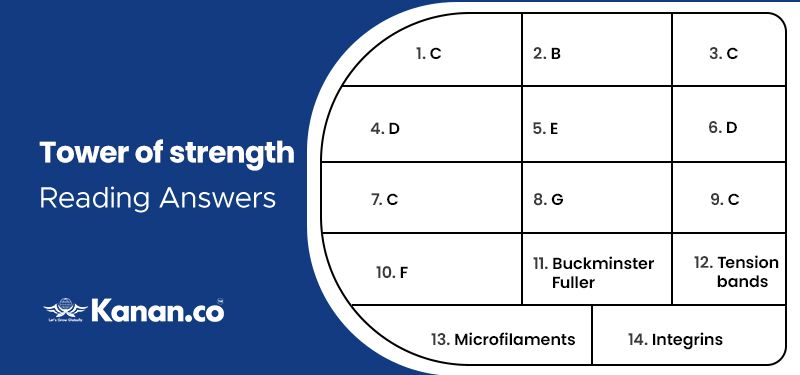
We have given Tower of Strength reading answers, in the table given below.

Answer Table
| 1. C | 4. D | 7. C | 10. F | 13. Microfilaments |
| 2. B | 5. E | 8. G | 11. Buckminster Fuller | 14. Integrins |
| 3. C | 6. D | 9. C | 12. Tension bands |
Tower of Strength IELTS Reading Practice Test - Exam Review
We have given Tower of Strength IELTS reading answers. This article will help you to be excellent in the IELTS reading practice test. Read the given passage carefully to answer the question.
Passage
We have given Tower of Strength reading answers with location. Go through the given passage and answer the questions.
Tower of Strength reading answers
A. Of all the stories of art influencing science, tensegrity is one of the most far-reaching. On one level, tensegrity is a system of creating architecture or sculptures involving rods in compression and wires in tension. It was invented by sculptor Kenneth Snelson at Black Mountain College, the hotbed of international modernism, in 1948. At the time, Snelson was taking part in a summer school with the engineer Buckminster Fuller, who pioneered the idea of applying geometric forms to architectural and engineering innovation.
B. Using an abstract sculpture as a starting point, Snelson then added tension wires to the free-floating members. Fuller encouraged him and when they met up again in 1949, Snelson had perfected a concept in which stiff rods can be supported without touching a network of wires. Although “tensegrity’ (from ‘tensional integrity`) was coined by Fuller, the idea was entirely Snelson’s, and he went on to make many more tensegrity sculptures, the most famous of which is the sixty-foot-high Needle Tower (1968), now at the Hirshhorn Museum and Sculpture Garden, Washington DC.
C. Basic tensegrity structures can be made from three drinking straws, six paper clips, and nine rubber bands. When the structure is wired up, you can see that none of the rods actually touch; they’re held in equilibrium by the rubber bands. Even this simplest model has very interesting properties. Although drinking straws are weak, with a tendency to buckle, the tension bands hold them in such a way that the compressive force is always directed straight down the tube and buckling doesn’t happen. The first thing you notice if you make one is that it is immensely fiddly to assemble — pieces keep falling apart — but once the last band is secured, you can fling the object around, squash it, and it seems indestructible. The structure isn’t symmetrical in its properties. In one direction, it squashes flat and bounces back. In the other direction, it resists the pressure. If you wanted to create versatile 3D structures out of nothing much, tensegrity would take some beating.
D. It is strange that architects and engineers didn’t discover the principle before 1948 since the benefits of structures held in tension over traditional building techniques had been known since the invention of the suspension bridge in 1796. And the great maverick biologist D’Arcy Thompson in On Growth and Form (1917) had extensively analysed the principles of tension and compression both in nature and engineering. Kenneth Snelson believed that tensegrity was a pure art and that it would never be really useful architecturally. It took some time to prove him wrong, but in the 1980s, tensegrity architecture began to appear. The key protagonist was David Geiger and the first important structure was his Gymnastics Hall at the Korean Olympics in 1988.
E. Five years later, its significance in quite a different field became apparent when scientists described the tensegrity model of cell structure, and this is where the principle is now making waves. What is it that prevents living things from collapsing to a blob of jelly on the floor? Unsurprisingly, it is likely to be tense integrity. For a long time, biologists ignored the mechanical properties of cells: they were just `elastic bags` full of interesting chemicals. But there has to be an architecture; tissue is tough, resilient stuff that keeps its shape.
F. The human body is certainly a tensegrity structure; it consists of 206 bones — tensegrity rods — that do not touch, held together by tendons and muscles. And the tension of living cells seems to be maintained by tensegrity structures within the cell; microfilaments play the role of the rubber bands and stiff microtubules are the rods. Donald Ingber, at the Harvard Medical School, researches how cells move and stick to each other, and he believes that tensegrity offers ‘the most unified model of cell mechanics’. It explains some basic properties of cells very well.
G. If cells are placed on a microscope slide, they flatten under gravity. When cells are surrounded by other cells, proteins called integrins attach one cell to another at specific locations. These act as tensegrity wires, pulling the cells taut in all directions. When the integrin network is disrupted, the cells sag. Whether or not the cell is a tensegrity structure is still controversial, but in a series of recent papers, Ingber and his team have been gradually picking off the objections with detailed studies of cell structure. For the lay observer, pictures of a cell showing triangular structures resembling a geodesic dome are highly suggestive of tensegrity.
H. It has been a long road since Black Mountain College in 1948, but it all comes back to Kenneth Snelson and his sculpture. Once asked what he would save from a fire in his office, Donald Ingber replied: ‘The tensegrity model made by Kenneth Snelson, a gift from the artist himself’.
Questions
Questions 1-3
- According to the information in the reading passage, when were the following made?
- Write the correct letter A,B,C or D next to questions 1-3.
1. An advance in biology based on tensegrity principle
2. A work of art based on tensegrity principle
3. A building based on tensegrity principle
A. The 18th century
B. The first half of the 20th century
C. The second half of the 20th century
D. The 21st century
Questions 4 -10
- The reading passage has eight paragraphs A-H
- Which paragraph contains the following information?
- NB: you may use any letter more than once.
4. An error made by the inventor of tensegrity
5. The branch of science on which tensegrity is currently having the greatest impact
6. The writer’s surprise that tensegrity remained unknown in engineering
7. An account of how a sculpture was made
8. An unresolved issue concerning the nature of individual cell structure
9. An explanation of why a basic tensegrity structure keeps its shape
10. An analogy between components of a tensegrity model and a skeleton
Questions 11-14
- Answer the questions with words from the reading passage.
- Write no more than three words for each answer.
11. Who first used the word ‘tensegrity’?
12. Which parts of the tensegrity model prevent the straws losing their shape?
13. Which parts of a cell hold its microtubules in place?
14. What substances join cells to each other?
Answers for Tower of Strength with Explanation
We have given the tower of strength reading answers with explanations, this section will help you to identify your mistakes during the answering process.
1. Answer: C
Explanation: “Five years later, its significance in quite a different field became apparent when scientists described the tensegrity model of cell structure, and this is where the principle is now making waves”. With this line it is clear that in the second half of the 20th century the advancement in cell structure was seen due to the significant tensegrity principles. Hence the given answer is located in the first 3 lines of paragraph E.
2. Answer: B
Explanation: “tensegrity’ (from ‘tensional integrity`) was coined by Fuller, the idea was entirely Snelson’s, and he went on to make many more tensegrity sculptures, the most famous of which is the sixty-foot-high Needle Tower (1968), now at the Hirshhorn Museum and Sculpture Garden, Washington DC”. With this line it is clear that Snelson created many sculptures, including the famous Needle Tower using the tensegrity principle. Hence the given answer is located in the last 4 lines of paragraph B.
3. Answer: C
Explanation: “In the 1980s, tensegrity architecture began to appear. The key protagonist was David Geiger and the first important structure was his Gymnastics Hall at the Korean Olympics in 1988”. With this line it is clear that 1988 is a second part of the 20th century. Hence the given answer is located in the last 3 lines of paragraph D.
4. Answer: D
Explanation: “Kenneth Snelson believed that tensegrity was a pure art and that it would never be really useful architecturally. It took some time to prove him wrong”. With this line it is clear that Snelson made a mistake in tensegrity and it was proven wrong. Hence the given answer is located in the 6-7 lines of paragraph D.
5. Answer: E
Explanation: “its significance in quite a different field became apparent when scientists described the tensegrity model of cell structure, and this is where the principle is now making waves”. With this line it is clear that the branch of science on which tensegrity is currently having the greatest impact. Hence the given answer is located in the first 3 lines of paragraph E.
6. Answer: D
Explanation: “It is strange that architects and engineers didn’t discover the principle before 1948 since the benefits of structures held in tension over traditional building techniques had been known since the invention of the suspension bridge in 1796”. With this line it is clear that the writer’s surprise that tensegrity remained unknown in engineering. Hence the given answer is located in the first 3 lines of paragraph D.
7. Answer: C
Explanation: “Basic tensegrity structures can be made from three drinking straws, six paper clips, and nine rubber bands. When the structure is wired up, you can see that none of the rods actually touch; they’re held in equilibrium by the rubber bands”. With this line it is clear that paragraph C states about how a sculpture was made. Hence the given answer is located in the first 3 lines of paragraph C.
8. Answer: G
Explanation: “Whether or not the cell is a tensegrity structure is still controversial”. With this line it is clear that there is an unresolved issue concerning the nature of individual cell structure. Hence the given answer is located in the 5th line of paragraph G.
9. Answer: C
Explanation: “Although drinking straws are weak, with a tendency to buckle, the tension bands hold them in such a way that the compressive force is always directed straight down the tube and buckling doesn’t happen”. With this line it is clear that the structure is able to retain its properties because it is asymmetrical. Hence the given answer is located in the 4-6 lines of paragraph C.
10. Answer: F
Explanation: “The human body is certainly a tensegrity structure; it consists of 206 bones — tensegrity rods — that do not touch, held together by tendons and muscles”. With this line it is clear that analogy between components of a tensegrity model and a skeleton. Hence the given answer is located in the first 2 lines of paragraph F.
11. Answer: Buckminster Fuller
Explanation: “tensegrity’ (from ‘tensional integrity`) was coined by Fuller”. With this line it is clear that Fuller is the first one who used tensegrity. Hence the given answer is located in the 4th line of paragraph B.
12. Answer: Tension bands
Explanation: “When the structure is wired up, you can see that none of the rods actually touch; they’re held in equilibrium by the rubber bands”. With this line it is clear that the tension bands in a tensegrity model help keep its structure. Hence the given answer is located in the 2-3 lines of paragraph B.
13. Answer: Microfilaments
Explanation: “And the tension of living cells seems to be maintained by tensegrity structures within the cell; microfilaments play the role of the rubber bands and stiff microtubules are the rods”. With this line it is clear that microfilaments play the role of the rubber bands. Hence the given answer is located in the 2-4 lines of paragraph F.
14. Answer: Integrins
Explanation: “Proteins called integrins attach one cell to another at specific locations”. With this line it is clear that Integrins substances join cells to each other. Hence the given answer is located in the 2-3 lines of paragraph G.
Other reading answers

About Author Roshan Sunthar
Roshan Sunthar is a study abroad expert as well as a renowned writer and author in international education. His academic excellence and 5+ years of work experience give him in-depth knowledge of international standardised exams and test preparation in IELTS, TOEFL, GRE, PTE, SAT, etc. The study materials he prepares incorporate exam-like questions. He’s also an expert in writing Statement of Purposes (SOPs) and Letter of Recommendations (LORs) for college admissions. He usually spends his leisure time watching English classics and documentaries, travelling, etc.
Kanan.co is a trusted study abroad consultancy offering comprehensive services, resources, and solutions for students and education institutions. We support students at every stage of their global education journey, ensuring a smooth and guided experience. Along with test preparation for IELTS, GRE, TOEFL, and SAT, we provide expert services such as SOP writing, visa guidance, accommodation support, scholarship assistance, and education loan support. Our expertise and commitment to excellence make us a reliable partner for students pursuing international education.
Free Online Mock Test 2026
Practice our mock test worth Rs. 25000 for Free and know your IELTS score!








Global Headquarters
Kanan Int EdTech Inc
320 Bay Street, Suite 321 (Spaces), Toronto ON, Canada M5B 1N9
Indian Headquarters
Kanan International Pvt. Ltd.
D-wing, 2nd Floor, Trident Complex, Ellora Park Vadiwadi Road, Vadodara, Gujarat 390007
IT/ Digital Campus
Kanan International Pvt. Ltd
Old, New No 3, 2nd Floor, 1A, Dr Sadasivam Rd, T. Nagar, Chennai, Tamil Nadu 600017
Our branches
- Bardoli
- Bharuch
- Chennai
- Dehradun
- Gurugram
- Himatnagar
- Karnal
- Nadiad
- Navsari
- Palanpur
- Rajkot
- Vadodara
- Valsad
- Vallabh Vidyanagar
- Vapi
Study Abroad
Test Prep
Top Universities
Consultants
IELTS Centers
GRE Centers
TOEFL Centers
SAT Centers
Language Courses in Vadodara
Study Abroad Calculators
Featured Blogs
Study Abroad Consultants in Chennai
Study Abroad Consultants in Surat
Study Abroad Consultants in Navsari
Study Abroad Consultants in Bardoli
Study Abroad Consultants in Ahmedabad
Study Abroad Consultants in Anand
Study Abroad Consultants in Khanna
Study Abroad Consultants in Nadiad
Study Abroad Consultants in Vadodara
Study abroad consultants in Valsad
Copyright © 2026 KANAN.CO All rights reserved.