- Study Abroad
- / ielts
- / voynich manuscript reading answers
Voynich Manuscript Reading Answers


Author
17-09-2025

Here, we have provided the “Voynich Manuscript” reading answers as an illustration for the IELTS reading practice test along with questions and answers. This article has 14 questions based on the given passage in 4 different types namely- 4 questions as locating information, 4 questions as matching information, 5 questions as summary completion and 1 question as multiple choice question.
Check out our YouTube Channel to Practice Full-Length IELTS Reading Tests Daily

Table of contents:
- Solution for Voynich Manuscript
- Voynich Manuscript IELTS reading practice test
- Passage
- Questions
- Answers with explanation
Solution for Voynich Manuscript
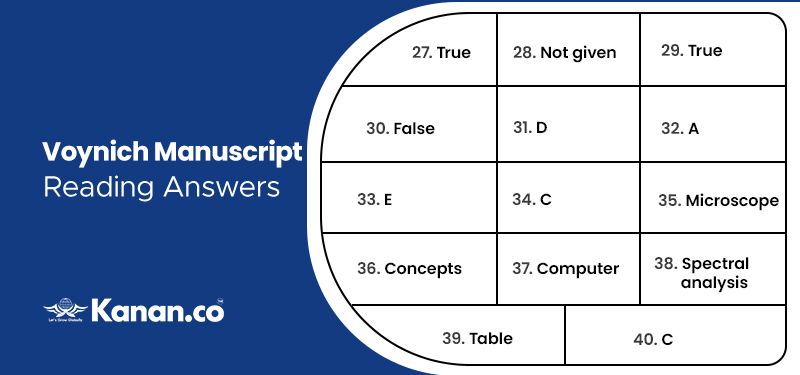
Answers for the Voynich Manuscript reading answers in the table form.

Answer Table
| 27. True | 30. False | 33. E | 36. Concepts | 39. Table |
| 28. Not given | 31. D | 34. C | 37. Computer | 40. C |
| 29. True | 32. A | 35. Microscope | 38. Spectral analysis |
Voynich Manuscript IELTS reading practice test - Exam Review
The passage for Voynich Manuscript IELTS reading answers is provided below to enrich your reading skill, with a practice test section which may help you to enhance your answering skill.
Passage
Check out the given passage for a Voynich Manuscript reading answers with location, it helps you to get some important keywords to answer the questions.
Voynich Manuscript reading answers
- The Starkly modern Beinecke Library at Yale University is home to some of the most valuable books in the world first folios of Shakespeare, Gutenberg Bibles and manuscripts from the early Middle Ages, Yet the library’s most controversial possession is an unprepossessing vellum manuscript about the size of hardback book, containing 240-odd pages of drawings and text of unknown age and authorship. Catalogued as MS408, the manuscript would attract little attention were it not for the fact that the drawings hint at esoteric knowledge, while the text seems to be some sort of code- one that no-one has been able to break. It’s known to scholars as the voynich manuscript, after the American book dealer Wilfrid Voynich, who bought the manuscript from a Jesuit college in Italy in 1912.
- Over the years, the manuscript has attracted the attention of everyone from amateur dabblers to top codebreakers, all determined to succeed where countless others have failed. Academic research papers, books and websites are devoted to making sense of the contents of the manuscript. Which are freely available to all ‘Most other mysteries involve secondhand reports.’ says Dr Gordon Rugg of Keele University, a leading Voynich expert. But this is one that you can see for yourself.
- It is certainly strange: page after page of drawings of weird plants, astrological symbolism and human figures, accompanied by a script that looks like some form of shorthand. What does it say and what are the drawings about? Voynich himself believed that the manuscript was the work of the 13th century English monk Roger Bacon, famed for his knowledge of alchemy, philosophy and science. In 1921 Voynich’s view that Bacon was the writer appeared to win support from the work of william Newbold, professor of philosophy at the University of Pennsylvania, who claimed to have found the key to the cipher system used by Bacon. According to Newbold, the manuscript proved that Bacon had access to microscopes centuries before they were supposedly first invented. They claim that this mediaeval monk had observed living cells created a sensation. It soon became clear. However, that Newbold had fallen victim to wishful thinking. Other scholars showed that his ‘decoding’ methods produced a host of possible interpretations. The Voynich manuscript has continued to defy the efforts of world-class experts. In 1944, a team was assembled to tackle the mystery, led by William Friedman, the renowned American codebreaker. They began with the most basic code breaking task: analysing the relative frequencies of the characters making up the test, looking for signs of an underlying structure. Yet Friedman’s team soon found themselves in deep water. The precise size of the ‘alphabet’ of the Voynich manuscript was unclear: it’s possible to make out more than 70 distinct symbols among the 170,000-character text. Furthermore, Friedman discovered that some words and phrases appeared more often than expected in a standard language, casting doubt on claims that the manuscript concealed a real language, as encryption typically reduces word frequencies.
- Friedman concluded that the most plausible resolution of this paradox was that “Voynichese is some sort of specially created artificial language, whose words are devised from concepts, rather than linguistics. So, could the Voynich manuscript be the earliest known example of an artificial language? Friedman’s hypothesis commands respect because of the lifetime of crypt analytical expertise he brought to bear,’ says Rob Churchill, co- author of the Voynich Manuscript, that still leaves a host of questions unanswered, however, such as the identity of the author and the meaning of the bizarre drawings. ‘It does little to advance our understanding of the manuscript as a whole,’ says Churchill. Even though Friedman was working more than 60 years ago, he suspected that major insights would come reality that the device that had already transformed codebreaking: the computer. In this he was right-it is now the key tool for uncovering clues about the pleasure from manuscript’s language.
- The insights so far have been perplexing. For example, in 2001 another leading Voynich scholar, Dr Gabriel Landin of Birmingham University in the UK, published the results of his study of the manuscript using a pattern-detecting method called spectral analysis. This revealed evidence that the manuscript contains genuine words, rather than random nonsense, consistent with the existence of some underlying natural language. Yrt the following year, Voynich expert Ren Zandbergen of the European SPace Agency in Darmstadt, Germany showed that the entropy of the text (a measure of the rate of transfer of information was consistent with Friedman’s suspicions that an artificial language had been used.
- Many are convinced that the Voynich manuscript isn’t a hoax. For how could a medieval hoaxer create so many telltale signs of a message from random nonsense? Yet even this has been challenged in new research by Rugg.
- Using a system, first published by the Italian mathematician Girolama Cardano in 1150 in which a specially constructed grille issued to pick out symbols from a table, Rugg found he could readily generate text with many of the basic traits of the Voynich manuscript Publishing his results in 2004 Rugg stresses that he hadn’t set out to prove the manuscript. Publishing his results in that it’s feasible to hoax something this complex in a few months, he says. Inevitably, others beg to differ. Some scholars, such as Zandbergen, still suspect the text has genuine meaning, though believe it may never be decipherable. Others, such as Churchill, have suggested that the sheer weirdness of the illustrations and text hint at an author who had lost touch with reality. What is clear is that the book-sized manuscript kept under lock and key at Yale University has none of its fascination. “Many derive great intellectual pleasure from solving puzzles,’ says Rugg. The Voynich manuscript is as challenging a puzzle as anyone could ask for.
Questions
Questions 27-30
- Do the following statements agree with the information given in Reading passage 3?
- In boxes 27-30 on your answer sheet, write
27. It is uncertain when the Voynich manuscript was written.
28. Wilfrid Voynich donated the manuscript to the Beinecke LIbrary.
29. Interest in the Voynich manuscript extends beyond that of academics and professional codebreakers.
30. The text of the Voynich manuscript contains just under 70 symbols.
Questions 31-34
- Look at the following statements (questions 31-34) and the list of people below.
- Match each statement with the correct person A-H
- Write the correct letter A-H in boxes 31-34 on your answers sheet.
31. The number of times that some words occur make it unlikely that the manuscript is based on an authentic language.
32. Unlike some other similar objects of fascination, people can gain direct access to the Voynich manuscript.
33. The person who wrote the manuscript may not have been entirely sane.
34. It is likely that the author of the manuscript is the same person as suggested by Wilfrid Voynuch.
List of people
- Gordon Rugg
- Roger Bacon
- William Newbold
- William Friedman
- Rob Churchill
- Gabriel Landini
- Ren Zandbergen
- Girolamo Cardano
Questions 35-39
- Choose no more than two words from the passage for each answer.
- Write your answers in boxes 35-39 on your answer sheet
Voynich Researchers
William Newbold believed that the author of the Voynich manuscript had been able to look at cells through a 35_______. Other researchers later demonstrated that there were flaws in his argument. William Friedman concluded that the manuscript was written in an artificial language that was based on 36_______. He couldn’t find out the meaning of this language but he believed that the 37_________ would continue to bring advances in code breaking.
Dr Gabriel Landini used a system known as 38__________ in his research, and claims to have demonstrated the presence of genuine words.
Dr Gordon Rugg’s system involved a grille that made it possible to quickly select symbols that appeared in a 39_________. Rugg’s conclusion was that the manuscript lacked genuine meaning.
Question 40
- Choose the correct letter A,B, C or D
- Write the correct letter in box 40 on your answer sheet.
40. The writer’s main aim in this passage is to
- Explain the meaning of the manuscript
- Determine the true identity of the manuscript’s author
- Describe the numerous attempts to decode the manuscript
- Identify which research into the manuscript has had the most media coverage.
Answers for the Voynich Manuscript with Explanation
In this section, we have given the answers for the Voynich Manuscript reading answers with explanation. This will help you to rectify your errors.
27. Answer: True
Explanation: “Yet the library’s most controversial possession is an unprepossessing vellum manuscript about the size of hardback book, containing 240-odd pages of drawings and text of unknown age and authorship”. With this line it is clear that it is uncertain when the Voynich manuscript was written. Hence the given answer is located in the 3-6 lines of paragraph A.
28. Answer: Not given
29. Answer: True
Explanation: “Over the years, the manuscript has attracted the attention of everyone from amateur dabblers to top codebreakers, all determined to succeed where countless others have failed. Academic research papers, books and websites are devoted to making sense of the contents of the manuscript”. With this line it is clear that interest in the Voynich manuscript extends beyond that of academics and professional codebreakers. Hence the given answer is located in the first 4 lines of paragraph B.
30. Answer: False
Explanation: “The precise size of the ‘alphabet’ of the Voynich manuscript was unclear: it’s possible to make out more than 70 distinct symbols among the 170,000-character text”. With this line it is clear that the given statement contradicts with the given information. Hence the given answer is located in the 19-21 lines of paragraph C.
31. Answer: D
Explanation: “Friedman discovered that some words and phrases appeared more often than expected in a standard language, casting doubt on claims that the manuscript concealed a real language, as encryption typically reduces word frequencies”. With this line it is clear that William Friedman says “the number of times that some words occur make it unlikely that the manuscript is based on an authentic language”. Hence the given answer is located in the last 3 lines of paragraph C.
32. Answer: A
Explanation: “The book-sized manuscript kept under lock and key at Yale University has none of its fascination. “Many derive great intellectual pleasure from solving puzzles,’ says Rugg. The Voynich manuscript is as challenging a puzzle as anyone could ask for”. With this line it is clear that Gordon Rugg says “Unlike some other similar objects of fascination, people can gain direct access to the Voynich manuscript”. Hence the given answer is located in the last 4 lines of paragraph G.
33. Answer: E
Explanation: “Friedman’s hypothesis commands respect because of the lifetime of crypt analytical expertise he brought to bear,’ says Rob Churchill, co- author of the Voynich Manuscript, that still leaves a host of questions unanswered, however, such as the identity of the author and the meaning of the bizarre drawings. ‘It does little to advance our understanding of the manuscript as a whole,’ says Churchill. Even though Friedman was working more than 60 years ago, he suspected that major insights would come reality that the device that had already transformed codebreaking: the computer. In this he was right-it is now the key tool for uncovering clues about the pleasure from manuscript’s language”. With this line it is clear that the person who wrote the manuscript may not have been entirely sane. Hence the given answer is located in paragraph D.
34. Answer: C
Explanation: “In 1921 Voynich’s view that Bacon was the writer appeared to win support from the work of william Newbold, professor of philosophy at the University of Pennsylvania, who claimed to have found the key to the cipher system used by Bacon. According to Newbold, the manuscript proved that Bacon had access to microscopes centuries before they were supposedly first invented”. With this line it is clear that William Newbold says “It is likely that the author of the manuscript is the same person as suggested by Wilfrid Voynich”. Hence the given answer is located in the 6-10 lines of paragraph C.
35. Answer: Microscope
Explanation: “According to Newbold, the manuscript proved that Bacon had access to microscopes centuries before they were supposedly first invented. They claim that this mediaeval monk had observed living cells created a sensation”. With this line it is clear that William Newbold believed that the author of the Voynich manuscript had been able to look at cells through a microscope. Hence the given answer is located in the 9-12 lines of paragraph C.
36. Answer: Concepts
Explanation: “Friedman concluded that the most plausible resolution of this paradox was that “Voynichese is some sort of specially created artificial language, whose words are devised from concepts, rather than linguistics”. With this line it is clear that William Friedman concluded that the manuscript was written in an artificial language that was based on concepts. Hence the given answer is located in the 1-3 lines of paragraph D.
37. Answer: Computer
Explanation: “Even though Friedman was working more than 60 years ago, he suspected that major insights would come reality that the device that had already transformed codebreaking: the computer”. With this line it is clear that he couldn’t find out the meaning of this language but he believed that computers would continue to bring advances in code breaking. Hence the given answer is located in the 9-12 lines of paragraph D.
38. Answer: Spectral analysis
Explanation: “The insights so far have been perplexing. For example, in 2001 another leading Voynich scholar, Dr Gabriel Landin of Birmingham University in the UK, published the results of his study of the manuscript using a pattern-detecting method called spectral analysis”. With this line it is clear that Dr Gabriel Landini used a system known as spectral analysis in his research, and claims to have demonstrated the presence of genuine words. Hence the given answer is located in the 1-4 lines of paragraph E.
39. Answer: Table
Explanation: “Using a system, first published by the Italian mathematician Girolama Cardano in 1150 in which a specially constructed grille issued to pick out symbols from a table, Rugg found he could readily generate text with many of the basic traits of the Voynich manuscript Publishing his results in 2004 Rugg stresses that he hadn’t set out to prove the manuscript”. With this line it is clear that Dr Gordon Rugg’s system involved a grille that made it possible to quickly select symbols that appeared in a table. Rugg’s conclusion was that the manuscript lacked genuine meaning. Hence the given answer is located in the 1-5 lines of paragraph G.
40. Answer: C
Explanation: “Describe the numerous attempts to decode the manuscript”. The main aim of the writer is to describe the numerous attempts to decode the manuscripts. Hence the given answer is C.
Other reading answers

About Author Gayathri Nagarajan
Gayathri, a trusted study-abroad expert, with expertise in standardized tests like IELTS, TOEFL, PTE, GRE, and GMAT. With a strong tech background from SASTRA University, she excels in software testing and has a passion for content writing and digital marketing. She aids students in finding the perfect academic fit, offering guidance on course selection, LOR and SOP writing. She remains up-to-date with the latest trends in higher education, delivering credible, accurate information on international education, including courses and test prep materials. As a trusted Study abroad expert at Kanan International, explore her latest blogs and articles for comprehensive insights into studying abroad and realizing your academic aspirations.
Kanan.co is a trusted study abroad consultancy offering comprehensive services, resources, and solutions for students and education institutions. We support students at every stage of their global education journey, ensuring a smooth and guided experience. Along with test preparation for IELTS, GRE, TOEFL, and SAT, we provide expert services such as SOP writing, visa guidance, accommodation support, scholarship assistance, and education loan support. Our expertise and commitment to excellence make us a reliable partner for students pursuing international education.
Free Online Mock Test 2026
Practice our mock test worth Rs. 25000 for Free and know your IELTS score!








Global Headquarters
Kanan Int EdTech Inc
320 Bay Street, Suite 321 (Spaces), Toronto ON, Canada M5B 1N9
Indian Headquarters
Kanan International Pvt. Ltd.
D-wing, 2nd Floor, Trident Complex, Ellora Park Vadiwadi Road, Vadodara, Gujarat 390007
IT/ Digital Campus
Kanan International Pvt. Ltd
Old, New No 3, 2nd Floor, 1A, Dr Sadasivam Rd, T. Nagar, Chennai, Tamil Nadu 600017
Our branches
- Bardoli
- Bharuch
- Chennai
- Dehradun
- Gurugram
- Himatnagar
- Karnal
- Nadiad
- Navsari
- Palanpur
- Rajkot
- Vadodara
- Valsad
- Vallabh Vidyanagar
- Vapi
Study Abroad
Test Prep
Top Universities
Consultants
IELTS Centers
GRE Centers
TOEFL Centers
SAT Centers
Language Courses in Vadodara
Study Abroad Calculators
Featured Blogs
Study Abroad Consultants in Chennai
Study Abroad Consultants in Surat
Study Abroad Consultants in Navsari
Study Abroad Consultants in Bardoli
Study Abroad Consultants in Ahmedabad
Study Abroad Consultants in Anand
Study Abroad Consultants in Khanna
Study Abroad Consultants in Nadiad
Study Abroad Consultants in Vadodara
Study abroad consultants in Valsad
Copyright © 2026 KANAN.CO All rights reserved.