- Study Abroad
- / ielts
- / wittgenstein on freud reading answers
Wittgenstein on Freud Reading Answers


Author
17-09-2025

In this article, we have given Wittgenstein on Freud reading practice test with questions and answers along with explanations. This passage has 14 questions in 2 different question forms namely- 6 questions as yes, no or not given and 8 questions as summary completion questions type.
Check out our YouTube Channel to Practice Full-Length IELTS Reading Tests Daily

Table of content:
- Solution for Wittgenstein on Freud
- Wittgenstein on Freud IELTS reading practice test
- Passage
- Questions
- Answers with explanation
Solution for Wittgenstein on Freud
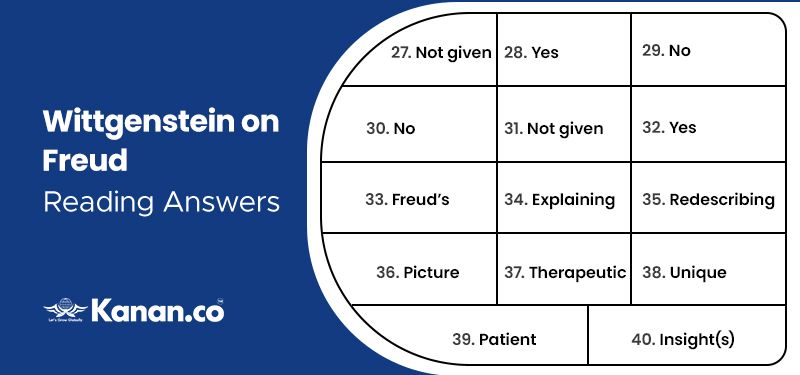
Below, the answers for Wittgenstein on Freud reading answers is given in the table form.

Answer Table
| 27. Not given | 30. No | 33. Freud’s | 36. Picture | 39. Patient |
| 28. Yes | 31. Not given | 34. Explaining | 37. Therapeutic | 40. Insight(s) |
| 29. No | 32. Yes | 35. Redescribing | 38. Unique |
Wittgenstein on Freud IELTS reading practice test - Exam Review
In this article, we have provided Wittgenstein on Freud IELTS reading answers. This article will challenge your reading skill. Read the given passage to answer the questions.
Passage
We have given Wittgenstein on Freud reading answers with location. Read the given passage carefully and answer the questions.
Wittgenstein on Freud reading answers
- Ludwig von Wittgenstein has justly been regarded as one of the major philosophers of the twentieth century, especially for his writings on the philosophy of language and logic. His work on psychoanalysis and criticism of his fellow Viennese, Sigmund Freud, have, however, been generally overlooked.
- Wittgenstein is both highly critical of and at the same time greatly admiring of Freud’s work. Perhaps it would be fairer to say that he is not critical so much of psychoanalysis as of Freud claims for it. For Freud, it was essential that his work be regarded as science: that he had developed a new branch of medicine based on scientific principles, having established causal relationships between behaviour in childhood and that in adulthood. Wittgenstein, while accepting the usefulness of Freud’s method, disputes that these relationships are causal, therefore denying Freud’s theories’ scientific validity.
- In causal relationships, we can at least imagine contradictory cases. For example, I can imagine placing a pan of water on a hot stone and water freezing(of course I do not expect it to happen and would be very surprised if I did). With Freud’s theory, however, this is not the case. One of the central planks of this theory is the pursuit of hidden meaning in such things as dreams, work of art, even language(the famous ‘Freudian slip’). Take the example of dreams. For Freud, these are all sexual wish-fulfillments. Freud however, will not accept any contradiction to his theory and argues that in these cases the sexual element is camouflaged, or even repressed. This is a strange notion, for how can a dream fulfil a wish if the desire is so disguised that the dreamer does not even recognise it? More importantly, if under no circumstances will Freud allow his hypothesis to be contradicted, how can we verify it? It therefore behoves us to recognise that, despite his assertions, Freud's theories are not causal hypotheses, and thus not scientific.
- One might ask, given this analysis, how Freud came to make this mistake, or rather why he believed that his explanations were causal. It is a confusion between what we might call the “depth-grammar” and “surface-grammar” of certain sentences. If we say, ‘the window broke because the stone hit it’, we are outlining a causal relationship between the stone hitting the window and the window breaking, this being designated by the word ‘because’. However, if we say, ‘he hit her because he was angry’, whilst it may appear that the word ‘because’ performs the same function, this is not the case. The similarity lies only on the surface; if we look at the depth-grammar, we see that in the first sentences ‘because’ denotes a causal relationship, whereas in the second we are rather talking in terms of motivations, reasons and other non-causal terms. Freud’s mistake, therefore, is to believe that both types of sentences are similar: he confuses the surface-grammar.
- Despite all this confusion, I have stated that Wittgenstein was highly appreciative of Freud’s work, and this is because he essentially reformulates what Freud was trying to do. Freud believed that he was explaining people’s behaviour, while Wittgenstein suggests that he is redescribing it. To him, Freud is providing a ‘picture’ of human behaviour which may enable us to make certain connections that other ways of looking would not reveal, and by showing these patterns and connections the method may have therapeutic value. In this case, although the ‘picture’ described by Freud’s method is not a true one(for by Wittgenstein’s arguments it cannot be), nevertheless it is unique, enabling the patient to have insights into their problems that no other method could provide.
Questions
Questions 27-32
- Do the following statements agree with the information given in the passage?
- In boxes 27-32, write:
- YES if the statement agrees with the information
- NO if the statement contradicts the information
- NOT GIVEN if there is no information given
27. Wittgenstein was a great moral philosopher.
28. Wittgenstein owes the high regard in which he is held, in part, to his work on the philosophy of language and logic.
29. Wittgenstein totally admired Freud’s work without reservation.
30. Wittgenstein supports Freud’s claims as to the causal relationship between childhood behaviour and that in adulthood.
31. Freud’s theory on causal relationships enjoys considerable support in spite of Wittgenstein’s objections.
32. The writer agrees with Wittgenstein that Freud’s theory re causal hypotheses is not specific.
Questions 33-40
- Complete the text below, using one word only from the passage for each blank space.
- Write your answers in boxes 33-40 on your answer sheet.
Despite 33…….. confusion regarding surface-grammar, Wittgenstein held his work in high regard.
Freud believed that he was 34…..…… people’s behaviour, while to Wittgenstein he was merely 35……….. it. In other words, Wittgenstein believes that Freud provides a 36…… of human behaviour, which allows us to look at things in different ways. This, according to Wittgenstein, may be 37…..……
According to the writer, although Freud’s ‘picture’ is not genuine, still it is 38……….. . It allows the 39….…… to have 40…..…… into his or her problems.
Answers for Wittgenstein on Freud with Explanation
In this section we have given the answers for Wittgenstein on Freud reading answers with explanation. Use this article to identify your mistakes while answering.
27. Answer: Not given
28. Answer: Yes
Explanation: “Ludwig von Wittgenstein has justly been regarded as one of the major philosophers of the twentieth century, especially for his writings on the philosophy of language and logic”. With this line it is clear that Wittgenstein owes the high regard in which he is held, in part, to his work on the philosophy of language and logic. Hence the given answer is located in the first 3 lines of paragraph A.
29. Answer: No
Explanation: “Wittgenstein is both highly critical of and at the same time greatly admiring of Freud’s work”. With this line it is clear that the given statement contradicts with the given information in the passage. Hence the given answer is located in the first 2 lines of paragraph 2.
30. Answer: No
Explanation: “For Freud, it was essential that his work be regarded as science: that he had developed a new branch of medicine based on scientific principles, having established causal relationships between behaviour in childhood and that in adulthood. Wittgenstein, while accepting the usefulness of Freud’s method, disputes that these relationships are causal, therefore denying Freud’s theories’ scientific validity”. With this line it is clear that the given statement contradicts with the given information in the passage. Hence the given answer is located in the last 6 lines of paragraph 2.
31. Answer: Not given
32. Answer: Yes
Explanation: “It therefore behoves us to recognise that, despite his assertions Freud’s theories are not causal hypotheses, and thus not scientific”. With this line it is clear that the writer agrees with Wittgenstein that Freud’s theory re causal hypotheses is not specific. Hence the given answer is located in the last 3 lines of paragraph 3.
33. Answer: Freud’s
Explanation: “Freud’s mistake, therefore, is to believe that both types of sentences are similar: he confuses the surface-grammar”. With this line it is clear Freud had confusion regarding surface grammar. Hence the given answer is located in the last 2 lines of paragraph 4.
34. Answer: Explaining
Explanation: “Despite all this confusion, I have stated that Wittgenstein was highly appreciative of Freud’s work, and this is because he essentially reformulates what Freud was trying to do. Freud believed that he was explaining people’s behaviour, while Wittgenstein suggests that he is redescribing it”. With this line it is clear that Freud believed that he was explaining people’s behaviour. Hence the given answer is located in the first 4 lines of paragraph 5.
35. Answer: Redescribing
Explanation: “Freud believed that he was explaining people’s behaviour, while Wittgenstein suggests that he is redescribing it. To him, Freud is providing a ‘picture’ of human behaviour which may enable us to make certain connections that other ways of looking would not reveal, and by showing these patterns and connections the method may have therapeutic value”. With this line it is clear that Wittgenstein was merely redescribing it. Hence the given answer is located in the 3-7 lines of paragraph 5.
36. Answer: Picture
Explanation: “Freud is providing a ‘picture’ of human behaviour which may enable us to make certain connections that other ways of looking would not reveal, and by showing these patterns and connections the method may have therapeutic value. In this case, although the ‘picture’ described by Freud’s method is not a true one(for by Wittgenstein’s arguments it cannot be), nevertheless it is unique, enabling the patient to have insights into their problems that no other method could provide”. With this line it is clear that Wittgenstein believes that Freud provides a picture of human behaviour, which allows us to look at things in different ways. Hence the given answer is located in the last 7 lines of paragraph 5.
37. Answer: Therapeutic
Explanation: “Freud’s method is not a true one(for by Wittgenstein’s arguments it cannot be), nevertheless it is unique, enabling the patient to have insights into their problems that no other method could provide”. With this line it is clear that according to Wittgenstein, it may be therapeutic. Hence the given answer is located in the last 3 lines of paragraph 5.
38. Answer: Unique
Explanation: “Freud’s method is not a true one(for by Wittgenstein’s arguments it cannot be), nevertheless it is unique, enabling the patient to have insights into their problems that no other method could provide”. With this line it is clear the writer, although Freud’s ‘picture’ is not genuine, still it is Unique. It allows the Patient to have insight into his or her problems. Hence the given answer is located in the last 3 lines of paragraph 5.
39. Answer: Patient
Explanation: “Freud’s method is not a true one(for by Wittgenstein’s arguments it cannot be), nevertheless it is unique, enabling the patient to have insights into their problems that no other method could provide”. With this line it is clear the writer, although Freud’s ‘picture’ is not genuine, still it is Unique. It allows the patient to have insight into his or her problems. Hence the given answer is located in the last 3 lines of paragraph 5.
40. Answer: Insight(s)
Explanation: “Freud’s method is not a true one(for by Wittgenstein’s arguments it cannot be), nevertheless it is unique, enabling the patient to have insights into their problems that no other method could provide”. With this line it is clear the writer, although Freud’s ‘picture’ is not genuine, still it is Unique. It allows the patient to have insight into his or her problems. Hence the given answer is located in the last 3 lines of paragraph 5.
Other reading answers

About Author Manimegalai Samidurai
Manimegalai is a multifaceted professional, excelling as an author, writer, and study-abroad expert. Her vast knowledge of English proficiency exams, including IELTS, GRE, SAT, and PTE, and exceptional content writing skills make her a go-to resource for students seeking guidance and support in their foreign education journey. She is a trusted authority in writing content related to these test-prep exams, making her an invaluable resource for those seeking guidance. With her well-researched and informative blogs, articles, and study materials, Manimegalai has helped countless students achieve their desired band scores and get admissions to top-notch colleges & universities in countries like Canada, USA, UK, Australia, Ireland, etc.
Kanan.co is a trusted study abroad consultancy offering comprehensive services, resources, and solutions for students and education institutions. We support students at every stage of their global education journey, ensuring a smooth and guided experience. Along with test preparation for IELTS, GRE, TOEFL, and SAT, we provide expert services such as SOP writing, visa guidance, accommodation support, scholarship assistance, and education loan support. Our expertise and commitment to excellence make us a reliable partner for students pursuing international education.
Free Online Mock Test 2026
Practice our mock test worth Rs. 25000 for Free and know your IELTS score!








Global Headquarters
Kanan Int EdTech Inc
320 Bay Street, Suite 321 (Spaces), Toronto ON, Canada M5B 1N9
Indian Headquarters
Kanan International Pvt. Ltd.
D-wing, 2nd Floor, Trident Complex, Ellora Park Vadiwadi Road, Vadodara, Gujarat 390007
IT/ Digital Campus
Kanan International Pvt. Ltd
Old, New No 3, 2nd Floor, 1A, Dr Sadasivam Rd, T. Nagar, Chennai, Tamil Nadu 600017
Our branches
- Bardoli
- Bharuch
- Chennai
- Dehradun
- Gurugram
- Himatnagar
- Karnal
- Nadiad
- Navsari
- Palanpur
- Rajkot
- Vadodara
- Valsad
- Vallabh Vidyanagar
- Vapi
Study Abroad
Test Prep
Top Universities
Consultants
IELTS Centers
GRE Centers
TOEFL Centers
SAT Centers
Language Courses in Vadodara
Study Abroad Calculators
Featured Blogs
Study Abroad Consultants in Chennai
Study Abroad Consultants in Surat
Study Abroad Consultants in Navsari
Study Abroad Consultants in Bardoli
Study Abroad Consultants in Ahmedabad
Study Abroad Consultants in Anand
Study Abroad Consultants in Khanna
Study Abroad Consultants in Nadiad
Study Abroad Consultants in Vadodara
Study abroad consultants in Valsad
Copyright © 2026 KANAN.CO All rights reserved.