- Study Abroad
- / ielts
- / you are what you speak reading answers
You Are What You Speak Reading Answers


Author
17-09-2025

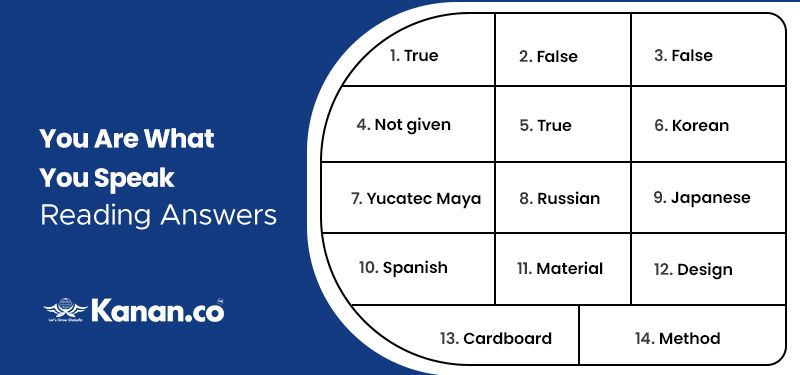
In this article you will find the “you are what you speak” reading answers as an illustration for the IELTS reading practice test. This article has 14 questions in 3 different types namely - 5 questions as true, false or not given, 5 questions matching features and 4 questions as summary completion.
Check out our YouTube Channel to Practice Full-Length IELTS Reading Tests Daily

Table of contents:
- The solution for you are what you speak
- You are what you speak IELTS reading practice test
- Passage
- Questions
- Answers with explanation
Solution for You Are What You Speak
Here the answers for you are what you speak, reading answers is given in the table form.

Answer Table
| 1. True | 4. Not given | 7. Yucatec Maya | 10. Spanish | 13. Cardboard |
| 2. False | 5. True | 8. Russian | 11. Material | 14. Method |
| 3. False | 6. Korean | 9. Japanese | 12. Design |
You are what you speak IELTS reading practice test - Exam Review
We have provided you are what you speak IELTS reading answers. This article will help you to attain band scores in your major exams, Read the given passage to answer the questions.
Passage
We have given you are what you speak reading answers with location. Scrutinize the given passage carefully and answer the questions.
You are what you speak reading answers
- Does the language you speak influence the way you think? Does it help define your worldview? Anyone who has tried to master a foreign tongue has at least thought about the possibility.
- At first glance the idea seems perfectly plausible. Conveying even simple messages requires that you make completely different observations depending on your language. Imagine being asked to count some pens on a table. As an English speaker, you only have to count them and give the number. But a Russian may need to consider the gender and a Japanese speaker has to take into account their shape (long and cylindrical) as well, and use the number word designated for items of that shape.
- On the other hand, surely pens are just pens, no matter what your language compels you to specify about them? Little linguistic peculiarities, though amusing, don’t change the objective world we are describing. So how can they alter the way we think?
- Scientists and philosophers have been grappling with this thorny question for centuries. There have always been those who argue that our picture of the Universe depends on our native tongue. Since the 1960s, however, with the ascent of thinkers like Noam Chomsky, and a host of cognitive scientists, the consensus has been that linguistic differences don’t really matter, that language is a universal human trait, and that our ability to talk to one another owes more to our shared genetics than to our varying cultures. But now the pendulum is beginning to swing the other way as psychologists re-examine the question.
- A new generation of scientists is not convinced that language is innate and hard-wired into our brains and they say that small, even apparently insignificant differences between languages do affect the way speakers perceive the world. ‘The brain is shaped by experience,’ says Dan Slobin of the University of California at Berkeley. ‘Some people argue that language just changes what you attend to, says Lera Boroditsky of the Massachusetts Institute of Technology. ‘But what you attend to changes what you encode and remember. In short, it changes how you think.
- To start with the simplest and perhaps subtlest example, preparing to say something in a particular language demands that you pay attention to certain things and ignore others. In Korean, for instance, simply to say ‘hello’ you need to know if you’re older or younger than the person you’re addressing. Spanish speakers have to decide whether they are on intimate enough terms to call someone by the informal tu rather than the formal Usted. In Japanese, simply deciding which form of the word ‘I’ to use demands complex calculations involving things such as your gender, their gender and your relative status. Slobin argues that this process can have a huge impact on what we deem important and, ultimately, how we think about the world.
- Whether your language places an emphasis on an object’s shape, substance or function also seems to affect your relationship with the world, according to John Lucy, a researcher at the Max Planck Institute of Psycholinguistics in the Netherlands. He has compared American English with Yucatec Maya, spoken in Mexico’s Yucatan Peninsula. Among the many differences between the two languages is the way objects are classified. In English, shape is implicit in many nouns. We think in terms of discrete objects, and it is only when we want to quantify amorphous things like sugar that we employ units such as ‘cube’ or ‘cup’. But in Yucatec, objects tend to be defined by separate words that describe shape. So, for example, ‘long banana’ describes the fruit, while ‘flat banana’ means the ‘banana leaf’ and ‘seated banana’ is the ‘banana tree’.
- To find out if this classification system has any far-reaching effects on how people think, Lucy asked English- and Yucatec-speaking volunteers to do a likeness task. In one experiment, he gave them three combs and asked which two were most alike. One was plastic with a handle, another wooden with a handle, the third plastic without a handle. English speakers thought the combs with handles were more alike, but Yucatec speakers felt the two plastic combs were. In another test, Lucy used a plastic box, a cardboard box and a piece of cardboard. The Americans thought the two boxes belonged together, whereas the Mayans chose the two cardboard items. In other words, Americans focused on form, while the Mayans focused on substance.
- Despite some criticism of his findings, Lucy points to his studies indicating that, at about the age of eight, differences begin to emerge that reflect language. ‘Everyone comes with the same possibilities, he says, ‘but there’s a tendency to make the world fit into our linguistic categories.’ Boroditsky agrees, arguing that even artificial classification systems, such as gender, can be important.
- Nevertheless, the general consensus is that while the experiments done by Lucy, Boroditsky, and others may be intriguing, they are not compelling enough to shift the orthodox view that language does not have a strong bearing on thought or perception. The classic example used by Chomskians to back this up is color. Over the years many researchers have tried to discover whether linguistic differences in categorizing colours lead to differences in perceiving them. Colors, after all, fall on a continuous spectrum, so we shouldn’t be surprised if one person’s ‘red’ is another person’s ‘orange’. Yet most studies suggest that people agree on where the boundaries are, regardless of the colour terms used in their own language.
Questions
Questions 1-5
- Do the following statements agree with the information in the reading passage? Write
- True- if the statement agrees with the information
- False - if the statement contradicts the information
- Not given - if there is no information on this
1. Learning a foreign language makes people consider the relationship between language and thought.
2. In the last century, cognitive scientists believed that linguistic differences had a critical effect on communication.
3. Dan Slobin agrees with Chomsky on how we perceive the world.
4. Boroditsky has conducted gender experiments on a range of speakers.
5. The way we perceive color is a well-established test of the effect of language on thought.
Questions 6-10
- Look at the following features (questions 6-10) and the list of languages below
- Match each features with the correct language A-E
6. The importance of the relative age of speakers
7. The use of adjectives to distinguish the names of objects or things
8. A need to use some numbers with the correct gender
9. A relationship between form and number
10. The need to know how friendly your relationship is with the person you are addressing
List of Languages
A Russian
B Japanese
C Korean
D Spanish
E Yucatec Maya
Questions 11-14
- Write the correct letter A-J, in boxes 11-14 on your answer sheet.
Lucy’s Experiments
In the likeness task, Lucy gave his subjects three combs. Two of these were made of the same 11…………. and two were alike in that they had the same 12……….. In another experiment, plastic and 13…………. items were used. The 14…………. that English and Yucatec speakers used to group these objects helped him show that speakers of different languages think about things differently.
- Method
- Language
- Cardboard
- Design
- Purpose
- Gender
- Box
- Material
- Similarity
- Wood
Answers for you are what you speak with explanation
Here the answers for you are what you speak, reading answers with explanations are given. Use this section to identify your errors while answering.
1. Answer: True
Explanation: “Does the language you speak influence the way you think? Does it help define your worldview? Anyone who has tried to master a foreign tongue has at least thought about the possibility”. With this line it is clear that learning a foreign language makes people consider the relationship between language and thought. Hence the given answer is located in paragraph A.
2. Answer: False
Explanation: “Since the 1960s, however, with the ascent of thinkers like Noam Chomsky, and a host of cognitive scientists, the consensus has been that linguistic differences don’t really matter, that language is a universal human trait, and that our ability to talk to one another owes more to our shared genetics than to our varying cultures”. With this line it is clear that the statement contradicts with the given information. Hence the given answer is located in the 3-7 lines of paragraph D.
3. Answer: False
Explanation: “Since the 1960s, however, with the ascent of thinkers like Noam Chomsky, and a host of cognitive scientists, the consensus has been that linguistic differences don’t really matter, that language is a universal human trait”, and “scientists are not convinced that language is innate and hard-wired into our brains and they say that small, even apparently insignificant differences between languages do affect the way speakers perceive the world. ‘The brain is shaped by experience,’ says Dan Slobin of the University of California at Berkeley”. With this line it is clear that the statement contradicts with the given information. Hence the given answer is located in the 3-5 lines of paragraph D and 1-5 lines of paragraph E.
4. Answer: Not given
5. Answer: True
Explanation: “Yet most studies suggest that people agree on where the boundaries are, regardless of the colour terms used in their own language”. With this line it is clear that the way we perceive color is a well-established test of the effect of language on thought. Hence the given answer is located in the last 3 lines of paragraph J.
6. Answer: Korean
Explanation: “In Korean, for instance, simply to say ‘hello’ you need to know if you’re older or younger than the person you’re addressing”. With this line it is clear that in Korea it is important to know the relative age of speakers. Hence the given answer is located in the 3-4 lines of paragraph F.
7. Answer: Yucatec Maya
Explanation: “But in Yucatec, objects tend to be defined by separate words that describe shape. So, for example, ‘long banana’ describes the fruit, while ‘flat banana’ means the ‘banana leaf’ and ‘seated banana’ is the ‘banana tree". With this line it is clear that in Yucatec the use of adjectives to distinguish the names of objects or things. Hence the given answer is located in the last 3 lines of paragraph G.
8. Answer: Russian
Explanation: “ Imagine being asked to count some pens on a table. As an English speaker, you only have to count them and give the number. But a Russian may need to consider the gender and a Japanese speaker has to take into account their shape (long and cylindrical) as well, and use the number word designated for items of that shape”. With this line it is clear that the Russian speakers need to use some numbers with the correct gender. Hence the given answer is located in the 3-7 lines of paragraph B.
9. Answer: Japanese
Explanation: “Japanese speaker has to take into account their shape (long and cylindrical) as well, and use the number word designated for items of that shape”. With this line it is clear that the Japanese speakers a relationship between form and number. Hence the given answer is located in the last 2 lines of paragraph B.
10. Answer: Spanish
Explanation: “Spanish speakers have to decide whether they are on intimate enough terms to call someone by the informal tu rather than the formal Usted”. With this line it is clear that Spanish speakers need to know how friendly your relationship is with the person you are addressing. Hence the given answer is located in the 4-6 lines of paragraph F.
11. Answer: Material
Explanation: “One was plastic with a handle, another wooden with a handle, the third plastic without a handle”. With this line it is clear that in the likeness task, Lucy gave his subjects three combs. Two of these were made of the same material and two were alike in that they had the same design. Hence the given answer is located in the 4-5 lines of paragraph H.
12. Answer: Design
Explanation: “One was plastic with a handle, another wooden with a handle, the third plastic without a handle”. With this line it is clear that in the likeness task, Lucy gave his subjects three combs. Two of these were made of the same material and two were alike in that they had the same design. Hence the given answer is located in the 4-5 lines of paragraph H.
13. Answer: Cardboard
Explanation: “In another test, Lucy used a plastic box, a cardboard box and a piece of cardboard”. With this line it is clear that in another experiment, plastic and cardboard items were used. Hence the given answer is located in the 7-8 lines of paragraph H.
14. Answer: Method
Explanation: “The Americans thought the two boxes belonged together, whereas the Mayans chose the two cardboard items. In other words, Americans focused on form, while the Mayans focused on substance”. With this line it is clear that the methods that English and Yucatec speakers used to group these objects helped him show that speakers of different languages think about things differently. Hence the given answer is located in the last 3 lines of paragraph H.
Other reading answers

About Author Roshan Sunthar
Roshan Sunthar is a study abroad expert as well as a renowned writer and author in international education. His academic excellence and 5+ years of work experience give him in-depth knowledge of international standardised exams and test preparation in IELTS, TOEFL, GRE, PTE, SAT, etc. The study materials he prepares incorporate exam-like questions. He’s also an expert in writing Statement of Purposes (SOPs) and Letter of Recommendations (LORs) for college admissions. He usually spends his leisure time watching English classics and documentaries, travelling, etc.
Kanan.co is a trusted study abroad consultancy offering comprehensive services, resources, and solutions for students and education institutions. We support students at every stage of their global education journey, ensuring a smooth and guided experience. Along with test preparation for IELTS, GRE, TOEFL, and SAT, we provide expert services such as SOP writing, visa guidance, accommodation support, scholarship assistance, and education loan support. Our expertise and commitment to excellence make us a reliable partner for students pursuing international education.
Free Online Mock Test 2026
Practice our mock test worth Rs. 25000 for Free and know your IELTS score!








Global Headquarters
Kanan Int EdTech Inc
320 Bay Street, Suite 321 (Spaces), Toronto ON, Canada M5B 1N9
Indian Headquarters
Kanan International Pvt. Ltd.
D-wing, 2nd Floor, Trident Complex, Ellora Park Vadiwadi Road, Vadodara, Gujarat 390007
IT/ Digital Campus
Kanan International Pvt. Ltd
Old, New No 3, 2nd Floor, 1A, Dr Sadasivam Rd, T. Nagar, Chennai, Tamil Nadu 600017
Our branches
- Bardoli
- Bharuch
- Chennai
- Dehradun
- Gurugram
- Himatnagar
- Karnal
- Nadiad
- Navsari
- Palanpur
- Rajkot
- Vadodara
- Valsad
- Vallabh Vidyanagar
- Vapi
Study Abroad
Test Prep
Top Universities
Consultants
IELTS Centers
GRE Centers
TOEFL Centers
SAT Centers
Language Courses in Vadodara
Study Abroad Calculators
Featured Blogs
Study Abroad Consultants in Chennai
Study Abroad Consultants in Surat
Study Abroad Consultants in Navsari
Study Abroad Consultants in Bardoli
Study Abroad Consultants in Ahmedabad
Study Abroad Consultants in Anand
Study Abroad Consultants in Khanna
Study Abroad Consultants in Nadiad
Study Abroad Consultants in Vadodara
Study abroad consultants in Valsad
Copyright © 2026 KANAN.CO All rights reserved.