- Study Abroad
- / gre
- / decimals
GRE Decimals: Concept, Types & Practice Samples with Answers


Author
10-12-2024

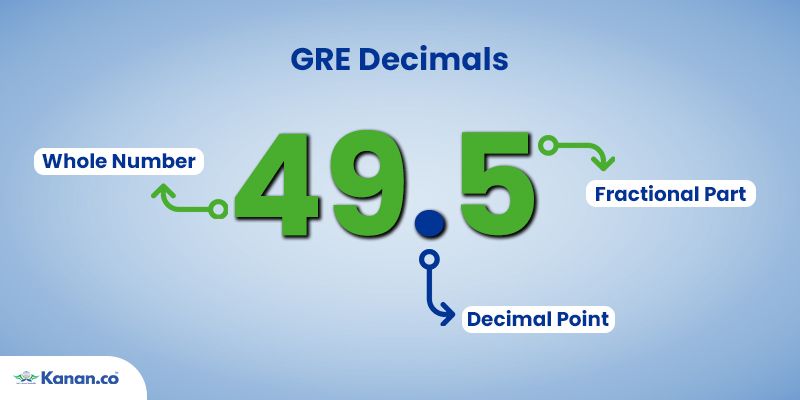
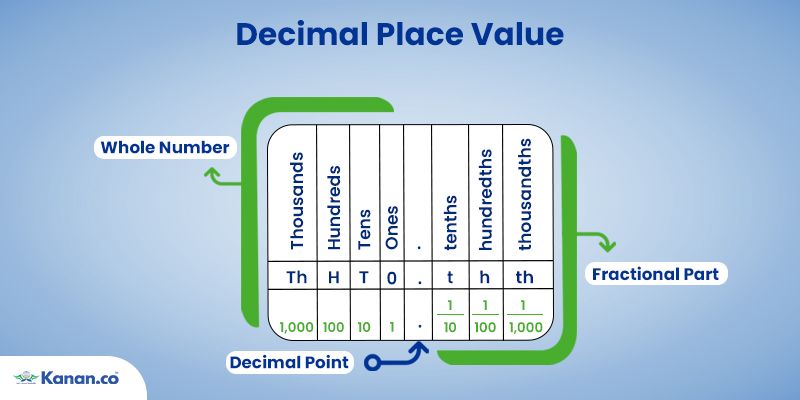
GRE Decimals are the key component of the GRE Quant section. Decimal questions are given weightage in the GRE arithmetic section, appearing in various formats such as multiple choice, numeric entry, or quantitative comparison questions. A decimal number uses a decimal point (".") to denote fractional values, enabling precise representation of numbers between whole values. The digits after the decimal point indicate values based on powers of 10. For example, in the decimal number 10.98, 10 is the whole number part, while .98 is the fractional part, where 9 represents one-tenth (1/10), and 8 represents one-hundredth (1/100). Decimals are commonly used in daily math calculations, finance, and measurements. In this article, we’ll explore types of decimals, operations involving decimals, provide some practice problems and a few tips to approach these questions in the main exam.
Explaining Complex Decimal Concepts
Decimal concepts may seem simple at first glance, but they involve crucial operations that are tested in the GRE Quantitative Reasoning section. A solid understanding of these concepts is key to effectively solving decimal-related questions on the exam.
Decimals and Fractions
Decimals and fractions are two different ways to represent parts of a whole or partial values. A decimal can be converted into a fraction, and a fraction can similarly be expressed as a decimal. For eg: the decimal 0.5 is equivalent to the fraction ½. On the other hand fraction ⅘ (dividing the numerator 4 with the denominator 5) can be represented in decimal as 0.8.
The below table gives you the decimal values for various fractions. This can help you simplify the sums and save time converting these fractions to decimals.
| Fraction | Decimal | Fraction | Decimal |
| 1/20 | 0.05 | 1/2 | 0.5 |
| 1/16 | 0.0625 | 3/5 | 0.6 |
| 1/12 | 0.083333 | 5/8 | 0.625 |
| 1/10 | 0.1 | 2/3 | 0.6666 |
| 1/8 | 0.125 | 7/10 | 0.7 |
| 1/6 | 0.16666 | 3/4 | 0.75 |
| 1/5 | 0.2 | 4/5 | 0.8 |
| 1/4 | 0.25 | 5/6 | 0.83333 |
| 3/10 | 0.3 | 7/8 | 0.875 |
| 1/3 | 0.33333 | 9/10 | 0.9 |
| 3/8 | 0.375 | 15/16 | 0.9375 |
| 2/5 | 0.4 | 19/20 | 0.95 |
Decimals, Percentage, and Ratios
Percentage means per 100, which is a way of representing a number as a fraction of 100. For eg: 58% can be represented in decimal as 0.58 (which is 58/100).
On the other hand ratios are simple expressions to represent a part to whole or one part to another part. For eg: 5:6 ratio can be represented in decimal form as 0.83 (which is ⅚ )
Rounding off Decimals
Rounding off is the process of simplifying decimals to the nearest tenth, hundredth, or other specified place value. This approach makes calculations easier and helps achieve a more concise value. For example, in the decimal 6.859, the digit 8 is in the tenths place, 5 is in the hundredths place, and 9 is in the thousandths place.
|
Rules for rounding off Decimals As a first step, determine the place (either tenth, hundredths and thousandths) you need to round off. Check the digit next to the digit you wish to round off. *If the digit is 5 or more, then round up by increasing one to the last retained digit. Rounding off 6.859 to the nearest tenth gives the value 6.9 * If it is less than 5, then keep the last retained digit and truncate the rest of the digits to the right. |
Types of Decimals
Decimals can be categorized into 3 types based on the nature of the digits seen after the decimal point.
Terminating Decimals
Terminating decimals are called so, as they have a finite number of digits after the decimal points. It ends or terminates at a certain place value and hence the name. Eg. 8.93, 25.981, 6.7, 0.5 etc. They can also be represented as fractions
For eg: 8.93 can be written as 8.93/1
And as it has 2 decimal places, it can be rewritten as
8.93 100
— * —
1 1
Which can be simplified as 893/100, which can be further represented in mixed fraction as
8*93
—
100
Repeating or Recurring Decimals
After a decimal point if one or more digits keep repeating indefinitely, then these kinds of decimals are called repeating decimals. Eg. 0.444444, 0.52525 or 0.165165165 are few examples of recurring decimals. Since the numbers keep repeating, bar notation is used to represent repeating decimals. For example 0.44444 can be represented as 0.4 using bar notation. By this we can understand that the number 4 is repeating after the decimal and hence bar notion is used. Likewise with the number 0.525252, then this will be represented in bar notation as 0.52 as 52 keeps repeating.
Non-Terminating, Non-Repeating Decimals or Irrational Decimals
A non-terminating and non-repeating decimals are one which goes on forever without repeating a pattern. They cannot be defined using a bar notion or it doesn’t end. For e.g. the value of Pi (π) 3.14159265359 and keeps going on. Another √2 is 1.41421356237…. It is not possible to represent these numbers as a fraction.
Arithmetic Operations With Decimals
Arithmetic operations like addition, subtraction, multiplication and division can be done with decimal numbers too similar to the whole numbers. Scroll down to know more about the arithmetic operations done with decimal numbers.
Addition & Subtraction Using Decimals
To add and subtract decimals first line up the numbers vertically ensuring you place the digits in corresponding tenths and hundredths place. If any places are left, then fill it with zero and then proceed with addition/subtraction from right to left.
Eg: 56.96 + 4.3 → 56.96 + 4.30 → 61.26
Eg: 425.35 − 36.2 → 425.35 − 36.20 → 389.15
Multiplication & Division Using Decimals
To multiply/divide the decimal number follow the steps. To multiply the numbers 13.9 * 2.5
- First ignore the decimal point and consider it as a whole number and derive the product, which is 3475.
- Add up the decimal points which are 2 here, and we can derive that the product's decimal point should be after two places.
- And hence the result is 34.75.
- If we divide the same numbers , applying the same rules then the result is 13.9 / 2.5 is equal to 5.56.
GRE Decimals Practice Problems
1. Basic Squaring / Square Roots
Question 1:
If 𝑥 = 0.4, what is the value of 𝑥2?
Solution:
To find 𝑥2, square 0.4:
0.4×0.4=0.16
Answer:
0.16
Question 2:
If x=1.25 and y=0.75, find the value of x2 - y2
Solution:
Substitute x=1.25 and y=0.75
Use the difference of squares formula: x2 - y2 =(x+y)(x−y)
Calculate x+y = 1.25 + 0.75 = 2.0
Calculate x−y = 1.25 − 0.75 = 0.5
Multiply: 2.0 × 0.5 = 1.0
Answer:
1.0
2. Decimal Operations
Question 1:
What is 2.75+3.6×0.2−1.25
Solution:
Follow the order of operations (PEMDAS/BODMAS):
Multiply first:
3.6 × 0.2 = 0.72
Then, add:
2.75+0.72=3.47
Finally, subtract:
3.47−1.25=2.22
Answer:
2.22
Question 2:
Calculate (4.25+3.75)×0.6−1.5/0.25
Solution:
Perform the addition:
4.25+3.75=8.0.
Multiply by 0.6:
8.0×0.6=4.8
Divide:
1.5/0.25=6
Subtract:
4.8−6=−1.2
Answer = −1.2
3. Decimals with Fractions
Question 1:
Convert 0.375 to a fraction and simplify.
Solution:
Write 0.375 as 375/1000
Simplify by dividing both the numerator and denominator by 125:
375 ÷ 125
—----------
1000 ÷ 125
Which is equal to 3/8
Answer:
3 / 8
Question 2:
Convert 0.875 to a fraction and simplify. Then add 1/4 to your result.
Solution:
Convert 0.875 to a fraction:
0.875 = 875/1000 = 7/8
Add 1/4 to 7/8
Convert 1/4 to an equivalent fraction with a denominator of 8:
1/4 = 2/8
Add 7/8 + 2/8 = 9/8 = 1.125
Answer:
1.125 or 9/8
4. Ordering Decimals
Question 1:
Arrange the following numbers in ascending order:
0.5, ⅓, 0.45, 0.49
Solution:
Convert
1/3≈0.333
Compare all numbers:
0.333
0.45,
0.49,
0.5.
Ascending order:
0.333,0.45,0.49,0.5.
Answer
1/3,0.45,0.49,0.5
Question 2:
Arrange the following in descending order: 2/5,0.62,0.56,7/12
12
Solution
Convert fractions to decimals:
2/5 = 0.4
7/12 ≈ 0.583
List all values as decimals:
0.4,0.62,0.56,0.583
Arrange in descending order:
0.62,0.583,0.56,0.4.
Answer
0.62, 7/12, 0.56, 2/5
5. Other Decimals
Question 1:
If
a=0.03 and b=1.25, what is the result of
b/a
Solution:
Divide
b/a which is 1.25/0.03 = 41.6666...≈41.67
Answer
41.67
Question 2:
If a=5.76 and b=0.24, calculate 𝑎/𝑏 and round to the nearest hundredth.
Solution:
Divide a by 𝑏
5.76 / 0.24 = 24
Answer
24.00
6. Decimal Rounding
Question 1:
Round 7.6834 to the nearest hundredth.
Solution:
Identify the hundredths place in 7.6834, which is 3
Look at the thousandth place (3). Since it is less than 5, we round down.
Answer:
7.68
Question 2:
Calculate (8.75×0.4+2.15)/1.3 and round to the nearest tenth.
Solution:
Multiply:
8.75×0.4=3.5.
Add:
3.5+2.15=5.65.
Divide:
5.65 / 1.3 ≈ 4.346
Round to the nearest tenth:
4.3
Answer
4.3
7. Combined Operations with Decimals and Fractions
Question 1:
If c=3.25 and 𝑑 = 1/8 , what is the value of c−d?
Solution:
Convert
d=⅛ = 0.125
Subtract
3.25 − 0.125 = 3.125
Answer:
3.125
Question 2:
If m=2.5 and 𝑛 = 3/8 , calculate m−n+ 1/2 and express the result as a decimal.
Solution:
Convert fractions to decimals as a first step
𝑛 = 3/8 = 0.375 and 1/2 = 0.5
Substitute:
2.5−0.375+0.5
Perform the operations:
2.5−0.375=2.125
2.125+0.5=2.625
Answer:
2.625
8. Square Root of a Decimal
Question 1:
What is the approximate value of √0.64 ?
Solution:
Since
0.64=(0.8)2
the square root of
√0.64 = 0.8
Answer:
0.8
Question 2:
What is the approximate value of √1.44 + √0.81 ?
Solution:
Find √1.44 = 1.2
Find√ 0.81 = 0.9
Add:
1.2 + 0.9 = 2.1
Answer:
2.1
Tips to approach GRE Decimal Questions
In order to approach and crack the GRE Decimal questions effectively here are a few tips.
- Understand the decimal concepts and rules before attempting the questions.
- Understanding place value will help with operations like rounding and comparing decimals.
- Memorize the decimal representation of fractions like ½, ¼, ¾ etc to save time on conversions.
- Remember the rules for converting decimals to fractions, percentages and ratios. This can help you save time for simplifying the calculations.
- Round off to decimal to the nearest whole number, so that you can speed up the process.
- While you can use the on-screen calculator, reserve it for complex calculations, as basic ones may be quicker to do mentally.
In this guide, we’ve articulated essential concepts you need to know for GRE decimals. If you need more help, book a free GRE demo today! Call us at 73555 73555 to learn more about our Test Prep and study abroad services.

About Author Gayathri Nagarajan
Gayathri, a trusted study-abroad expert, with expertise in standardized tests like IELTS, TOEFL, PTE, GRE, and GMAT. With a strong tech background from SASTRA University, she excels in software testing and has a passion for content writing and digital marketing. She aids students in finding the perfect academic fit, offering guidance on course selection, LOR and SOP writing. She remains up-to-date with the latest trends in higher education, delivering credible, accurate information on international education, including courses and test prep materials. As a trusted Study abroad expert at Kanan International, explore her latest blogs and articles for comprehensive insights into studying abroad and realizing your academic aspirations.
Kanan.co is a trusted study abroad consultancy offering comprehensive services, resources, and solutions for students and education institutions. We support students at every stage of their global education journey, ensuring a smooth and guided experience. Along with test preparation for IELTS, GRE, TOEFL, and SAT, we provide expert services such as SOP writing, visa guidance, accommodation support, scholarship assistance, and education loan support. Our expertise and commitment to excellence make us a reliable partner for students pursuing international education.
Sign Up for a Free GRE Demo Class!
Ace GRE Quant & Verbal with 320+ Score — Join Us!








Global Headquarters
Kanan Int EdTech Inc
320 Bay Street, Suite 321 (Spaces), Toronto ON, Canada M5B 1N9
Indian Headquarters
Kanan International Pvt. Ltd.
D-wing, 2nd Floor, Trident Complex, Ellora Park Vadiwadi Road, Vadodara, Gujarat 390007
IT/ Digital Campus
Kanan International Pvt. Ltd
Old, New No 3, 2nd Floor, 1A, Dr Sadasivam Rd, T. Nagar, Chennai, Tamil Nadu 600017
Our branches
- Bardoli
- Bharuch
- Chennai
- Dehradun
- Gurugram
- Himatnagar
- Karnal
- Nadiad
- Navsari
- Palanpur
- Rajkot
- Vadodara
- Valsad
- Vallabh Vidyanagar
- Vapi
Study Abroad
Test Prep
Top Universities
Consultants
IELTS Centers
GRE Centers
TOEFL Centers
SAT Centers
Language Courses in Vadodara
Study Abroad Calculators
Featured Blogs
Study Abroad Consultants in Chennai
Study Abroad Consultants in Surat
Study Abroad Consultants in Navsari
Study Abroad Consultants in Bardoli
Study Abroad Consultants in Ahmedabad
Study Abroad Consultants in Anand
Study Abroad Consultants in Khanna
Study Abroad Consultants in Nadiad
Study Abroad Consultants in Vadodara
Study abroad consultants in Valsad
Copyright © 2026 KANAN.CO All rights reserved.