- Study Abroad
- / gre
- / factors or multiples
GRE Math Factors or Multiples: Practice Questions


Author
11-12-2024

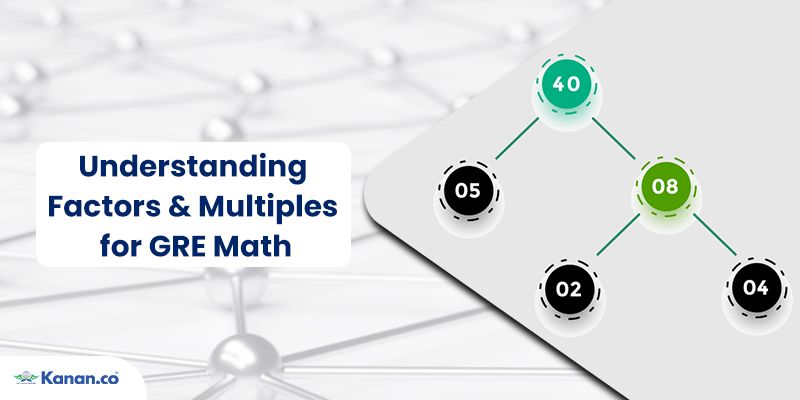
GRE Factors or Multiples is a part of GRE arithmetic in the Quant section, evaluating your ability to understand the relationships between numbers through division and multiplication. Factors are numbers (1, 2, 3, ...) that divide evenly without leaving a remainder, and multiples are the results of multiplying numbers and any integer. It's essential to understand these foundational concepts, as they frequently appears in the GRE.
So, what exactly is a factor? A factor is a number that divides another number evenly, leaving no remainder. Factors of a number are the divisors that result in whole numbers.
| Factor: Numbers that divide evenly |
Now that we know what a factor is, let’s learn multiples. While a divisor (or factor) divides a number, a multiplier does the opposite—it multiplies it. A multiple is the result of multiplying a number by an integer, extending by adding the number repeatedly to cover all products. Common multiples are shared by two or more numbers and are useful for finding the Least Common Multiple (LCM).
| Multiple: Products of a number |
In the GRE, we can expect up to 2-3 questions related to factors, multiples, and their applications, such as calculating the Greatest Common Factor (GCF) and the Least Common Multiple (LCM). This article will guide you through the basics of GRE Factors or Multiples, including prime numbers, their relationship to factors and multiples, and provide practice questions with explanations.
Differences Between GRE Factors and Multiples with Example
Factors and multiples are essential components of the GRE arithmetic section, particularly under the topic of integers, along with concepts GCF, LCM, and prime numbers. Here is a quick comparison of factors and multiples:
| Feature | Factors | Multiples |
| Definition | Numbers that divide another number without leaving a remainder. | Results of multiplying a given number by an integer. |
| Relation to the Number | Factors are equal to or less than the number itself. | Multiples are greater than or equal to the number. |
| Examples | Factors of 12: 1, 2, 3, 4, 6, 12 | Multiples of 3: 3, 6, 9, 12, 15, 18, etc. |
| Starting Point | Always starts from 1 or the smallest factor of a number. | Begins from the number itself and continues infinitely. |
| Number of Values | Finite number of factors for any given integer. | Infinite number of multiples for any integer. |
| Application on the GRE | Useful for finding divisors, GCF, and factoring problems. | Used in LCM, sequences, and divisibility questions. |
| Relation to Prime Numbers | Factors include prime factors (if any) of the number. | Multiples do not involve prime factors but are generated by multiplication. |
| Visual Representation | Can be represented by dividing the number into groups. | Can be represented by counting multiples on a number line. |
| Pairing of Numbers | Can be paired to form the original number (e.g., 1x12, 2x6 for 12). | Generated by repeated addition of the number itself (e.g., 12, 24, 36). |
| Conceptual Difference | Factors are components that build up the number. | Multiples extend the number’s value by scaling it. |
Now lets see an example understanding the concept Factors and Multiples
Suppose we have the number 18:
- Factors of 18: The factors are numbers that divide 18 without leaving a remainder, such as 1, 2, 3, 6, 9, and 18.
- Multiples of 18: Multiples are obtained by multiplying 18 by whole numbers. Some multiples of 18 are 18, 36, 54, 72, and 90.
Example
For two numbers A = 24 and B = 36:
- Find the Greatest Common Factor (GCF) of A and B.
- Determine the Least Common Multiple (LCM) of A and B.
Solution
1. Finding the GCF (Greatest Common Factor):
-
- Factors of 24: 1, 2, 3, 4, 6, 8, 12, 24
- Factors of 36: 1, 2, 3, 4, 6, 9, 12, 18, 36
- The common factors of 24 and 36 are 1, 2, 3, 4, 6, and 12.
- The greatest of these common factors is 12.
Correct answer is GCF: 12
2. Finding the LCM (Least Common Multiple):
-
- Multiples of 24: 24, 48, 72, 96, 120, ...
- Multiples of 36: 36, 72, 108, 144, ...
- The smallest multiple that both numbers share is 72.
Correct answer is LCM: 72
In this example, we applied the concepts of factors to find the GCF, which is the largest number that divides both 24 and 36 without a remainder. For the LCM, we used the concept of multiples to find the smallest multiple common to both 24 and 36.
GRE Factors or Multiples Practice Questions with Answers
Try these GRE practice questions on factors and multiples to build your understanding of topics like divisors, common multiples, GCF, and LCM. Each problem includes a detailed answer to help you learn simple ways to solve GRE factors and multiple questions.
Example Question #1
Find the greatest common factor of 18 and 30.
Possible Answers:
- 6
- 3
- 18
- 9
Correct Answer: 6
Explanation: First, list the factors of each number. Factors are the numbers that can divide evenly into the given numbers.
- The factors of 18 are: 1, 2, 3, 6, 9, and 18.
- The factors of 30 are: 1, 2, 3, 5, 6, 10, 15, and 30.
To find the greatest common factor, look for the largest number that appears in both lists. In this case, the largest common factor is 6.
Example Question #2
What is the least common multiple of 36 and 48?
Possible Answers:
- 72
- 144
- 288
- 96
- 36
Correct Answer:
144
Explanation:
The least common multiple (LCM) is the smallest number that is a multiple of both numbers. Let's list some multiples of 36 and 48 and find the smallest number that appears in both lists.
Multiples of 36: 36, 72, 108, 144, 180, 216, ...
Multiples of 48: 48, 96, 144, 192, 240, 288, ...
The smallest number that appears in both lists is 144.
Therefore, the least common multiple of 36 and 48 is 144.
Example Question #3
What is the least common multiple of 2a, 3ab, 4b, 6a, and 12ab?
Possible Answers:
- 24a²b²
- 12ab
- 24ab
- 18ab
- 48a²b²
Correct Answer:
24ab
Explanation:
To find the least common multiple (LCM), we need a number that each item in the list can divide into evenly. For the coefficients, the maximum value is 12, and by finding the smallest multiple of the higher coefficients (6 and 4) that also includes 12, we get 24 as our LCM. This is because 24 can be divided evenly by 2, 3, 4, 6, and 12.
For the variables, we need "a" and "b" to fit into this LCM. Both a and b must appear at least once, but we don’t need higher exponents since the terms in the list don't include them. Thus, the least common multiple for the list is 24ab.
Example Question #4
If x is the greatest common divisor of 45 and 75, and y is the least common multiple of 30 and 50, then x + y = ?
Possible Answers:
- 175
- 125
- 105
- 150
Correct Answer:
175
Explanation:
Step 1: Finding the Greatest Common Divisor (GCD) of 45 and 75
The greatest common divisor (GCD) is the largest number that divides both numbers evenly.
Prime factorization of 45: 45 can be broken down into 32 × 5 (since 45 = 3 × 3 × 5).
Prime factorization of 75: 75 can be broken down into 3×52 (since 75 = 3 × 5 × 5).
Identifying the common factors:
Both 45 and 75 have 3 and 5 as factors. The highest common factors of both numbers are 3 and 5.
Calculating the GCD:
Multiply these common factors to find the GCD: 3 × 5 = 15.
So, x = 15.
Step 2: Finding the Least Common Multiple (LCM) of 30 and 50
The least common multiple (LCM) is the smallest number that both numbers divide into evenly.
Prime factorization of 30: 30 can be broken down into 2 × 3 × 5.
Prime factorization of 50: 50 can be broken down into 2 × 52 .
Identifying the highest powers of each prime factor:
- For the number 2, the highest power is 2 (appears in both numbers as 21).
- For the number 3, the highest power is 3 (appears only in 30 as 31).
- For the number 5, the highest power is 52 (appears in 50 as 52).
Calculating the LCM:
Multiply the highest powers of all prime factors to find the LCM: 2 × 3 × 52 = 2 × 3 × 25 = 150
- So, y=150y = 150y=150.
Step 3: Adding the Results
Now that we have x = 15 and y = 150, we can find x + yy:
x + y = 15 + 150 = 175
Final Answer:
Therefore, x + y = 175.
Example Question #5
Which of the following is a prime number?
Possible Answers:
- 53
- 25
- 42
- 18
- 49
Correct Answer:
53
Explanation:
A prime number is a number that has only two factors: 1 and itself. Let's examine the factors of each option to determine which one is prime.
- Factors of 53: 1, 53
- Factors of 25: 1, 5, 25
- Factors of 42: 1, 2, 3, 6, 7, 14, 21, 42
- Factors of 18: 1, 2, 3, 6, 9, 18
- Factors of 49: 1, 7, 49
Since only 53 has exactly two factors (1 and 53), it is the only prime number in this list.
Example Question #6
What is the greatest common factor of 9240 and 6160?
Possible Answers:
- 120
- 80
- 40
- 160
- 20
Correct Answer:
40
Explanation:
For large numbers, finding the GCF can be time-consuming if we fully factorize. Here’s a more efficient approach:
Prime Factorization of 9240:
9240 is even, so divide by 2 until you can’t anymore:
- 9240 ÷ 2 = 4620
- 4620 ÷ 2 = 2310
- 2310 ÷ 2 = 1155
Next, check divisibility by 3: 1155 ÷ 3 = 385
Then, check divisibility by 5: 385 ÷ 5 = 77
Finally, 77 = 7 × 11, which are both primes.
So, the prime factorization of 9240 is 23 × 3 × 5 × 7 × 11.
Prime Factorization of 6160:
6160 is even, so divide by 2 until it’s no longer even:
- 6160 ÷ 2 = 3080
- 3080 ÷ 2 = 1540
- 1540 ÷ 2 = 770
- 770 ÷ 2 = 385
From above, 385 can be factorized as 5 × 7 × 11.
So, the prime factorization of 6160 is 24 × 5 × 7 × 11.
Identify Common Factors:
The numbers share prime factors of 23 , 5, 7, and 11.
The lowest power of 2 in both factorizations is 23 .
Calculate the GCF:
Multiply the common factors:
23 × 5 × 7 × 11 = 40.
Thus, the greatest common factor of 9240 and 6160 is 40.
Example Question #7
If y is a prime number, then 5y is:
Possible Answers:
- divisible by 6
- a prime number
- odd
- divisible by 10
- cannot be determined
Correct Answer:
cannot be determined
Explanation:
To determine the properties of 5y, we can test different prime numbers for y to see if any consistent results arise.
1. Odd or Even:
- If y = 2 (the only even prime number), then 5y = 5 × 2 = 10, which is even.
- If y = 3 (an odd prime), then 5y = 5 × 3 = 15, which is odd.
- Therefore, 5y can be either odd or even, so we cannot determine if it’s consistently odd or even.
2. Prime or Composite:
- If y = 2, 5y = 10, which is composite.
- If y = 3, 5y = 15, which is also composite.
- Thus, 5y is not a prime number for these examples, but we still cannot determine a consistent result for all possible values of y.
3. Divisibility by 6 or 10:
- For y = 2, 5y = 10, which is divisible by 10.
- For y = 3, 5y = 15, which is not divisible by 10.
- Likewise, 5y is not consistently divisible by 6, as neither 10 nor 15 meet this criterion.
Since 5y does not follow a consistent pattern based on whether y is a prime number, the answer is "cannot be determined".
Example Question #8
Quantitative Comparison
Quantity A: The number of prime numbers between 0 and 75, inclusive.
Quantity B: The number of prime numbers between 76 and 150, inclusive.
Possible Answers:
- Quantity B is greater.
- The relationship cannot be determined from the information given.
- Quantity A is greater.
- The two quantities are equal.
Correct Answer:
Quantity A is greater.
Explanation:
Prime numbers become less common as we move higher on the number line. If we identify primes from 0 to 75, we find several (2, 3, 5, 7, 11, 13, 17, 19, 23, 29, 31, 37, 41, 43, 47, 53, 59, 61, 67, 71, 73) totaling 21 primes. However, from 76 to 150, the primes (79, 83, 89, 97, 101, 103, 107, 109, 113, 127, 131, 137, 139, 149) total only 14 primes.
Thus, there are more prime numbers between 0 and 75 than between 76 and 150, making Quantity A greater. This follows the principle that primes are more concentrated among smaller numbers, making intervals closer to 0 more prime-dense.
Example Question #9
Let m and n be distinct positive integers such that m + n is a prime number. If m⋅x + n⋅x = m + n, which of the following is a possible value of x?
Possible Answers:
- 2
- 3
- 1
- 4
- None of the above
Correct Answer:
1
Explanation:
This question explores basic number properties, particularly around primes and integer operations. Since m + n is a prime number, it can only be divisible by 1 and itself. This means the expression m⋅x + n⋅x must simplify to equal m + n only under certain conditions.
When x = 1, the equation becomes m⋅1 + n⋅1 = m + n, which is consistent with the prime condition for m + n. However, if x = 2 or any other integer greater than 1, the expression m⋅x + n⋅x would yield a value greater than m + n, as it would be a multiple of m + n. Thus, the only solution that keeps m + n prime is x = 1.
This eliminates the "None of the above" option as well, confirming that x = 1 is the only possible value.
Example Question #10
942(305) + 150(942) is equal to which of the following?
Possible Answers:
- (942 + 305)(150 + 942)
- 942(305 + 150)
- 305(942 + 150)
- (305 + 150)(942 + 305)
- 150(305 + 942)
Correct Answer: 942(305 + 150)
Explanation:
To simplify this expression, we can factor out the common term, 942, from both parts of the sum. This gives us:
942(305) + 942(150) = 942(305 + 150)
So, the correct answer is 942(305 + 150), as it consolidates the expression by factoring out the common term 942.
Example Question #11
m is a positive integer, and q = 3 × 7 × 10 × m.
- Quantity A: The remainder when q is divided by 6
- Quantity B: The remainder when q is divided by 21
Possible Answers:
- Quantity B is greater.
- The relationship cannot be determined from the information given.
- Quantity A is greater.
- The two quantities are equal.
Correct answer: The relationship cannot be determined from the information given.
Explanation:
Let's examine Quantity B first. We want to determine the remainder when q is divided by 21.
The expression q = 3 × 7 × 10 × m includes both 3 and 7 as factors, which are the prime factors of 21. Therefore, q will always be divisible by 21, making the remainder 0 regardless of the value of m. Thus, Quantity B is always 0.
Now, let’s analyze Quantity A, which is the remainder when q is divided by 6.
Since q = 3 × 7 × 10 × m = 210 × m, the divisibility by 6 will depend on the factor m because 210 is itself divisible by 6. If m is a multiple of 6, then q will also be divisible by 6, and the remainder will be 0. However, if m is not a multiple of 6, the remainder when dividing by 6 can vary depending on the value of m.
Since Quantity A could be 0 or non-zero depending on the value of m, the relationship between Quantity A and Quantity B cannot be determined from the information given.
Example Question #12
If a is an integer and 540a is an integer, which of the following could be the value of a?
Possible Answers:
- 30
- 12
- 28
- 25
- 15
Correct answer: 15
Explanation:
To determine the possible value of a, we need a factor of a that can completely cancel out part of the factorization of 540, ensuring 540a remains an integer.
The prime factorization of 540 is: 540 = 2 × 2 × 3 × 3 × 3 × 5
Therefore, a must contain factors that align with parts of this prime factorization. Among the answer choices, only a = 15 (where 15 = 3 × 5) has a factorization that cancels with some of the prime factors in 540, producing an integer result. Other answer choices lack this compatibility, leaving 15 as the correct answer.
Key Takeaways on GRE Factors or Multiples
Here are the key points to keep in mind when tackling GRE questions on factors and multiples:
- Factors and multiples are separate concepts. Factors are numbers that divide another number exactly, while multiples are created by multiplying a number by any integer.
- You can create infinite multiples of a number by repeatedly multiplying it with integers.
- When you add, subtract, or multiply multiples, the result will always be another multiple of the same number. However, division does not guarantee a multiple as the quotient may not be an integer.
- Understanding how factors and multiples relate to each other is crucial for addressing GRE quantitative problems, particularly those dealing with divisibility and multiplication.
- Working through multiple maths questions involving factors and multiples will help you recognize numerical patterns and apply these concepts effectively.
- Proficiency in factors and multiples is vital for solving problems involving prime factors, divisibility, the least common multiple (LCM), and the greatest common divisor (GCD).
In conclusion, understanding factors and multiples is key to solving many GRE problems. It's not just about knowing the rules, but also about seeing how these ideas fit together to make problem-solving easier and faster. The more you practice, the more you'll start to recognize patterns. If you're looking for clear guidance and support, Kanan International offers personalized coaching to help you master GRE Factors or Multiples and other important concepts. With our expert help, you'll feel more confident and ready to tackle any GRE question.

About Author Sravani Kota
Sravani is an enthusiastic author who is deeply passionate about continuous learning, writing, and reading. Her academic background includes a Bachelor's and Master's degree in engineering from JNTU, gaining expertise in technical English writing, paper publications, test preps like IELTS, GRE, SAT, TOEFL, etc., and study abroad services like SOP, LOR, etc. Her expertise in the education sector makes her an excellent resource for students seeking guidance and advice. In her leisure time, she enjoys spending quality time with family, watching popular TV shows like Stranger Things and Money Heist, and she also loves to travel, explore new places, and create videos of her experiences.
Kanan.co is a trusted study abroad consultancy offering comprehensive services, resources, and solutions for students and education institutions. We support students at every stage of their global education journey, ensuring a smooth and guided experience. Along with test preparation for IELTS, GRE, TOEFL, and SAT, we provide expert services such as SOP writing, visa guidance, accommodation support, scholarship assistance, and education loan support. Our expertise and commitment to excellence make us a reliable partner for students pursuing international education.
Sign Up for a Free GRE Demo Class!
Ace GRE Quant & Verbal with 320+ Score — Join Us!








Global Headquarters
Kanan Int EdTech Inc
320 Bay Street, Suite 321 (Spaces), Toronto ON, Canada M5B 1N9
Indian Headquarters
Kanan International Pvt. Ltd.
D-wing, 2nd Floor, Trident Complex, Ellora Park Vadiwadi Road, Vadodara, Gujarat 390007
IT/ Digital Campus
Kanan International Pvt. Ltd
Old, New No 3, 2nd Floor, 1A, Dr Sadasivam Rd, T. Nagar, Chennai, Tamil Nadu 600017
Our branches
- Bardoli
- Bharuch
- Chennai
- Dehradun
- Gurugram
- Himatnagar
- Karnal
- Nadiad
- Navsari
- Palanpur
- Rajkot
- Vadodara
- Valsad
- Vallabh Vidyanagar
- Vapi
Study Abroad
Test Prep
Top Universities
Consultants
IELTS Centers
GRE Centers
TOEFL Centers
SAT Centers
Language Courses in Vadodara
Study Abroad Calculators
Featured Blogs
Study Abroad Consultants in Chennai
Study Abroad Consultants in Surat
Study Abroad Consultants in Navsari
Study Abroad Consultants in Bardoli
Study Abroad Consultants in Ahmedabad
Study Abroad Consultants in Anand
Study Abroad Consultants in Khanna
Study Abroad Consultants in Nadiad
Study Abroad Consultants in Vadodara
Study abroad consultants in Valsad
Copyright © 2026 KANAN.CO All rights reserved.