- Study Abroad
- / gre
- / fractions
GRE Math: Fractions | Operations with Fractions


Author
02-12-2024

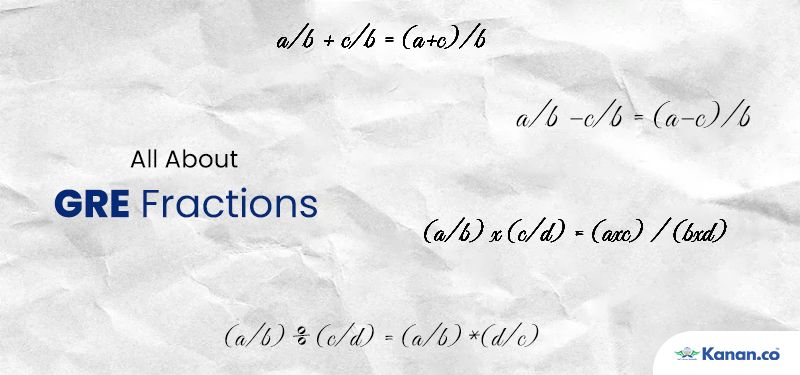
GRE Fractions is a topic within the Arithmetic section, which is part of the quantitative section of the GRE test. A Fraction is a number in the form of c/d, where c and d are integers and d≠0. The integer ‘c’ is the numerator and ‘d’ is the denominator. For example, if ¾ is a fraction, ‘3’ is the numerator, and ‘4’ is the denominator. Such numbers are also called rational numbers. It is important to note that every integer ‘n’ is a rational number, and n is equal to n/1.
Some fractions can be proper, improper, or mixed numbers. A proper fraction has a numerator that is less than the denominator, and vice versa for improper fractions. In a fraction c/d, where c and d are whole numbers and d≠0, you say c/d is a proper fraction if c<d. If c=d or c>d, it is an improper fraction. Mixed numbers consist of both a whole number and a common fraction. For example, 2 ⅓ is a mixed number, where 2 is the whole number and ⅓ is the fraction. All types of fractions should always be simplified to their lowest terms.
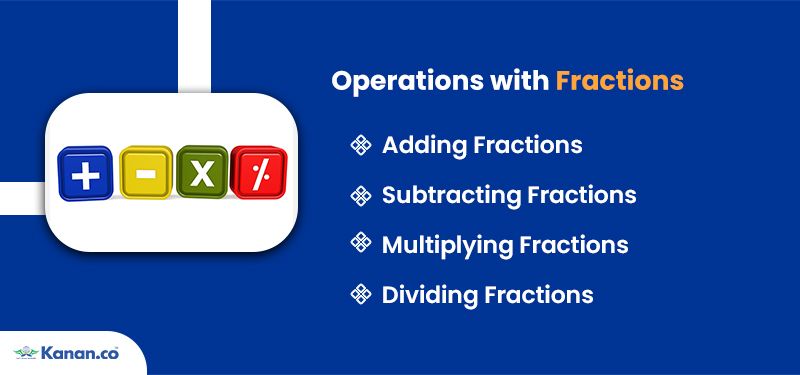
Here is an infographic summarizing operations with fractions in the GRE Math Section.
Note: The relationship between fractions and decimals is intrinsic, and knowing about this connection is crucial in the GRE. The other way to represent a fraction is decimal. For instance, the fraction ¼ is equivalent to decimal 0.25.
Let’s see how Fractions in the GRE Arithmetic are solved for each operation in detail, beginning with Adding Fractions.
Adding Fractions
To add two fractions, they must have a common denominator. Then, add the numerators to find the numerator of the sum, while keeping the common denominator as the denominator of the sum. In simple terms, a/b + c/b = (a+c)/b
If the fraction does not have a common denominator, create one by finding the Least Common Multiple (LCM) of the denominator or using the product of the denominators. Fraction rules like a/b + c/d = ad/bd + bc/bd = (ad + bc) / bd.
Let’s see sample examples related to adding fractions
Example: How to add Fractions? (h3)
Question 1: Add this fraction 3/9 + 5/9
Answer:
In the above example question, the denominator is the same which is ‘9’. Hence add the numerators, keeping common denominator to find the result
3/9 + 5/9 = (3 + 5) / 9 = 8/9 ≃ 0.889
Question 2: Add this fraction ½ + ¼
Answer:
In the above fraction, the denominators are not the same, you have to use equivalent fractions that have a common denominator. First, you must find the least common multiple of two denominators and then calculate the result.
Method 1: Product of denominators
½ + ¼ = (1x4) / (2x4) + (1x2) / (4x2) = 4/8 + 2/8 = 6/8 = ¾
(OR)
Method 2: LCM method
Find LCM of denominators (2,4)
- List the multiples of each number:
- Multiples of 2: 2, 4, 6, 8, ...
- Multiples of 4: 4, 8, 12, ...
- Identify the smallest common multiple: The first common multiple of 2 and 4 is 4.
So, the LCM of (2, 4) is 4.
Now in the given fraction example ½ + ¼, multiply numerator and denominator of ½ by 2 to make denominator 4.
((1x2) / (2x2) )+ ¼ = 2/4 + 1/4 = ¾
Method 1, the product of denominators is quicker to find.
Subtracting Fractions
Subtraction of fractions also requires a common denominator, say like a/b –c/b = (a–c)/b. If the fractions share different denominators, convert them to have the same denominator using the same approach as in addition. Once the fractions have a common denominator, subtract the numerators, and place the result over the common denominator.
In simple terms, a/b – c/d = ad/bd – bc/bd = (ad – bc) / bd. It's essential to maintain the correct order when subtracting fractions, as reversing the order will give the opposite, or negative, value. When you subtract the mixed numbers, you may have a fraction to subtract which is the greater fraction. Below are few examples related to subtracting fractions
Example: How to subtract Fractions?
Question 1: Simplify 15/12 – 2/9
Answer:
In the above example, the denominator is not the same. Just like adding fractions, when you want to subtract fractions, you must have a common denominator.
Calculate the LCM of denominators (12,9)
- List the prime factors of each number:
- 12 = 22 x 3
- 9 = 32
- Take the highest power of each prime factor:
- For 2, the highest power is 22
- For 3, the highest power is 32
- Multiply these together to get the LCM:
LCM=22 x 32 = 4×9 = 36
So, the LCM of 12 and 9 is 36.
Now, For the above example 15/12 - 2/9, multiply the numerator and denominator of (15/12) with 3 and (2/9) with 4, to get the equivalent denominator.
(15/12) * (3/3) – (2/9) * (4/4) = (45/36) – (8/36)
Now retain the denominator and subtract numerators
= (45–8) / 36 = 37/36
Question 2: Subtract these mixed numbers 8 ¾ – 5 ⅙
Answer:
The denominators in the above fraction equation are not similar, for that, multiply the numerator and denominator of ¾ with 3 and ⅙ with 2.
8 ¾ = 8 (3*3)/(4*3) = 8 9/12
–5 ⅙ = –5 (1*2) / (6*2) = –5 2/12
Now that the denominator is same, subtract numerator numbers
8 ¾ = 8 9/12
–5 ⅙ = – 5 2/12
3 7/12
3 7/12 = 3 14/24
Note: You can also add mixed numbers using the same process.
Multiply Fractions
Multiplication of fractions does not require common denominators. You can multiply the numerators together and keep the result over the product of denominators. Next, you must reduce the fractions to the lowest terms. In simple terms, (a/b) * (c/d) = (a*c) / (b*d)
When the numbers are large or several fractions need to be multiplied, you can divide a numerator and denominator by a common factor. Let’s see some examples of multiplying fractions
Example: How to Multiply Fractions?
Question 1: Multiply the fraction ⅘ x ⅛
Now, multiply the numerators together to get the numerator product and denominators together to get the denominator product
⅘ x ⅛ = (4*1) / (5*8) = 4/40 = 1/10
Question 2: Multiply mixed numbers 3 ⅖ x 1 ¼
To multiply these mixed numbers, first convert them into equivalent improper fractions and then do computation.
3 ⅖ = 17/5
1 ¼ = 5/4
Now, multiply the numerators together to get the numerator product and denominators together to get the denominator product
3 ⅖ x 1 ¼ = (17/5) x (5/4) = (17x5)
_________ = 17/4 = 4 ¼
5x4
Note: To multiply a fraction by a whole number, you must remember that any integer n can be written as n/1. For example, 2 x ¾ = 2/1 x 3/4 = (2x3) / (1x4) = 6/4 = 3/2 =1.5
Dividing Fractions
When you want to divide one fraction by another, change the problem to multiplication by the reciprocal of the divisor. This means, first invert the second fraction, then multiply the first fraction with the inverted fraction. In simple terms, (a/b) ፥ (c/d) = (a/b) * (d/c)
Note that when performing multiplications or divisions with mixed numbers, you must first replace each mixed number with an equivalent improper fraction, and then do computation. Below are some examples of Dividing fractions
Example: How to divide Fractions?
Question 1: Divide ⅗ by ⅚
Answer: To divide by a fraction, multiply with its reciprocal.
Reciprocal of ⅚ is 6/5
⅗ ፥ ⅚ = 3/5 x 6/5 = (3x6)/(5x5) = 18/25
Question 2: Do the indicated division 11 ⅓ ፥ 2 ⅚
Note: To divide a fraction by a whole number, note that any integer n can be written as n/1. For example, ⅔ ፥ 4= 2/3 ፥ 4/1 = ⅔ x ¼ = (2x1)/(3x4) = 2/12 = ⅙
Answer: We can write 4 as 4/1. And then multiply by its reciprocal (¼) to ⅔ to get the result.
GRE Fractions: Practice Questions with Answers
Having already introduced the basic concepts of operations with fractions in the GRE Quantitative Reasoning section, let’s delve deeper into more complex aspects of fractions using these practice problems.
1. Quantity B: ⅓ + 0.43 + ⅕ and Quantity C: ¼ + 0.5 + ⅓
Which of the following answers is correct?
a) Quantity B is greater. b) The two quantities are equal c) Quantity C is greater. d) The relationship cannot be determined from the given information.
Correct Answer: Quantity C is greater.
Explanation:
The GRE test has a built-in calculator now. Simply convert fractions to decimals and compute.
Quantity B: ⅓ + 0.43 + ⅕ = 0.333 + 0.43 + 0.2 = 0.963
Quantity C: ¼ + 0.5 + ⅓ = 0.25 + 0.5 + 0.3333 = 1.083
Quantity C is greater than Quantity B.
2. Solve for y: y/4 = 3y/8 – 12
a) 96 b) –12 c) –82 d) 14
Correct Answer: a) 96
Explanation:
Start by isolating the y factors
y/4 = 3y/8 – 12
y/4 – 3y/8 = –12
The LCM of denominators 4,8 is 8. Multiply y/4 with 2/2
y/4(2/2) – 3y/8 = –12
2y/8 – 3y/8 = –12
–y/8 = –12
y= 12x8 = 96
3. There are 200 students in St.Joseph’s school in the graduating senior class. Out of these students, 7/10 are going to college, ⅖ are going to St.Joseph’s university. How many students are going to St.Joseph’s University?
a) 122 b) 306 c) 56 d) Answer cannot be determined
Correct Answer: c) 56
Explanation:
To answer this question, use this process
200 x (7/10) x (⅖) = 280/5 = 56
4. 30 percent of 300 is p.
P percent of q is 15.
Quantity A: p
Quantity B: q
a) the relationship between A and B cannot be determined
b) Quantity A is greater
c) The two quantities are equal
d) Quantity B is greater
Correct Answer: d
Explanation:
The values of p and q must be determined to make the comparison
Given, 30 percent of 300 is p, so its value can be determined as follows:
P = (0.30x300) = 90
Now that the value of p is known, we can find the value of q.
it is given that the p percent of q is 15
q(0.01p) = 15
q = 15/0.01p
Now substitute the value of p which is 90.
q = 15 / (0.01)(90) = 15/0.9 =16.667
Thus, the value of q is greater than p. Hence from the above options, option d is correct.
5. Imagine you are making a fruit juice mix. The recipe says to use a ratio of 3 parts orange juice and 2 parts apple juice. If you have 7 cups of juice in total, what fraction of juice is orange juice?
a) ⅖ b) ⅗ c) ⅙ d) 7
Correct Answer: b
Explanation:
Given, The ratio of orange juice to apple juice is 3:2
The total ratio of orange juice to apple juice is 3+2 = 5
Orange juice is 3 out of 5 parts
So, the fraction of orange juice is ⅗ .
6. Simplify 15/2 * 3/11 * 5/8
a)11/65 b) 132/15 c) 215/170 d) 225/176
Correct Answer: d
Explanation:
Multiplying fractions is quite simple. All you have to do is multiply numerators with each other and all the denominators with each other. For this question the answer is
15/2 * 3/11 * 5/8 = (15x3x5) / (2x11x8) = 225/176
7. What is equivalent to 1/5
_____
8/15
a) 4/75 b) ¾ c) 5/4 d) ⅜
Correct Answer: d
Explanation:
While solving the above fraction, remember for dividing by a fraction, you must multiply the reciprocal of the fraction.
Reciprocal of 8/15 is 15/8.
Hence, ⅕ x 15/8 = (1x15) / (5x8) = 15/40 = 3/8
8. Find the reciprocal of the following expression 22 ⅓
a) 1/22 b) 2/67 c) 33/22 d) none of these
Correct Answer: b
Explanation:
For this problem, you must first convert this mixed number into fraction
22 ⅓ = ((3*22) + 1 ) / 2 = 67/2
To find the reciprocal of any fraction, you have to invert the numerator and denominator.
Hence the answer is 2/67.
Tips to solve GRE Fractions Effectively
Here are five tips to solve GRE fraction problems effectively:
- Always simplify fractions before performing operations. Reducing fractions to their lowest terms makes calculations easier and faster. For instance, simplify 18/24 as ¾ before proceeding.
- When adding or subtracting fractions, convert them to have the same denominator. This helps avoid errors and makes calculations straightforward. For example, to add ⅓ and ¼, rewrite them as 4/12, and 3/12, then add to get 7/12.
- When dividing fractions, multiply by the reciprocal of the divisor. For example, ⅗ ÷ ⅔ becomes 3/5 x 3/2 = 9/10.
- If you encounter mixed numbers, convert them to improper fractions before performing any operations. For instance, convert 1⅔ to 5/3 to simplify calculations.
- Estimation can help quickly eliminate answer choices, especially in multiple-choice questions. For example, if you’re adding ⅖ and ⅜ , approximate 0.4+0.375≈0.8. This can guide you to the correct answer range.
With practice, these strategies can make solving GRE fractions quicker and more accurate.

About Author Tejaswini Kota
Tejaswini is an enthusiastic writer, reader and a passionate learner. Additionally, she was a research fellow and holds a grip in English writings and research/paper publications. She holds bachelors and masters degrees in engineering. She spent three years in the education industry and is currently working as a full-time content writer at Kanan International, writing articles for study abroad projects. She is proficient in creating good quality content that helps the students for language proficiency tests like IELTS, GRE, TOEFL etc. and can help in advising you the right choice of college for admission.
Kanan.co is a trusted study abroad consultancy offering comprehensive services, resources, and solutions for students and education institutions. We support students at every stage of their global education journey, ensuring a smooth and guided experience. Along with test preparation for IELTS, GRE, TOEFL, and SAT, we provide expert services such as SOP writing, visa guidance, accommodation support, scholarship assistance, and education loan support. Our expertise and commitment to excellence make us a reliable partner for students pursuing international education.
Sign Up for a Free GRE Demo Class!
Ace GRE Quant & Verbal with 320+ Score — Join Us!








Global Headquarters
Kanan Int EdTech Inc
320 Bay Street, Suite 321 (Spaces), Toronto ON, Canada M5B 1N9
Indian Headquarters
Kanan International Pvt. Ltd.
D-wing, 2nd Floor, Trident Complex, Ellora Park Vadiwadi Road, Vadodara, Gujarat 390007
IT/ Digital Campus
Kanan International Pvt. Ltd
Old, New No 3, 2nd Floor, 1A, Dr Sadasivam Rd, T. Nagar, Chennai, Tamil Nadu 600017
Our branches
- Bardoli
- Bharuch
- Chennai
- Dehradun
- Gurugram
- Himatnagar
- Karnal
- Nadiad
- Navsari
- Palanpur
- Rajkot
- Vadodara
- Valsad
- Vallabh Vidyanagar
- Vapi
Study Abroad
Test Prep
Top Universities
Consultants
IELTS Centers
GRE Centers
TOEFL Centers
SAT Centers
Language Courses in Vadodara
Study Abroad Calculators
Featured Blogs
Study Abroad Consultants in Chennai
Study Abroad Consultants in Surat
Study Abroad Consultants in Navsari
Study Abroad Consultants in Bardoli
Study Abroad Consultants in Ahmedabad
Study Abroad Consultants in Anand
Study Abroad Consultants in Khanna
Study Abroad Consultants in Nadiad
Study Abroad Consultants in Vadodara
Study abroad consultants in Valsad
Copyright © 2026 KANAN.CO All rights reserved.