- Study Abroad
- / gre
- / inequalities
GRE Math: Equations/Inequalities


Author
03-12-2024

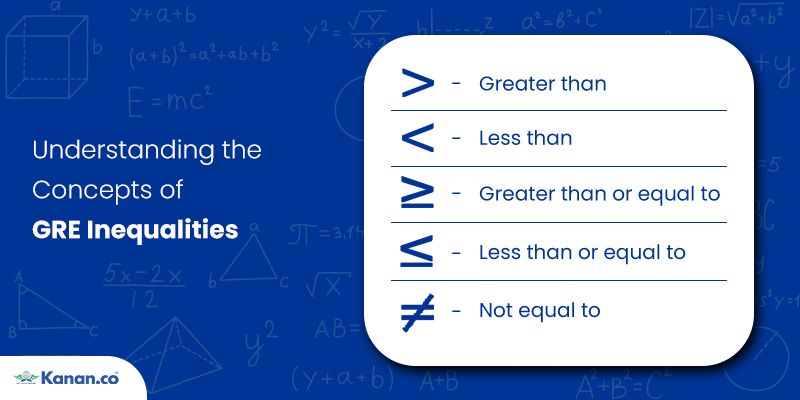
GRE Equations and inequalities are key components of GRE algebra, used to compare and solve mathematical expressions. An equation shows that two expressions are equal, typically using the "=" symbol. In contrast, an inequality compares expressions to determine whether one is greater, smaller, or equal to the other under certain conditions, represented by symbols like >, <, ≥, and ≤.
Inequalities are represented as follows:
| > - Greater than < - Less than ≥ - Greater than or equal to ≤ - Less than or equal to ≠ - Not equal to |
While equations aim to find exact values that satisfy equality, inequalities focus on a range of possible values that meet the comparison criteria. You can expect 2-3 questions on Inequalities in the quantitative reasoning section of GRE. This article will cover fundamental concepts of GRE Inequalities followed by rules, basic properties, strategies, and practice questions to help you master these concepts for the GRE. Let's get started!
What are Inequalities and Types Included
GRE inequalities test your ability to compare expressions and analyze the range of possible solutions. A key aspect of solving inequalities is understanding how to represent them visually using number lines or graphing techniques. These representations help interpret solutions more effectively, whether it's shading regions on a number line or plotting boundaries on a graph.
Let’s explore the key types of inequalities with examples and their graphical representations on a number line to strengthen your problem-solving skills for the GRE Quantitative Reasoning section.
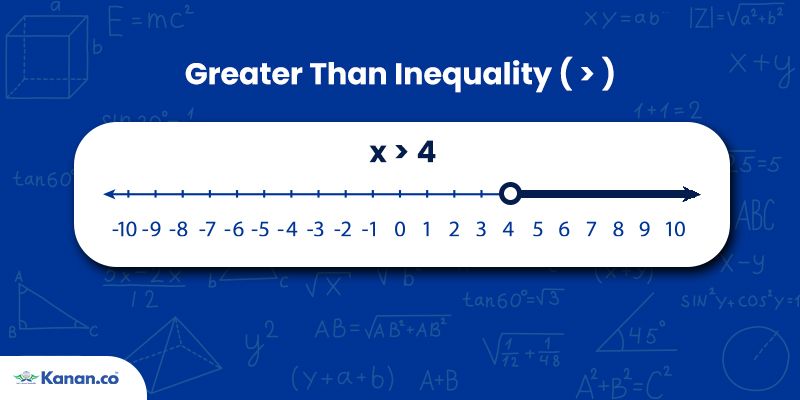
1. Greater Than Inequality ( > )
Greater-than inequalities indicate that one value is strictly larger than another.
Example: Solve x > 4.
x can take any real value greater than 4.
2. Less Than Inequality ( < )
Less-than inequalities signify that one value is strictly smaller than another.
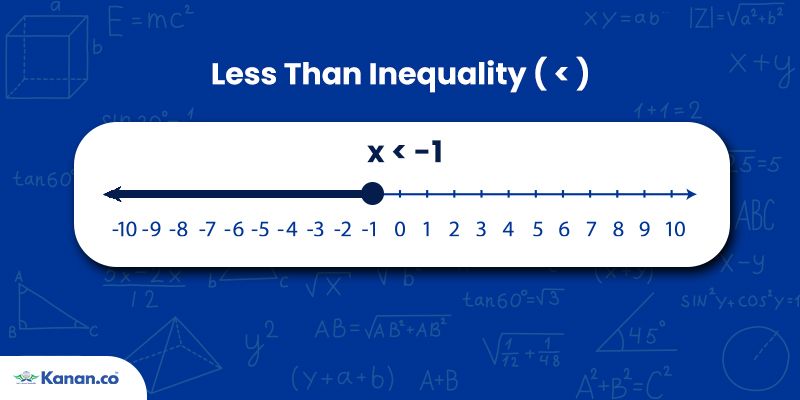
Example: Solve x < -1.
x can take any real value less than -1.
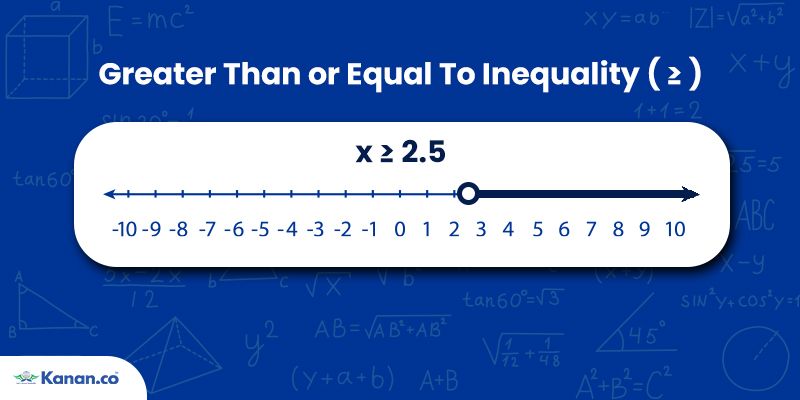
3. Greater Than or Equal To Inequality ( ≥ )
These inequalities include values that are greater than or equal to the given number.
Example: Solve x ≥ 2.5.
x can take any real value greater than or equal to 2.5.
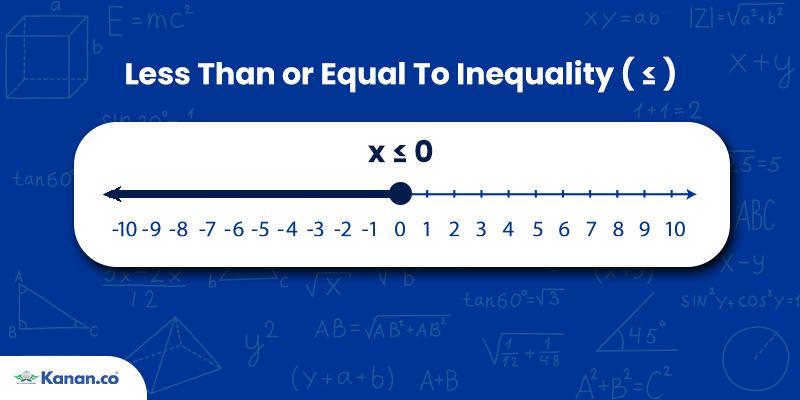
4. Less Than or Equal To Inequality ( ≤ )
This inequality includes values smaller than or equal to the given number.
Example: Solve x ≤ 0.
x can take any real value less than or equal to 0.
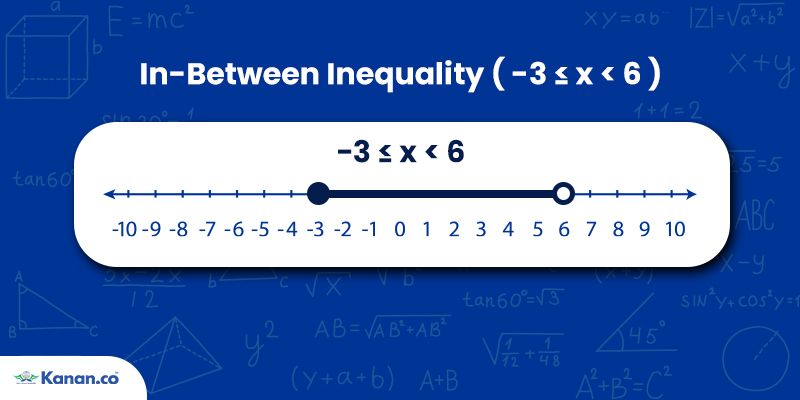
5. In-Between Inequality ( -3 ≤ x < 6 )
These inequalities define a range of values between two boundaries, including one endpoint and excluding the other.
Example: Solve −3 ≤ x < 6.
x can take any value greater than or equal to -3 and less than 6.
Basic Properties of GRE Inequalities
There are six basic properties of inequalities, which we can easily demonstrate using the example below.
Property 1: Adding or Subtracting the Same Number
Adding or subtracting the same number to both sides of an inequality does not change its sign.
Example 1: 9 > 5
Add 3 to both sides:
9 + 3 > 5 + 3 → 12 > 8 (The inequality sign holds true)
Example 2: 6 < 10
Subtract 2 from both sides:
6 - 2 < 10 - 2 → 4 < 8 (The inequality sign holds true)
Property 2: Multiplying or Dividing by a Positive Number
Multiplying or dividing both sides of an inequality by a positive number does not change its sign.
Example 1: 4 < 8
Multiply both sides by 3:
4 × 3 < 8 × 3 → 12 < 24 (The inequality sign holds true)
Example 2: 15 > 5
Divide both sides by 5:
15 ÷ 5 > 5 ÷ 5 → 3 > 1 (The inequality sign holds true)
Property 3: Multiplying or Dividing by a Negative Number
Multiplying or dividing both sides of an inequality by a negative number reverses its sign.
Example 1: 10 > 2
Multiply both sides by −2:
10 × −2 < 2 × −2 → -20 < -4 (the inequality sign reverses)
Example 2: -3 < 1
Divide both sides by −1:
−3 ÷ −1 > 1 ÷ −1 → 3 > -1 (the inequality sign reverses)
Property 4: Adding Two Inequalities
If two inequalities have the same sign, they can be added together.
Example 1: 5 > 2 and 7 > 3
Add the inequalities:
5 + 7 > 2 + 3 → 12 > 5
Example 2: For x > y and z < w, first multiply z < w by −1 to reverse its sign:
-z > -w. Then add:
x - z > y - w.
Property 5: Taking the Square Root
Taking the square root of both sides of an inequality does not change its sign, provided the values are non-negative.
Example: x2 > Y2, where x > 0 and y > 0
Taking square roots:
x > y
Property 6: Square of a Number is Always Non-Negative
The square of any real number is always greater than or equal to zero.
Example: x2 ≥ 0
This holds true for all real numbers. x2 = 0 only when x = 0
Advanced Concepts of GRE Inequalities
So far, we have explored how basic operations apply to inequalities. Now, let's dive into the more advanced properties of inequalities.
A) Inequalities in Fractions
Proper fractions fall within specific ranges on the number line, such as -1 < x < 1. For positive proper fractions (0 < x < 1), a unique property holds: √x > x > x².
Example:
If x = 0.25,
- √0.25 = 0.5,
- 0.252 = 0.0625.
Thus, 0.5 > 0.25 > 0.0625.
B) Squaring Inequalities
Squaring both sides of an inequality depends on the signs of the values:
- Flip the sign if both sides are negative.
- Keep the sign the same if both sides are positive.
- Avoid squaring when you’re unsure about signs i.e. if one side is positive and the other side is negative.
Example:
- If a < -3, squaring both sides of a < −3 flips the inequality because squaring negative numbers results in positive values. For a < −3, squaring gives a2 > 9, not a2 < 9
- If a > 3, squaring both sides keeps the inequality direction, resulting in a2 > 9.
C) Square Root Inequalities
Taking the square root of both sides is valid only for non-negative values. If both sides are positive, the inequality sign remains unchanged.
Example:
If x > 9, taking the square root: √x > 3.
D) Reciprocal of Inequalities
Reciprocating both sides flips the inequality sign if values are positive or negative. Do not reciprocate if signs are unknown.
Example:
If 2 < 3, taking reciprocals: 1/2 > 1/3.
If -3 < -2, taking reciprocals: 1/(-3) > 1/(-2).
E) Like Inequalities
Like inequalities can be added if the inequality signs are the same. If signs differ, adjust them first.
Example:
If 4a + 2b < 10 and 2a + 4b < 20, adding:
6a + 6b < 30.
F) Max-Min Concept of Inequalities
To determine the maximum or minimum value in inequalities, consider the extreme values within the given ranges. Analyze the endpoints of the ranges to identify the highest or lowest possible outcomes.
Example:
If -3 ≤ x ≤ 2 and 1 ≤ y ≤ 4,
- Maximum value of xy = 2 × 4 = 8.
- Minimum value of xy = -3 × 4 = -12.
G) Quadratic Inequalities
Solve quadratic inequalities by factoring and plotting critical points on a number line. Alternate signs across regions and identify the valid range based on the inequality.
Example:
Solve x2 - 5x + 6 ≤ 0:
- Factorize:(x - 2)(x - 3) ≤ 0.
- Critical points are x = 2, x = 3.
- Valid range is 2 ≤ x ≤ 3.
H) Higher-Degree Inequalities
For cubic or quartic inequalities, use critical points to divide the number line into regions. Alternate signs and identify valid regions as per the inequality.
Example:
Solve x3 − 4x2 + x ≤ 0:
- Factorize: x(x - 3)(x + 1) ≤ 0.
- Critical points are x = 0, x = 3, x = -1.
- Valid regions: -1 ≤ x ≤ 0 and x ≥ 3.
GRE Inequalities Practice Questions with Answers
Strengthen your skills in solving GRE inequality problems with these practice questions. Each question comes with a detailed solution, making it easier to understand and apply key concepts effectively.
Example Question 1: System of Equations
Solve for x:
3x + 4y = 12
2x - y = 4
Possible Answers:
x = 2
x = -1
x=4/3
x = 0
x = 28/11
Correct Answer:
x = 28/11
Explanation:
From the second equation, solve for y in terms of x:
y = 2x - 4
Substitute this value of y into the first equation:
3x + 4(2x - 4) = 12
Simplify:
3x + 8x - 16 = 12
11x - 16 = 12
11x = 28
x = 28/11
Therefore, the correct answer is x = 28/11.
Example Question 2: Inequalities
Solve the inequality
−6x + 3 ≥ −15
Solution:
−6x + 3≥ −15
−6x ≥ −18
Multiply both sides by −1, which flips the inequality symbol:
6x ≤ 18
Divide both sides by 6:
x ≤ 3
Final Answer:
The solution set of −6x + 3 ≥ −15 consists of all the real numbers less than or equal to 3.
Example Question 3: Inequalities
Each of the following possible answers is equivalent to the given expression, except?
(ab) / c × [4(a + b)]
Possible Answers:
- (4a2 b + 4ab2 )/c
- 4ab(a + b) / c
- 4ab(b+a) / c
- 4a2 +b2 / c
Correct Answer:
4a2+b2 / c
Explanation:
- Option 1 is equivalent because multiplying the fractions ab/c and 4(a + b)/1 involves multiplying numerators and denominators, resulting in 4ab(a + b) / c. Expanding this using the distributive property gives (4a2b + 4ab2)/c.
- Option 2 is equivalent as it represents the expression (ab) / c ⋅ [4(a + b)] directly in a simplified fractional form.
- Option 3 is equivalent due to the commutative property of addition, where a + b = b + a.
- Option 4 is not equivalent because it simplifies incorrectly and ignores the ab term while incorrectly expanding the parentheses as a2 + b2, which is not part of the given expression.
Example Question 4: How to find solution to an inequality with division
Solve the inequality
[(4z−5) / 3] ≤ 9
Solution:
[(4z−5) / 3] ≤ 9
4z − 5 ≤ 27
Add 5 to both sides:
4z ≤ 32
Divide both sides by 4:
z ≤ 8
Final Answer:
The solution set of [(4z−5) / 3] ≤ 9 consists of all the real numbers less than or equal to 8.
Example Question 5: Inequalities
Solve the following inequalities and compare the quantities:
∣5x − 7∣ ≤ 23
∣4y + 9∣ ≤ 25
Quantity A: The smallest possible value for x
Quantity B: The smallest possible value for y
Possible Answers:
- Quantity B is larger.
- Quantity A is larger.
- A comparison cannot be determined from the given information.
- The two quantities are equal.
Correct Answer:
Quantity A is larger.
Explanation:
For the first inequality:
|5x - 7| ≤ 23
Rewrite it as:
−23 ≤ 5x − 7 ≤ 23
Add 7 to all parts:
−16 ≤ 5x ≤ 30
Divide by 5:
−3.2 ≤ x ≤ 6
The smallest value of x is −3.2.
For the second inequality:
|4y + 9| ≤ 25
Rewrite it as:
−25 ≤ 4y + 9 ≤ 25
Subtract 9 from all parts:
−34 ≤ 4y ≤ 16
Divide by 4:
−8.5 ≤ y ≤ 4
The smallest value of y is −8.5.
Comparison:
The smallest value of y (−8.5) is smaller than the smallest value of x (−3.2).
Therefore, Quantity A is larger.
Example Question 6: Simplifying Inequalities
A company produces custom water bottles, and the cost, in cents, of manufacturing x water bottles is 1800 + 25x. Here, 1800 represents the fixed cost of operating the factory, while 25 cents is the cost of producing each bottle. Each water bottle is sold for 60 cents. How many bottles must the company sell to ensure that revenue is at least equal to the manufacturing cost?
Possible Answers:
- 30
- 36
- 40
- 45
- 52
Solution:
The revenue from selling x water bottles at 60 cents each is 60x. To determine the smallest x where revenue equals or exceeds manufacturing cost, solve:
60x ≥ 1800 + 25x
Simplify:
60x − 25x ≥ 1800
35x ≥ 1800
x ≥ 1800 / 35 ≈ 51.43
Since x must be an integer, round up to the next whole number:
x = 52
The company must sell 52 water bottles to break even or make a profit.
Example Question 7: Inequalities
Find the slope of the inequality equation 2y - 4 > 3x + y - 6.
Possible Answers:
- 2
- 1
- −1
- 0
- 3
Explanation:
Start with the inequality:
2y - 4 > 3x + y - 6
Simplify the terms:
2y - y > 3x - 6 + 4
y > 3x - 2
The equation y > 3x - 2 is in slope-intercept form y = mx + b, where m is the slope. From this, the slope m = 3.
Example Question 8: GRE Quantitative Reasoning
∣2x − 8∣ ≤ 20
Quantity A: x
Quantity B: 10
Which of the following answers is true?
Possible Answers:
- The two quantities are equal.
- Quantity A is larger.
- A comparison cannot be determined from the given information.
- Quantity B is larger.
Correct Answer:
A comparison cannot be determined from the given information.
Explanation:
For the inequality ∣2x − 8∣ ≤ 20, we interpret it as:
−20 ≤ 2x − 8 ≤ 20
Adding 8 to all sides:
−12 ≤ 2x ≤ 28
Dividing through by 2:
−6 ≤ x ≤ 14
Thus, x can range from −6 to 14. Since x can be both smaller or larger than 10, the relationship between the two quantities cannot be determined.
Example Question 9: How to find solution to an inequality with division
(√5/−x) < 3
Which of the following answers could be the value of x?
Possible Answers:
- −1
- −0.5
- −2
- −4
- All of the answer choices are valid.
Correct Answer:
−2
Explanation:
The inequality simplifies to:
√5 < −3x
Dividing by −3 (and reversing the inequality sign):
x > −√5/3
The approximate value of √5 is 2.24, so:
x > −2.24/3 ≈ −0.75
Thus, x must be greater than −0.75. Among the options, only −0.5 satisfies this condition.
Example Question 10: How to find solution to an inequality with division
Fill in the blank with either <, >, or = symbols:
(y−5) - [(y2 − 25) / (y + 5)] for y ≥ −5.
Possible Answers:
- (y−5) = [(y2 − 25) / (y + 5)]
- (y−5) > [(y2 − 25) / (y + 5)]
- (y−5) < [(y2 − 25) / (y + 5)]
- None of the answers are correct.
- The rational expression is undefined.
Explanation:
Let’s simplify the given expression:
We know that y2 − 25 can be factored as:
y2 − 25 = (y − 5) (y + 5)
Thus, the second expression becomes:
(y2 − 25) / (y + 5) = [(y − 5) (y + 5)] / (y + 5) (for y ≠ −5).
Therefore, for y ≥ −5 and y ≠ −5, the two expressions are equal:
(y−5) = [(y2 − 25) / (y + 5)].
Summary of GRE Inequalities
Here are the key points to remember when working with inequalities on the GRE. Once you know these, you'll be able to solve even the most complex quantitative comparison questions with ease.
- You can add or subtract any value to both sides of an inequality without changing its validity.
- Multiplying or dividing by a positive value keeps the inequality's direction intact.
- Only square both sides when both quantities are surely positive.
- Avoid multiplying or dividing quantities with a negative number, as this reverses the inequality.
- Never use a variable for multiplication or division if its sign is unknown.
- When a variable is always positive (e.g., x2), it is safe to use it for operations.
With these points in mind, you can confidently solve GRE linear inequality questions, and aim for a top score in the Quantitative section. If you're looking for expert guidance on GRE inequalities, Kanan International, with 25 years of experience, is here to support your GRE preparation journey.

About Author Sravani Kota
Sravani is an enthusiastic author who is deeply passionate about continuous learning, writing, and reading. Her academic background includes a Bachelor's and Master's degree in engineering from JNTU, gaining expertise in technical English writing, paper publications, test preps like IELTS, GRE, SAT, TOEFL, etc., and study abroad services like SOP, LOR, etc. Her expertise in the education sector makes her an excellent resource for students seeking guidance and advice. In her leisure time, she enjoys spending quality time with family, watching popular TV shows like Stranger Things and Money Heist, and she also loves to travel, explore new places, and create videos of her experiences.
Kanan.co is a trusted study abroad consultancy offering comprehensive services, resources, and solutions for students and education institutions. We support students at every stage of their global education journey, ensuring a smooth and guided experience. Along with test preparation for IELTS, GRE, TOEFL, and SAT, we provide expert services such as SOP writing, visa guidance, accommodation support, scholarship assistance, and education loan support. Our expertise and commitment to excellence make us a reliable partner for students pursuing international education.
Sign Up for a Free GRE Demo Class!
Ace GRE Quant & Verbal with 320+ Score — Join Us!








Global Headquarters
Kanan Int EdTech Inc
320 Bay Street, Suite 321 (Spaces), Toronto ON, Canada M5B 1N9
Indian Headquarters
Kanan International Pvt. Ltd.
D-wing, 2nd Floor, Trident Complex, Ellora Park Vadiwadi Road, Vadodara, Gujarat 390007
IT/ Digital Campus
Kanan International Pvt. Ltd
Old, New No 3, 2nd Floor, 1A, Dr Sadasivam Rd, T. Nagar, Chennai, Tamil Nadu 600017
Our branches
- Bardoli
- Bharuch
- Chennai
- Dehradun
- Gurugram
- Himatnagar
- Karnal
- Nadiad
- Navsari
- Palanpur
- Rajkot
- Vadodara
- Valsad
- Vallabh Vidyanagar
- Vapi
Study Abroad
Test Prep
Top Universities
Consultants
IELTS Centers
GRE Centers
TOEFL Centers
SAT Centers
Language Courses in Vadodara
Study Abroad Calculators
Featured Blogs
Study Abroad Consultants in Chennai
Study Abroad Consultants in Surat
Study Abroad Consultants in Navsari
Study Abroad Consultants in Bardoli
Study Abroad Consultants in Ahmedabad
Study Abroad Consultants in Anand
Study Abroad Consultants in Khanna
Study Abroad Consultants in Nadiad
Study Abroad Consultants in Vadodara
Study abroad consultants in Valsad
Copyright © 2026 KANAN.CO All rights reserved.