- Study Abroad
- / gre
- / lines and angles
GRE Lines and Angles: Basics and Practice Questions


Author
10-12-2024

GRE lines and angles are a part of geometry, used to calculate slopes, measure angles, and solve problems involving shapes in the GRE quantitative section. A line is a one-dimensional figure that extends endlessly in both directions without any width, while an angle is formed when two straight lines meet at a point, creating a measurable space between them.
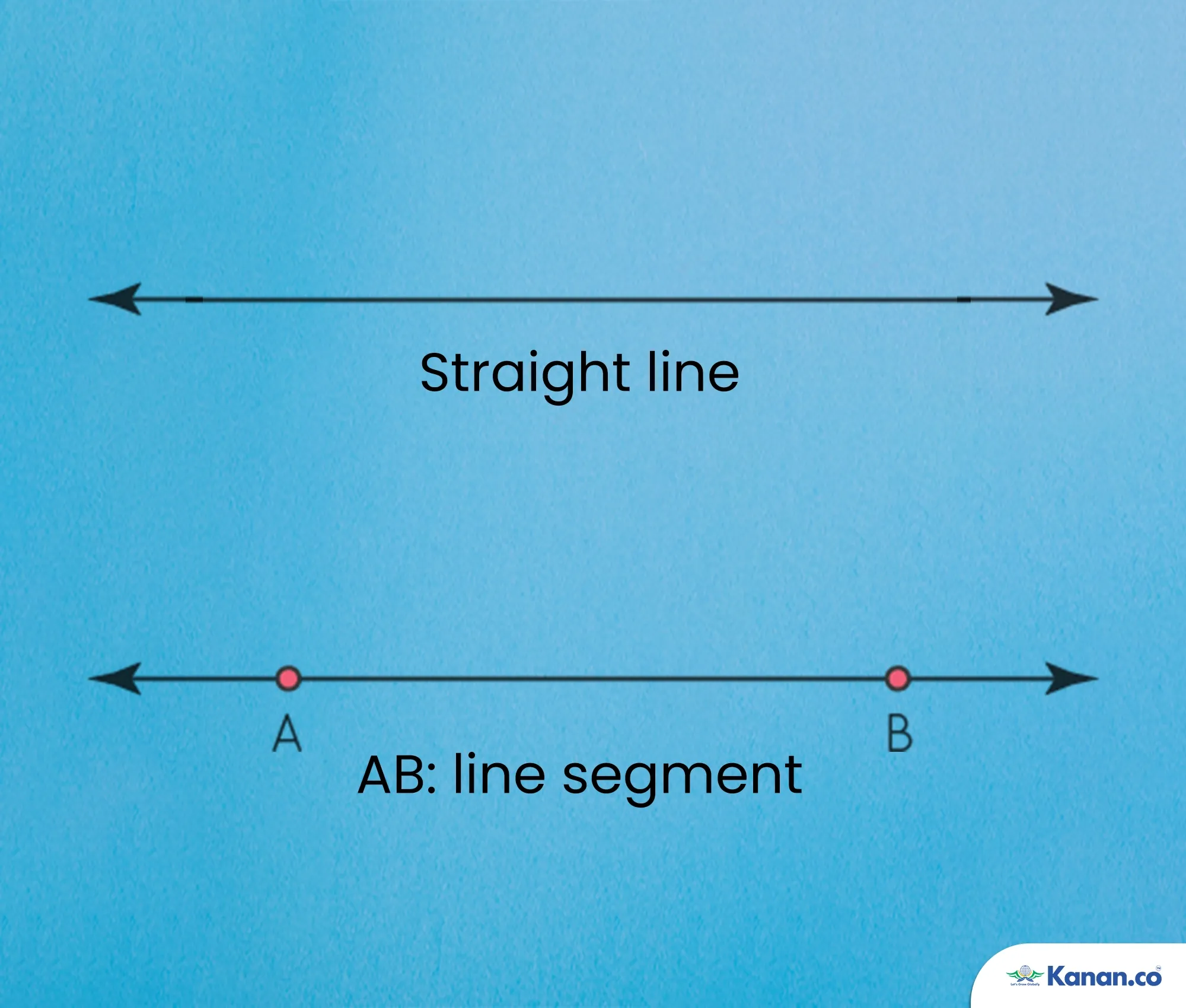
Lines and line segments, though related, differ in structure. A line has no endpoints and extends infinitely, either maintaining the same direction as a straight line or changing direction continuously as a curved line. On the other hand, a line segment is a finite portion of a line with two fixed endpoints. There can be an infinite number of line segments on a line. For instance, in the diagram, AB represents a line segment, and when two line segments of equal length exist, they are termed congruent line segments.
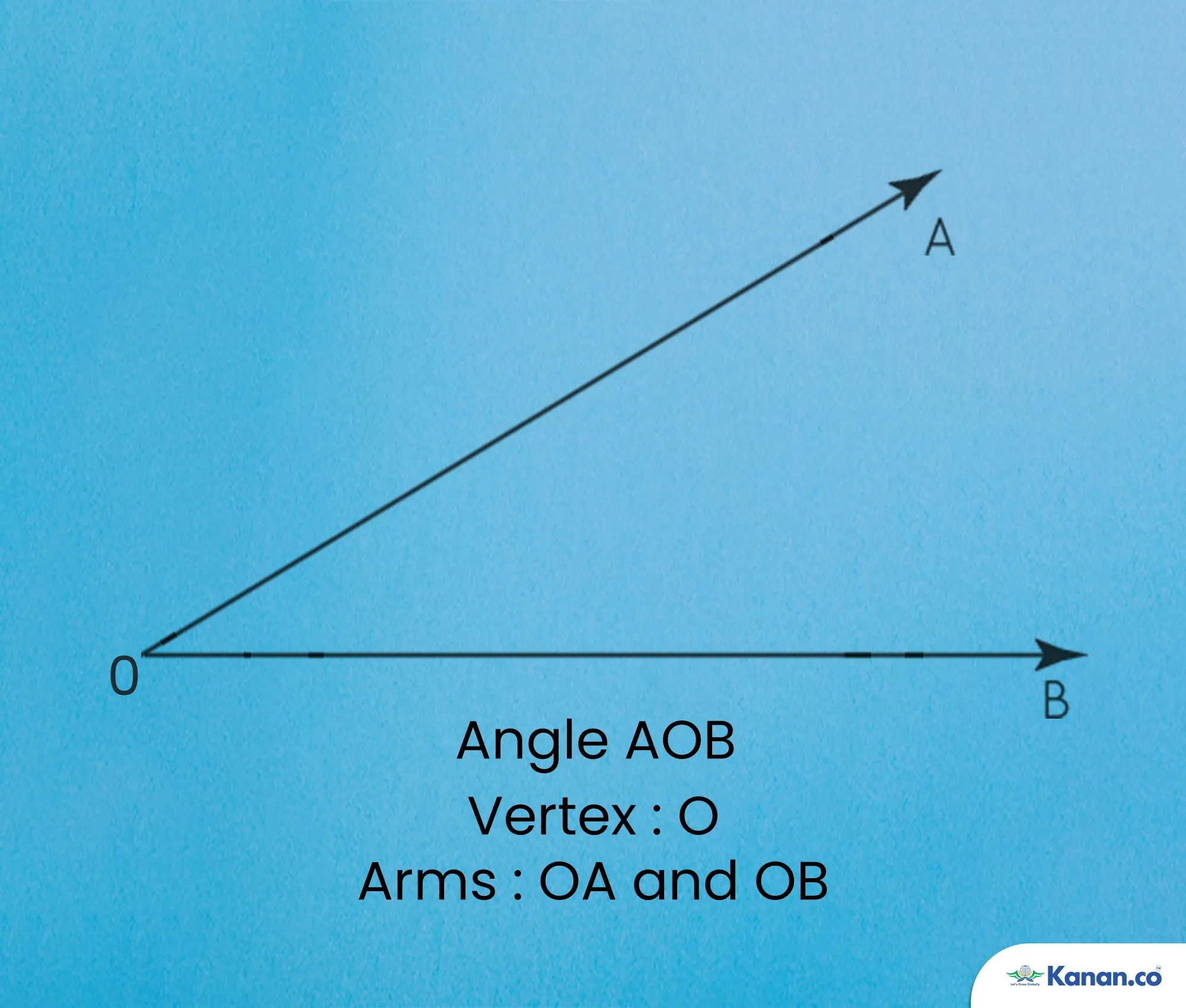
Angles add depth to geometry by showing the relationships between intersecting lines. When two straight lines intersect, they form an angle, measured in degrees or radians. The straight lines form the arms of the angle, and the point where they intersect is called the vertex.
Lines and angles are not only crucial in GRE geometry but also have practical applications in fields like physics, engineering, architecture, computer graphics, and design. You can expect 2-3 questions on lines and angles in the GRE's quantitative section. This article will explore the basics of GRE lines and angles, their types, and provide practice questions with answers to help you prepare effectively. Let's get started!
GRE Line Forms
Lines in geometry can be represented using different mathematical forms. Each form has its advantages depending on the information provided in the problem, which is especially useful for tackling GRE Quantitative Reasoning questions. Below, we explain the commonly used line forms, their significance, and provide examples for better understanding.
1. General Form of a Line
The general form of a line equation is written as:
ax + by + c = 0, where a, b, and c are arbitrary constants.
This form is universal and can represent any straight line, including vertical and horizontal lines. It is particularly useful when analyzing relationships between multiple lines (e.g., checking if two lines are parallel or perpendicular).
- The slope of the line is given by −a/b.
- The y-intercept is −c/b.
Example: Convert the line 3x + 4y - 12 = 0 into slope-intercept form.
Solution:
Rearrange to isolate y:
4y = −3x + 12
⇒y = −3/4x + 3
The slope is −3/4, and the y-intercept is 3.
2. Point-Intercept Form of a Line
The point-intercept form is one of the simplest and most common ways to represent a line:
y = mx + b
Here:
- m is the slope (rate of change of y with respect to x), and
- b is the y-intercept (the point where the line crosses the y-axis).
This form is particularly useful when the slope and y-intercept of a line are known.
Example: Write the equation of a line with slope m = 2 and y-intercept b = -5.
Solution: Substitute into the formula: y = 2x - 5
3. Using Two Points to Define a Line
A line can be uniquely determined using two points on a two-dimensional plane. By knowing the coordinates of two points, we can draw a line that passes through both. No other line can pass through the same two points, which makes this line unique.
The equation of a straight line that passes through two points P1 (x1 , y1 ) and P2 (x2 , y2 ) is given by the following formula:
(y − y1) / (x - x1) = (y1 − y2) / (x1 − x2)
Example: Find the equation of the line passing through the points C(6, 2) and D(10, 8).
Solution:
To find the equation, substitute the coordinates of points C and D into the formula
(y − y1) / (x - x1) = (y1 − y2) / (x1 − x2)
(y−2) / (x−6) = (2 − 8) / (6 − 10)
Simplifying the equation:
(y−2) / (x−6) = −6 / −4 = 3/2
2(y − 2) = 3(x − 6)
2y - 4 = 3x - 18
2y - 3x + 14 = 0
Alternatively, you can express the equation in slope-intercept form as:
y = 3/2x − 7
4. Using One Point and the Slope
If one point P(x1 , y1 ) on the line and the slope m are known, the equation is written as:
y - y1 = m(x - x1 )
This approach is helpful when we know the direction of the line (slope) and a specific point through which it passes.
Example: Find the equation of a line passing through A(1, 2) with slope m = -3.
Solution: y − 2 = −3(x − 1)
⇒ y = −3x + 5
5. Intercept Form of a Line
The intercept form is written as:
x/a + y/b = 1
Where:
- a is the x-intercept (where the line crosses the x-axis), and
- b is the y-intercept (where the line crosses the y-axis).
This form is particularly useful when both intercepts are known or need to be calculated.
Example: Find the equation of a line whose x-intercept is 6 and y-intercept is 3.
Solution: Substitute into the formula: x/6 + y/3 = 1
⇒ 3x + 6y = 18
⇒ x + 2y = 6
Types of GRE Lines
The types of GRE lines in geometry are used to solve complex problems in mathematics and real-world applications. These lines form the basis for analyzing shapes, structures, and spatial relationships. Below, we’ll explore the types in detail, along with explanations and examples for each.
1. Vertical Lines
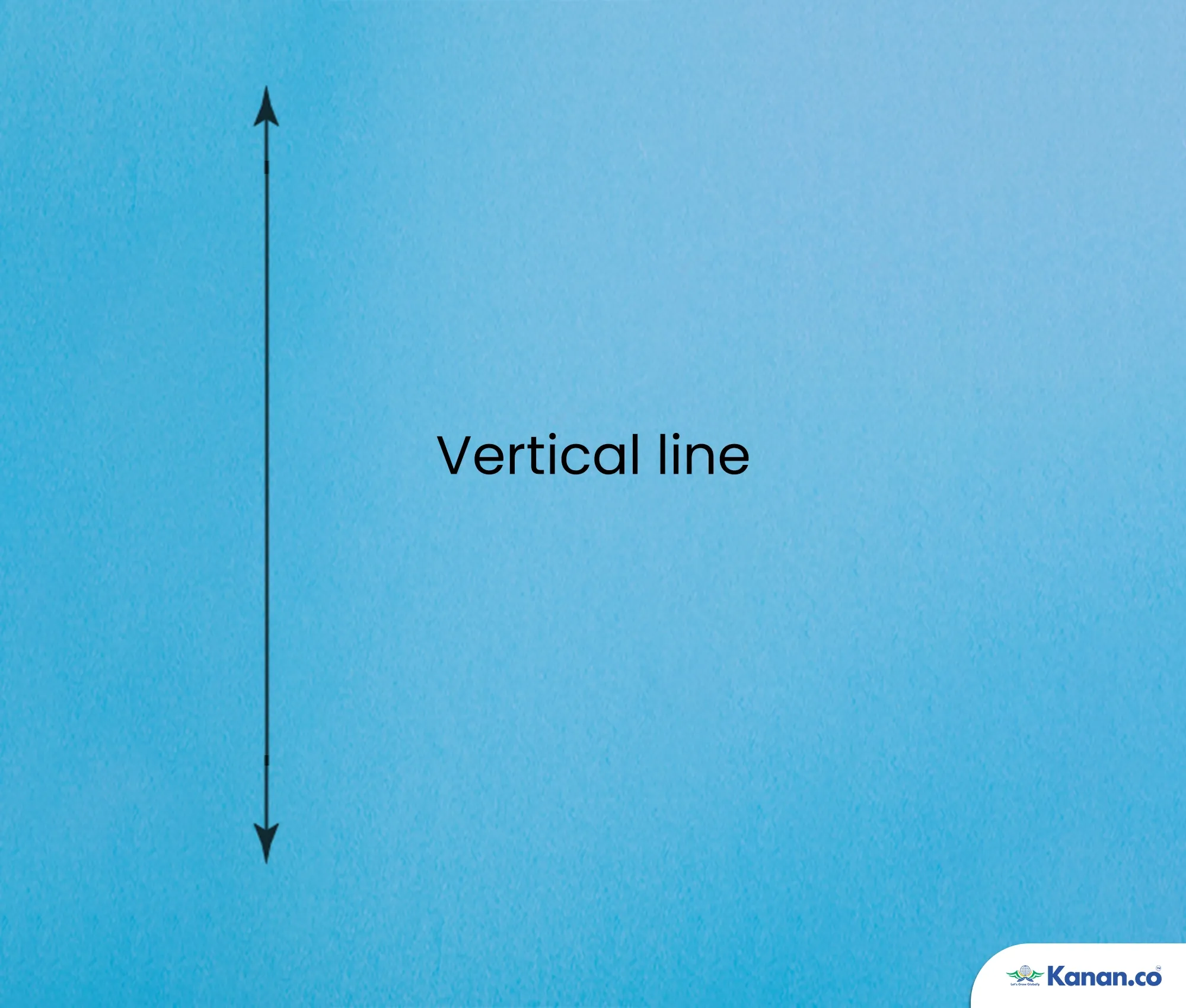
Vertical lines are straight lines that move up and down, parallel to the y-axis in a two-dimensional plane. They have an undefined slope because the change in the x-coordinates is zero, which makes it impossible to calculate a slope using the formula. These lines are represented by equations of the form x = a, Where:
- x: Represents the x-coordinate of any point on the line.
- a: Denotes the x-intercept, where the line crosses the x-axis.
A vertical line is characterized by its independence from y. This means y can take any value, but x remains fixed at a. Such lines run parallel to the y-axis.
Example:
The equation x = 4 represents a vertical line. This line passes through the x-axis at 4, and all its points share the same x-coordinate. Points such as (4, 1), (4, -3), and (4, 5) lie on the line.
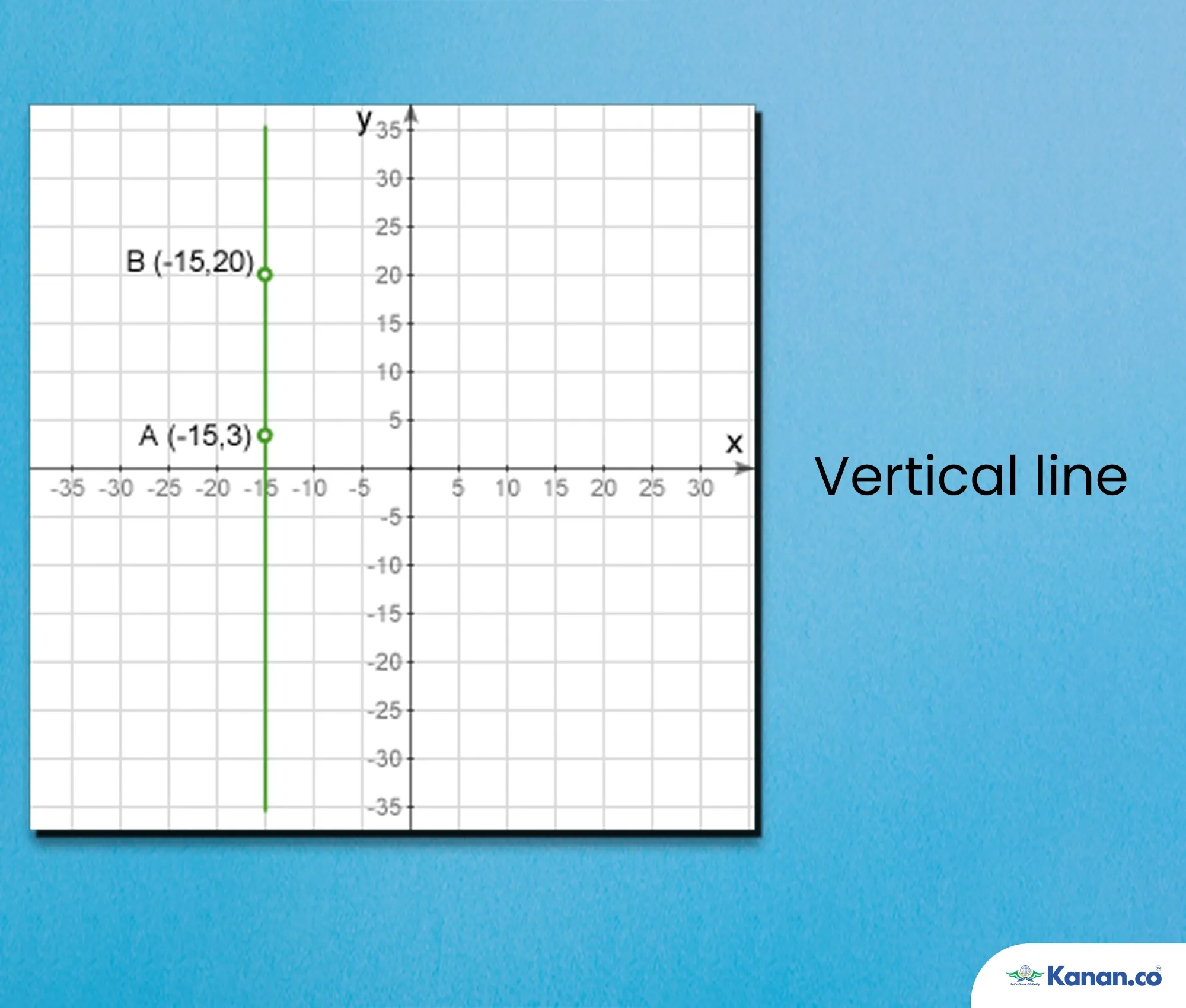
In this case, no matter the value of y, the x-coordinate is always 4. This constant x-value defines the line as vertical and parallel to the y-axis.
2. Horizontal Lines
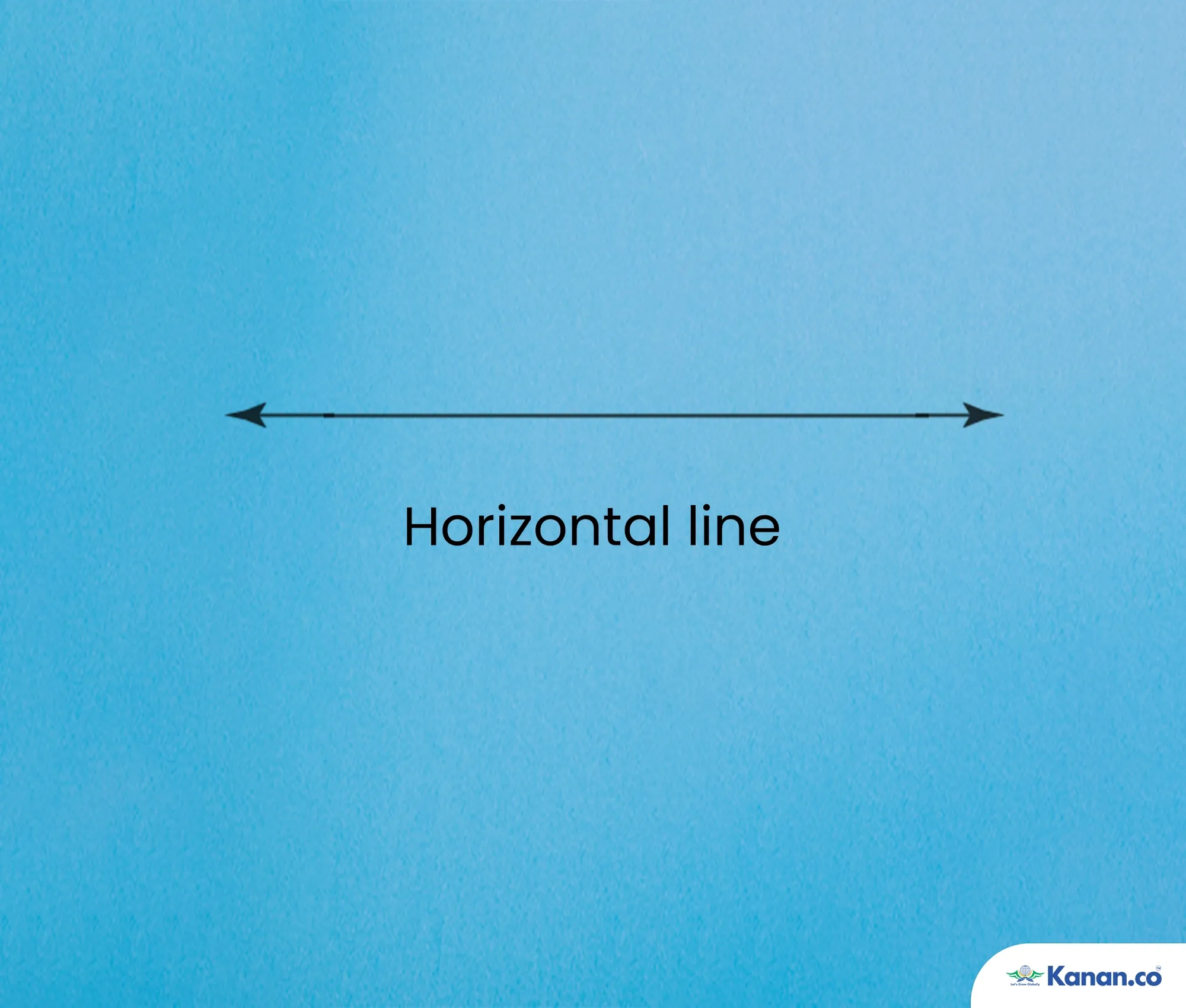
Horizontal lines are straight lines that run left to right, parallel to the x-axis. These lines have a slope of zero because the change in y-coordinates is zero, making the numerator in the slope formula zero. Their equation is of the form y = b, Where:
- y: Represents the y-coordinate of any point on the line.
- b: Denotes the y-intercept, where the line crosses the y-axis.
Horizontal lines are independent of x, meaning x can take any value, but y remains constant at b. These lines run parallel to the x-axis.
Example:
The equation y = -2 represents a horizontal line. This line crosses the y-axis at -2, and all its points share the same y-coordinate. Points such as (0, -2), (3, -2), and (-5, -2) lie on the line.
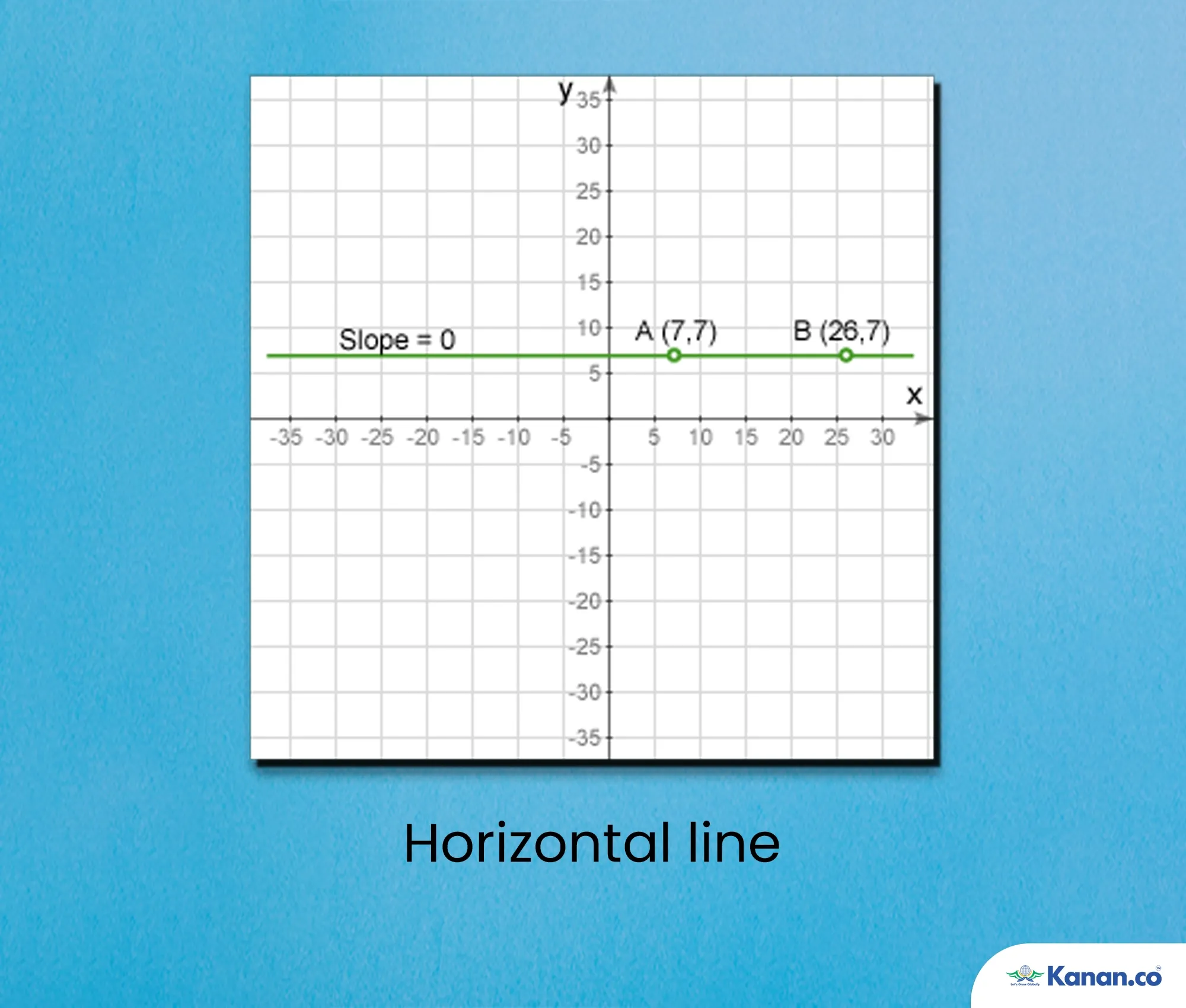
In this scenario, regardless of the x-value, the y-coordinate remains fixed at -2. This constant value of y defines the line as horizontal and parallel to the x-axis.
3. Parallel Lines
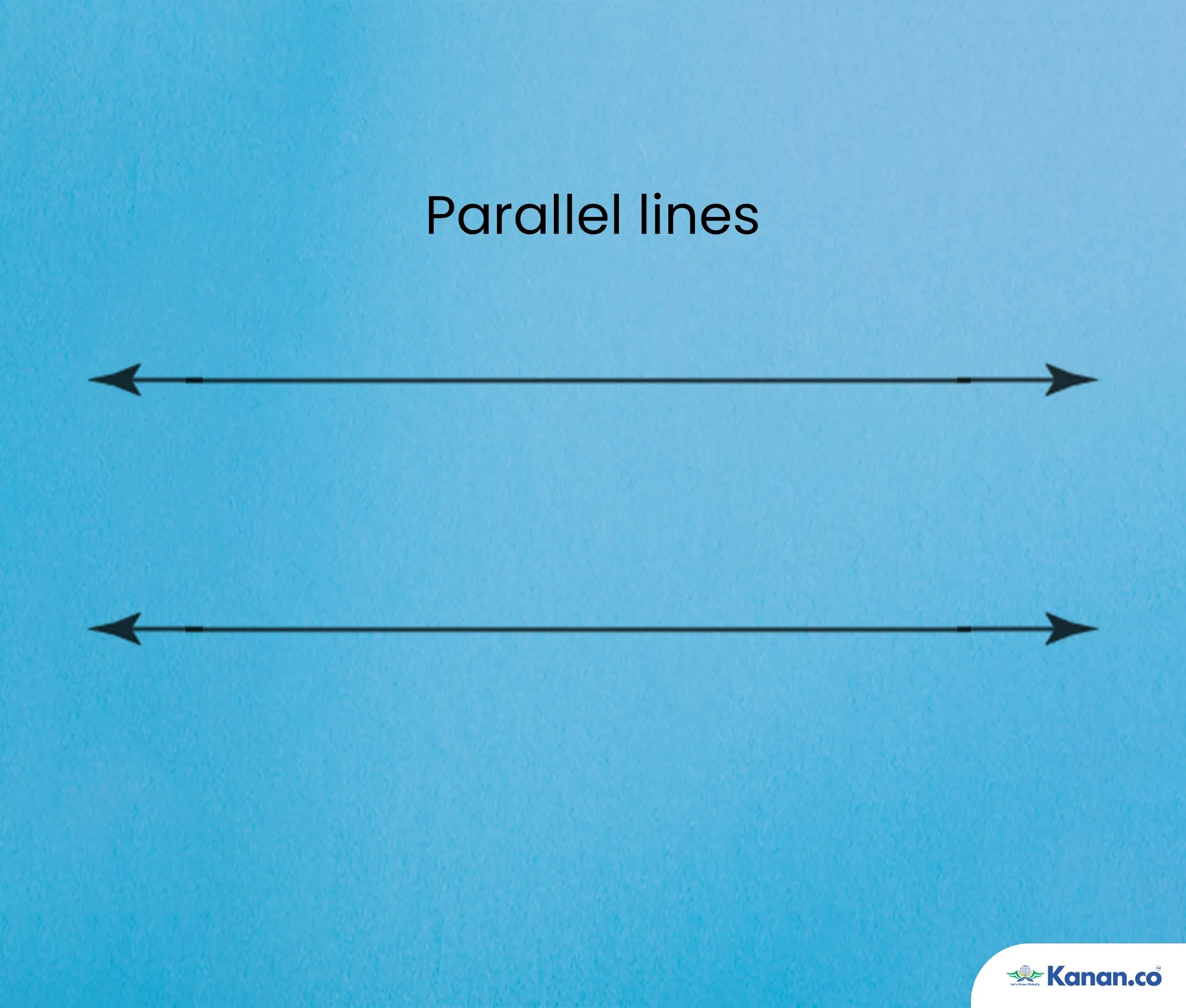
Parallel lines are lines in a plane that never meet, no matter how far they are extended. They have the same slope but different y-intercepts. Parallel lines remain equidistant from each other at all points. The equation of a parallel line to a given line is written as y = mx + c, where:
- m: Represents the slope of the line (same as the original line).
- c: Denotes the y-intercept, which differentiates the parallel line from the original line.
Parallel lines are often used in problems involving angles, distances, and geometric patterns.
Example:
If the equation of the original line is y = 2x + 3, then the equation y = 2x - 4 represents a line parallel to it.
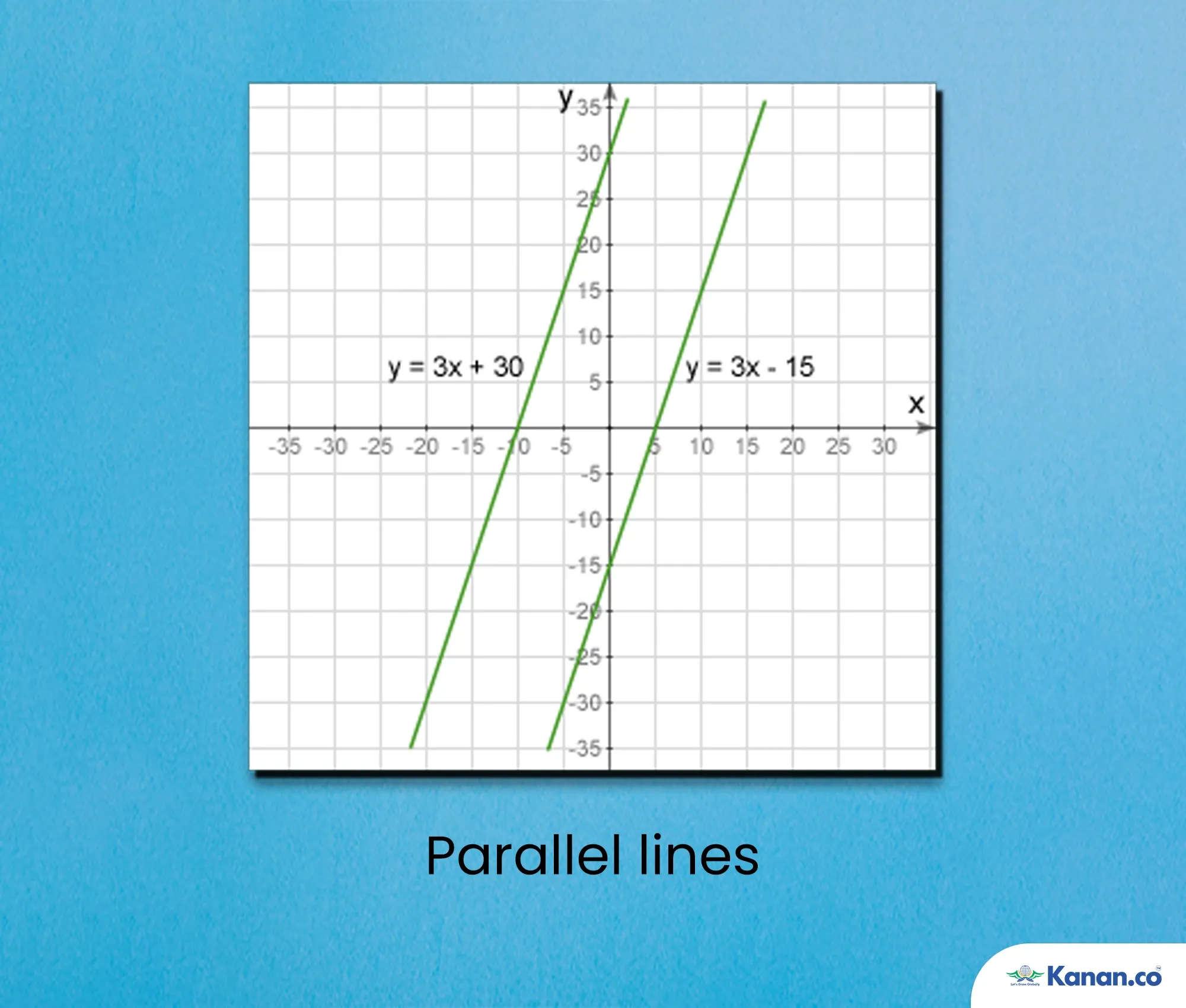
In this case, both lines have the same slope of 2, ensuring they never intersect. However, the y-intercepts are different (3 and −4), which keeps the lines distinct and parallel. For example, the points (0, -4) and (1, -2) lie on the parallel line y = 2x - 4.
4. Perpendicular Lines
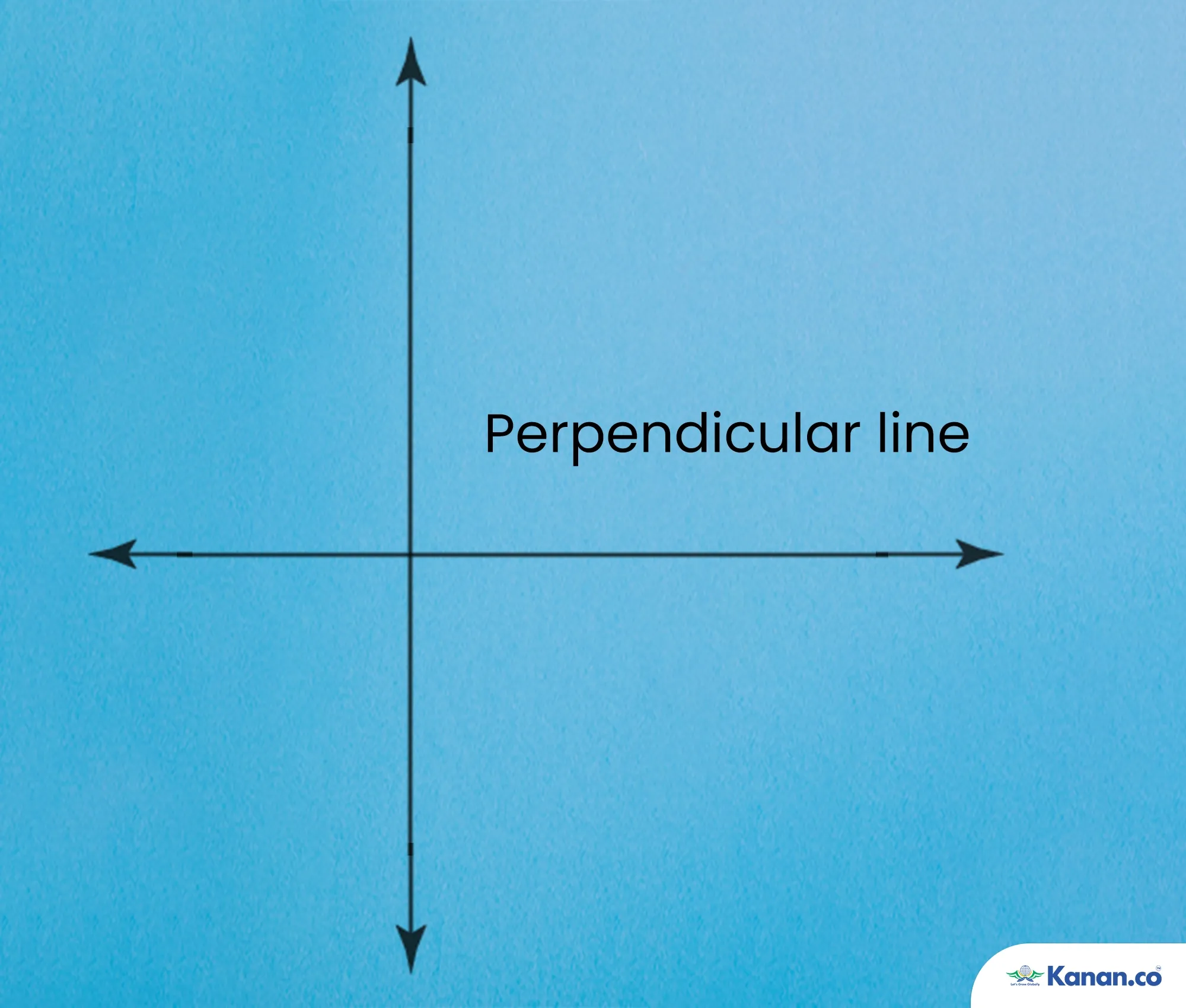
Perpendicular lines are lines that intersect at a right angle (90°). The slopes of perpendicular lines are negative reciprocals of each other. If one line has a slope mmm, the other line will have a slope of −1/m. The equation of a perpendicular line can be derived from the given line and its slope.
Example:
If the equation of a line is y = 2x + 3, then the equation y = (−1/2)x + 1 represents a line perpendicular to it.
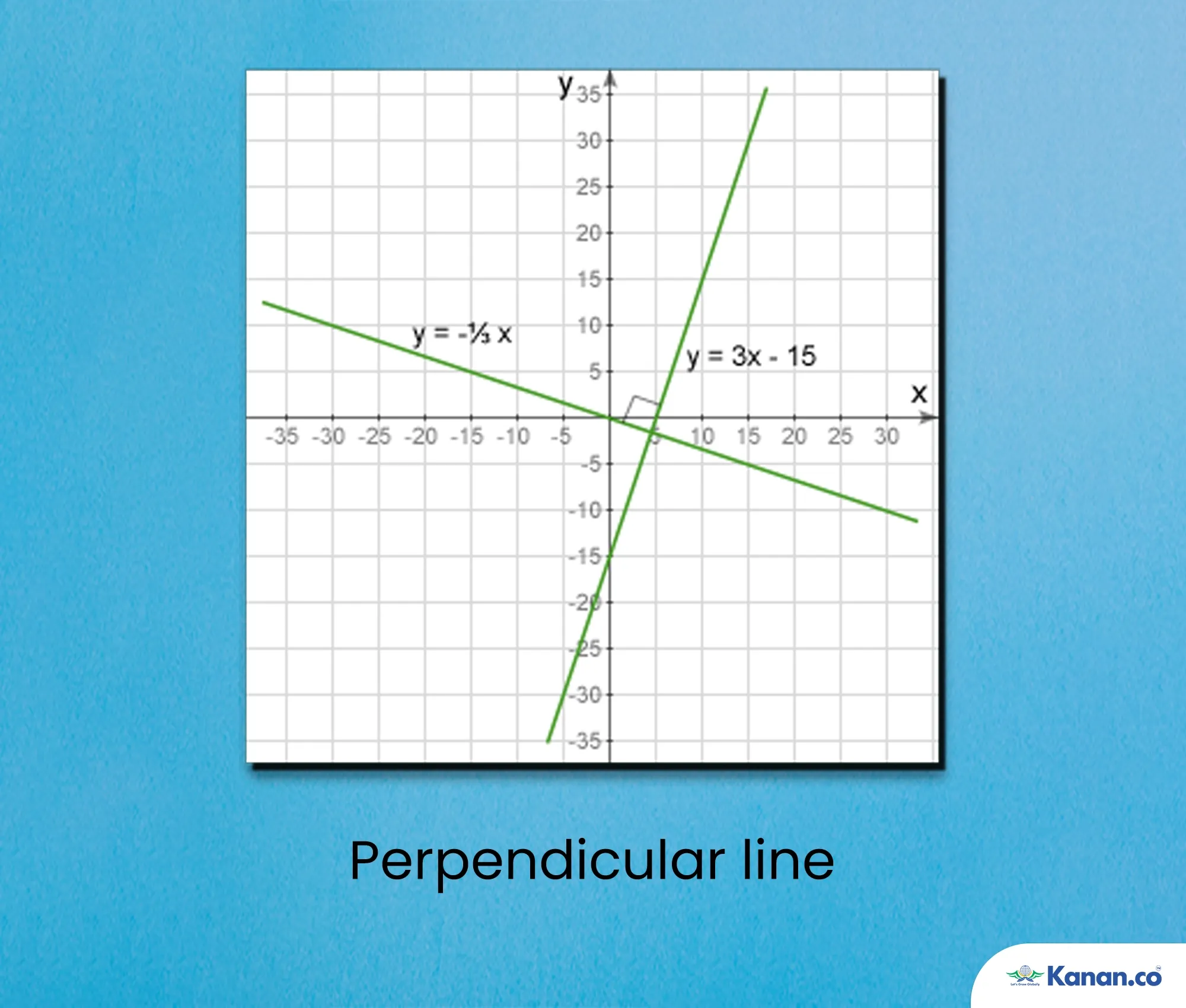
In this case, the slope of the first line is 2, and the slope of the perpendicular line is −1/2, satisfying the condition for perpendicularity. The lines intersect at a point and form a right angle.
5. Intersection of Two Straight Lines
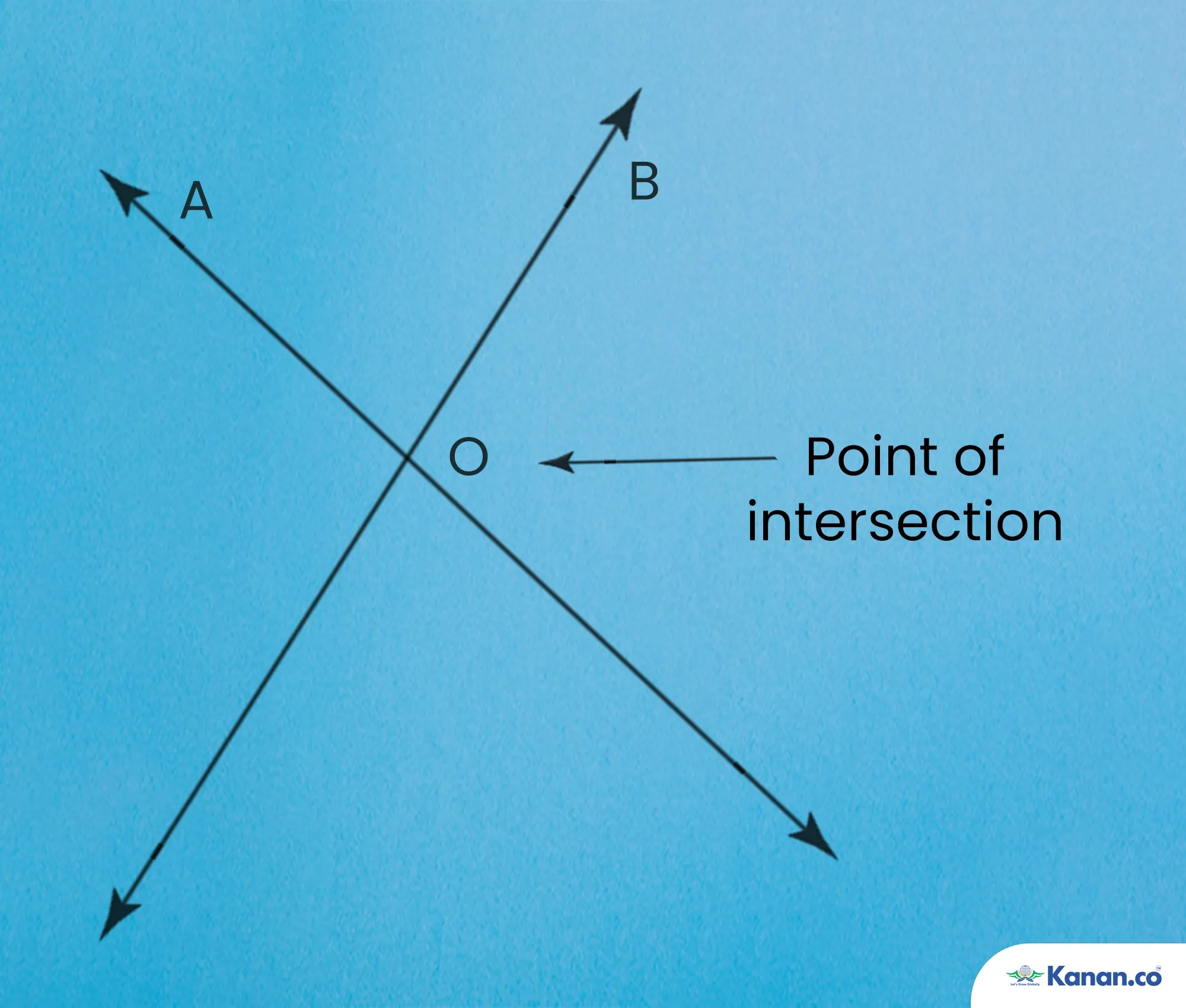
The intersection of two straight lines is the point where they meet. This point can be found by solving their equations simultaneously. If the lines are parallel, they do not intersect, and if they are coincident, they overlap completely.
Example:
Consider the equations of two lines:
- y = 2x + 1
- y = -x + 4
To find their intersection point, solve the equations simultaneously:
- 2x + 1 = -x + 4
- 3x = 3
- x = 1
Substitute x = 1 into either equation:
- y = 2(1) + 1 = 3.
The intersection point is (1, 3).
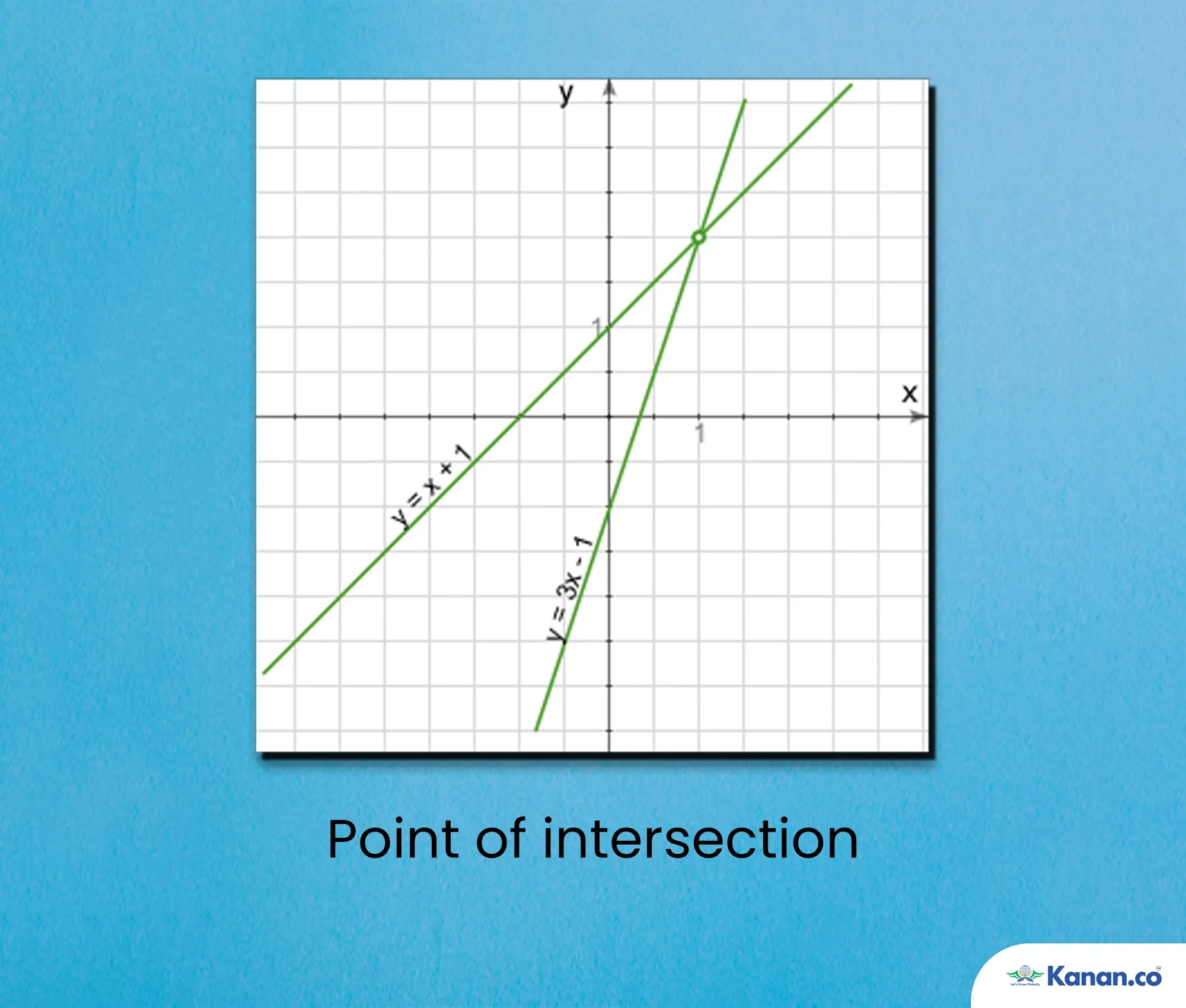
At this point, both equations are satisfied, and the lines meet.
6. Distance from a Point to a Line
The distance from a point to a line is the shortest distance between the point and the line, measured along a perpendicular segment. This distance can be calculated using the formula:
Distance = ∣Ax1 + By1 + C∣ / √(A2 +B2 )
Where:
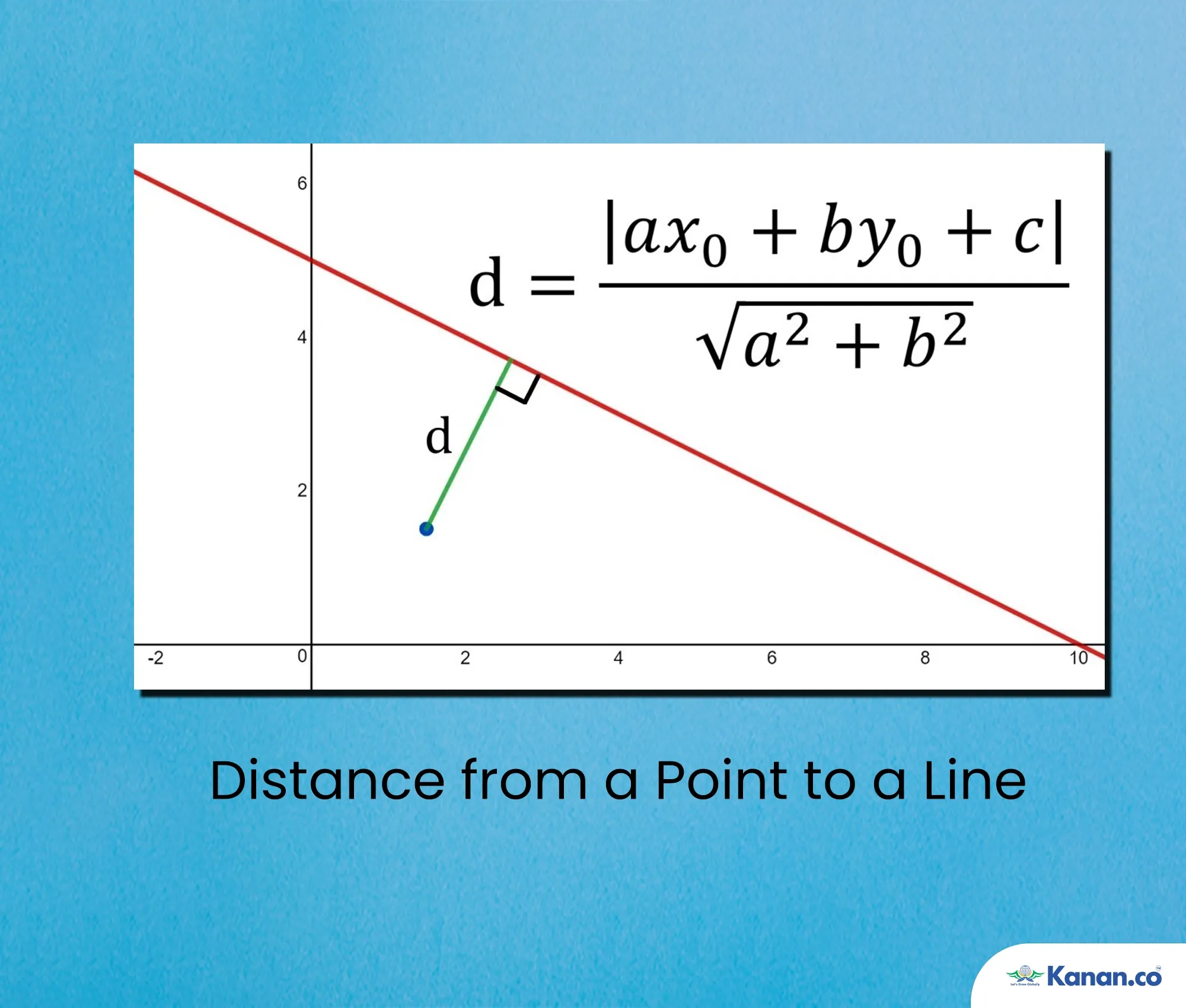
- (x1 , y1 ): Coordinates of the point.
- Ax + By + C = 0: Equation of the line.
- ∣⋅∣: Denotes absolute value.
Example:
Find the distance from the point (3, 4) to the line 2x - y + 5 = 0.
Substitute the values into the formula:
Distance = ∣2(3) − 4 + 5∣ / √(22 +(−1)2 )
= ∣6−4+5∣ / √(4+1)
= 7 / √5.
The shortest distance between the point and the line is 7 / √5, which can also be expressed in decimal form if required.
Types of GRE Angles
Angles are a fundamental part of geometry, helping us understand shapes, designs, and spatial relationships. Here’s a detailed explanation of the types of angles and examples with solutions.
1. Adjacent Angles
Adjacent angles share a common arm and vertex but do not overlap. These angles lie next to each other, forming a linear pair or part of a shape like a polygon.
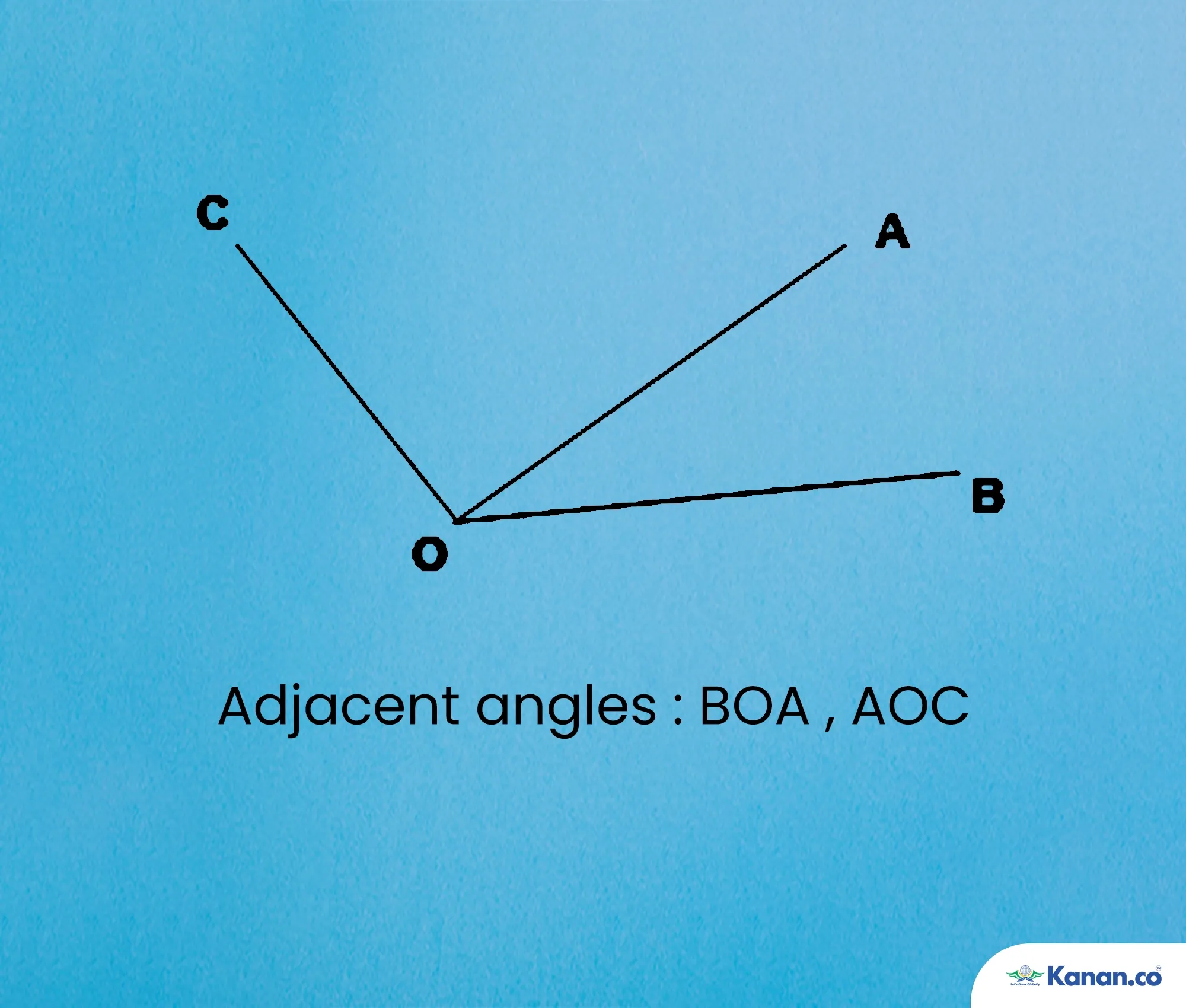
In the above image two angles sharing a common arm, such as ∠BOA and ∠AOC
Example:
In the figure, if ∠BOA = 40° and ∠AOC = 50°, find the total measure of both angles.
Solution:
The total measure of the two adjacent angles is given by:
Total measure = ∠BOA + ∠AOC = 40° + 50° = 90°
Thus, the total measure is 90°, which shows the two angles together form a right angle.
2. Right Angle
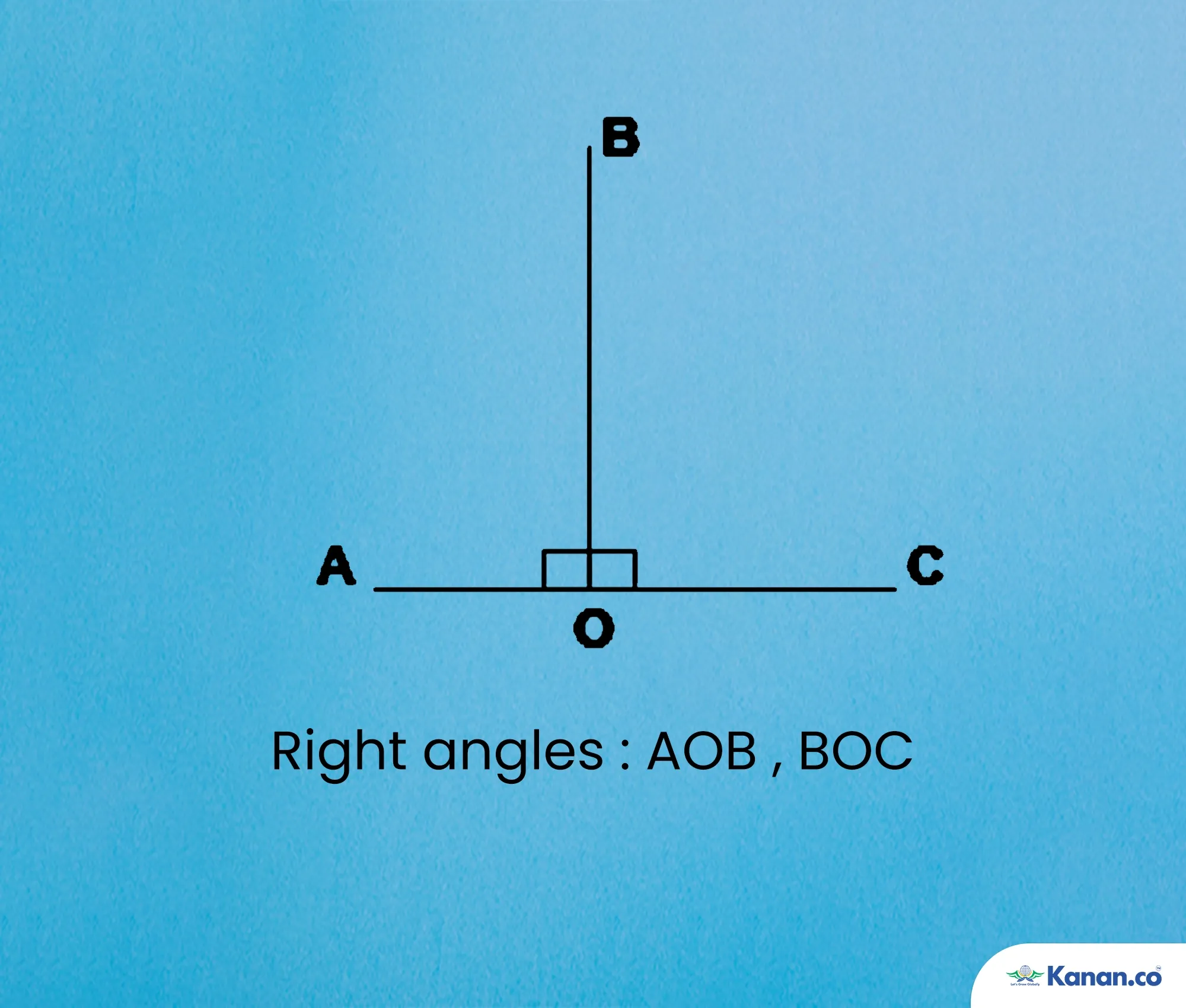
A right angle measures exactly 90°. It is represented with a small square in the corner to denote perpendicularity or equality of adjacent angles formed by intersecting lines.
Example:
A ladder leans against a wall forming a right angle at the base. The ladder is 13 ft long, and the distance from the base of the ladder to the wall is 5 ft. Find the height of the wall.
Solution:
Using the Pythagorean theorem: Ladder2 = Base2 + Height2
132 = 52 + Height2 ⟹ 169 = 25 + Height2 ⟹ Height2 = 144 ⟹ Height = 12 ft
3. Acute Angle
An acute angle measures less than 90°. It is sharper than a right angle and commonly found in triangles and polygons.
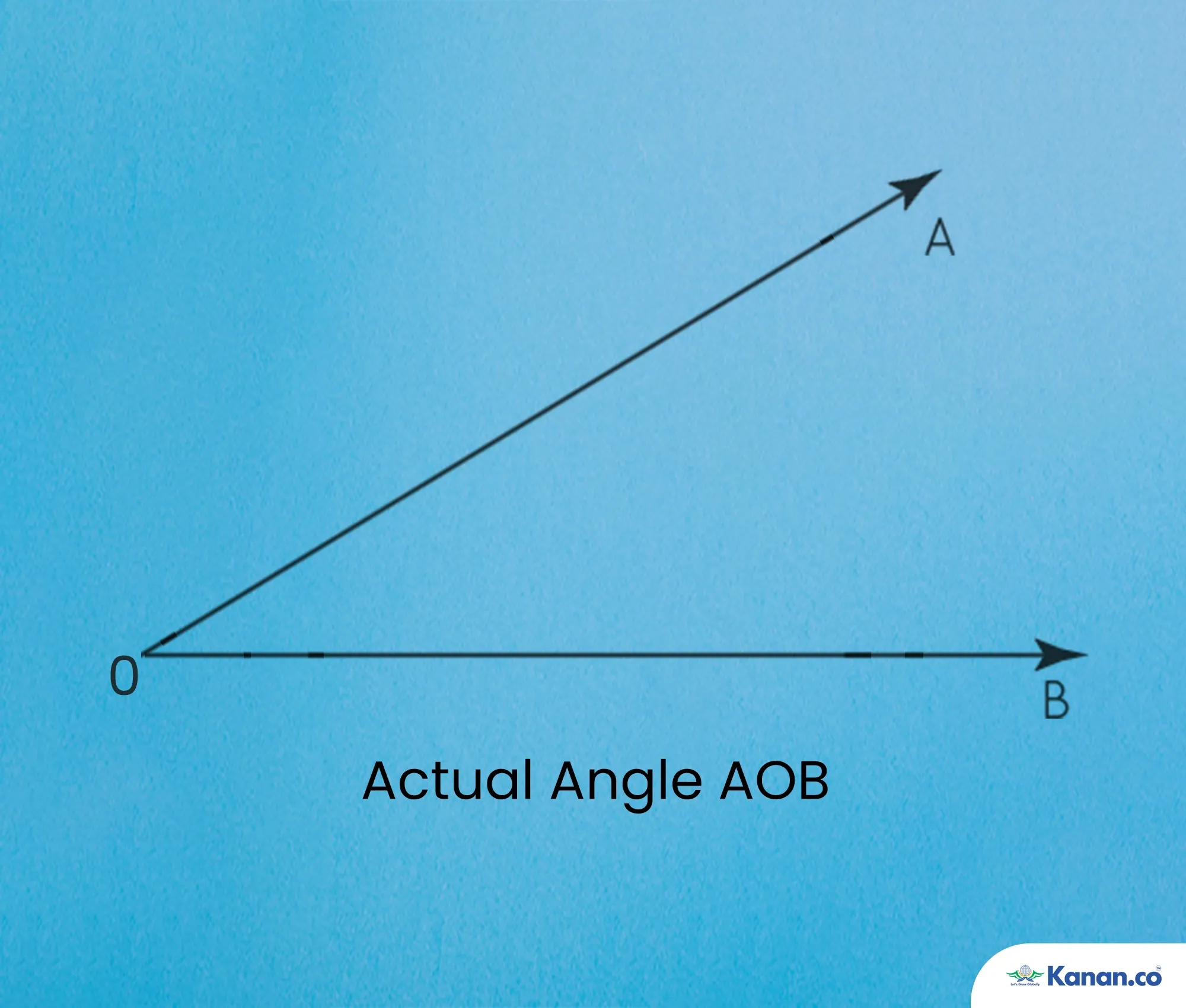
Example:
If ∠ABC = 45°, prove that it is an acute angle.
Solution:
Condition for an acute angle: Measure < 90°
Here, ∠ABC = 45°, which is less than 90°. Hence, it is an acute angle.
4. Obtuse Angle
An obtuse angle measures more than 90° but less than 180°. It is wider than a right angle but does not form a straight line.
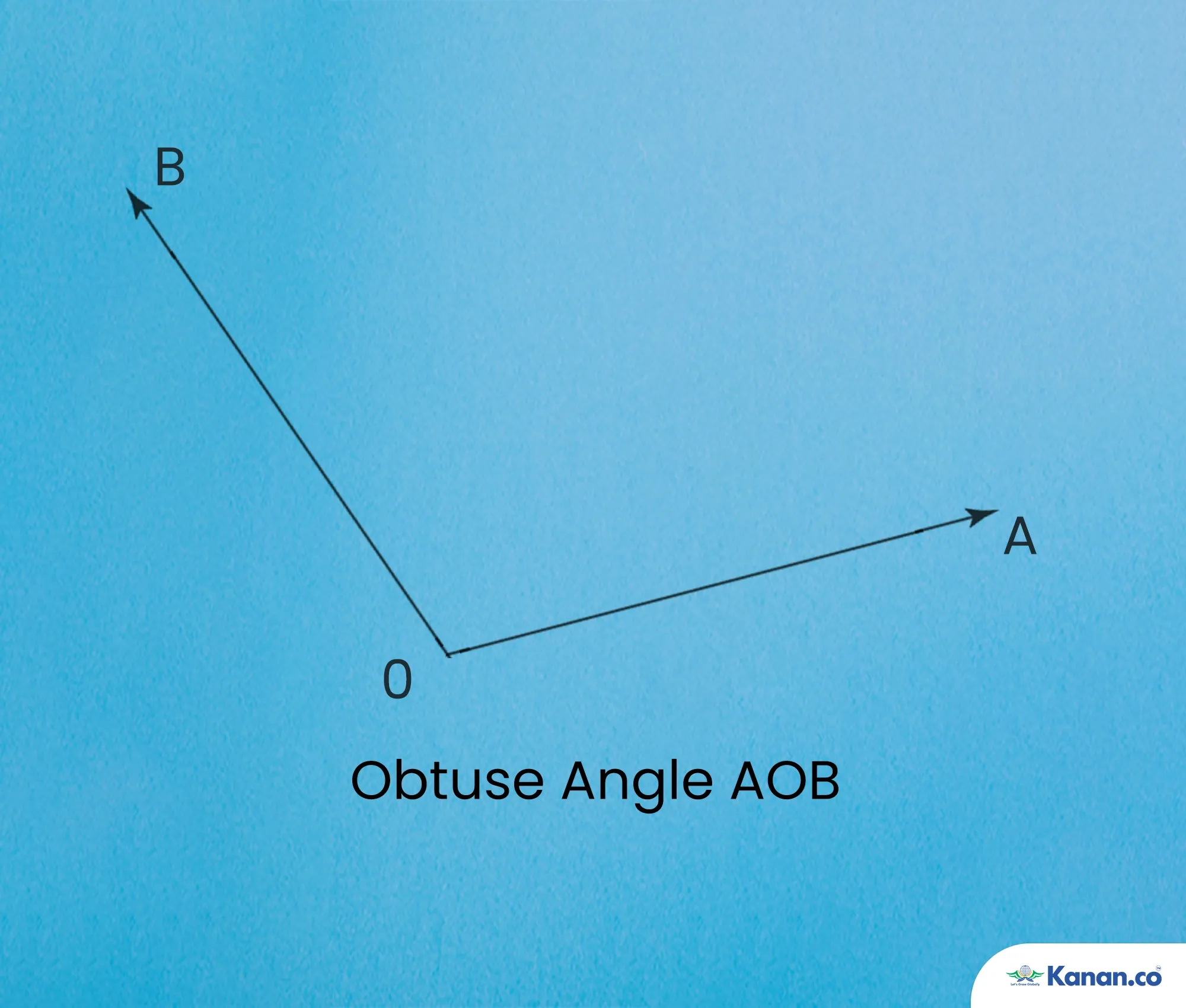
Example:
If ∠DEF = 120°, prove that it is an obtuse angle.
Solution:
Condition for an obtuse angle: 90° < Measure < 180°
Here, ∠DEF = 120°, which satisfies the condition for an obtuse angle.
5. Vertically Opposite Angles
Vertically opposite angles are formed when two straight lines intersect at a point, creating four angles in total. The angles opposite each other at the intersection point are called vertically opposite angles. These angles are always equal in measure due to the symmetrical nature of the intersection.
Let’s consider two straight lines intersecting at point O:
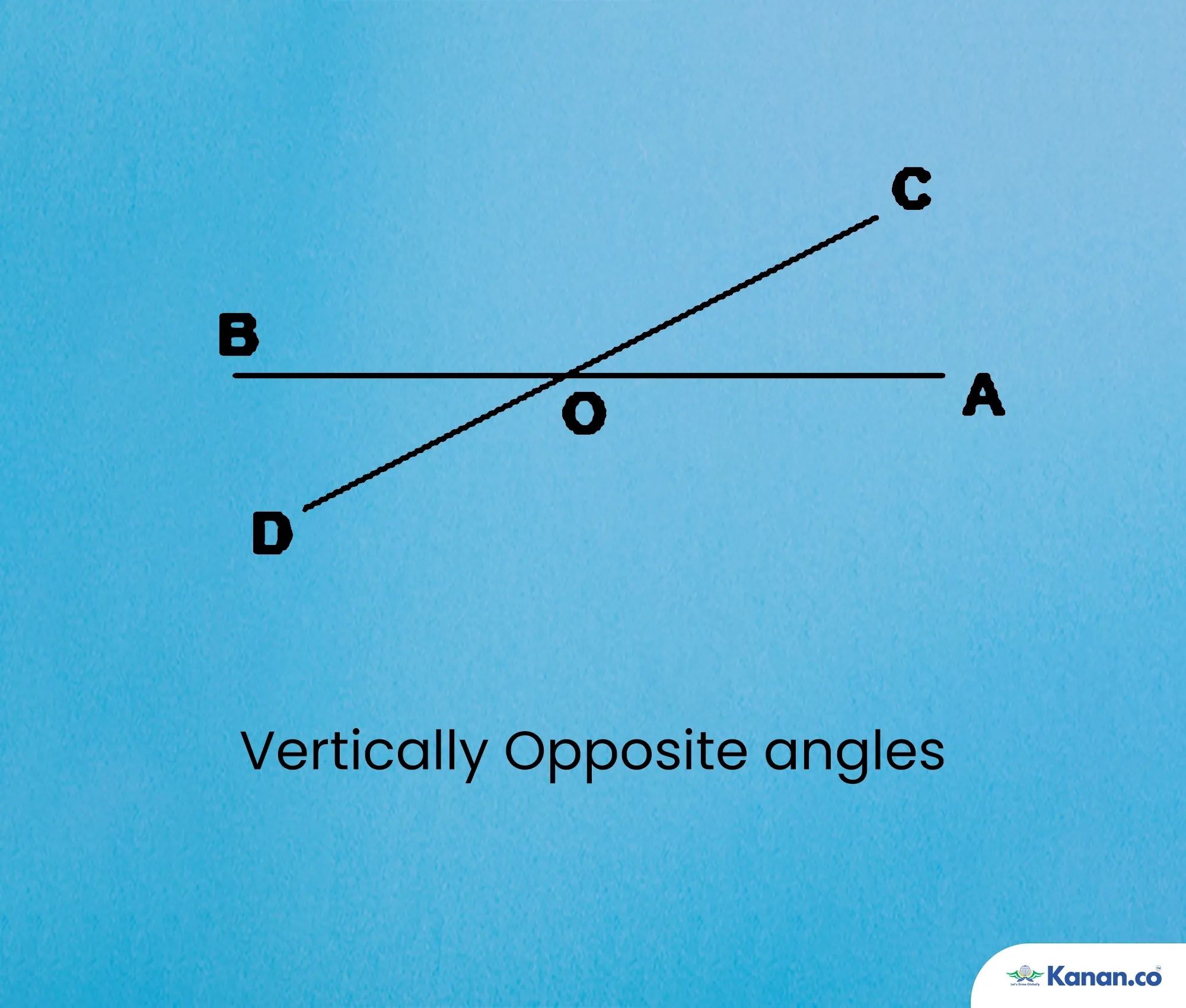
- The angles formed at O are ∠AOC, ∠BOD, ∠AOB and ∠COD.
- Here, ∠AOC is vertically opposite to ∠BOD, and ∠AOB is vertically opposite to ∠COD.
- The pairs (∠AOC, ∠BOD) and (∠AOB, ∠COD) are congruent (equal in measure).
This equality arises because the sum of adjacent angles at any intersection is always 180∘, and the remaining pair must balance out symmetrically.
Example:
Two straight lines intersect at a point O, forming the angles ∠AOC = 65∘ and ∠BOD = 3x + 5∘. Find the value of x and the measures of all four angles.
Solution:
At the intersection:
∠AOC and ∠BOD are vertically opposite angles, so they are equal.
∠AOC = ∠BOD ⟹ 65° = 3x + 5°
65 − 5 = 3x ⟹ 60 = 3x ⟹ x = 20
The value of x is 20.
Now calculate all four angles:
- ∠AOC = 65°
- ∠BOD = 3x + 5 = 3(20) + 5 = 65°
- Adjacent angles ∠AOB and ∠COD are supplementary to ∠AOC and ∠BOD, respectively:
∠AOB = 180° − ∠AOC = 180°− 65°= 115°
∠COD = 180° − ∠BOD = 180° − 65°=115°
Therefore,
∠AOC = ∠BOD = 65∘ (vertically opposite angles).
∠AOB = ∠COD = 115° (adjacent supplementary angles).
6. Reflex Angle
A reflex angle measures more than 180° but less than 360°. It forms the larger part of a circle when an angle extends beyond a straight line, essentially forming a complete turn. Reflex angles are used in various geometry problems, especially in scenarios involving rotations, circular shapes, and angle measurements beyond straight lines.
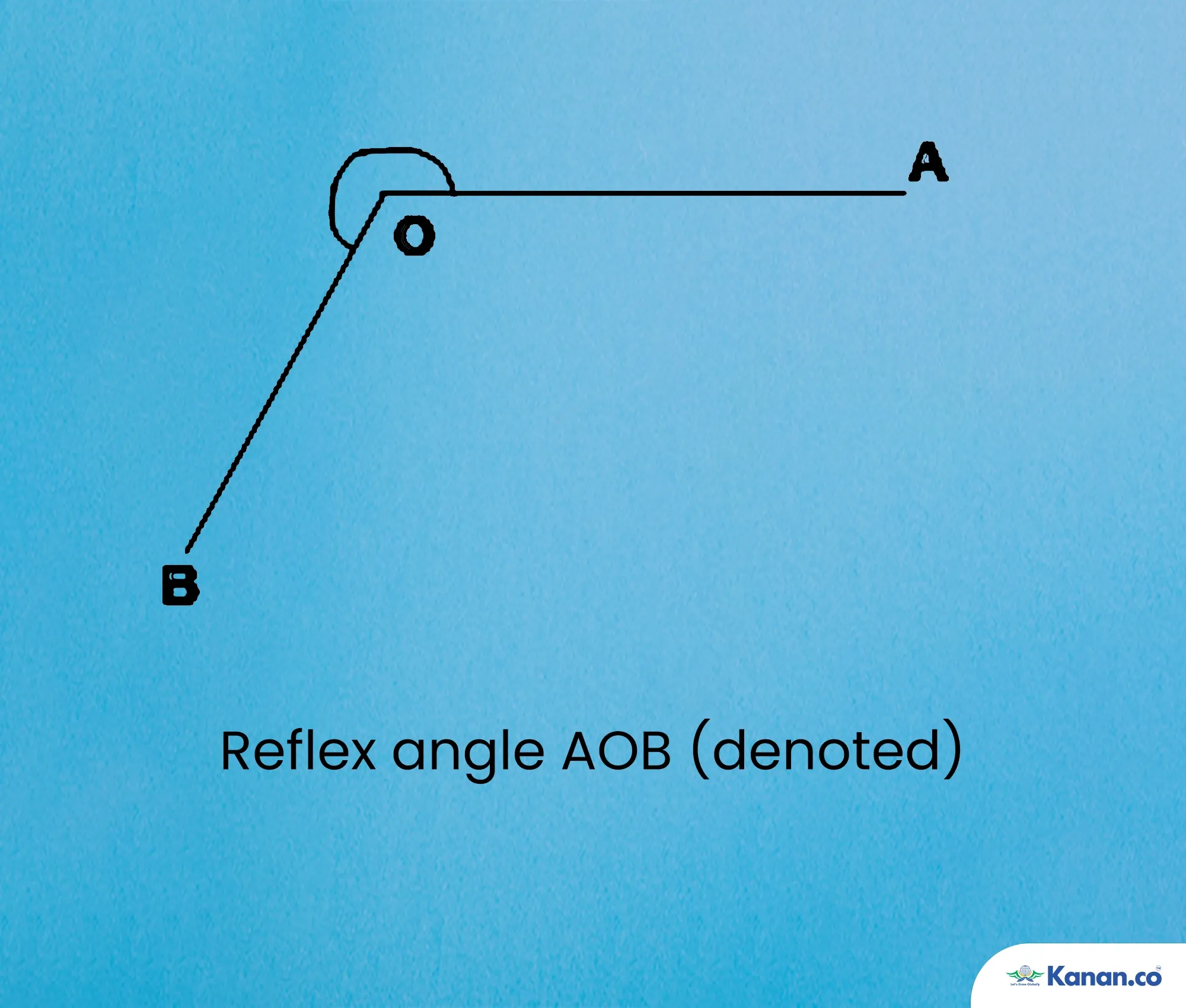
Example:
Find the measure of a reflex angle ∠AOB if the smaller interior angle θ = 120° .
Solution:
The sum of an angle and its reflex counterpart is 360° .
Reflex Angle = 360° −θ
Reflex Angle = 360° − 120° = 240°
Thus, the reflex angle ∠AOB measures 240°.
In this case, the smaller angle θ = 120° represents the acute portion of the angle, while the reflex angle represents the larger sweep, covering 240°. Reflex angles often appear in rotational geometry and can be easily computed by subtracting the given angle from 360°.
7. Supplementary Angles
Supplementary angles are two angles that together form a straight angle, meaning their measures add up to 180°. These angles can either be adjacent (forming a straight line) or non-adjacent. Supplementary angles are crucial in solving geometry problems involving straight lines and angle relationships.
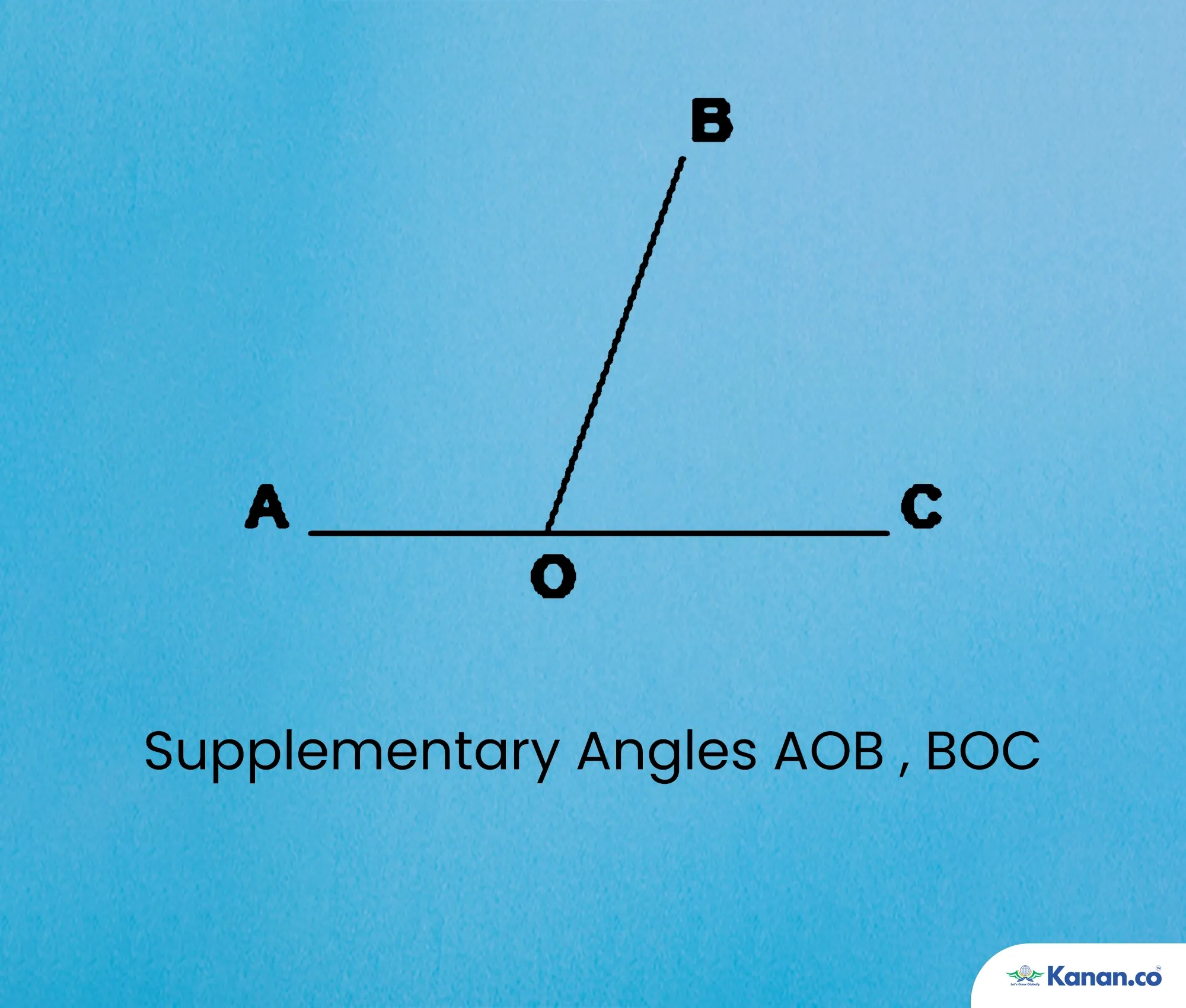
Example:
Problem:
Two angles are supplementary. One angle measures 75°. Find the measure of the other angle.
Solution:
Let the two angles be x and y, where x + y = 180°.
Given x = 75° , substitute this into the equation:
75° + y = 180°
y = 180° − 75° = 105°
Therefore, the second angle measures 105° . Together, the angles 75° and 105∘ form a supplementary pair.
8. Complementary Angles
Complementary angles are two angles that together form a right angle, meaning their measures add up to 90°. These angles are often found in right triangles and geometric figures involving perpendicular lines. Complementary angles can either be adjacent, forming a right angle, or non-adjacent but still summing to 90°.
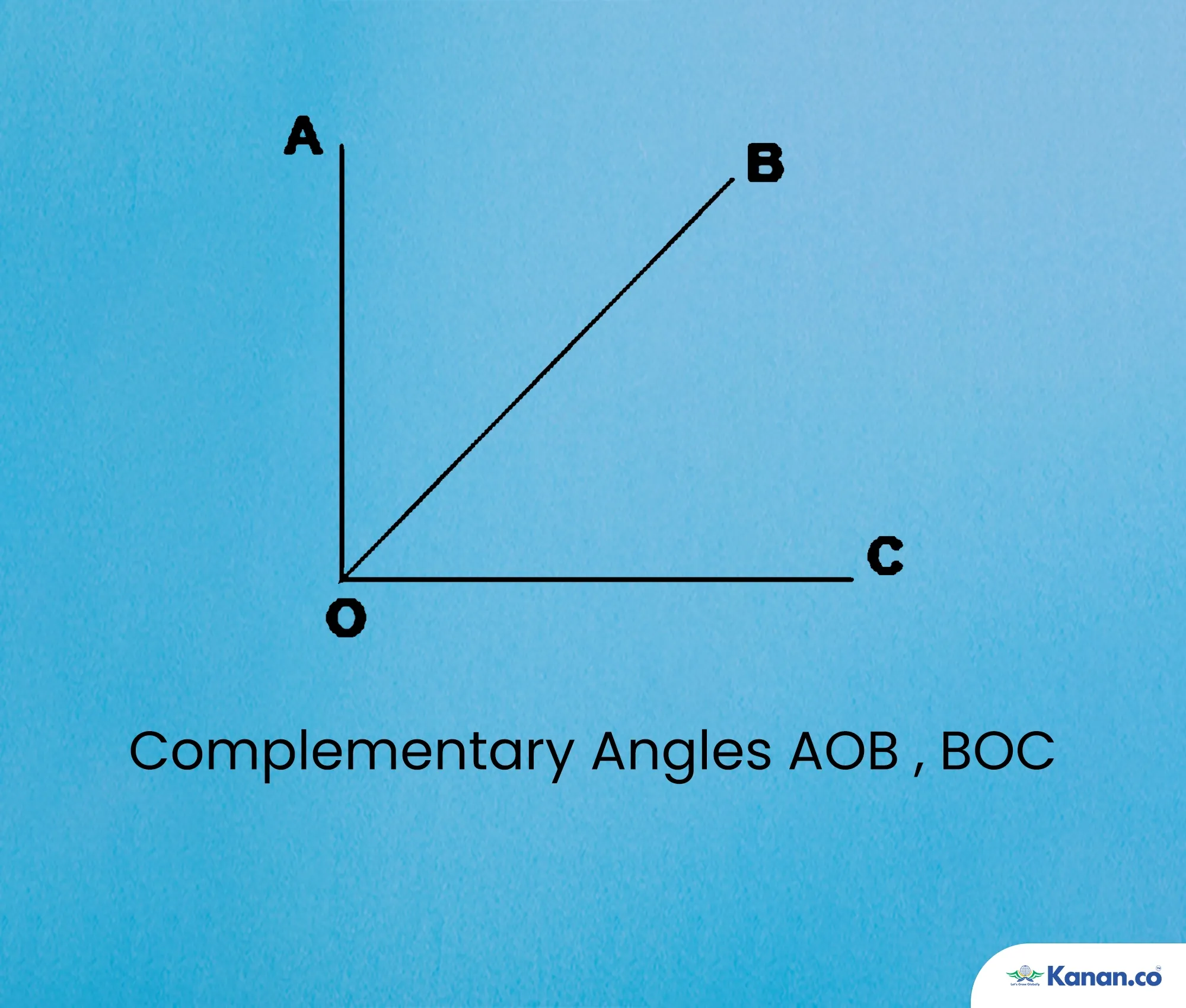
Example:
Two angles are complementary. One angle measures 65° . Find the measure of the other angle.
Solution:
Let the two angles be x and y, where x + y = 90°.
Given x = 65°, substitute this into the equation:
65° + y = 90°
y = 90° − 65° = 25°
Therefore, the second angle measures 25°. Together, the angles 65∘ and 25° form a complementary pair.
9. Angle Bisector
An angle bisector is a line or ray that divides an angle into two equal parts. It passes through the vertex of the angle, creating two smaller angles of equal measure. The angle bisector is essential in geometric constructions, proofs, and solving problems involving congruence and symmetry.
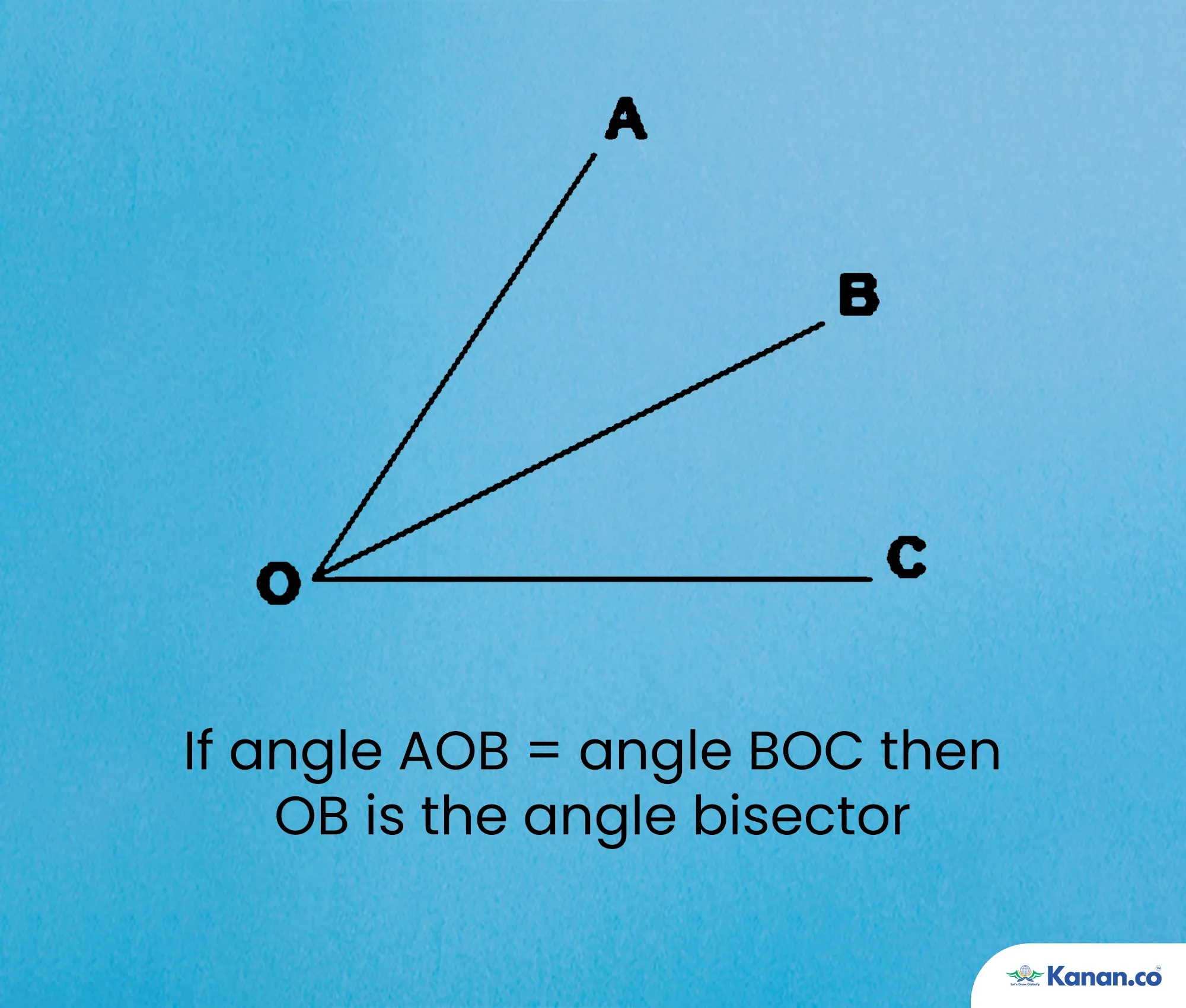
Example:
Given that ∠BOA = 40° and ∠COA = 70° , find ∠BOC.
Solution:
Since ∠BOA and ∠COA form a linear pair (i.e., they are adjacent angles on a straight line), the sum of the two angles will be 180∘.
Thus,
∠BOC = 180° − (∠BOA + ∠COA ) = 180° − (40° + 70° ) = 180° − 110° = 70°.
GRE Lines & Angles Practice Questions with Answers
Improve your GRE Lines and Angles skills with these practice problems. Each question comes with a clear solution to help you grasp the key concepts and strengthen your problem-solving abilities.
Example Question 1: Coordinate Geometry
Solve for the equation of the line running through the point (1, 3) and parallel to the line 4x - 2y = 6.
Possible Answers:
- y = 2x + 1
- y = -2x + 5
- y = 2x + 3
- y = -2x + 4
- y = 4x - 3
Correct Answer: y = 2x + 1
Solution: First, solve the given equation for y. This will give you the slope-intercept form of the equation:
4x - 2y = 6
Isolate y by moving the x-terms to the other side:
-2y = -4x + 6
Now divide by -2 to solve for y:
y = 2x - 3
Thus, the slope of the line is 2. Since the new line is parallel, it will have the same slope. Using the point (1, 3) and the point-slope form of the equation:
y - 3 = 2(x - 1)
Distribute and solve for y:
y = 2x + 1
Therefore, the correct equation of the line passing through (1, 3) and parallel to 4x - 2y = 6 is y = 2x + 1.
Example Question 2: Lines
Find the Equation of a Line Parallel to One Passing Through Points (3, 5) and (10, -2).
Possible Answers:
- y = 7/8x - 3.25
- y = -1x + 8
- y = -8/7x + 10
- y = x + 8
- y = -7/8x + 6
Correct Answer: y = -1x + 8
Solution:
To begin, we need to find the slope of the line passing through the points (3, 5) and (10, -2). To do this, we use the slope formula:
m = (y2 - y1 ) / (x2 - x1 )
Substituting in the values for the points (3, 5) and (10, -2):
m = (-2 - 5) / (10 - 3) = (-7) / 7 = -1
Now that we know the slope of the given line is -1, we can use this slope for the parallel line since parallel lines have the same slope.
For a parallel line, we can use the point-slope form of the equation, y - y1 = m(x - x1 ), where (x1 , y1 ) is any point on the line. We will use the point (3, 5):
y - 5 = -1(x - 3)
y - 5 = -x + 3
y = -x + 8
Therefore, the equation for the parallel line is:
y = -1x + 8
Example Question 3: Coordinate Geometry
If the line passing through the points (6, 4) and (–3, q) is parallel to the line y = 3x + 2, what is the value of q?
Possible Answers:
- 7
- 2
- -23
- -1
- 13
Correct Answer:
q = -23
Solution:
Since the lines are parallel, the slopes must be the same. The slope of the given line y = 3x + 2 is 3 (as the coefficient of x is the slope).
Now, we use the formula for the slope between two points:
slope, m = (y2 - y1 ) / (x2 - x1 )
Substitute the points (6, 4) and (-3, q):
(q−4) / (−3−6) = 3
(q−4) / -9 = 3
Multiply both sides by -9:
q - 4 = -27
q = -23
So the value of q is -23.
Example Question 4: Perpendicular Lines and Slopes
Which of these formulas could be a formula for a line perpendicular to the line 4x + 5y = 20?
Possible Answers:
- 5y − 4x = 25
- 3x + 4y = 12
- 4y + 5x = 30
- 5y + 3x = 18
- 5y − 4x = 20
Correct Answer: 5y − 4x = 25
Solution: This is a two-step problem. First, we need to find the slope of the original line by converting it to the slope-intercept form (y = mx + b).
Start with the original equation:
4x + 5y = 20
Subtract 4x from both sides:
5y = -4x + 20
Now, divide both sides by 5:
y = −4/5x + 4
The slope of the original line is -4/5. For two lines to be perpendicular, the slopes must be negative reciprocals of each other. The negative reciprocal of -4/5 is 5/4.
Now, let's find the line with a slope of 5/4:
Option verification: For the equation 5y − 4x = 25, let's rewrite it in slope-intercept form:
5y = 4x + 25
Divide both sides by 5:
y = 4/5x + 5
This gives us a slope of 4/5, which is the negative reciprocal of -4/5. Thus, this line is perpendicular to the original line.
Example Question 5: Comparing Slopes of Parallel and Perpendicular Lines
Quantity A: The slope of a line parallel to 3y + 12x = 9
Quantity B: The slope of a line perpendicular to 2y - 10x = 8
Which of the following is true?
Possible Answers:
- Quantity B is larger.
- The relationship between the quantities cannot be determined from the information provided.
- Quantity A is larger.
- The two quantities are equal.
Correct Answer:
Quantity B is larger.
Explanation:
We start by converting each equation to slope-intercept form (y = mx + b), where m represents the slope.
Quantity A:
3y + 12x = 9
Rearrange to isolate y:
3y = -12x + 9
Divide through by 3:
y = -4x + 3
The slope of the line is −4. Since parallel lines have the same slope, the slope for Quantity A is −4.
Quantity B:
2y - 10x = 8
Rearrange to isolate y:
2y = 10x + 8
Divide through by 2:
y = 5x + 4
The slope of the line is 5. For perpendicular lines, the slope is the opposite reciprocal. Thus, the slope for Quantity B is −1/5.
Comparison:
The slope of Quantity A (−4) is more negative than the slope of Quantity B (−1/5). Hence, Quantity B (−1/5) is a larger value.
Final Answer is Quantity B is larger.
Example Question 6: Finding the Slope of Parallel Lines
What is the slope of any line parallel to 8x - 3y = 9?
Possible Answers:
- 8/3
- −3/8
- 3/8
- 9
- -8
Correct Answer:
8/3
Explanation:
To find the slope of a line parallel to the given equation, we need to first rewrite the equation in the slope-intercept form (y = mx + b), where m is the slope.
Start with the given equation:
8x - 3y = 9
Rearrange to isolate y:
-3y = -8x + 9
Divide through by −3:
y = 8/3x − 3
From this equation, the slope (m) of the line is 8/3.
Since parallel lines share the same slope, the slope of any line parallel to the given equation is also 8/3.
Final Answer: 8/3
Example Question 7: Classifying the Relationship Between Two Lines
There are two lines:
3x - 2y = 12
3x + 2y = 8
Are these lines perpendicular, parallel, non-perpendicular intersecting, or the same lines?
Possible Answers:
- The same
- Non-perpendicular intersecting
- Perpendicular
- Parallel
- None of the other answers
Correct Answer:
Non-perpendicular intersecting
Explanation:
To determine the relationship between the lines, convert both equations into slope-intercept form (y = mx + b):
- Start with the first line:
3x - 2y = 12
Rearrange for y:
-2y = -3x + 12
Divide by −2:
y = 3/2x − 6
The slope of the first line is 3/2. - Now for the second line:
3x + 2y = 8
Rearrange for y:
2y = -3x + 8
Divide by 2:
y = −3/2x + 4
The slope of the second line is −3/2.
These lines are not parallel, as their slopes are not identical. They are also not perpendicular, as their slopes are not negative reciprocals (3/2 and −3/2 do not satisfy this condition).
Since the slopes are different, the lines intersect, but not at a right angle. Therefore, the two lines are non-perpendicular intersecting.
Example Question 8: Finding the Angle Between Intersecting Lines
In the figure shown below, it is given that ∠ABE = 90∘ and ∠JKL = 40∘. Further, lines CD and EF are parallel, and lines AB and GH intersect at point P. Find the value of ∠GPH.
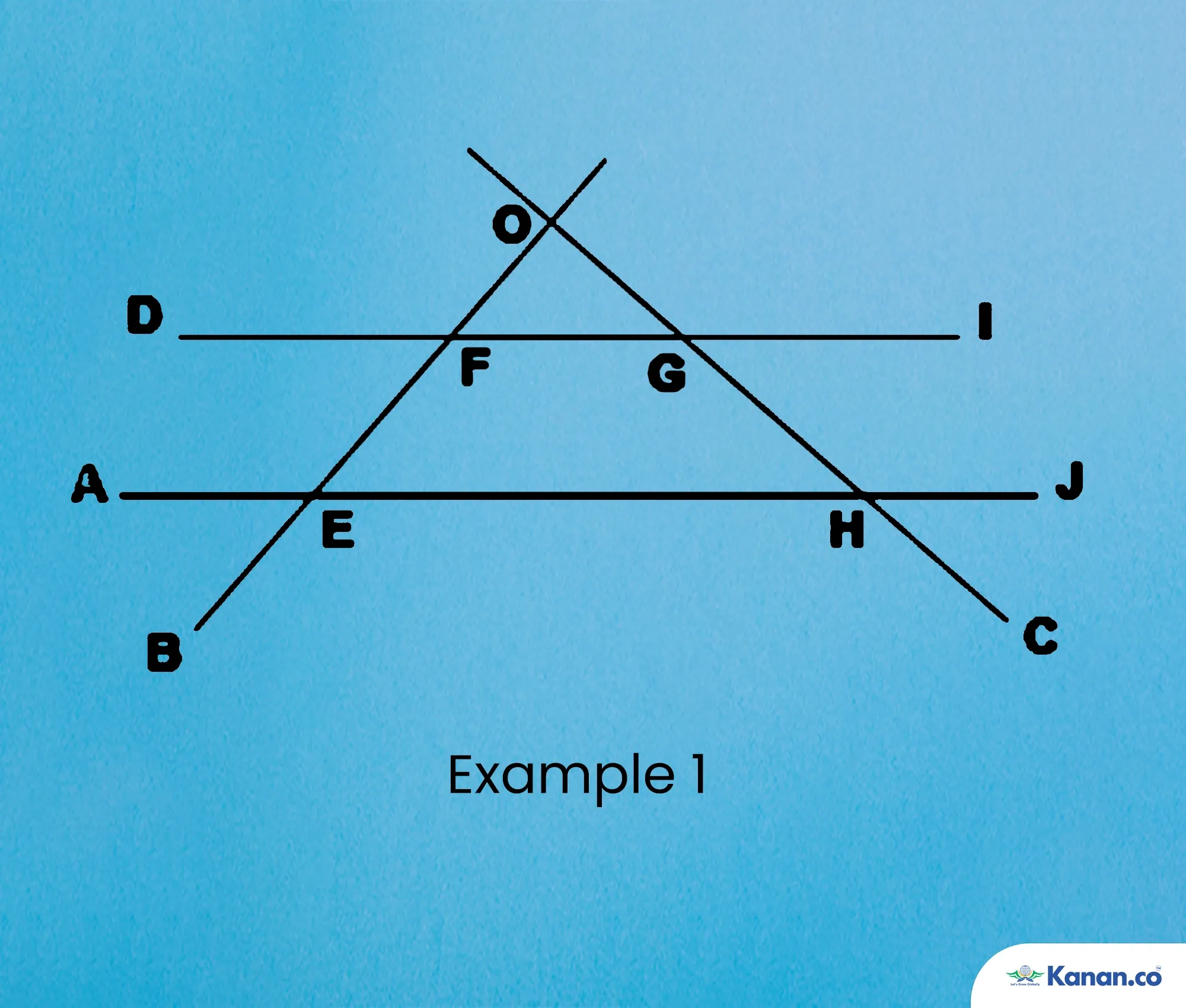
Solution:
Step 1: Establish the relationship between ∠JKL and ∠KPH
Since CD and EF are parallel, and AB acts as a transversal, the alternate interior angles are equal. Therefore:
∠JKL = ∠KPH = 40°
Step 2: Determine ∠BPH
∠BPH is a supplementary angle to ∠KPH, as they lie on a straight line.
∠BPH + ∠KPH = 180°
∠BPH = 180° −40° = 140°
Step 3: Use complementary property to find ∠GPH
It is given that ∠ABE = 90∘, and ∠BPH and ∠GPH form a straight angle (180°).
Thus:
∠GPH + ∠BPH = 180°
∠GPH = 180° − 140° = 40°
Final Answer: ∠GPH = 40°
Example Question 9: Solving for Angles with Parallel Lines
In the figure shown below, if x = y - 20° and PQ is parallel to RS, find the value of ∠y.
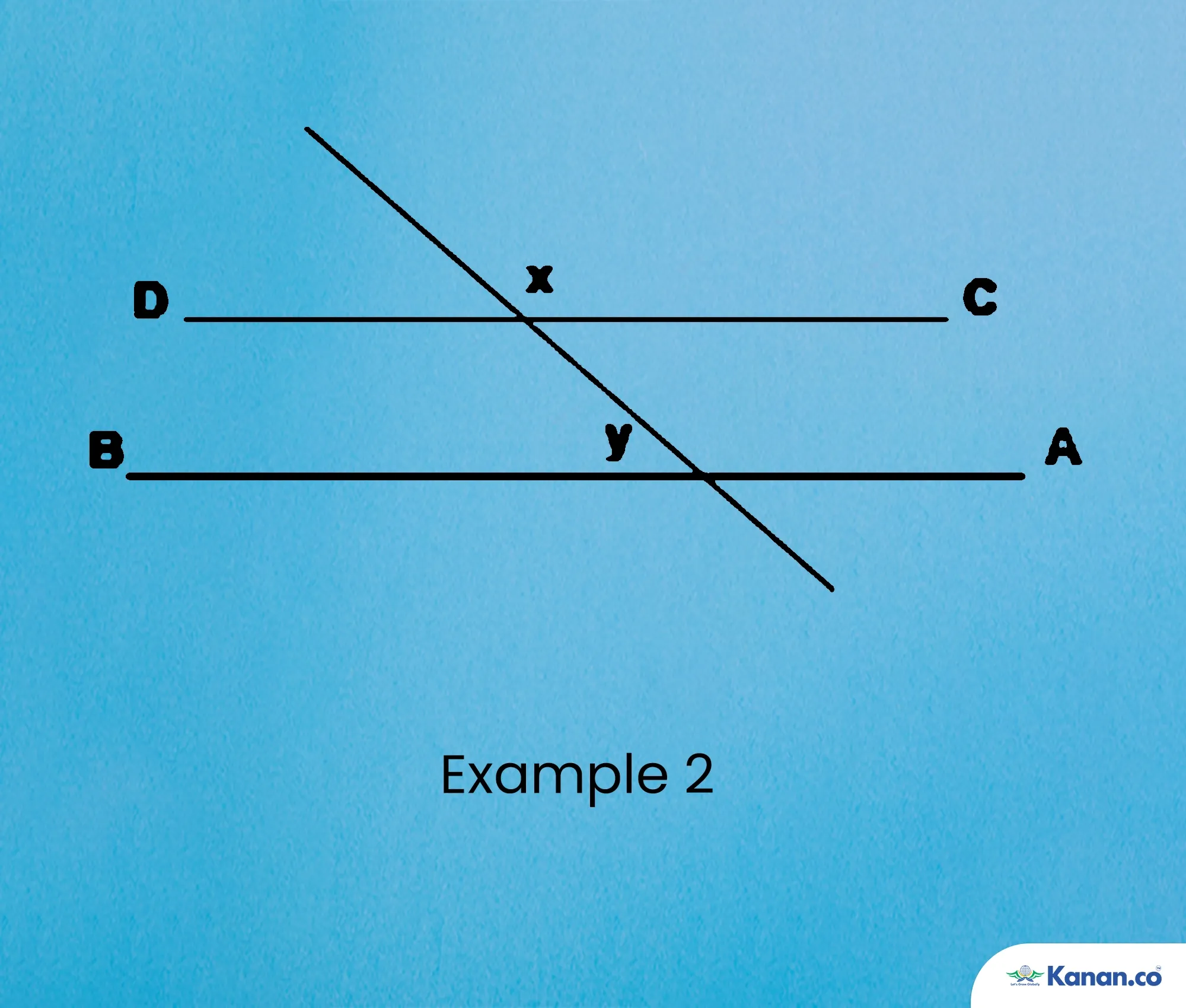
Solution:
Step 1: Identify vertical angles
From the figure, ∠Ax = ∠x, based on the property of vertical angles being equal.
Step 2: Use the supplementary angle relationship
Since PQ and RS are parallel and the transversal intersects them, ∠x and ∠y are supplementary.
∠x + ∠y = 180°
Step 3: Substitute x = y - 20°
Substitute the value of x into the equation:
(y−20∘) + y = 180°
Step 4: Solve for ∠y
Simplify the equation:
2y − 20° = 180°
2y = 180° + 20°
2y = 200°
y = 100°
Therefore the final Answer is ∠y = 100°
Example Question 10: Interior Angles of a Hexagon
In a six-sided polygon, one angle measures 120∘. What are the possible measurements of the other angles?
Solution:
Calculate the total sum of the interior angles:
For a polygon with n sides, the sum of the interior angles is given by:
Sum of angles = (n−2) ✕ 180
In this case, for a hexagon (n = 6):
(6 − 2) ✕ 180 = 720°
Subtract the given angle from the total:
One angle is 120°, so the remaining sum for the other five angles is:
720°∘ − 120° = 600°
Determine the possible angles:
The sum of the remaining five angles must equal 600∘. For example, the other angles could measure:
90°, 110°, 120°, 130°, and 150°
These angles add up to:
90 + 110 + 120 + 130 + 150 = 600°
Final Answer:
The other angles in the polygon could measure 90°, 110°, 120°, 130°, and 150°.
Summary of GRE Lines & Angles
Here are the key points to remember when solving GRE geometry questions involving lines and angles. With these concepts, you’ll handle even the trickiest problems with confidence.
- Lines are infinite and straight, while line segments are their finite portions. Never assume their orientation unless explicitly stated.
- Adding or subtracting angle measures works when they form linear pairs or supplementary angles.
- Parallel lines create specific angle relationships when intersected by a transversal, such as corresponding and alternate angles.
- Bisectors divide angles or line segments into two equal parts, while perpendicular bisectors are equidistant from segment endpoints.
- Be cautious of assuming lines are perpendicular unless clearly indicated, as geometry often requires explicit proof.
In conclusion, mastering GRE Lines & Angles is essential for solving geometry questions with ease. The more you practice and understand the concepts, the faster and more accurately you'll approach these problems. If you need personalized support to strengthen your GRE preparation, Kanan International, with 28 years of experience, is here to guide you every step of the way.

About Author Sravani Kota
Sravani is an enthusiastic author who is deeply passionate about continuous learning, writing, and reading. Her academic background includes a Bachelor's and Master's degree in engineering from JNTU, gaining expertise in technical English writing, paper publications, test preps like IELTS, GRE, SAT, TOEFL, etc., and study abroad services like SOP, LOR, etc. Her expertise in the education sector makes her an excellent resource for students seeking guidance and advice. In her leisure time, she enjoys spending quality time with family, watching popular TV shows like Stranger Things and Money Heist, and she also loves to travel, explore new places, and create videos of her experiences.
Kanan.co is a trusted study abroad consultancy offering comprehensive services, resources, and solutions for students and education institutions. We support students at every stage of their global education journey, ensuring a smooth and guided experience. Along with test preparation for IELTS, GRE, TOEFL, and SAT, we provide expert services such as SOP writing, visa guidance, accommodation support, scholarship assistance, and education loan support. Our expertise and commitment to excellence make us a reliable partner for students pursuing international education.
Sign Up for a Free GRE Demo Class!
Ace GRE Quant & Verbal with 320+ Score — Join Us!








Global Headquarters
Kanan Int EdTech Inc
320 Bay Street, Suite 321 (Spaces), Toronto ON, Canada M5B 1N9
Indian Headquarters
Kanan International Pvt. Ltd.
D-wing, 2nd Floor, Trident Complex, Ellora Park Vadiwadi Road, Vadodara, Gujarat 390007
IT/ Digital Campus
Kanan International Pvt. Ltd
Old, New No 3, 2nd Floor, 1A, Dr Sadasivam Rd, T. Nagar, Chennai, Tamil Nadu 600017
Our branches
- Bardoli
- Bharuch
- Chennai
- Dehradun
- Gurugram
- Himatnagar
- Karnal
- Nadiad
- Navsari
- Palanpur
- Rajkot
- Vadodara
- Valsad
- Vallabh Vidyanagar
- Vapi
Study Abroad
Test Prep
Top Universities
Consultants
IELTS Centers
GRE Centers
TOEFL Centers
SAT Centers
Language Courses in Vadodara
Study Abroad Calculators
Featured Blogs
Study Abroad Consultants in Chennai
Study Abroad Consultants in Surat
Study Abroad Consultants in Navsari
Study Abroad Consultants in Bardoli
Study Abroad Consultants in Ahmedabad
Study Abroad Consultants in Anand
Study Abroad Consultants in Khanna
Study Abroad Consultants in Nadiad
Study Abroad Consultants in Vadodara
Study abroad consultants in Valsad
Copyright © 2026 KANAN.CO All rights reserved.