- Study Abroad
- / gre
- / square roots
GRE Equation with Square Roots: Rules & Practice Problems


Author
20-12-2024

GRE square roots involve finding values that, when squared, yield the original number, making them the inverse of exponents. In GRE, if the "√" symbol appears as part of the question, we can only use the positive answer of the square root. This positive root is often known as the principal square root. However, if the "√" symbol is NOT part of the question, then both the negative and positive roots of a square root can be used. The number under the radical symbol never gives the negative number result. In addition, a square root is a second-order root, while higher-order roots, like a cube (³√n) and fourth roots (⁴√n), follow the same principle. Odd-order roots and even-order roots differ significantly within the real number system.
According to the ETS's Mathematical Conventions pdf document, all numbers in GRE test questions are real, including integers, rational, and irrational numbers, while excluding imaginary numbers. Square root problems in the GRE Quant test assess the candidate's understanding of GRE arithmetic fundamentals, focusing on positive and negative solutions. Mastering square roots is crucial for solving various GRE questions, especially as radicals challenge test-takers to think of opposite operations. This blog will guide you through GRE square root concepts, providing insights and examples to strengthen your skills.
GRE Square Roots: Rules
All positive numbers have two square roots, one positive and one negative. The only square root of 0 is 0. The symbol √n denotes the non-negative square root of the non-negative number n. Therefore, √100 = 10, -√100 = -10, √-100 = 10 and √0 = 0. Typically, square roots can be added or subtracted only if their radicands match. Moreover, it is easy to find the square root for perfect squares like 4, 9, 16. Different methods exist to find the square root for imperfect squares like 2, 3, 6, etc.
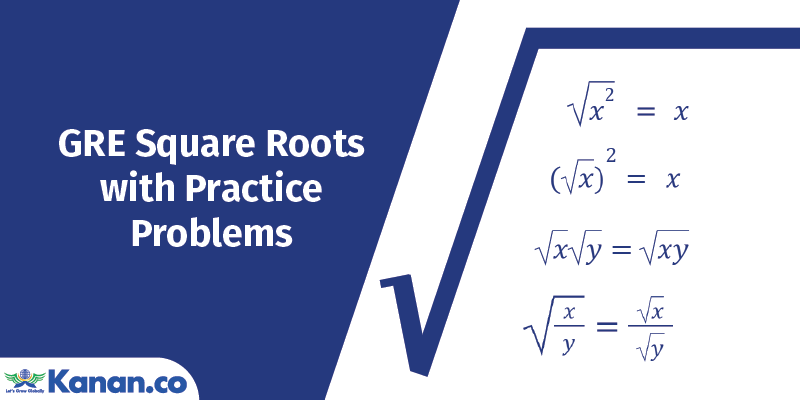
Below are the four important rules regarding operations with square roots, where a>0 and b>0.
Rule 1: (√a)^2 = a
Example: (√2)^2 = 2
Explanation: Mathematically, when you square a square root, you are essentially reversing the square rooting process. The square root symbol indicates finding a value that, when squared, gives the original radicand. Here, √a is the square root of “a”, and squaring it ((√a)^2) returns the radicand “a”, which can be an actual number, a real number, or a plain variable. This process works because the square and square root are inverse operations.
Rule 2: √a^2 = a
Example: √9 = 3
Explanation: Square rooting a number or variable squared removes the square, leaving the positive root of the value under the radical. Mathematically, a^2 inside the square root symbol simplifies to “a”, provided “a” represents a positive real number or a plain variable. The result is always the positive root because, in math, the principal square root is taken unless otherwise specified.
Rule 3: √a √b = √ab
Example: √2 √5 = √10
Explanation: When multiplying two square roots, you can combine the number under a single square root symbol. This rule is valid for real numbers and variables as long as both square root values are non-negative. The order of operations ensures that the multiplication of the values under the radical occurs before taking the square root.
Rule 4: √a/√b = √a/b
Example: √3/√9 = √3/9 = √1/3
Explanation: When dividing two square roots, you can express the division as a single square root of the fraction. The radicand in the numerator is divided by the radicand in the denominator. The index of the square root remains the same, and this property helps simplify expressions in math problems involving fractions. It is important to ensure that the denominator value is not zero, as division by zero is undefined.
By applying the above four rules, you can simplify and solve problems efficiently in Quantitative comparison (QC) sections or other math contexts.
GRE Square Roots Practice Problems with Solutions
1. Simplify
3√5/√2+5√2/√5
Solution:
Rationalize the denominators:
-> 3√5/√2 = 3√10/2
-> 5√2/√5 = 5√10/5
= √10
Add the terms:
3√10/2 + √10 = 3√10 + 2√10/2
= 5√10/2
Answer: 5√10/2
2. Compare the Quantities
Quantity A: √72 + √288
Quantity B: √162 + √128
Solution:
In this quantitative comparison (QC), we simplify each square root:
√72 = 6√2, √288 = 12√2, √162 = 9√2, √128 = 8√2
Add the terms:
Quantity A: 6√2 + 12√2 = 18√2
Quantity A: 9√2 + 8√2 = 17√2
Since, 18√2 > 17√2
Answer: Quantity A is greater.
3. Simplify the Expression
√45+√20+√5
Solution:
Simplify each square root:
√45 = 3√5, √20 = 2√5, √5 = √5
Add the terms:
3√5 + 2√5 + √5 = 6√5
Answer: 6√5
4. Solve for x:
√12x-√3=√3x+3, x>0
Solution:
Isolate one square root:
√12x =√3x+√3+3
Square both sides:
12x = (√3x+√3+3)^2
Expand:
12x = 3x+3+9
Simplify and solve for x:
12x - 3x = 12
9x = 12
x = 12/9
= 4/3
Answer: x = 4/3
5. Simplify
√245x^4/√35x^2
Solution:
Simplify the numerator and denominator:
-> √245x^4 = √49*5*x^4
= 7x^2√5
-> √35x^2 = √35*x
Simplify the fraction:
7x^2√5/√35*x = 7x√5/√35
= (7x√5/√35)
x = √35/7√5
= √7*5/7√5
= √7 √5 / 7√5 = √7/7
Answer: x = √7/7
By mastering the distinction between when to consider both positive and negative roots versus when to focus solely on the positive root, you will gain a clear understanding of how to approach square root problems effectively. The above-given problems are samples of the GRE square root concept designed to enhance your preparation. Practicing a variety of square root problems aids you in excelling in the GRE Arithmetic.

About Author Manimegalai Samidurai
Manimegalai is a multifaceted professional, excelling as an author, writer, and study-abroad expert. Her vast knowledge of English proficiency exams, including IELTS, GRE, SAT, and PTE, and exceptional content writing skills make her a go-to resource for students seeking guidance and support in their foreign education journey. She is a trusted authority in writing content related to these test-prep exams, making her an invaluable resource for those seeking guidance. With her well-researched and informative blogs, articles, and study materials, Manimegalai has helped countless students achieve their desired band scores and get admissions to top-notch colleges & universities in countries like Canada, USA, UK, Australia, Ireland, etc.
Kanan.co is a trusted study abroad consultancy offering comprehensive services, resources, and solutions for students and education institutions. We support students at every stage of their global education journey, ensuring a smooth and guided experience. Along with test preparation for IELTS, GRE, TOEFL, and SAT, we provide expert services such as SOP writing, visa guidance, accommodation support, scholarship assistance, and education loan support. Our expertise and commitment to excellence make us a reliable partner for students pursuing international education.
Sign Up for a Free GRE Demo Class!
Ace GRE Quant & Verbal with 320+ Score — Join Us!








Global Headquarters
Kanan Int EdTech Inc
320 Bay Street, Suite 321 (Spaces), Toronto ON, Canada M5B 1N9
Indian Headquarters
Kanan International Pvt. Ltd.
D-wing, 2nd Floor, Trident Complex, Ellora Park Vadiwadi Road, Vadodara, Gujarat 390007
IT/ Digital Campus
Kanan International Pvt. Ltd
Old, New No 3, 2nd Floor, 1A, Dr Sadasivam Rd, T. Nagar, Chennai, Tamil Nadu 600017
Our branches
- Bardoli
- Bharuch
- Chennai
- Dehradun
- Gurugram
- Himatnagar
- Karnal
- Nadiad
- Navsari
- Palanpur
- Rajkot
- Vadodara
- Valsad
- Vallabh Vidyanagar
- Vapi
Study Abroad
Test Prep
Top Universities
Consultants
IELTS Centers
GRE Centers
TOEFL Centers
SAT Centers
Language Courses in Vadodara
Study Abroad Calculators
Featured Blogs
Study Abroad Consultants in Chennai
Study Abroad Consultants in Surat
Study Abroad Consultants in Navsari
Study Abroad Consultants in Bardoli
Study Abroad Consultants in Ahmedabad
Study Abroad Consultants in Anand
Study Abroad Consultants in Khanna
Study Abroad Consultants in Nadiad
Study Abroad Consultants in Vadodara
Study abroad consultants in Valsad
Copyright © 2026 KANAN.CO All rights reserved.