- Study Abroad
- / ielts
- / a buzz in the world of chemistry reading answers
IELTS Sample Reading Passage, Questions and Answers


Author
19-09-2025

In this article we have given a practice test with answers and explanations. This passage comprises of 15 questions divided into four question types - summary completion, flow chart completion, list selection, and multiple choice questions. Refer your answers and correct if any inaccuracies. The explanation will also helps you to understand the answer better and can appraoch similarly for other practise tests.
Solution Table
| 1. offshoot | 5. once | 9. Resin buds | 13. E |
| 2. In vogue | 6. Limitless | 10. Pot to pot | 14. C |
| 3. appearing | 7. (polypropylene) mesh sacs | 11. Characterised and purified | 15. A |
| 4. Follow religiously | 8. Thermal sealing | 12. F |

Check out our YouTube Channel to Practice Full-Length IELTS Reading Tests Daily

A Buzz In The World Of Chemistry Reading Passage
A
For the past few years, one of the buzz terms in the pharmaceutical, agrochemical and biotechnology industries has been ‘combinatorial chemistry’. Surf the net and find thousands of references to it. Read any of the general science weeklies, such as nature or new scientist, and every few issues, another worthy author is going to save the 21st century from everything nasty with this miraculous technology. Some of the more specialist journals have devoted whole issues to reviewing combinatorial chemistry.
B
These reviews all have the same format. First, there is the section from the research and development director of a major chemical company, a person who has not worked at the bench for years, if not decades. This is filled with business speak; the jargon keeps the shareholder happy and makes them proud to own a bit of something at the forefront of science. Section two is from a director of a venture capital funded synthetic chemistry company located on greenfield side, probably in a portacabin, or perhaps, in a new business park, rent free for the first five years from the local authority of a small town no one has heard of. He discusses the molecular modelling packages that they are using to build ‘virtual’ libraries containing millions of compounds. The third section is by someone who, in fact, practises combinatorial chemistry and who developed an automated system to do the syntheses and to assay the products. They can probably synthesise a few thousands compounds per week.
C
We know that organic chemistry is the chemistry of carbon, biochemistry the chemistry of life and physical chemistry the application of physics to chemical behaviour. What then is combinatorial chemistry?
D
Combinatorial chemistry is the branch of synthetic organic chemistry. We all remember mathematics classes at school just before end of the term when we were given silly sums to do: How many waves can five differently coloured beads are arranged on a string?. Maths teachers call these permutation and combination problems; hence, combinatorial chemistry.
E
After the development of solid phase peptide synthesis in the 1960s by Merrifield, soon synthetic peptide chemists were also doing permutation and combination sums, there are 20 naturally occurring amino acids, the building blocks of peptides and proteins, the workhouse molecules of life, how many ways can these be arranged, or chemical bonded, to synthesise novel peptides which might be put to any number of uses in the pharmacy? If we take just one molecule of each of the 20 amino acids and join the together to form a peptide, we find that we can arrange these in 20! Or 2.432902008177*10^18 ways. Nature knows no such restraint; it can use multiple copies of each amino acid, and so can synthesise 20^20 or 1.048576*10^26 twenty amino acids peptides. Proteins contain hundreds of amino acids. The number of possible sequences are truly innumerable!
F
They become even more so when one considers the other polymeric molecules of life: lipids carbohydrates and nucleic acids.
G
Classically trained synthetic chemists strive for purity. One remembers twelve years ago chemists synthesising a 20 residue peptide. He went off the lab, was ever so busy, producing a different high performance liquid chromatography (HPLC) trace every few days to show his biologist customers how the reactions were processed. A few months after the request was placed, the biologists were given a few milligrams of their desired peptide and half a rainforest worth of HPLC printout!
H
That was fine when only one product was sought. Now the demand is for thousands of products to satisfy the automated high-through-put screening system employed by the major pharmaceutical companies. How can this be achieved?
I
Let us consider solid phase synthesis strategies. In these, the compound of interest is synthesised on a solid support, a resin bead. These beads are typically 100 microns in diameter made from cross-linked polyvinyl; benzene or polyethylene glycol polymers.
J
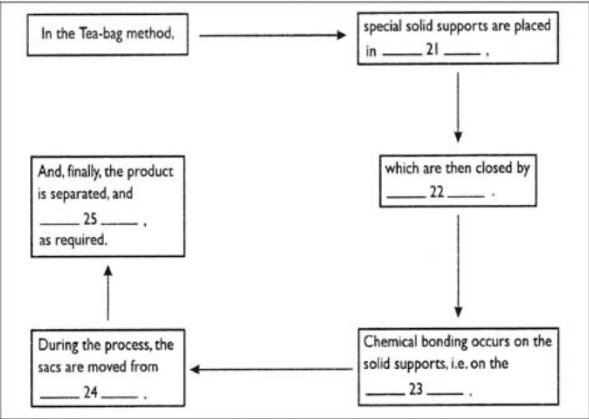
Using the Tea-bag method, developed by Houghten in the 1980s, typically about 100mg of the 100 micron beads are put into polypropylene mesh sacs which have a 75 micron mesh size. These are thermally sealed and the synthesis takes place on the resin beads with the sac. During the synthesis reaction cycles, the sacs are transferred from reagent pot to pot in sequence, and at the end of the synthesis, the product is cleaved off the bead, characterised and purified as need be. Using this strategy, one need to use a separate sac for each compound to be synthesised and automated systems have now been developed for multiple sac manipulation.
K
The sensitivity of compound analytical techniques has developed apace with the technology, and whereas, in the 1980s, one required several millimoles of product to characterise, now this can be done with femtomoles or in some cases attomoles)10^-18 moles)! Therefore, one need only recover product from 1 bead, about 2-3 picmoles. Automated systems are now being developed to synthesise on single magnetic beads using only 2-3 nanoliters of reagent per cycle. When the ‘classical’ Tea-bag strategy was developed, 100 millimetres per cycle were considered to be a phenomenal solvent cost-cutting exercise.
L
The development of high-the-put automated screening has demanded from synthetic chemistry large arrays or libraries of compounds to satisfy the investment made in installing these systems. Will combinatorial chemistry be able to meet this demand? Are the synthesisers well enough developed to meet this? Peptide and oligonucleotide solid phase strategies have been well enough developed over the past 30 years. Will solution methods and other novel chemistries be able to keep apace? Can virtual chemicals be used to remedy real problems? After all, we are living a real world.
Questions
Questions 1-6
Complete the text below, which is a summary of paragraphs A-E. Choose your answers from the word list and write them in boxes.
There are more words than spaces, so you will not be able to use them all. You may use each word only once.
Combinatorial chemistry as an 1._________ of synthetic organic chemistry has been very much 2. _______ in recent years, 3.__________ in a plethora of articles written by experts in the field. Moreover, all the reviews in specialist publications 4.________ the same formula. But what about the origin of combinatorial chemistry? It comes from permutation and combination problems in mathematics 5._________ solid phase peptide synthesis was developed, synthetic peptide chemists started doing similar calculations as well. The 20 naturally occurring amino acids provided them with 6.______ possibilities.
WORD LIST:
Known
In vogue
Appearing
Limitless
In the air
Once
Offspring
Until
Doubled
Usually follow
Offshoot
Limites
As
Followed religiously
References
Questions 7-11
Look at the paragraphs I and J which describe the Tea-bag method. Using the information in the passage, complete the flowchart.
Write your answers in the boxes on your answers sheet.
Questions 12-14
Use NO MORE THAN THREE WORDS for each answer.
Below is a list of the regular types of contributors to chemistry reviews.
Which three contributors are described by the writer? Write your answer A-F in the order they occur in the text on boxes 12-14 on the answer sheet.
A. a direct of s technology business park.
B. someone who is from a major company and involved directly in research.
C. someone who is involved in the new technology of combinatorial chemistry.
D. An amateur chemist who synthesised thousands of compounds per week.
E. the director of a small obscurely located and investment funded operation.
F. An out-of-practice director of some major chemical enterprise.
Questions 15
Choose the appropriate letter (A-D) and write it in boxes on your answers sheet.
15. Physical chemistry________
- Deals with the way physics is applied to chemical behaviour.
- Is closely connected with organic chemistry.
- Deals with the way chemistry is applied to physical behaviour.
- Led to the development of combinatorial chemistry.
Answers With Explanations
(Note: The text in italics mentions the location and referring lines written in the reading passage.)
1. Answer: offshoot
Explanation: In the first line of paragraph D, “Combinatorial chemistry is the branch of synthetic organic chemistry”. Here Brach should be read as Offshoot, Hence the answer.
2. Answer: in vogue
Explanation: In the first two lines of paragraph A, “For the past few years, one of the buzz terms in the pharmaceutical, agrochemical and biotechnology industries has been ‘combinatorial chemistry”. The term Buzzword should be read as in vogue and hence the answer
3. Answer: appearing
Explanation: In the last two lines of paragraph A, “Some of the more specialist journals have devoted whole issues to reviewing combinatorial chemistry”. Reviews has appeared in Journals.
4. Answer: follow religiously
Explanation: In the first line of paragraph B, “These reviews all have the same format”. Since the same format is followed rigorously. Hence the answer.
5. Answer: once
Explanation: In the last two lines of paragraph D, “Maths teachers call these permutation and combination problems; hence, combinatorial chemistry”.
6. Answer: limitless
Explanation: In the fifth, sixth and seventh lines of paragraph E, “If we take just one molecule of each of the 20 amino acids and join the together to form a peptide, we find that we can arrange these in 20! Or 2.432902008177*10^18 ways”.
7. Answer: (polypropylene) mesh sacs
Explanation: In the second line of paragraph J, “the 100 micron beads are put into polypropylene mesh sacs which have a 75 micron”.
8. Answer: thermally sealed
Explanation: In the third line of paragraph J, “These are thermally sealed and the synthesis takes place on the resin beads”.
9. Answer: resin beds
Explanation: In the third line of paragraph J, “These are thermally sealed and the synthesis takes place on the resin beads”.
10. Answer: pot to pot
Explanation: In the fifth line of paragraph J, “reagent pot to pot in sequence, and at the end of the synthesis, the product is cleaved off the”.
11. Answer: characterised and purified
Explanation: In the sixth line of paragraph J, “characterised and purified as need be”.
12. Answer: F
Explanation: In the second last line of paragraph H, “to satisfy the automated high-through-put screening system employed by the major pharmaceutical companies”.
13. Answer: E
Explanation: In the fifth line of paragraph B, “from a director of a venture capital funded synthetic chemistry company located on greenfield”.
14. Answer: C
Explanation: In the first two lines of paragraph A, “For the past few years, one of the buzz terms in the pharmaceutical, agrochemical and biotechnology industries has been ‘combinatorial chemistry”.
15. Answer: A
Explanation: In the third and fourth line of paragraph B, “This is filled with business speak; the jargon keeps the shareholder happy and makes them proud to own a bit of something at the forefront of science”.
Other Reading Tests

About Author Gayathri Nagarajan
Gayathri, a trusted study-abroad expert, with expertise in standardized tests like IELTS, TOEFL, PTE, GRE, and GMAT. With a strong tech background from SASTRA University, she excels in software testing and has a passion for content writing and digital marketing. She aids students in finding the perfect academic fit, offering guidance on course selection, LOR and SOP writing. She remains up-to-date with the latest trends in higher education, delivering credible, accurate information on international education, including courses and test prep materials. As a trusted Study abroad expert at Kanan International, explore her latest blogs and articles for comprehensive insights into studying abroad and realizing your academic aspirations.
Kanan.co is a trusted study abroad consultancy offering comprehensive services, resources, and solutions for students and education institutions. We support students at every stage of their global education journey, ensuring a smooth and guided experience. Along with test preparation for IELTS, GRE, TOEFL, and SAT, we provide expert services such as SOP writing, visa guidance, accommodation support, scholarship assistance, and education loan support. Our expertise and commitment to excellence make us a reliable partner for students pursuing international education.
Free Online Mock Test 2026
Practice our mock test worth Rs. 25000 for Free and know your IELTS score!








Global Headquarters
Kanan Int EdTech Inc
320 Bay Street, Suite 321 (Spaces), Toronto ON, Canada M5B 1N9
Indian Headquarters
Kanan International Pvt. Ltd.
D-wing, 2nd Floor, Trident Complex, Ellora Park Vadiwadi Road, Vadodara, Gujarat 390007
IT/ Digital Campus
Kanan International Pvt. Ltd
Old, New No 3, 2nd Floor, 1A, Dr Sadasivam Rd, T. Nagar, Chennai, Tamil Nadu 600017
Our branches
- Bardoli
- Bharuch
- Chennai
- Dehradun
- Gurugram
- Himatnagar
- Karnal
- Nadiad
- Navsari
- Palanpur
- Rajkot
- Vadodara
- Valsad
- Vallabh Vidyanagar
- Vapi
Study Abroad
Test Prep
Top Universities
Consultants
IELTS Centers
GRE Centers
TOEFL Centers
SAT Centers
Language Courses in Vadodara
Study Abroad Calculators
Featured Blogs
Study Abroad Consultants in Chennai
Study Abroad Consultants in Surat
Study Abroad Consultants in Navsari
Study Abroad Consultants in Bardoli
Study Abroad Consultants in Ahmedabad
Study Abroad Consultants in Anand
Study Abroad Consultants in Khanna
Study Abroad Consultants in Nadiad
Study Abroad Consultants in Vadodara
Study abroad consultants in Valsad
Copyright © 2026 KANAN.CO All rights reserved.