- Study Abroad
- / ielts
- / a new planet is discovered reading answers
A New Planet is Discovered Reading Answers


Author
17-09-2025

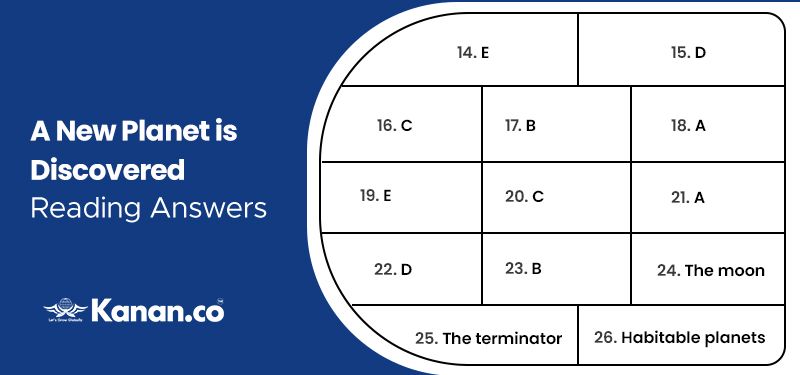
Here we have given A new planet is discovered reading answers as an illustration for the IELTS reading practice test. This article has 13 questions based on the given passage in 3 different types namely - 5 questions as locating information, 5 questions as diagram labelling, 3 questions as short answer questions.
Check out our YouTube Channel to Practice Full-Length IELTS Reading Tests Daily

Table of contents:
- Solution for A new planet is discovered
- A new planet is discovered IELTS reading practice test
- Passage
- Questions
- Answers with explanation
Solution for A New Planet is Discovered
Below, we have given the answers for A new planet is discovered reading answers in table form.

Answer table
| 14. E | 17. B | 20. C | 23. B | 26. Habitable planets |
| 15. D | 18. A | 21. A | 24. The moon | |
| 16. C | 19. E | 22. D | 25. The terminator |
A New Planet is Discovered IELTS reading practice test - Exam Review
We have given A new planet is discovered IELTS reading answers, This article will assist you to be excellent in the IELTS reading practice to challenge your reading skill and read the given passage to answer the questions.
Passage
Here the passage for A new planet is discovered reading answers with location is given. Go through the given passage and answer the given questions.
A new planet is discovered reading answers
[Humans have long been fascinated by the possibility of extraterrestrial life. Novels, films and folk tales have encouraged curiosity and speculation about what might be 'out there' in space. More recently, scientists have joined in on the collective wonderment after the first discovery by astronomers of a new planet-Gliese 581g-that could almost certainly support such organisms. Steven Vogt-one of the two astronomers credited with discovering the planet declared that the chances of life on this planet are 100%' and that he has 'almost no doubt about it'. ]
A. Although we currently know very little about Gliese 581g, a couple of its features strongly indicate that this planet might harbour the existence of organisms. Firstly, Gliese 581g is located at almost exactly the right distance from its red dwarf parent star (Gliese 581) to sustain liquid water, which is the only known criterion for organic formation. Planets that orbit too close to or too far away from their stars do not have a suitable climate; this can only be found in a slender strip of solar space around each star known to astronomers as a 'habitable zone'. Around our star Sun-Earth is the only planet that occupies this zone, although it nearly stretches to Venus and Mars. Gliese 581g is also the right size for organic life. It is about 3.1 to 4.3 times the size of Earth, and this relatively low mass means it should be made mostly of rock. Planets that grow beyond 10 times the size of Earth tend to become gaseous and uninhabitable, without the solid or liquid infrastructure necessary for organisms.
B. Gliese 581g is part of a string of planets in the Gliese 581 solar system. Two of Gliese 581g's siblings- Gliese 581e and Gliese 581b-orbit too close to their parent star to support any kind of life on them. Gliese 581c skims the near side of the habitable zone but scientists suggest that it does not have enough of a toehold in this zone to provide a stable infrastructure for organic formations roughly the same goes for Gliese 581d, which has a stronger presence in the habitable zone on its far side, but may not be hot enough for liquid water-opinion is not 'completely settled' on this matter, says James Kasting of Pennsylvania State University. Kasting, who has studied the two Gliese 581 planets on the outer edges of the habitable zone, suggests that Gliese 581g is 'smack dab in the middle' of the zone which, along with its size and composition, makes it the most exciting and realistic prospect for extraterrestrial life yet.
C. The comparisons between the Earth and Gliese 581g should not be overstated, however. Even if Gliese 581g can sustain organisms it would be a very different place to live. The main difference is that Gliese 581g orbits much closer to its star than the Earth does to the Sun. Because Gliese 581 is only 1% as bright as the Sun, it exudes little warmth, and its habitable zone lies much closer than the Sun's. At this closer distance, planets in the zone get locked into strong gravitational pulls that tend to slow their circular movements over time. Eventually, they become stuck with one side constantly facing the star-just as the Moon always shows the Earth the same face. Because of this, Gliese 581g experiences permanent daytime on the side likely facing the star and permanent shadow on the other side. It is estimated therefore that average temperatures on the star side would be about 71 degrees C and average temperatures on the other much chillier: -34°C. Nevertheless, Steven Vogt suggests that Gliese 581g probably has a comfortable area along the midpoint, known as the terminator. Any life here would always see the star sitting on the horizon and consequently experience eternal sunrise or sunset.
D. Even if there is no life on Gliese 581g, its discovery reveals that habitable planets are quite common, with around 10 to 20% of red dwarfs and sun-like stars boasting them. Gliese 581 is one of just nine stars at that particular distance which astronomers have searched with high enough precision to uncover a planet in the habitable zone. While the odds may prove to be slightly lower than 10 per cent, the evidence of life or at least, the high possibility of life is still overwhelming. There are at least a few hundred billion stars in our galaxy, which means that around 20 to 40 billion planets have the potential for the development of organisms.
E. And so, the search for life continues. Unfortunately, Gliese 581g is not particularly amenable to observation. The next step in finding out the chances of life on the planet would be to measure its light spectrum, a process that would reveal molecular oxygen if indeed it exists. The elara from the parent star makes this impossible to do with current instruments, however. Another way to gather information would be to transport a vessel to and trom the planet. The technology currently exists to do this, but at 20 light years from earth, it would take 200 years for astronomers to receive the result. Luckily, new information may just be a few years away. Astronomers suggest that many rocky planets are likely to be found in habitable zones during the coming years, and some of these will provide a better platform for research with current instruments.
Questions
Questions 14-18
- Reading Passage 2 has five paragraphs, A—E.
- Which paragraph contains the following information?
- Write the correct letter, A—E, in boxes 14-18 on your answer sheet.
14. A reason why we cannot learn much more about Gliese 581g in the near future
15. An estimate of the number of planets in habitable zones
16. An explanation for why Gliese 581g may not rotate
17. Gliese 581 g’s location in relation to other planets
18. A prerequisite for the beginning of life
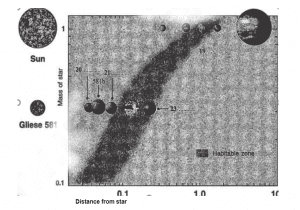
Questions 19-23
- Complete the diagram below.
- Choose the correct letter A—E from the box below.
- Write your answers in boxes 19-23 on your answer sheet.
Distance from star
- Gliese 581c
- Gliese 581d
- Gliese 581e
- Gliese 581g
- Earth
Questions 24-26
- Answer the questions below using NO MORE THAN TWO WORDS from the passage for each answer.
- Write your answers in boxes 24-26 on your answer sheet.
24. To what can Gliese 581g be compared because of its lack of circular motion?
25. What is the name for the central meridian on Gliese 581g where there is no darkness?
26. What do astronomers now realize are not rare occurrences?
Answers for A New Planet is Discovered with explanation
Answers for A new planet is discovered reading answers with explanations, are given here. This will help you to rectify your mistake.
14. Answer: E
Explanation: “And so, the search for life continues. Unfortunately, Gliese 581g is not particularly amenable to observation. The next step in finding out the chances of life on the planet would be to measure its light spectrum, a process that would reveal molecular oxygen if indeed it exists”. With this line it is clear that paragraph E states the reason why we cannot learn much more about Gliese 581g in the near future. Hence the given answer is located in the first 4 lines of paragraph E.
15. Answer: D
Explanation: “Even if there is no life on Gliese 581g, its discovery reveals that habitable planets are quite common, with around 10 to 20% of red dwarves and sun-like stars boasting them. Gliese 581 is one of just nine stars at that particular distance which astronomers have searched with high enough precision to uncover a planet in the habitable zone”. With this line it is clear that paragraph D states an estimate of the number of planets in habitable zones. Hence the given answer is located in the 1-4 lines of paragraph D.
16. Answer: C
Explanation: “The main difference is that Gliese 581g orbits much closer to its star than the Earth does to the Sun. Because Gliese 581 is only 1% as bright as the Sun, it exudes little warmth, and its habitable zone lies much closer than the Sun's. At this closer distance, planets in the zone get locked into strong gravitational pulls that tend to slow their circular movements over time”. With this line it is clear that paragraph C states an explanation for why Gliese 581g may not rotate. Hence the given answer is located in the 3-7 lines of paragraph C.
17. Answer: B
Explanation: “Gliese 581g is part of a string of planets in the Gliese 581 solar system. Two of Gliese 581g's siblings- Gliese 581e and Gliese 581b-orbit too close to their parent star to support any kind of life on them. Gliese 581c skims the near side of the habitable zone but scientists suggest that it does not have enough of a toehold in this zone to provide a stable infrastructure for organic formations roughly the same goes for Gliese 581d, which has a stronger presence in the habitable zone on its far side, but may not be hot enough for liquid water”. With this line it is clear that paragraph B states that Gliese 581 g’s location in relation to other planets. Hence the given answer is located in the 1-7 lines of paragraph B.
18. Answer: A
Explanation: “Firstly, Gliese 581g is located at almost exactly the right distance from its red dwarf parent star (Gliese 581) to sustain liquid water, which is the only known criterion for organic formation. Planets that orbit too close to or too far away from their stars do not have a suitable climate; this can only be found in a slender strip of solar space around each star known to astronomers as a 'habitable zone". With this line it is clear that paragraph A states about prerequisites for the beginning of life. Hence the given answer is located in the 2-7 lines of paragraph A.
19. Answer: E
Explanation: “ Planets that orbit too close to or too far away from their stars do not have a suitable climate; this can only be found in a slender strip of solar space around each star known to astronomers as a 'habitable zone". With this line it is clear that Earth as the reference of Gliese 581 g is made with Earth, and as per the condition and positioning. Hence the given answer is located in the 5-7 lines of paragraph A.
20. Answer: C
Explanation: “Two of Gliese 581g's siblings- Gliese 581e and Gliese 581 b-orbit too close to their parent star to support any kind of life on them”. With this line it is clear that Gliese 581e orbits too close to its star to support life. Hence the given answer is located in the 1-3 lines of paragraph B.
21. Answer: A
Explanation: “Gliese 581c skims the near side of the habitable zone but scientists suggest that it does not have enough of a toehold in this zone to provide a stable infrastructure for organic formations”. With this line it is clear that Gliese 581c is near the habitable zone but is not stable enough for life. Hence the given answer is located in the 3-5 lines of paragraph B.
22. Answer: D
Explanation: “Kasting, who has studied the two Gliese 581 planets on the outer edges of the habitable zone, suggests that Gliese 581g is 'smack dab in the middle' of the zone which, along with its size and composition, makes it the most exciting and realistic prospect for extraterrestrial life yet”. With this line it is clear that Gliese 581g is in the middle of the habitable zone and is a realistic prospect for life. Hence the given answer is located in the last 4 lines of paragraph B.
23. Answer: B
Explanation: “roughly the same goes for Gliese 581d, which has a stronger presence in the habitable zone on its far side”. With this line it is clear that Gliese 581d is on the far side of the habitable zone but may not be hot enough for liquid water. Hence the given answer is located in the 5-6 lines of paragraph B.
24. Answer: The moon
Explanation: “Eventually, they become stuck with one side constantly facing the star-just as the Moon always shows the Earth the same face. Because of this, Gliese 581g experiences permanent daytime on the side likely facing the star and permanent shadow on the other side”. With this line it is clear that Gliese 581g be compared because of its lack of circular motion. Hence the given answer is located in the 7-10 lines of paragraph C.
25. Answer: The terminator
Explanation: “Nevertheless, Steven Vogt suggests that Gliese 581g probably has a comfortable area along the midpoint, known as the terminator. Any life here would always see the star sitting on the horizon and consequently experience eternal sunrise or sunset”. With this line it is clear that terminator is the name for the central meridian on Gliese 581g where there is no darkness. Hence the given answer is located in the last 4 lines of paragraph C.
26. Answer: Habitable planets
Explanation: “Even if there is no life on Gliese 581g, its discovery reveals that habitable planets are quite common, with around 10 to 20% of red dwarves and sun-like stars boasting them” and “Astronomers suggest that many rocky planets are likely to be found in habitable zones during the coming years, and some of these will provide a better platform for research with current instruments”. With this line it is clear that the astronomers believe that many habitable planets are likely to be found as there is a higher probability of occurrence of such planets than what was believed to be. Hence the given answer is located in the first 2 lines of paragraph D and last 3 lines of paragraph E.
Other reading answers

About Author Tejaswini Kota
Tejaswini is an enthusiastic writer, reader and a passionate learner. Additionally, she was a research fellow and holds a grip in English writings and research/paper publications. She holds bachelors and masters degrees in engineering. She spent three years in the education industry and is currently working as a full-time content writer at Kanan International, writing articles for study abroad projects. She is proficient in creating good quality content that helps the students for language proficiency tests like IELTS, GRE, TOEFL etc. and can help in advising you the right choice of college for admission.
Kanan.co is a trusted study abroad consultancy offering comprehensive services, resources, and solutions for students and education institutions. We support students at every stage of their global education journey, ensuring a smooth and guided experience. Along with test preparation for IELTS, GRE, TOEFL, and SAT, we provide expert services such as SOP writing, visa guidance, accommodation support, scholarship assistance, and education loan support. Our expertise and commitment to excellence make us a reliable partner for students pursuing international education.
Free Online Mock Test 2026
Practice our mock test worth Rs. 25000 for Free and know your IELTS score!








Global Headquarters
Kanan Int EdTech Inc
320 Bay Street, Suite 321 (Spaces), Toronto ON, Canada M5B 1N9
Indian Headquarters
Kanan International Pvt. Ltd.
D-wing, 2nd Floor, Trident Complex, Ellora Park Vadiwadi Road, Vadodara, Gujarat 390007
IT/ Digital Campus
Kanan International Pvt. Ltd
Old, New No 3, 2nd Floor, 1A, Dr Sadasivam Rd, T. Nagar, Chennai, Tamil Nadu 600017
Our branches
- Bardoli
- Bharuch
- Chennai
- Dehradun
- Gurugram
- Himatnagar
- Karnal
- Nadiad
- Navsari
- Palanpur
- Rajkot
- Vadodara
- Valsad
- Vallabh Vidyanagar
- Vapi
Study Abroad
Test Prep
Top Universities
Consultants
IELTS Centers
GRE Centers
TOEFL Centers
SAT Centers
Language Courses in Vadodara
Study Abroad Calculators
Featured Blogs
Study Abroad Consultants in Chennai
Study Abroad Consultants in Surat
Study Abroad Consultants in Navsari
Study Abroad Consultants in Bardoli
Study Abroad Consultants in Ahmedabad
Study Abroad Consultants in Anand
Study Abroad Consultants in Khanna
Study Abroad Consultants in Nadiad
Study Abroad Consultants in Vadodara
Study abroad consultants in Valsad
Copyright © 2026 KANAN.CO All rights reserved.