- Study Abroad
- / ielts
- / a new threat in yellowstone reading answers
A New Threat in Yellowstone Reading Answers


Author
17-09-2025

“A new threat in yellowstone reading answers” are given in the table below. Cross verify your answers with ours and correct the wrong answers.
| 1. AH | 5. TM | 9. 2 Percent | 13. A |
| 2. AW | 6. AB | 10. 50 Percent | |
| 3. GP | 7. SF | 11. A | |
| 4. JG | 8. 50 | 12. C |

After finishing the passage "A new threat in yellowstone reading answers," you can practise all IELTS reading question types. Most importantly, you don't need to read the entire passage because skimming and scanning will speed up the process of finding the right answers. Below are the question types of the mentioned passage: –
IELTS Reading Multiple choice questions
IELTS Reading Diagram completion
IELTS Reading Matching features
Check out our YouTube Channel to Practice Full-Length IELTS Reading Tests Daily

IELTS Reading Passage: A New Threat in Yellowstone
These are 13 questions based on the information provided; you should set aside 20 minutes to complete them. A new threat in yellowstone IELTS reading answers with locations are accessible for review once the test has been completed.
A New Threat in Yellowstone
A. Yellowstone National Park is situated over a sizable supervolcano, as is well known. The term "supervolcano" refers to a volcanic centre that has experienced an eruption of magnitude 8, or deposits that are greater than 1,000 cubic kilometres, according to the Volcano Explosivity Index (VEI). Professor George Peters describes the potential outcomes if something were to happen because this sounds alarming. "A major eruption would cover the rest of the United States and Canada in several inches of ash and destroy everything in a radius of hundreds of kilometres. This could stop all agricultural production and result in a decade-long cooling of the planet's climate. Geologist Tony Masters tries to reassure everyone by saying there isn't much to worry about right now. Tens of thousands to millions of years ago, all VEI 8 eruptions took place, including the most recent one at Yellowstone. Although it is extremely unlikely to happen in the next million years or so, another eruption could happen.
B. Controversy is nothing new to Yellowstone. It was previously claimed in the media that US Geological Survey (USGS) geologists had not completed their work properly and that scientists had to wait until they saw images of Yellowstone taken from space before identifying it as a supervolcano. This was refuted by the Yellowstone scientists. Alice Wheeler, a spokesperson, clarifies their stance. "The USGS scientist first recognized the three Yellowstone calderas and revealed to the world the massive eruptions that created them. He used traditional fieldwork methods to map the caldera's boundaries, strolling around with a hammer and hand lens while paying close attention to the distribution of the rocks.Also in agreement was the National Aeronautics and Space Administration (NASA). Their spokesperson, Stan Forsyth, explains. Although it has been claimed by a number of authors that these massive calderas in Yellowstone were found from space, we believe that the rumour originated because the initial field work that located them was partially funded by NASA.
C. The fact that the supervolcano has recently been found to be larger than initially believed has increased people's anxiety is a new issue in Yellowstone. Seismologists from the University of Utah have collaborated with scientists from a number of other organisations to use a method called seismic tomography to create an image of the Yellowstone magma reservoir. Julia Grey, a master's student, explains the findings. We have found that there are two magma reservoirs, one shallow and one deep, and that they are much larger than previously thought by carefully examining data from thousands of earthquakes. We already knew about the shallow one, but the deeper one is a recent discovery.
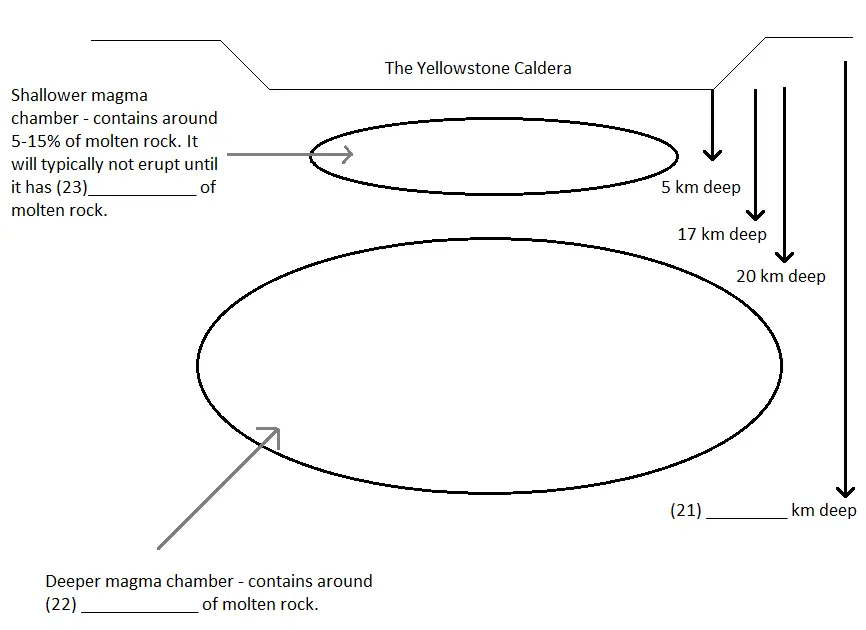
D. The research teams analysed data from tens of thousands of earthquakes to construct a picture of this second magma reservoir beneath Yellowstone. In hot, partially molten rock, seismic waves move more slowly, while in cold, solid rock, they move more quickly. A subsurface image of the hot or partially molten bodies in the crust beneath Yellowstone was created by the researchers by mapping the areas where seismic waves move more slowly. The deeper magma storage region is 4.5 times larger than the shallow magma body, ranges in depth from 20 to 50 kilometres, and contains about 2% melt. The shallower magma storage region is roughly 90 km long, ranges in depth from 5 to 17 km, and is 2.5 times larger than what a previous, less reliable study suggested. Between 5 and 15 percent of this magma reservoir is made up of molten rock. Although Yellowstone's past volcanic activity has been fueled by this region of crustal magma storage, magma typically does not erupt unless it has melted by more than 50%.
E. The US and international media acted quickly to dramatise the discovery and overstate the danger that it poses. Amy Brent, a scientist who studies Yellowstone Park, has soothing words. "These results do not change the assessment of Yellowstone's volcanic hazard. The region where magma is stored inferred is no bigger than what was known. Simply put, the research improves our understanding of the magmatic system. Simply put, we now know more important details about how the Yellowstone volcano functions.
F. The Yellowstone region has experienced recurrent eruptions over a protracted period of time, according to numerous independent reports that support Brent's assertions. Supervolcanoes hardly ever erupt, and eventually the cycle brings about their demise. Andrea Haller, a geologist for the US government, describes the status of the Yellowstone supervolcano. We can infer that Yellowstone's current activity is on the dying cycle by examining the patterns of behaviour in two previously finished caldera cycles. Based on comparisons with other supervolcanoes, this is stated. Scientists are aware of historical behaviour and the current comparative stage of Yellowstone.Yellowstone is thought to be in the midst of its third and final dying cycle right now. The fact that dying volcanoes produce less newly molten material from the Earth's crust leads to this conclusion. Haller keeps going. The majority of the material we've seen in the magma chambers is made up of recycled volcanic rocks that were once buried inside calderas and are now being used again. Yellowstone has already erupted enough of this material to indicate that the crust's capacity to melt in the future is running out.
G. Whatever the case, it appears that Yellowstone's geological condition can still be dangerous during the average person's lifetime. Prior to the volcano becoming harmless, the park has frequently been forced to close because of volcanic activity.
Glossary:
Caldera: A sizable volcano crater.
Magma: Is molten rock.
A New Threat in Yellowstone Reading Questions
Questions 14-20
Look at the following statements (questions 14-20) and the list of people below.
Match each statement with the correct person’s initials.
Write the correct initials in boxes 14-20 on your answer sheet.
14. The Yellowstone supervolcano is in the final stages of its dying cycle.
15. Conventional geology methods were first used to identify the Yellowstone supervolcano.
16. Canada's agriculture would be destroyed by a significant Yellowstone eruption.
17. The magma chambers in Yellowstone are bigger than previously believed.
18. Thousands of years ago, there was a significant eruption at Yellowstone.
19. Scientific understanding of the Yellowstone volcano's operation has improved.
20. NASA has in the past contributed funding to the study of the Yellowstone supervolcano.
- GP George Peters
- TM Tony Masters
- AW Alice Wheeler
- SF Stan Forsyth
- JG Julia Grey
- AB Amy Brent
- AH Andrea Haller
Click to know more about IELTS Reading Matching Features
Questions 21-23
Label the diagram below.
Write NO MORE THAN THREE WORDS AND/OR A NUMBER from the text for each answer.
Write your answers in boxes 21-23 on your answer sheet.
The Yellowstone Supervolcano
Click to know more about IELTS Reading Diagram Completion
Questions 24-26
Choose the correct letter A, B, C or D.
Write the correct letter in boxes 24-26 on your answer sheet.
24. It is possible to create images of the magma chambers because
A. Of the varying rates at which seismic waves move through various types of rock.
B. Sections of magma are impermeable to seismic waves.
C. Only colder rock is detected by seismic waves.
D. Rapid seismic wave propagation.
25. Yellowstone supervolcano's demise
A. Will take place within a few years.
B. Never able to be predicted.
C. Because there isn't any recently molten rock, can be predicted.
D. After the following major eruption.
26. National Park of Yellowstone
A. will likely need to be shut down during specific dangerous times.
B. will most likely never reopen due to the risks.
C. never need to be shut down during peoples' lifetimes.
D. will try to prevent wild animals from entering it.
Click to know more about IELTS Reading Multiple Choice Questions
A new threat in yellowstone Reading answers with Explanation
A new threat in yellowstone Reading answers with explanations can help you correct errors and identify the information needed for your answer.
(Note: The text in italics from the reading passage shows the location from where the answer is taken or inferred.)
1. A
Explanation: In the fourth and fifth lines of paragraph D, “A subsurface image of the hot or partially molten bodies in the crust beneath Yellowstone was created by the researchers by mapping the areas where seismic waves move more slowly”.
2. C
Explanation: In the fourth and fifth lines of paragraph D, “A subsurface image of the hot or partially molten bodies in the crust beneath Yellowstone was created by the researchers by mapping the areas where seismic waves move more slowly”.
3. A
Explanation: In the last two lines of paragraph G, “Prior to the volcano becoming harmless, the park has frequently been forced to close because of volcanic activity”.
4. 50
Explanation: In the sixth and seventh lines of paragraph D, “The deeper magma storage region is 4.5 times larger than the shallow magma body, ranges in depth from 20 to 50 kilometres, and contains about 2% melt”.
5. 2 Percent
Explanation: In the seventh line of paragraph D, “in depth from 20 to 50 kilometres, and contains about 2% melt”.
6. 50 Percent
Explanation: In the last line of paragraph D, “unless it has melted by more than 50%”.
7. AH
Explanation: In the fourth, fifth and sixth lines of paragraph F, “Andrea Haller, a geologist for the US government, describes the status of the Yellowstone supervolcano. We can infer that Yellowstone's current activity is on the dying cycle by examining the patterns of behaviour in two previously finished caldera cycles”.
8. AW
Explanation: In the fifth and sixth lines of paragraph B, “The USGS scientist first recognized the three Yellowstone calderas and revealed to the world the massive eruptions that created them”.
9. GP
Explanation: In the fifth, sixth and seventh lines of paragraph A, “A major eruption would cover the rest of the United States and Canada in several inches of ash and destroy everything in a radius of hundreds of kilometres”.
10. JG
Explanation: In the fifth, sixth and seventh lines of paragraph C, “We have found that there are two magma reservoirs, one shallow and one deep, and that they are much larger than previously thought by carefully examining data from thousands of earthquakes”.
11. TM
Explanation: In the last three lines of paragraph A, “Tens of thousands to millions of years ago, all VEI 8 eruptions took place, including the most recent one at Yellowstone. Although it is extremely unlikely to happen in the next million years or so, another eruption could happen”.
12. AB
Explanation: In the second and third lines of paragraph E, “Amy Brent, a scientist who studies Yellowstone Park, has soothing words. "These results do not change the assessment of Yellowstone's volcanic hazard”.
13. SF
Explanation: In the last four lines of paragraph B, “Their spokesperson, Stan Forsyth, explains. Although it has been claimed by a number of authors that these massive calderas in Yellowstone were found from space, we believe that the rumour originated because the initial field work that located them was partially funded by NASA”.
Check the other reading passages
- If at first you don't succeed reading answers
- The pursuit of happiness reading answers
- The canals of de lesseps reading answers
Conclusion
IELTS reading resources like "A new threat in yellowstone Reading Answers" are very helpful. The above-mentioned locations have resources and sample tests you can use to get ready for the IELTS. This page was produced as a resource for those learning for the IELTS reading test as a result.

About Author Roshan Sunthar
Roshan Sunthar is a study abroad expert as well as a renowned writer and author in international education. His academic excellence and 5+ years of work experience give him in-depth knowledge of international standardised exams and test preparation in IELTS, TOEFL, GRE, PTE, SAT, etc. The study materials he prepares incorporate exam-like questions. He’s also an expert in writing Statement of Purposes (SOPs) and Letter of Recommendations (LORs) for college admissions. He usually spends his leisure time watching English classics and documentaries, travelling, etc.
Kanan.co is a trusted study abroad consultancy offering comprehensive services, resources, and solutions for students and education institutions. We support students at every stage of their global education journey, ensuring a smooth and guided experience. Along with test preparation for IELTS, GRE, TOEFL, and SAT, we provide expert services such as SOP writing, visa guidance, accommodation support, scholarship assistance, and education loan support. Our expertise and commitment to excellence make us a reliable partner for students pursuing international education.
Free Online Mock Test 2026
Practice our mock test worth Rs. 25000 for Free and know your IELTS score!








Global Headquarters
Kanan Int EdTech Inc
320 Bay Street, Suite 321 (Spaces), Toronto ON, Canada M5B 1N9
Indian Headquarters
Kanan International Pvt. Ltd.
D-wing, 2nd Floor, Trident Complex, Ellora Park Vadiwadi Road, Vadodara, Gujarat 390007
IT/ Digital Campus
Kanan International Pvt. Ltd
Old, New No 3, 2nd Floor, 1A, Dr Sadasivam Rd, T. Nagar, Chennai, Tamil Nadu 600017
Our branches
- Bardoli
- Bharuch
- Chennai
- Dehradun
- Gurugram
- Himatnagar
- Karnal
- Nadiad
- Navsari
- Palanpur
- Rajkot
- Vadodara
- Valsad
- Vallabh Vidyanagar
- Vapi
Study Abroad
Test Prep
Top Universities
Consultants
IELTS Centers
GRE Centers
TOEFL Centers
SAT Centers
Language Courses in Vadodara
Study Abroad Calculators
Featured Blogs
Study Abroad Consultants in Chennai
Study Abroad Consultants in Surat
Study Abroad Consultants in Navsari
Study Abroad Consultants in Bardoli
Study Abroad Consultants in Ahmedabad
Study Abroad Consultants in Anand
Study Abroad Consultants in Khanna
Study Abroad Consultants in Nadiad
Study Abroad Consultants in Vadodara
Study abroad consultants in Valsad
Copyright © 2026 KANAN.CO All rights reserved.