- Study Abroad
- / ielts
- / academic
- / reading
- / question types
- / diagram labelling
IELTS Academic Reading Diagram Labelling


Author
17-09-2025

In IELTS academic reading diagram labelling, a paragraph and a diagram will be given, for which you have to label the parts referring to the passage. You may find it challenging to solve diagram labelling questions but our tips will guide you to tackle this question.
In this task a diagram explaining a scientific or natural process or structure of a living or non-living thing is presented. Your task is to fill specific parts of the diagram with text or word from the reading passage.
In this article, you will find expert-proven tips and strategies which will help you to solve IELTS Academic Reading Diagram Labelling as this is one of the significant IELTS academic reading question types. It also helps you to attain an 8+ band score in the IELTS reading section.
Check Out our YouTube Channel to Practice Full-Length IELTS Reading Tests Daily

Table of Contents
- IELTS Academic Reading Diagram Labelling - Tips & Strategies to Solve
- Common problems faced by students in diagram labelling
- Skills required to solve diagram labelling
- Diagram Labelling Practice exercise 1
- Diagram labelling Practice exercise 2
- Diagram Labelling Practice exercise 3
- Diagram Labelling Practice exercise 4
- Answer for Practice Exercise
- Conclusion
IELTS Academic Reading Diagram Labelling - Strategies & Tips to Solve
IELTS academic reading diagram labelling Tips & Strategies listed below will be helpful for you to get a good band score in diagram labelling.
- In the diagram, notice the various components and their arrangements for correct interpretation. If it is a Process Diagram, notice the arrows to understand the process.
- Also consider the words close to the blanks. These are mostly picked from the text or reworded with basic synonyms.
- Read the labels provided already as these are helpful in finding the answer.
- You may find answers in the description of the diagram.
- Before you answer a question, try to find a keyword present in the paragraph and highlight it.
- Complete the easier questions first so you may get more time to solve the difficult questions.
- The answers may not be in progressive order.
- Look at the parts to be labelled and decide what type of information is required to the blank.
- Keep yourself calm and pay more attention to the complicated diagrams.
- Understand the link between the diagram and the label to fill the blanks correctly.
These IELTS academic reading diagram labelling tips & strategies will help furthermore to improve your knowledge in diagram labelling.
Also read: IELTS academic reading tips
Common problems faced by students in diagram labelling
- Finding the answers in the paragraph may be time consuming.
- Students may misspell or misunderstand the words thus finding it difficult to answer the question.
Skills required to solve diagram labelling
- Skilled in identifying the noun, adjective, verb, synonyms, keyword, paraphrases
- Ability to break the diagram
Diagram Labelling Practice exercise 1
School Experiments Reading Passage
It is essential when conducting this experiment to wear safety goggles. This experiment is divided into four distinct sections. The first, the reaction stage, is when a glass beaker is placed on top of a tripod, and 20cm of dilute sulphuric acid poured into it. The acid is then heated. When it is almost boiling, a small quantity of copper oxide powder is added to the beaker. The mixture is then stirred with a glass spatula until the copper oxide has dissolved. This process is then repeated until 1g of powder has been added to the sulphuric acid. The heat is then removed from the beaker and the solution allowed to cool. The second stage is the filtration stage and, as the name suggests, is where a filter and conical flask are used to remove any copper oxide that has not reacted. A clear copper sulphate solution will be left in the glass dish. The third stage is where heat is applied to the copper sulphate solution in order to concentrate the solution: the concentration stage. The final crystallization stage happens when the solution begins to cool, and pure copper sulphate crystals start to form.
Questions 1 – 6
The diagram below shows how copper sulphate can be made using simple laboratory equipment.
Choose NO MORE THAN THREE WORDS AND/OR A NUMBER from the passage for each answer.
Label the diagram.
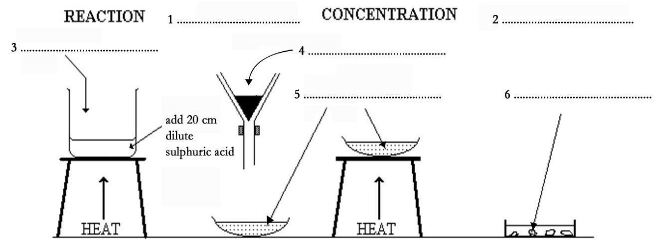
Diagram labelling Practice exercise 2
The platypus (Ornithorhynchus anatinus) Reading Passage
The platypus (Ornithorhynchus anatinus) is one of the most unusual, unlikely and evolutionary distinct animals alive. According to the BBC, the first time a platypus was brought from Australia to Britain, people believed that a hoodwinker had sewn two animals together and that they were the victims of a hoax. Platypuses are best described as a hotchpotch of more recognizable species such as the duck, beaver or otter. The physical structure, habitat and reproduction system of the platypus makes it an interesting and unique mammal.
Weighing around three pounds, the platypus measures 15 inches (38 cm) from its head to lower back. The tail adds about 5 inches (13 cm). However, the creatures inhabiting colder regions are bigger. The physiology of the platypus is adapted for survival on land as well as in water. The shape of its bill gives it the name duck-billed platypus. This flexible body part is smooth like suede and has receptors for navigation and detection of movements of freely-swimming food, such as shrimp. The eyes and ears located in the grooves behind the bill are covered by folds of skin and a watertight seal that closes the nostrils when it is underwater. Platypuses have thick waterproof fur which allows them to stay warm underwater. Although most of its fur is dark brown, a patch near the eyes and on the underside is of a lighter shade. When on land, the webbing on their feet retracts, making their claws more pronounced and hence, these animals walk awkwardly on their knuckles to protect the web.
Yet another peculiar fact about these animals is that they are one of the very few mammals which are poisonous. Male platypuses have a horny spur on the ankles of their hind feet. It is connected to a venom gland in the upper leg. It releases a poison capable of causing excruciating pain to humans and is also capable of killing other small animals. Fat is stored in the tail.
These mammals inhabit only one small area of the world. Platypuses make their homes in freshwater bodies that flow throughout the eastern and south-eastern coasts of Australia and the island of Tasmania. Though these creatures exist only on one side of one continent, platypuses can be found in various climate extremes such as in lowlands, plateaus, cold mountains and tropical rainforests. Although platypuses spend a lot of time in the water, they waddle onto the riverbanks to claw through the mud using their nails and feet to make burrows which are tunnels with chambers or rooms. They can also reside under debris, rock ledges or roots.
Platypuses are nocturnal and hence are most actively hunting during the night which can last for about 10 to 12 hours. Hunting for food takes place under the water. As they swim, they try to detect food such as insects, larvae, worms or shellfish along the muddy bottom of the water body. They scoop the prey in their bills, store it in cheek pouches and swim to the surface. Because they do not have teeth but grinding plates, they use the gravel and dirt that they scooped up to fragment their food into digestible portions.
The platypus is listed as a species of ‘least concern’ by the International Union for Conservation of Nature (IUCN). However, being a carnivore, its role as that of controlling the population of species in the lower level of the food chain cannot be ignored. The biggest threats include natural predators such as snakes, water rats and goannas, and some introduced animals such as foxes, dogs and cats. Human activities such as land clearing and dams are the biggest threat to the loss of habitat. However, platypuses have been able to evade most of the human intrusion of their natural environment.
Questions 1-6
Label the diagram below.
Write ONE WORD ONLY from the passage for each answer.

Diagram Labelling Practice exercise 3
How Does Night Vision Work Reading Passage
Night vision technology has transformed from old-fashioned bulky devices to compact sophisticated equipment that can intensify any light source up to 50,000 times. A device for night vision was first developed in the 1930s by the German military, and later by the Americans. Today, it has become an essential device in the kit of soldiers, permitting them to find out their targets in reduced visibility or complete darkness and move around in comparative safety as there are fewer chances of a surprise attack. ‘It improves their mobility, their survivability and their lethality’, says Lt. Col. Timothy Fuller.
So, what makes night vision possible? Light is an electromagnetic wave, and the entire range of light that exists is termed as the electromagnetic spectrum. The light visible to humans is only a part of this spectrum, while infrared light and ultraviolet light are invisible to naked eyes. The night vision devices work on two different technologies. The first is image enhancement using the tiny amount of light available which is collected and amplified to the extent that we can easily see the image. Thermal imaging, on the other hand, functions by capturing the higher areas of the infrared spectrum, which is radiated by objects as heat instead of light.
Even on dark nights, the stars and the moon emit near-infrared light. In a device that works on image enhancement technique, this faint light is captured to amplify it to a visible level. As the light consisting of photons enters the front lens of the image intensifier tube, it hits a photocathode which converts the photons into electrons. These electrons multiply as they pass through a thin microchannel plate. At the end of the tube, the electrons strike a phosphor screen which converts them back into photons and creates an image, usually green, on the screen. Since more photons are emerging than those which entered the tube, the image is much brighter than the original scene. Rich Urich, director of operations at Night Vision Equipment Company in Prescott Valley Arizona, says, ‘The reason it is green is because when you put the unit down, you want your eyes to remain dilated so you can see in dim light.’
Thermal imaging devices record the temperature difference between an object and its surroundings using a sensor called a microbolometer. An image of the object is created, which is then sent to the display where the user can see it.
However, it is not only in warfare that this technology finds use. Night vision equipment is used extensively by law enforcement departments to detect criminals in the dark. They are also used on borders to keep a check on illegal crossings. The technology is also used to find leaks and repair insulation in homes.
Questions 1-5
Label the diagram below.
Write NO MORE THAN TWO WORDS from the passage for each answer.

Diagram Labelling Practice exercise 4
Mrs carlill and the carbolic smoke ball
A. On 14 January 1892, Queen Victoria’s grandson Prince Albert Victor, second in line to the British throne, died from flu. He had succumbed to the third and most lethal wave of the Russian flu pandemic sweeping the world. The nation was shocked. The people mourned. Albert was relegated to a footnote in history.
B. Three days later, London housewife Louisa Carlill went down with the flu. She was shocked. For two months, she had inhaled thrice daily from a carbolic smoke ball, a preventive measure guaranteed to fend off flu - if you believed the advert. Which she did. And why shouldn’t she when the Carbolic Smoke Ball Company had promised to cough up £100 for any customer who fell ill? Unlike Albert, Louisa recovered, claimed her £100 and set in train events that would win her lasting fame.
C. It started in the spring of 1889. The first reports of a flu epidemic came from Russia. By the end of the year, the world was in the grip of the first truly global flu pandemic. The disease came in waves, once a year for the next four years, and each worse than the last.
Whole cities came to a standstill. London was especially hard-hit. As the flu reached each annual peak, normal life stopped. The postal service ground to a halt, trains stopped running, banks closed. Even courts stopped sitting for lack of judges. At the height of the third wave in 1892, 200 people were buried every day at just one London cemetery. This flu was far more lethal than previous epidemics, and those who recovered were left weak, depressed, and often unfit for work. It was a picture repeated across the continent.
D. Accurate figures for the number of the sick and dead were few and far between but Paris, Berlin and Vienna all reported a huge upsurge in deaths. The newspapers took an intense interest in the disease, not just because of the scale of it but because of who it attacked. Most epidemics carried off the poor and weak, the old and frail. This flu was cutting as great a swathe through the upper classes, dealing death to the rich and famous, and the young and fit.
E. The newspaper-reading public was fed a daily diet of celebrity victims. The flu had worked its way through the Russian imperial family and invaded the royal palaces of Europe. It carried off the Dowager Empress of Germany and the second son of the king of Italy, as well as England’s future king. Aristocrats and politicians, poets and opera singers, bishops and cardinals - none escaped the attention of the Russian flu.
F. The public grew increasingly fearful. The press might have been overdoing the doom and gloom, but their hysterical coverage had exposed one terrible fact.
The medical profession had no answer to the disease. This flu, which might not even have begun in Russia, was a mystery. What caused it and how did it spread? No one could agree on anything.
G. By now, the theory that microorganisms cause disease was gaining ground, but no one had identified an organism responsible for flu (and wouldn’t until 1933). In the absence of a germ, many clung to the old idea of bad airs, or miasmas, possibly stirred by some great physical force - earthquakes, perhaps, or electrical phenomena in the upper atmosphere, even a passing comet.
H. Doctors advised people to eat well avoiding “unnecessary assemblies”, and if they were really worried, to stuff cotton wool up their nostrils. If they fell ill, they should rest, keep warm and eat a nourishing diet of “milk, eggs and farinaceous puddings”. Alcohol figured prominently among the prescriptions: one eminent English doctor suggested champagne, although he conceded “brandy M in considerable quantities has sometimes been given with manifest advantages”. French doctors prescribed warm alcoholic drinks, arguing that they never saw an alcoholic with flu. Their prescription had immediate results: over a three-day period, 1,200 of the 1,500 drunks picked up on the streets of Paris claimed they were following doctor’s orders.
I. Some doctors gave drugs to ease symptoms - quinine for fever, salicin for headache, heroin for an “incessant cough”. But nothing in the pharmacy remotely resembled a cure. Not surprisingly, people looked elsewhere for help. Hoping to cash in while the pandemic lasted, purveyors of patent medicines competed for the public’s custom with ever more outrageous advertisements. One of the most successful was the Carbolic Smoke Ball Company.
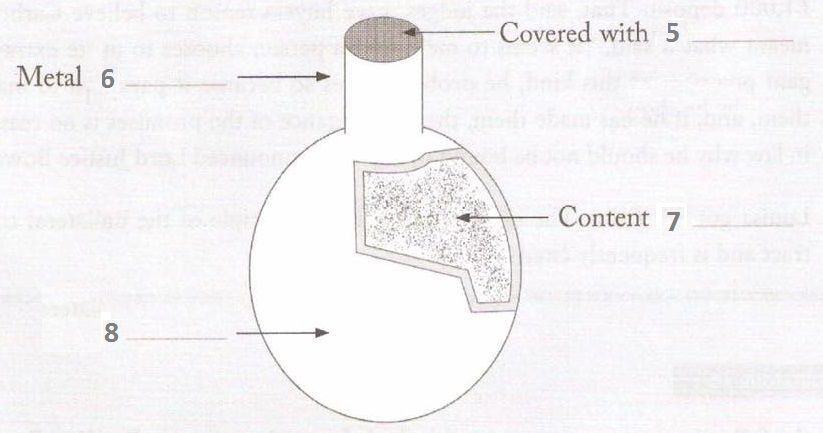
J. The carbolic smoke ball was a hollow rubber ball, 5 centimetres across, with a nozzle covered by gauze. Inside was a powder treated with carbolic acid, or phenol. The idea was to clutch it close to the nose and squeeze gently, inhaling deeply from the emerging cloud of pungent powder. This, the company claimed, would disinfect the mucous membranes, curing any condition related to “taking cold”. In the summer of 1890, sales were steady at 300 smoke balls a month. In January 1891, the figure skyrocketed to 1,500.
K. Eager to exploit the public’s mounting panic, the Carbolic Smoke Ball Company made increasingly extravagant claims. Oh 13 November 1892, its latest advert in the Pall Mall Gazette caught the eye of south London housewife Louisa Carlill. “Carbolic Smoke Ball,” it declared, “will positively cure colds, coughs, asthma, bronchitis, hoarseness, influenza, croup, whooping cough ...”. And the list went on. But it was the next part Mrs. Carlill found compelling. “A £100 reward will be paid by the Carbolic Smoke Ball Company to any person who contracts the increasing epidemic influenza, colds or any disease caused by taking cold, after having used the carbolic smoke ball according to the printed directions supplied with each ball. £1,000 is deposited with the Alliance bank, Regent Street, showing our sincerity in the matter.”
L. Mrs. Carlill hurried off to buy a smoke ball, price 10 shillings. After carefully reading the instructions, she diligently dosed herself thrice daily until 17 January - when she fell ill.
On 20 January, Louisa’s husband wrote to the Carbolic Smoke Ball Company. Unfortunately for them, Mr. Carlill happened to be a solicitor. His wife, he wrote, had seen their advert and bought a smoke ball on the strength of it. She had followed the instructions to the letter, and yet now - as their doctor could confirm - she had flu.
M. There was no reply. But £100 was not a sum to be sneezed at. Mr. Carlill persisted. The company resisted. Louisa recovered and sued. In June, Mr. Justice Hawkins found in Mrs. Carlill’s favour. The company’s main defence was that adverts were mere “puffery” and only an idiot would believe such extravagant claims. Judge Hawkins pointed out that adverts were not aimed at the wise and thoughtful, but at the credulous and weak. A vendor who made a promise “must not be surprised if occasionally he is held to his promise”.
N. Carbolic appealed. In December, three lord justices considered the case. Carbolic’s lawyers tried several lines of defence. But in the end, the case came down to a single matter: not whether the remedy was useless, or whether Carbolic had committed fraud, but whether its advert constituted a contract - which the company had broken. A contract required agreement between two parties, argued Carbolic’s lawyers. What agreement had Mrs. Carlill made with them?
O. There were times, the judges decided, when a contract could be one-sided. The advert had made a very specific offer to purchasers: protection from flu or £100. By using the smoke ball as instructed, Mrs. Carlill had accepted that offer. The company might just have wriggled out of if if it hadn’t added the bit about the £1,000 deposit. That, said the judges, gave buyers reason to believe Carbolic meant what it said. “It seems to me that if a person chooses to make extravagant promises of this kind, he probably does so because it pays him to make them, and, if he has made them, the extravagance of the promises is no reason in law why he should not be bound by them,” pronounced Lord Justice Bowen.
P. Louisa got £100. The case established the principle of the unilateral and is frequently cited today.
Questions 5-8
Complete the diagram below.
Choose NO MORE THAN TWO WORDS from the passage for each answer.
Write your answers in boxes 5-8 on your answer sheet.
Answer for Practice Exercise
You will find the answers for practice exercises 1, 2, and 3 right here.
School Experiments Reading Answers
(Note: The text in italics is from the reading passage and shows the location from where the answer is taken or inferred. The text in regular font explains the answer in detail.)
1. Filtration
Explanation : The second stage is the filtration stage and, …..
2. Crystallization
Explanation : The final crystallization stage happens when the solution begins to cool, and pure copper sulphate crystals start to form.Answers 1 and 2 can be understood from the mentioned information that defines stages. The two stages( out of four) are mentioned in the diagram. As it is a list, similar information is required. The guiding words for you are: first, second, third and final.
3. Copper oxide powder
Explanation : When it is almost boiling, a small quantity of copper oxide powder is added to the beaker.
The process of heating is mentioned in the diagram, and the arrow at Question 3 indicates the addition of an element.
4. Remove copper oxide / filter copper oxide
Explanation : The second stage is the filtration stage and, as the name suggests, is where a filter and conical flask are used to remove any copper oxide that has not reacted.
The dimensions of the flask and the shaded portion in the flask indicate the residue in the filter.
5. Copper sulphate solution
Explanation : A clear copper sulphate solution will be left in the glass dish. The third stage is where heat is applied to the copper sulphate solution in order to concentrate the solution; the concentration stage.
The shape of the dish, the heat are indicators of what is obtained next.
6. Copper sulphate crystals
Explanation : The final crystallization stage happens when the solution begins to cool, and pure copper sulphate crystals start to form.
The keyword ‘final’ guides you to the answer and the shape of the contents also lead you to the word ‘crystals’.
The Platypus (ornithorhynchus anatinus) Reading Answers
(Note: The text in italics is from the reading passage and shows the location from where the answer is taken or inferred. The text in the regular font explains the answer in detail.)
1. Food
Explanation: Paragraph 2 - The shape of its bill gives it the name duck-billed platypus. This flexible body part is smooth like suede and has receptors for navigation and detection of movements of freely-swimming food, such as shrimp.
2. Nostrils
Explanation: Paragraph 2 - The eyes and ears located in the grooves behind the bill are covered by folds of skin and a watertight seal that closes the nostrils when it is underwater.
3. Webbing
Explanation: Paragraph 2 - When on land, the webbing on their feet retracts, making their claws more pronounced …
4. Spur
Explanation: Paragraph 3 - Male platypuses have a horny spur on the ankles of their hind feet. It is connected to a venom gland in the upper leg. It releases a poison …
5. Fat
Explanation: Paragraph 3 - Fat is stored in the tail.
6. Fur
Explanation: Paragraph 2 - Platypuses have thick waterproof fur which allows them to stay warm underwater.
How does night vision work Reading Answers
(Note: The text in italics is from the reading passage and shows the location from where the answer is taken or inferred. The text in the regular font explains the answer in detail.)
1. Image intensifier
Explanation: Paragraph 3 - As the light consisting of photons enters the front lens of the image intensifier tube, ...
2. photocathode
Explanation: Paragraph 3 - ... it hits a photocathode which converts the photons into electrons.
3. Microchannel plate
Explanation: Paragraph 3 - These electrons multiply as they pass through a thin microchannel plate.
4. Phosphor screen
Explanation: Paragraph 3 - At the end of the tube, the electrons strike a phosphor screen which converts them back into photons ...
5. Green
Explanation: Paragraph 3 - ... and creates an image, usually green, on the screen. Since more photons are emerging than those which entered the tube, the image is much brighter than the original scene.
Mrs carlill and the carbolic smoke ball Reading Answers
(Note: The text in italics is from the reading passage and shows the location from where the answer is taken or inferred. The text in the regular font explains the answer in detail.)
5. Answer: Gauze
Explanation: In the second line of paragraph J, “gauze”.
6. Answer: nozzle
Explanation: In the first line of paragraph J, “centimetres across, with a nozzle covered”.
7. Answer: powder
Explanation: In the second line of paragraph J, “powder treated with carbolic acid, or phenol”.
8. Answer: Rubber ball
Explanation: In the first line of paragraph J, “was a hollow rubber ball”.
Also check IELTS academic reading matching sentence endings
Conclusion
The tips, strategies, and exercises explained in this article will help to boost your skill Building and confidence in attempting the IELTS academic reading diagram labelling test. We believe that this article will be more useful to practice your mock test and to achieve an 8+ band score in the IELTS academic reading task.
Free Online Mock Test 2026
Practice our mock test worth Rs. 25000 for Free and know your IELTS score!








Global Headquarters
Kanan Int EdTech Inc
320 Bay Street, Suite 321 (Spaces), Toronto ON, Canada M5B 1N9
Indian Headquarters
Kanan International Pvt. Ltd.
D-wing, 2nd Floor, Trident Complex, Ellora Park Vadiwadi Road, Vadodara, Gujarat 390007
IT/ Digital Campus
Kanan International Pvt. Ltd
Old, New No 3, 2nd Floor, 1A, Dr Sadasivam Rd, T. Nagar, Chennai, Tamil Nadu 600017
Our branches
- Bardoli
- Bharuch
- Chennai
- Dehradun
- Gurugram
- Himatnagar
- Karnal
- Nadiad
- Navsari
- Palanpur
- Rajkot
- Vadodara
- Valsad
- Vallabh Vidyanagar
- Vapi
Study Abroad
Test Prep
Top Universities
Consultants
IELTS Centers
GRE Centers
TOEFL Centers
SAT Centers
Language Courses in Vadodara
Study Abroad Calculators
Featured Blogs
Study Abroad Consultants in Chennai
Study Abroad Consultants in Surat
Study Abroad Consultants in Navsari
Study Abroad Consultants in Bardoli
Study Abroad Consultants in Ahmedabad
Study Abroad Consultants in Anand
Study Abroad Consultants in Khanna
Study Abroad Consultants in Nadiad
Study Abroad Consultants in Vadodara
Study abroad consultants in Valsad
Copyright © 2026 KANAN.CO All rights reserved.