- Study Abroad
- / ielts
- / a spark a flint how fire leapt to life reading answers
A spark, a flint: how fire leapt to life reading answers


Author
17-09-2025

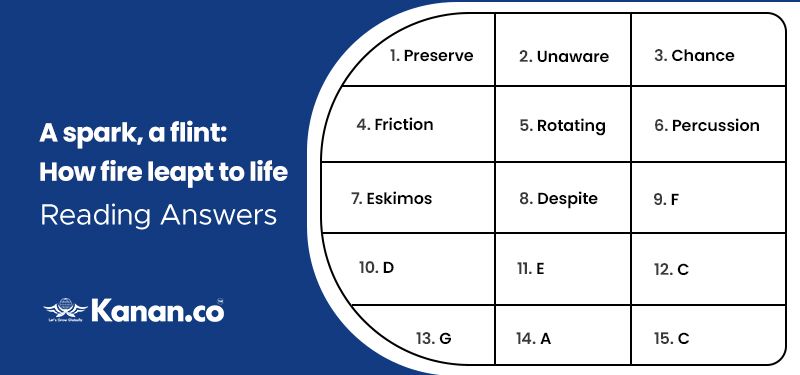
In this article we have given “A spark, a flint: how fire leapt to life” reading answers as a sample one for the IELTS reading practice test. This passage has 15 questions based on the given passage in 2 different types namely- 8 questions as summary completion and 7 questions as matching information.
Check out our YouTube Channel to Practice Full-Length IELTS Reading Tests Daily

Table of content:
- Solution for A spark, a flint: how fire leapt to life
- A spark, a flint: how fire leapt to life IELTS reading practice test
- Passage
- Questions
- Answers with explanation
Solution for A spark, a flint: how fire leapt to life
Answers for A spark, a flint: how fire leapt to life reading answers is given here in the table form.

Answer Table
| 1. Preserve | 4. Friction | 7. Eskimos | 10. D | 13. G |
| 2. Unaware | 5. Rotating | 8. Despite | 11. E | 14. A |
| 3. Chance | 6. Percussion | 9. F | 12. C | 15. C |
A spark, a flint: how fire leapt to life IELTS reading practice test - Exam Review
The passage for A spark, a flint: how fire leapt to life IELTS reading answers is provided below to enrich your reading skill, with a practice test section which may help you to enhance your answering skill.
Passage
Check out the given passage for A spark, a flint: how fire leapt to life reading answers with location, it helps you to get some important keywords to answer the questions.
A spark, a flint: how fire leapt to life reading answers
The control of fire was the first and perhaps greatest of humanity’s steps towards a life-enhancing technology.
- To early man, fire was a divine gift randomly delivered in the form of lightning, forest fire or burning lava. Unable to make flame for themselves, the earliest peoples probably stored fire by keeping slow burning logs alight or by carrying charcoal in pots.
- How and where man learnt how to produce flame at will is unknown. It was probably a secondary invention, accidentally made during tool-making operations with wood or stone. Studies of primitive societies suggest that the earliest method of making fire was through friction. European peasants would insert a wooden drill in a round hole and rotate it briskly between their palms This process could be speeded up by wrapping a cord around the drill and pulling on each end.
- The Ancient Greeks used lenses or concave mirrors to concentrate the sun’s rays and burning glasses were also used by Mexican Aztecs and the Chinese.
- Percussion methods of fire-lighting date back to Paleolithic times, when some Stone Age tool-makers discovered that chipping flints produced sparks. The technique became more efficient after the discovery of iron, about 5000 years ago In Arctic North
- America, the Eskimos produced a slow-burning spark by striking quartz against iron pyrites, a compound that contains sulphur. The Chinese lit their fires by striking porcelain with bamboo. In Europe, the combination of steel, flint and tinder remained the main method of fire-lighting until the mid 19th century.
- Fire-lighting was revolutionised by the discovery of phosphorus, isolated in 1669 by a German alchemist trying to transmute silver into gold. Impressed by the element’s combustibility, several 17th century chemists used it to manufacture fire-lighting devices, but the results were dangerously inflammable. With phosphorus costing the equivalent of several hundred pounds per ounce, the first matches were expensive.
- The quest for a practical match really began after 1781 when a group of French chemists came up with the Phosphoric Candle or Ethereal Match, a sealed glass tube containing a twist of paper tipped with phosphorus. When the tube was broken, air rushed in, causing the phosphorus to self-combust. An even more hazardous device, popular in America, was the Instantaneous Light Box — a bottle filled with sulphuric acid into which splints treated with chemicals were dipped.
- The first matches resembling those used today were made in 1827 by John Walker, an English pharmacist who borrowed the formula from a military rocket-maker called Congreve. Costing a shilling a box, Congreves were splints coated with sulphur and tipped with potassium chlorate. To light them, the user drew them quickly through folded glass paper.
- Walker never patented his invention, and three years later it was copied by a Samuel Jones, who marketed his product as Lucifers. About the same time, a French chemistry student called Charles Sauria produced the first “strike-anywhere” match by substituting white phosphorus for the potassium chlorate in the Walker formula. However, since white phosphorus is a deadly poison, from 1845 match-makers exposed to its fumes succumbed to necrosis, a disease that eats away jaw-bones. It wasn’t until 1906 that the substance was eventually banned.
- That was 62 years after a Swedish chemist called Pasch had discovered non-toxic red or amorphous phosphorus, a development exploited commercially by Pasch’s compatriot J E Lundstrom in 1885. Lundstrom’s safety matches were safe because the red phosphorus was non-toxic; it was painted on to the striking surface instead of the match tip, which contained potassium chlorate with a relatively high ignition temperature of 182 degrees centigrade.
- America lagged behind Europe in match technology and safety standards. It wasn’t until 1900 that the Diamond Match Company bought a French patent for safety matches — but the formula did not work properly in the different climatic conditions prevailing in America and it was another 11 years before scientists finally adapted the French patent for the US.
- The Americans, however, can claim several “firsts” in match technology and marketing. In 1892 the Diamond Match Company pioneered book matches. The innovation didn’t catch on until after 1896, when a brewery had the novel idea of advertising its product in match books. Today book matches are the most widely used type in the US, with 90 percent handed out free by hotels, restaurants and others.
- Other American innovations include an anti-after-glow solution to prevent the match from smouldering after it has been blown out; and the waterproof match, which lights after eight hours in water.
Questions
Questions 1-8
- Complete the summary below.
- Choose your answers from the box at the bottom of the page and write them in boxes 1-8 on your answer sheet.
- NB There are more words than spaces so you will not use them all You may use any of the words more than once.
EARLY FIRE-LIGHTING METHODS
Ex. Primitive societies saw fire as a … (Example) … gift.
They tried to 1………………… burning logs or charcoal 2………………. that they could create fire themselves.
It is suspected that the first man-made flames were produced by 3…………………
The very first fire-lighting methods involved the creation of 4………………. by, for example, rapidly 5……………….. a wooden stick in a round hole.
The use of 6……………….. or persistent chipping was also widespread in Europe and among other peoples such as the Chinese and 7…………………..
European practice of this method continued until the 1850s 8………………..the discovery of phosphorus some years earlier.
List of words
| Mexicans | Random | Roating |
| Despite | Preserve | Realising |
| Sunlight | Lacking | Heavenly |
| Percussion | Chance | Friction |
| Unaware | Without | Make |
| Heating | Eskimos | Surprised |
| Until | Smoke |
Questions 9-15
- Look at the following notes that have been made about the matches described in Reading Passage.
- Decide which type of match (A-H) corresponds with each description and write your answers in boxes 9-15 on your answer sheet.
- NB There are more matches than descriptions so you will not use them all. You may use any match more than once.
| Example | Answer |
| Could be lit after soaking in water | H |
Types of Matches
A. The Ethereal Match
B. The Instantaneous Lightbox
C. Congreves
D. Lucifers
E. The first strike-anywhere match
F. Lundstrom’s safety match
G. Book matches
H. Waterproof matches
9. Made using a less poisonous type of phosphorus.
10. Identical to a previous type of match.
11. Caused a deadly illness.
12. First to look like modern matches.
13. First matches used for advertising.
14. Relied on an airtight glass container.
15. Made with the help of an army design.
Answers for A spark, a flint: How fire leapt to life with explanation
In this section we have given the answers for a spark, a flint: how fire leapt to life with explanation. This portion will help you to identify your errors while answering.
1. Answer: Preserve
Explanation: “Unable to make flame for themselves, the earliest peoples probably stored fire by keeping slow burning logs alight or by carrying charcoal in pots”. With this line it is clear that they tried to preserve burning logs or charcoal. Hence the given answer is located in the last 3 lines of paragraph 1.
2. Answer: Unaware
Explanation: “Unable to make flame for themselves, the earliest peoples probably stored fire by keeping slow burning logs alight or by carrying charcoal in pots”. With this line it is clear that they tried to preserve burning logs or charcoal unaware that they could create fire themselves. Hence the given answer is located in the last 3 lines of paragraph 1.
3. Answer: Chance
Explanation: “It was probably a secondary invention, accidentally made during tool-making operations with wood or stone”. With this line it is clear that it is suspected that the first man-made flames were produced by chance. Hence the given answer is located in the 1-3 lines of paragraph 2.
4. Answer: Friction
Explanation: “Studies of primitive societies suggest that the earliest method of making fire was through friction”. With this line it is clear that the very first fire-lighting methods involved the creation of friction. Hence the given answer is located in the 3-4 lines of paragraph 2.
5. Answer: Rotating
Explanation: “European peasants would insert a wooden drill in a round hole and rotate it briskly between their palms. This process could be speeded up by wrapping a cord around the drill and pulling on each end”. With this line it is clear that the very first fire-lighting methods involved the creation of friction by, for example, rapidly rotating a wooden stick in a round hole. Hence the given answer is located in the last 3 lines of paragraph 2.
6. Answer: Percussion
Explanation: “Percussion methods of fire-lighting date back to Paleolithic times, when some Stone Age tool-makers discovered that chipping flints produced sparks”. With this line it is clear that the use of percussion or persistent chipping was also widespread in Europe. Hence the given answer is located in the first 3 lines of paragraph 4.
7. Answer: Eskimos
Explanation: “The Eskimos produced a slow-burning spark by striking quartz against iron pyrites, a compound that contains sulphur”. With this line it is clear that the use of percussion or persistent chipping was also widespread in Europe and among other peoples such as the Chinese and eskimos. Hence the given answer is located in the 4-6 lines of paragraph 4.
8. Answer: Despite
Explanation: “Fire-lighting was revolutionised by the discovery of phosphorus, isolated in 1669 by a German alchemist trying to transmute silver into gold”. With this line it is clear that European practice of this method continued until the 1850s despite the discovery of phosphorus some years earlier. Hence the given answer is located in the 1-2 lines of paragraph 5.
9. Answer: F
Explanation: “Lundstrom’s safety matches were safe because the red phosphorus was non-toxic”. With this line it is clear that made using a less poisonous type of phosphorus is matches with Lundstrom’s safety match. Hence the given answer is located in the 3-4 lines of paragraph 9.
10. Answer: D
Explanation: “Walker never patented his invention, and three years later it was copied by a Samuel Jones, who marketed his product as Lucifers”. With this line it is clear that Lucifers is matched with the Identical to a previous type of match. Hence the given answer is located in the 1-2 lines of paragraph 8.
11. Answer: E
Explanation: “About the same time, a French chemistry student called Charles Sauria produced the first “strike-anywhere” match by substituting white phosphorus for the potassium chlorate in the Walker formula”. With this line it is clear that causing a deadly illness is matched with the first strike- anywhere match. Hence the given answer is located in the 2-5 lines of paragraph 8.
12. Answer: C
Explanation: “The first matches resembling those used today were made in 1827 by John Walker, an English pharmacist who borrowed the formula from a military rocket-maker called Congreve”. With this line it is clear that First to look like modern matches with congreves. Hence the given answer is located in the first 3 of paragraph 7.
13. Answer: G
Explanation: “In 1892 the Diamond Match Company pioneered book matches. The innovation didn’t catch on until after 1896, when a brewery had the novel idea of advertising its product in match books”. With this line it is clear that First matches used for advertising. Hence the given answer is located in the 2-4 lines of paragraph 11.
14. Answer: A
Explanation: “The quest for a practical match really began after 1781 when a group of French chemists came up with the Phosphoric Candle or Ethereal Match, a sealed glass tube containing a twist of paper tipped with phosphorus”. With this line it is clear that relied on an airtight glass container the ethereal match. Hence the given answer is located in the 1-4 lines of paragraph 6.
15. Answer: C
Explanation: “The first matches resembling those used today were made in 1827 by John Walker, an English pharmacist who borrowed the formula from a military rocket-maker called Congreve”. With this line it is clear that congreves made it with the help of an army design. Hence the given answer is located in the first 3 of paragraph 7.
Other reading answers

About Author Manimegalai Samidurai
Manimegalai is a multifaceted professional, excelling as an author, writer, and study-abroad expert. Her vast knowledge of English proficiency exams, including IELTS, GRE, SAT, and PTE, and exceptional content writing skills make her a go-to resource for students seeking guidance and support in their foreign education journey. She is a trusted authority in writing content related to these test-prep exams, making her an invaluable resource for those seeking guidance. With her well-researched and informative blogs, articles, and study materials, Manimegalai has helped countless students achieve their desired band scores and get admissions to top-notch colleges & universities in countries like Canada, USA, UK, Australia, Ireland, etc.
Kanan.co is a trusted study abroad consultancy offering comprehensive services, resources, and solutions for students and education institutions. We support students at every stage of their global education journey, ensuring a smooth and guided experience. Along with test preparation for IELTS, GRE, TOEFL, and SAT, we provide expert services such as SOP writing, visa guidance, accommodation support, scholarship assistance, and education loan support. Our expertise and commitment to excellence make us a reliable partner for students pursuing international education.
Free Online Mock Test 2026
Practice our mock test worth Rs. 25000 for Free and know your IELTS score!








Global Headquarters
Kanan Int EdTech Inc
320 Bay Street, Suite 321 (Spaces), Toronto ON, Canada M5B 1N9
Indian Headquarters
Kanan International Pvt. Ltd.
D-wing, 2nd Floor, Trident Complex, Ellora Park Vadiwadi Road, Vadodara, Gujarat 390007
IT/ Digital Campus
Kanan International Pvt. Ltd
Old, New No 3, 2nd Floor, 1A, Dr Sadasivam Rd, T. Nagar, Chennai, Tamil Nadu 600017
Our branches
- Bardoli
- Bharuch
- Chennai
- Dehradun
- Gurugram
- Himatnagar
- Karnal
- Nadiad
- Navsari
- Palanpur
- Rajkot
- Vadodara
- Valsad
- Vallabh Vidyanagar
- Vapi
Study Abroad
Test Prep
Top Universities
Consultants
IELTS Centers
GRE Centers
TOEFL Centers
SAT Centers
Language Courses in Vadodara
Study Abroad Calculators
Featured Blogs
Study Abroad Consultants in Chennai
Study Abroad Consultants in Surat
Study Abroad Consultants in Navsari
Study Abroad Consultants in Bardoli
Study Abroad Consultants in Ahmedabad
Study Abroad Consultants in Anand
Study Abroad Consultants in Khanna
Study Abroad Consultants in Nadiad
Study Abroad Consultants in Vadodara
Study abroad consultants in Valsad
Copyright © 2026 KANAN.CO All rights reserved.