- Study Abroad
- / ielts
- / bringing cinnamon to europe reading answers
Bringing cinnamon to Europe reading answers


Author
16-09-2025

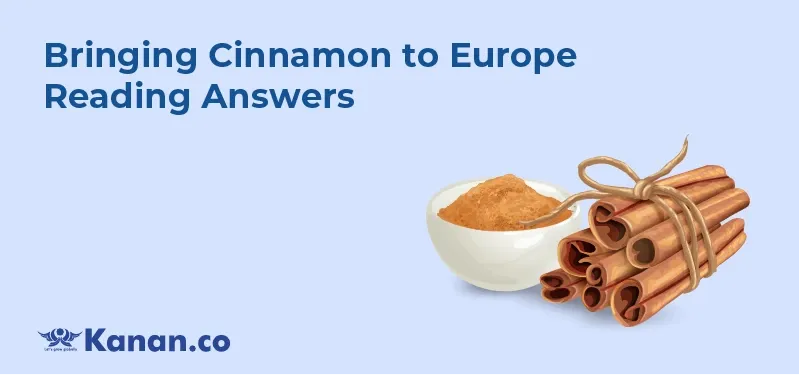
Check the Bringing cinnamon to Europe reading answers given below. Here, you may cross-check your responses and trace any mistakes.
| 1. oils | 2. friendship | 3. funerals | 4. wealth |
| 5. indigestion | 6. India | 7. camels | 8. Alexandria |
| 9. Venice | 10. True | 11. False | 12. Not Given |
| 13. False |
By reading Bringing cinnamon to Europe reading answers, You will be able to gain an understanding of how to approach the reading tests that are part of the IELTS.
You absolutely need to think of some good techniques if you want to do well in the reading section of the IELTS reading. The test has a 60-minute time constraint. As a result, you must actively read the chapter and reach its solution. Before going through the Bringing cinnamon to Europe reading answers, refer to our analyzed article for the answer strategy to improve your band score.
Moreover, the Bringing cinnamon to Europe reading passage devised from Cambridge 13, Test 2 consists of information regarding the values of cinnamon and its history. It includes three main IELTS Reading question types that are,
- IELTS Reading Matching Headings
- IELTS Reading True/False or Not Given
- IELTS Reading Note Completion
Check out our YouTube Channel to Practice Full-Length IELTS Reading Tests Daily
Strategies for solving “Bringing cinnamon to Europe”
Prior you take the reading section of the IELTS exam, make sure to review the strategies that have been provided here for you to improve your band score.
- Underline the important words in the incomplete notes set to identify the appropriate portion in the passage.
- Do not change the word form when you are answering the questions. It must be the exact word form given in the passage.
- If you didn’t find the central idea in the paragraph, a key detail in the paragraph could possibly be the answer.
- Usually, the first sentence of the paragraph tells the main idea. Still, selecting the heading based on the first sentence of the paragraph might lead to errors. It is possible that the first sentence refers to the previous paragraph.
- Your answer will be marked wrong if you write ‘Yes’ in the place of ‘True’ and ‘No’ in the place of ‘False’.
- You must take chances and practice all the above points in Bringing cinnamon to Europe reading answers in order to increase your performance.
Before answering the passage Bringing cinnamon to Europe reading answers with location please refer to the IELTS reading tips.
IELTS reading passage - Bringing cinnamon to Europe
You should spend about 20 minutes on Questions 1-14 based on the Reading Passage given below. After you've attempted all of the questions, review your answers using the provided Bringing cinnamon to Europe reading answers with locations.
Bringing cinnamon to Europe
- The inner bark of trees within the genus Cinnamomum, indigenous to the Indian subcontinent, is used to make cinnamon, a sweet, aromatic spice. It was well-known throughout the period of the Bible and is referenced in a number of its books as a component that was combined with oils for application to people's bodies as well as a token indicating friendship among lovers and friends. For a nice aroma, mourners in ancient Rome who were attending funerals would burn cinnamon. However, the spice was most frequently used as a food and beverage additive. The spice was used in the Middle Ages by Europeans who could afford it to flavor meals, especially meat, and to show off to others their capacity to get an expensive condiment from the "strange" East. A host would provide visitors with a platter during a feast with a variety of spices piled on it as a symbol of the wealth at his or her disposal. Additionally, cinnamon was said to offer health advantages and be able to treat a number of conditions, including indigestion.
- At the end of the Middle Ages, the European middle classes started to aspire to the living of the privileged, such as their use of spices. The need for cinnamon and other spices increased as a result. At that time, Arab traders carried cinnamon and kept the location of the spice's origin a closely-guarded secret from possible competitors. They rode camels through the desert to the Mediterranean from India, where it was cultivated. When they arrived in Alexandria, their trip was over. European merchants sailed there to get their supply of cinnamon, then returned to Venice with it. The spice then made its way from that important commercial port to marketplaces across Europe. Due to Venice's near monopoly on the trade and the limited availability of the spice due to the overland trade route, the Venetians established a price of cinnamon extravagantly high. These costs and the rising demand encouraged Europeans who wanted to participate in the spice trade to look for new ways to Asia.
- Portuguese traders came to Ceylon in the 15th century in the quest for cinnamon riches. Before Europeans arrived, the state produced cinnamon. Salagama members would pull cinnamon bark from fresh trees during the rainy season when it was more flexible. The coiled bark created the spice's "stick" shape while peeling. Salagama gave the finished object as an homage to the monarch. The Portuguese enslaved many more native Ceylonese to increase cinnamon production. 1518: Portugal builds a fort in Ceylon. This allowed them to secure the island, monopolize cinnamon trading, and generate huge profits. In the 16th century, Ceylon's cinnamon exports to India yielded a 10-fold profit. Eight days were spent traveling.
- The Dutch had the goal of dethroning the Portuguese as the rulers of cinnamon when they first arrived off the southern Asian coast at the start of the 17th century. The interior Ceylonese kingdom of Kandy was linked with the Dutch. They shielded the native ruler from the Portuguese in exchange for gifts of elephants and cinnamon. When the Dutch invaded and took control of the Portuguese industries in 1649, they ended the 150-year Portuguese monopoly. They had successfully driven the Portuguese from the island by 1658, seizing control of the valuable cinnamon trade in the process.
- Just like the Portuguese preceding them, the Dutch also mistreated the locals in order to maintain their market dominance. The Dutch started changing the Ceylonese harvesting procedures in order to increase production and feed Europe's insatiable need for cinnamon. As a result of routine bark-stripping, the island's stock of cinnamon trees eventually became almost depleted. The Dutch eventually started growing their domestic cinnamon trees to augment the dwindling supply of natural trees.
- The Dutch lost their monopoly over cinnamon when the English arrived in Ceylon in 1996. The output of cinnamon increased to 1,000 tonnes annually by the middle of the 19th century as a lower-grade composition of the spice became more palatable to European palates. By then, Brazil, Guyana, the West Indies, and other areas of the Indian Ocean were also growing cinnamon. A monopoly of cinnamon was no longer viable, and the economic potential of the spice trade as a whole was declining. Ultimately, coffee, tea, chocolate, and sugar commerce overtook spices.
Questions 1-4
Reading Passage has six sections, A-F.
Choose the correct heading for sections A-D from the list of headings below.
Write the correct number, i-v, in boxes 1-4 on your answer sheet.
1. Section A
2. Section B
3. Section C
4. Section D
List of Headings
- A civilized profit-making business
- Introduction of Portuguese traders to Mexicans
- Establishment of cinnamon’s monetary value
- Values of cinnamon other than just a food ingredient
- Occupation of Dutch over Portuguese monopoly
Click to practice more IELTS Reading Matching Headings Questions
Questions 5-8
Do the following statements agree with the information given in Reading Passage 1?
In boxes 5-8 on your answer sheet, write
TRUE if the statement agrees with the information
FALSE if the statement contradicts the information
NOT GIVEN if there is no information on this
5. During the 19th century, the spice trade continued to be an economically significant activity.
6. With their arrival in Ceylon, the Dutch supplanted the Portuguese in the cinnamon trade.
7. All through the 16th century, the Portuguese monopolized Ceylon's cinnamon trade.
8. Compared to the natural trees, the Dutch-planted trees produced more cinnamon.
Click to learn more about IELTS Reading True/False/Not Given
Questions 9 - 14
Complete the notes below.
Choose ONE WORD ONLY from the passage for each answer.
Write your answers in boxes 9-14 on your answer sheet.
The Early History of Cinnamon
|
Biblical times: added to 9. __________utilized to display 10. __________ Between citizens |
|
Ancient Rome: used for its sweet aroma at 11. __________ |
|
Middle Ages: added to food, especially meat was a sign of a person’s 12.__________ known as a remedy for 13. __________ and other health issues developed in 14. __________ |
Click to know more about IELTS Reading Note Completion
Bringing cinnamon to Europe Reading Answers With Explanations
Bringing cinnamon to Europe reading answers with explanations offered for your use, and will assist you in gaining an understanding of strategies that are helpful in reading and in tracing the answers.
(Note: The text in italics is from the reading passage and shows the location from where the answer is taken or inferred. The text in regular font explains the answer in detail.)
1. IV
Keyword Location: Paragraph A, Line 4 to last
Explanation: a sign of goodwill between lovers and friends, cinnamon was also used for a nice aroma, to offer health advantages
2. III
Keyword Location: Paragraph B, Line 8
Explanation: Due to Venice's near monopoly on the trade and the limited availability of the spice due to the overland trade route, the Venetians established a price of cinnamon extravagantly high.
3. I
Keyword Location: Paragraph C, Line 7
Explanation: In the 16th century, Ceylon's cinnamon exports to India yielded a 10-fold profit.
4. V
Keyword Location: Paragraph D, Line 4
Explanation: When the Dutch invaded and took control of the Portuguese industries in 1649, they ended the 150-year Portuguese monopoly. They had successfully driven the Portuguese from the island by 1658, seizing control of the valuable cinnamon trade in the process.
5. False
Keyword Location: Paragraph F, Line 5
Explanation: A monopoly of cinnamon was no longer viable, and the economic potential of the spice trade as a whole was declining.
6. False
Keyword Location: Paragraph E, Line 2
Explanation: The Dutch eventually started growing their domestic cinnamon trees to augment the dwindling supply of natural trees.
7. True
Keyword Location: Paragraph C, Line 6
Explanation: Portugal builds a fort in Ceylon. This allowed them to secure the island, monopolize cinnamon trading, and generate huge profits.
8. Not Given
Explanation: No information is provided in the passage regarding the statement, which justifies the answer as not given.
9. Oils
Keyword Location: Paragraph A, Line 3
Explanation: Throughout the period of the Bible and is referenced in a number of its books as a component that was combined with oils for application to people's bodies as well as a sign of goodwill
10. Friendship
Keyword Location: Paragraph A, Line 4
Explanation: Cinnamon was combined with oils for application to people's bodies as well as a token indicating friendship among lovers and friends
11. Funerals
Keyword Location: Paragraph A, Line 5
Explanation: For a nice aroma, mourners in ancient Rome who were attending funerals would burn cinnamon.
12. Wealth
Keyword Location: Paragraph A, Line 9
Explanation: A host would provide visitors with a platter during a feast with a variety of spices piled on it as a symbol of the wealth at his or her disposal.
13. Indigestion
Keyword Location: Paragraph A, last line
Explanation: Cinnamon was said to offer health advantages and be able to treat a number of conditions, including indigestion.
14. India
Keyword Location: Paragraph B, Line 4
Explanation: They rode camels through the desert to the Mediterranean from India, where it was cultivated.
Check the other reading passages
- Quiet Roads Ahead Reading Answers
- Natural Pesticide in India Reading Answers
- Fish Oil Reading Answers
Conclusion
The "Bringing cinnamon to Europe reading answers" and locations will assist you in locating the correct answers. In addition, we have included links to several sections where you may practice extra reading passages.

About Author Roshan Sunthar
Roshan Sunthar is a study abroad expert as well as a renowned writer and author in international education. His academic excellence and 5+ years of work experience give him in-depth knowledge of international standardised exams and test preparation in IELTS, TOEFL, GRE, PTE, SAT, etc. The study materials he prepares incorporate exam-like questions. He’s also an expert in writing Statement of Purposes (SOPs) and Letter of Recommendations (LORs) for college admissions. He usually spends his leisure time watching English classics and documentaries, travelling, etc.
Kanan.co is a trusted study abroad consultancy offering comprehensive services, resources, and solutions for students and education institutions. We support students at every stage of their global education journey, ensuring a smooth and guided experience. Along with test preparation for IELTS, GRE, TOEFL, and SAT, we provide expert services such as SOP writing, visa guidance, accommodation support, scholarship assistance, and education loan support. Our expertise and commitment to excellence make us a reliable partner for students pursuing international education.
Free Online Mock Test 2026
Practice our mock test worth Rs. 25000 for Free and know your IELTS score!








Global Headquarters
Kanan Int EdTech Inc
320 Bay Street, Suite 321 (Spaces), Toronto ON, Canada M5B 1N9
Indian Headquarters
Kanan International Pvt. Ltd.
D-wing, 2nd Floor, Trident Complex, Ellora Park Vadiwadi Road, Vadodara, Gujarat 390007
IT/ Digital Campus
Kanan International Pvt. Ltd
Old, New No 3, 2nd Floor, 1A, Dr Sadasivam Rd, T. Nagar, Chennai, Tamil Nadu 600017
Our branches
- Bardoli
- Bharuch
- Chennai
- Dehradun
- Gurugram
- Himatnagar
- Karnal
- Nadiad
- Navsari
- Palanpur
- Rajkot
- Vadodara
- Valsad
- Vallabh Vidyanagar
- Vapi
Study Abroad
Test Prep
Top Universities
Consultants
IELTS Centers
GRE Centers
TOEFL Centers
SAT Centers
Language Courses in Vadodara
Study Abroad Calculators
Featured Blogs
Study Abroad Consultants in Chennai
Study Abroad Consultants in Surat
Study Abroad Consultants in Navsari
Study Abroad Consultants in Bardoli
Study Abroad Consultants in Ahmedabad
Study Abroad Consultants in Anand
Study Abroad Consultants in Khanna
Study Abroad Consultants in Nadiad
Study Abroad Consultants in Vadodara
Study abroad consultants in Valsad
Copyright © 2026 KANAN.CO All rights reserved.