- Study Abroad
- / ielts
- / colour blindness reading answers
Colour Blindness reading answers


Author
16-09-2025

Colour Blindness reading answers are given below to verify your own answers.
| 14. H | 18. J | 22. D | 26. MACULA |
| 15. F | 19. E | 23. D | |
| 16. B | 20. G | 24. OPTIC NERVE | |
| 17. C | 21. C | 25. RETINA |

You need to do a right amount of practise to do the Colour Blindness reading answers. Spending time reading the passage will help you to understand how to relate the questions with the keywords given in the questions.
The IELTS reading test is for 60 minutes, this will test your time-management skills. You will be given three passages and questions of different question types. For locating the answers, we have provided Colour Blindness reading answers with locations which will help you in answering the reading test swiftly.
Colour Blindness reading passage contain information about a disease in which the ability to differentiate between certain colours gets reduced. This blog comes with three main IELTS Reading question types which are listed below.
- IELTS Reading Multiple Choice Questions
- IELTS Reading Matching sentence endings
- IELTS Reading Diagram completion
Check Out our YouTube Channel to Practice Full-Length IELTS Reading Tests Daily

Strategies for solving “Colour Blindness”
Before taking the Colour Blindness reading test, study the provided strategies to improve your IELTS band score.
- ‘Colour Blindness reading passage’ tells us about a rare disease that affects human vision. You should carefully read the causes and effects of the disease to answer the questions easily.
- For solving the ‘Colour Blindness reading answers’ read the question first, then read the passage, and underline or highlight any keywords. Check the options for the keywords to see what you can find if the question statement does not have much information.
- The sentence will be finished correctly, both grammatically and logically, if you pick the option that is correct. In addition, the answer must correspond to the information that is presented in the passage.
- Read the labels provided already because these are helpful in finding the answer. This will help you in the diagram completion method.
- In the case of multiple-choice questions, Note that you need to write the letter of the option on your answer sheet, not words or phrases.
- If you can't seem to find the answer, try not to panic. You have a better chance of getting the right answer if you guess, so take some time to relax and think about the question.
Before giving Colour Blindness IELTS reading answers refer to the IELTS reading tips.
IELTS Reading Passage - Colour Blindness
You should spend about 20 minutes on Questions 14-26 which are based on Reading Passage below. After you've attempted all of the questions, review your answers using the provided Colour Blindness reading answers with locations.
Colour Blindness
- The absence or malfunction of colour-sensitive cells in the retina causes colour blindness. Behind the lens, the retina is a neuro-membrane lining the inner back of the eye. The retina contains both rod cells (active in low light or night vision but incapable of colour discrimination) and cone cells (active in colour vision but inactive in low light or night vision) (active in average daylight, sensitive to colour). Cone cells, also known as photoreceptors, are primarily located in the macula, a central region of the retina. Cone cells allow for sharp, clear colour vision. The cones contain pigments that are sensitive to the spectrum of wavelengths and are light-sensitive. One type of cone is sensitive to short wavelengths, or the colour blue, while another type is sensitive to medium wavelengths, or the colour green, and the third type is sensitive to longer wavelengths, or the colour red. All of these cells transmit colour information to the brain via the optic nerve, which connects to the retina near the macula. Normal individuals, known as trichromats, are able to match all colours of the spectrum by combining these three fundamental colour sensitivity characteristics. Consequently, the vast spectrum of colours we perceive results from the response of cone cells to different wavelengths of light.
- There are numerous types of colour blindness. When there are deficiencies in the cones, either at birth or through other means, the cones are unable to distinguish between wavelengths, resulting in an altered perception of the colour spectrum. Those with impaired colour vision are deficient or lacking in one or more pigments. Anomalous trichromats are people with a deficiency in one of the pigments, the most common type of colour vision disorder. Dichromacy occurs when one of the cone pigments is absent and the colour is reduced to two dimensions. Typically, these individuals are aware of their colour vision impairment, which can have a significant impact on their daily lives. They cannot distinguish between red, orange, yellow, and green. All of these colours, which appear so dissimilar to the average observer, appear identical to them. The absence of the cones responsible for green and red hues can also impair the ability to perceive brightness.
- Out of the vast majority of cases of colourblindness, approximately 99 per cent, are inherited, resulting from partial or total loss of function in one or more of the different cone systems, and affecting both eyes without worsening over time. Red-green inherited (genetic) photoreceptor disorders are the most prevalent and are collectively referred to as "red-green colour blindness." It affects 8% of European males and 0.4% of European females. The X chromosome carries the gene for this. Due to the fact that males have an X-Y pairing and females have an X-X pairing, colour blindness is much more prevalent in males and is typically transmitted by their mothers. In other words, females may be carriers of colourblindness, but males are significantly more frequently affected. People with this disorder are unable to recognise red or green on their own but can do so when surrounded by other colours. Other forms of colour blindness are extremely uncommon. They include difficulties distinguishing blue from yellow. Both hues are regarded as white for conditions such as liver disease and diabetes.
- Monochromacy is the rarest form of colorblindness, in which a person can only see shades of black, grey, and white, as in a black-and-white film or photograph. Monochromacy occurs when two or all three cone pigments are absent, reducing colour and brightness perception to a single dimension. Achromatopsia is another term for total colour blindness, which is the inability to perceive colour.
- Problems with inherited colour vision cannot be treated or corrected. Depending on the cause, some acquired colour vision problems can be treated with surgery, such as the removal of a cataract. Certain tinted filters and contact lenses may also improve a person's ability to differentiate between colours. In addition, computer software has been created to aid those with visual colour difficulties and those with mild colour deficiencies in learning to associate colours with particular objects, so that they can identify colour in the same manner as everyone else. A common issue is with traffic lights, and worst of all, warning lights: colour-blind individuals are always aware of the position of the colours on the traffic light; red on the top, yellow in middle, and green at bottom. However, warning lights pose an entirely different issue. In this situation, there is only one light; there is no top, no bottom, and no right or left, just a single red or yellow light.
- Problems with colour vision can significantly affect a person's life, learning abilities, and career options. On a daily basis, there are certain annoyances and frustrations, such as not being able to tell the difference between green and ripe tomatoes when preparing food, or purchasing matching clothes that appear positively garish to the 'normal' eye. However, individuals with colour vision deficiencies typically learn to compensate for their inability to perceive colours. Although there is little or no treatment for colour blindness, the majority of colour-blind individuals compensate well for their condition and may even discover instances in which they are able to perceive details and images that normal-sighted individuals would miss. The U.S. Army once discovered that colour-blind individuals can detect camouflage colours in situations where those with normal colour vision are typically fooled.
Colour Blindness Reading Questions
Questions 1-3
Choose the correct letter A, B, C or D
1. Which group of people are least common?
- Anomalous trichromats
- People with dichromacy
- People with achromatopsia
- People who cannot detest blues from yellows
2. What would colour-blind people consider an everyday nuisance?
- Not being able to tell an apple from a tomato
- Not being able to identify the colour of warning lights
- Not being able to buy matching clothes
- Not being able to cook
3. What causes colour blindness?
- The malfunction of rod cells
- The absence of rod cells
- The malfunction of cone cells
- The retina’s inability to detect light
Click to know more about IELTS reading Multiple choice questions.
Questions 4-10
Complete each sentence with the correct ending A-K from the box below.
Write the correct letter A-K in the boxes 17-23 on your answer sheet.
4. Surprisingly, some people who are colour-blind ________
5. People with hereditary colour blindness _______
6. Because of our genetic make-up, colour blindness ________
7. Red-Green genetic photoreceptor disorders mean that people ________
8. People with monochromacy _______
9. The inability to see certain lights _______
10. Colour blindness can be caused by a birth defect, or ________
- cannot be treated by surgery.
- Can have very dangerous consequences for colour-blind people.
- Can be acquired or inherited.
- can affect men much more easily than women.
- can see better at night than during the day.
- can see no colour at all, other than shades of black, grey and white
- can affect their sensitivity to bright lights.
- can see things that people with normal vision cannot.
- cannot distinguish certain colours if they stand alone
- can mean having to wear contact lenses.
- can match all colours of the spectrum.
Click to know more about IELTS reading Matching Sentence endings
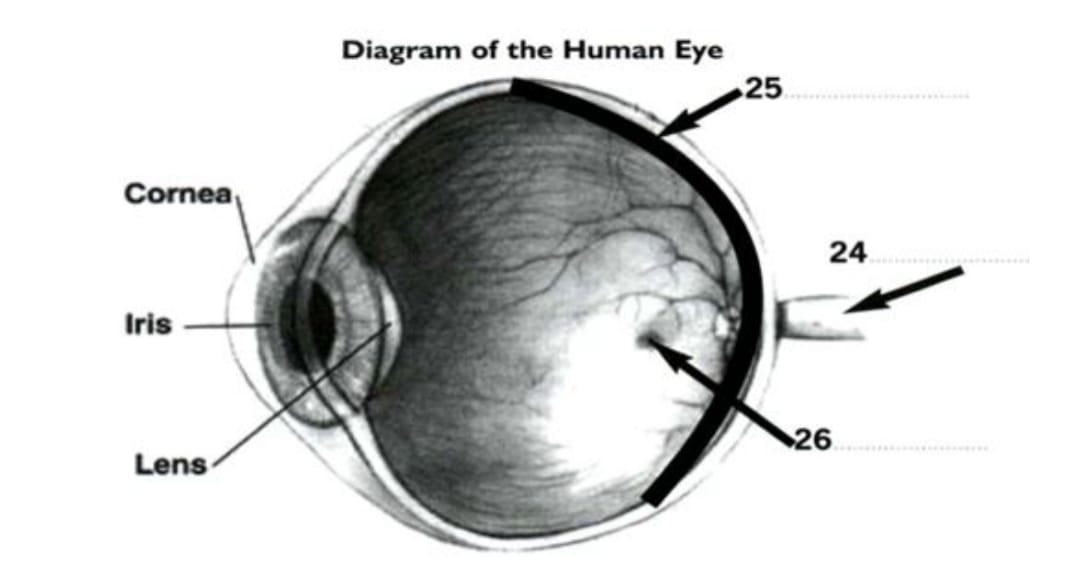
Questions 24–26
Complete the diagram below.
Choose NO MORE THAN TWO WORDS from the passage for each answer.
Click to know more about IELTS reading Diagram completion.
Colour Blindness reading answers with explanation
Colour Blindness reading answers with explanations can assist you in correcting errors and identifying the answer.
(Note: The text in italics is from the reading passage and shows the location from where the answer is taken or inferred. The text in the regular font explains the answer in detail.)
1. C
Keyword Location: Paragraph D
Explanation: As mentioned in the fourth paragraph, monochromacy is the rarest form of colourblindness and it is also known as achromatopsia. Thus, the correct answer is C.
2. C
Keyword Location: Paragraph F 4th line
Explanation: It is clearly mentioned in the passage that On a daily basis, there are certain annoyances and frustrations, such as not being able to tell the difference between green and ripe tomatoes when preparing food, or purchasing matching clothes that appear positively garish to the 'normal' eye. Hence, the correct answer is option C.
3. C
Keyword Location: Paragraph A 5th Line
Explanation: It is stated in the first paragraph cone cells (active in colour vision but inactive in low light or night vision) (active in average daylight, sensitive to colour). Cone cells, also known as photoreceptors, are primarily located in the macula, a central region of the retina. Cone cells allow for sharp, clear colour vision. The cones contain pigments that are sensitive to the spectrum of wavelengths and are light-sensitive. One type of cone is sensitive to short wavelengths, or the colour blue, while another type is sensitive to medium wavelengths, or the colour green, and the third type is sensitive to longer wavelengths, or the colour red. All of these cells transmit colour information to the brain via the optic nerve, which connects to the retina near the macula. Normal individuals, known as trichromats, are able to match all colours of the spectrum by combining these three fundamental colour sensitivity characteristics. Thus, we can get the idea that glitches in the working of cone cells can cause Colour Blindness. Therefore the correct option is C.
4. H
Keyword Location: Paragraph F last line
Explanation: According to the passage, The U.S. Army once discovered that colour-blind individuals can detect camouflage colours in situations where those with normal colour vision are typically fooled. This example shows us that, colour-blind people can discover things which cannot be seen by people with normal vision. Thus, the answer is H.
5. A
Keyword Location: Paragraph E 1st line
Explanation: As mentioned in the passage Problems with inherited colour vision cannot be treated or corrected. Depending on the cause, some acquired colour vision problems can be treated with surgery, such as the removal of a cataract. Thus, the correct answer is A.
6. D
Keyword Location: Paragraph C 6th line
Explanation: It is mentioned in the passage Due to the fact that males have an X-Y pairing and females have an X-X pairing, colour blindness is much more prevalent in males and is typically transmitted by their mothers. In other words, females may be carriers of colourblindness, but males are significantly more frequently affected. Thus, the correct answer is D
7. I
Keyword Location: Paragraph C 3rd Line
Explanation: Few sentences in paragraph C state that, Red-green inherited (genetic) photoreceptor disorders are the most prevalent and are collectively referred to as "red-green colour blindness." People with this disorder are unable to recognise red or green on their own but can do so when surrounded by other colours. Thus, the correct answer is I.
8. F
Keyword Location: Paragraph D 1st Line
Explanation: As mentioned in the passage, Monochromacy is the rarest form of colorblindness, in which a person can only see shades of black, grey, and white, as in a black-and-white film or photograph. Thus the correct answer is F.
9. B
Keyword Location: Paragraph E 7th line
Explanation: It is stated in the passage, A common issue is with traffic lights, and worst of all, warning lights: colour-blind individuals are always aware of the position of the colours on the traffic light; red on top, yellow in the middle, and green at the bottom. Thus, the correct option is B.
10. C
Keyword Location: Paragraph C 1st line
Explanation: According to paragraph C, Out of the vast majority of cases of colourblindness, approximately 99 per cent, are inherited, resulting from partial or total loss of function in one or more of the different cone systems, and affecting both eyes without worsening over time. Thus, we can get an idea that the correct option is C.
11. OPTIC NERVE
Keyword Location: Paragraph A 9th line
Explanation: According to the passage, All of these cells transmit colour information to the brain via the optic nerve, which connects to the retina near the macula. So, the correct answer is OPTIC NERVE.
12. RETINA
Keyword Location: Paragraph A 2nd line
Explanation: It is mentioned in the passage that Behind the lens, the retina is a neuro-membrane lining the inner back of the eye. Thus the correct answer is RETINA.
13. MACULA
Keyword Location: Paragraph A 5th line
Explanation: According to paragraph A, Cone cells, also known as photoreceptors, are primarily located in the macula, a central region of the retina. Hence, the correct answer is MACULA.
Check the other reading passages
Click the links to check the other important reading passages listed below.
- Emigration to the US Reading Answers
- Raising the Mary Rose Reading Answers
- Preface to how the other half thinks reading answers
Conclusion
The "Colour Blindness reading answers" article provides you the reading answers with explanations and locations. We hope that this article will help you in solving your IELTS reading test with a high band score.

About Author Arivarasi
Arivarasi is an experienced author with expertise in the study abroad industry and preparing test materials for exams like IELTS, TOEFL, GRE, SAT, PTE, etc. She stays up-to-date with university and college requirements for international students which allows her to provide guidance on course selection, documents like SOP, LOR, and scholarship opportunities. She has written numerous articles on study abroad exams, destinations, universities & colleges requirements, admission procedures, and the entire process of studying abroad. Collaborating with industry experts and counselors, she crafts informative articles that make students take the right decisions.
Kanan.co is a trusted study abroad consultancy offering comprehensive services, resources, and solutions for students and education institutions. We support students at every stage of their global education journey, ensuring a smooth and guided experience. Along with test preparation for IELTS, GRE, TOEFL, and SAT, we provide expert services such as SOP writing, visa guidance, accommodation support, scholarship assistance, and education loan support. Our expertise and commitment to excellence make us a reliable partner for students pursuing international education.
Free Online Mock Test 2026
Practice our mock test worth Rs. 25000 for Free and know your IELTS score!








Global Headquarters
Kanan Int EdTech Inc
320 Bay Street, Suite 321 (Spaces), Toronto ON, Canada M5B 1N9
Indian Headquarters
Kanan International Pvt. Ltd.
D-wing, 2nd Floor, Trident Complex, Ellora Park Vadiwadi Road, Vadodara, Gujarat 390007
IT/ Digital Campus
Kanan International Pvt. Ltd
Old, New No 3, 2nd Floor, 1A, Dr Sadasivam Rd, T. Nagar, Chennai, Tamil Nadu 600017
Our branches
- Bardoli
- Bharuch
- Chennai
- Dehradun
- Gurugram
- Himatnagar
- Karnal
- Nadiad
- Navsari
- Palanpur
- Rajkot
- Vadodara
- Valsad
- Vallabh Vidyanagar
- Vapi
Study Abroad
Test Prep
Top Universities
Consultants
IELTS Centers
GRE Centers
TOEFL Centers
SAT Centers
Language Courses in Vadodara
Study Abroad Calculators
Featured Blogs
Study Abroad Consultants in Chennai
Study Abroad Consultants in Surat
Study Abroad Consultants in Navsari
Study Abroad Consultants in Bardoli
Study Abroad Consultants in Ahmedabad
Study Abroad Consultants in Anand
Study Abroad Consultants in Khanna
Study Abroad Consultants in Nadiad
Study Abroad Consultants in Vadodara
Study abroad consultants in Valsad
Copyright © 2026 KANAN.CO All rights reserved.