- Study Abroad
- / ielts
- / designed to last reading answers
Designed to Last Reading Answers


Author
18-09-2025

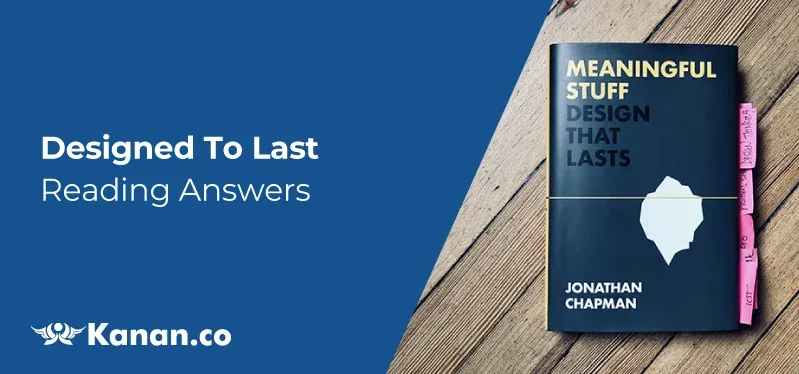
The Designed to Last reading answers are given in this post. The 13 questions which contribute to Designed to Last Reading Answers are as follows: Multiple Choice Questions (MCQs), Summary Completion, and Yes/No/Not Given form.
Table of Contents:
- Solution for Designed to Last
- Designed to Last IELTS Reading Practice Test
- Passage
- Questions
- Answers with Explanations
Solution for Designed to Last
For convenience, we have provided Designed to Last reading answers in the table below.
Answer Table
| 1. A | 5. D | 9. C | 13. Not Given |
| 2. B | 6. E | 10. Yes | |
| 3. C | 7. F | 11. No | |
| 4. B | 8. H | 12. Yes |
Designed to Last IELTS Reading Practice Test - Exam Review
Check out our YouTube Channel to Practice Full-Length IELTS Reading Tests Daily
Designed to Last Reading Answers offered here will improve your capacity for tactical time management and for finding solutions to reading task questions. It will additionally assist you to develop reading and analytical skills. Use the right tactics and resources to perform well in the IELTS reading section.
Passage
You should spend 20 minutes answering questions 1–13 for the Designed to Last reading passage. For your convenience, we have provided Designed to Last reading answers with locations.
Designed to Last
Could better design cure our throwaway culture?
- Jonathan Chapman, a senior lecturer at the University of Brighton, UK, is one of a new breed of “sustainable designers’. Like many of us, they are concerned about the huge waste associated with Western consumer culture and the damage this does to the environment. Some, like Chapman, aim to create objects we will want to keep rather than discard. Others are working to create more efficient or durable consumer goods or goods designed with recycling in mind. The waste entailed in our fleeting relationships with consumer durables is colossal.
- Domestic power tools, such as electric drills, are a typical example of such waste. However much DIY the purchaser plans to do, the truth is that these things are thrown away after being used, on average, for just ten minutes. Most will serve their conscience time, gathering dust on a shelf in the garage. People are reluctant to admit that they have wasted their money. However, the end is inevitable for thousands of years of landfill waste sites. In its design, manufacture, packaging, transportation, and disposal, a power tool consumes many times its own weight in resources, all for a shorter active lifespan than that of the average small insect.
- To understand why we have become so wasteful, we should look to the underlying motivation of consumers. ‘People own things to give expression to who they are and to show what group of people they feel they belong to’ Chapman says. In a world of mass production, however, that symbolism has lost much of its potency. For most of human history, people had an intimate relationship with objects they used or treasured. Often they made the objects themselves, or family members passed them on. For more specialist objects, people relied on expert manufacturers living close by, whom they probably knew personally. Chapman points out that all these factors gave objects a history – a narrative – and an emotional connection that today’s mass production cannot match. Without these personal connections, consumerist culture instead idolises novelty. We know we can’t buy happiness, but the chance to remake ourselves with glossy, box-fresh products seems irresistible. When the novelty fades we simply renew the excitement by buying more new stuff: what John Thackara of Doors of Perception, a network for sharing ideas about the future of design, calls the “schlock of the new”.
- As a sustainable designer, Chapman’s solution is what he calls “emotionally durable design”. Think about your favourite old jeans. They just don’t have the right feel until they have been worn and washed a hundred times, do they? It is like they are sharing your life story. You can fake that look, but it isn’t the same. Chapman says the gradual unfolding of a relationship like this transforms our interactions with objects into something richer than simple utility. Swiss industrial analyst Walter Stahel, visiting professor at the University of Surrey, calls it the “teddy-bear factor”. No matter how ragged and worn a favourite teddy becomes, we don’t rush out and buy another one. As adults, our teddy bear connects us to our childhoods, and this protects it from obsolescence. Stahel says this is what sustainable design needs to do.
- It is not simply about making durable items that people want to keep. Sustainable design is a matter of properly costing the whole process of production, energy use, and disposal. “It is about the design of systems, the design of culture,” says Tim Cooper from the Centre for Sustainable Consumption at Sheffield Hallam University in Britain. He thinks sustainable design has been “surprisingly slow to take off” but says looming environmental crises and resource depletion are pushing it to the top of the agenda.
- Thackara agrees. For him, the roots of impending environmental collapse can be summarised in two words: weight and speed. We are making more stuff than the planet can sustain and using vast amounts of energy moving more and more of it around ever faster. The Information Age was supposed to lighten our economies and reduce our impact on the environment, but the reverse seems to be happening. We have simply added information technology to the industrial era and hastened the developed world’s metabolism, Thackara argues.
- Once you grasp that, the cure is hardly rocket science: minimise waste and energy use, stop moving stuff around so much and use people more. EZIO MANZINI, Professor of industrial design at Politecnico di Milano University, Italy, describes the process of moving to a post-throwaway society as “changing the engine of an aircraft in mid-flight’ Even so, he believes it can be done, and he is not alone.
- Manzini says a crucial step would be to redesign our globalised world into what he calls the “multi-local society”. His vision is that every resource, from food to electricity generation, should as far as possible be sourced and distributed locally. These local hubs would then be connected to national and global networks to allow the most efficient use and flow of materials.
- So what will post-throwaway consumerism look like? For a start, we will increasingly buy sustainably designed products. This might be as simple as installing energy-saving light bulbs, more efficient washing machines, or choosing locally produced groceries with less packaging.
- We will spend less on material goods and more on services. Instead of buying a second car, for example, we might buy into a car-sharing network. We will also buy less and rent a whole lot more: why own things that you hardly use, especially things that are likely to be updated all the time? Consumer durables will be sold with plans already in place for their disposal. Electronic goods will be designed to be recyclable, with the extra cost added to the retail price as prepayment. As consumers become increasingly concerned about the environment, many big businesses are eagerly adopting sustainable design and brushing up their green credentials to please their customers and stay one step ahead of the competition.
Questions
Questions 1-5
Choose the correct letter, A, B, C or D.
Write your answers in boxes 1-5 on your answer sheet.
1. What does ‘conscience time’ imply in paragraph 2?
- People feel guilty when they throw things away easily.
- The shelf in the garage needs cleaning.
- The consumers are unaware of the waste problem.
- The power tool should be placed in the right place after being used.
2. Prior to mass production, people own things to show.
- Their quality.
- Their status.
- Their character.
- Their history.
3. The word ‘narrative’ in paragraph 3 refers to ____________.
- The novelty culture pursued by the customers.
- The motivation of buying new products.
- Object stories that relate personally and meaningfully to the owners.
- The image created by the manufacturers.
4. Without a personal connection, people buy new stuff for ____________.
- Sharing.
- Freshness.
- Collection.
- Family members.
5. The writer quotes the old jeans and teddy bear to illustrate that ____________.
- The products are used for simple utility.
- Producers should create more special stuff to attract consumers.
- Chapman led a poor childhood life.
- The emotional connections make us keep the objects for longer.
Questions 6-9
Complete the summary using the list of words, A-H, below.
Write the correct letter, A-H, in boxes 6-9 on your answer sheet.
Tim Cooper claims that although sustainable design proceeds 6. _____________ the coming problems are pushing the move. In accordance with Tim Cooper, Thackara believes that the origins of the looming environmental crises are weight and 7. ______________. The technology which was assumed to have a positive effect on our society actually accelerates the world’s 8. _______________. To cure this, Manzini proposes a ‘multi-local society’ which means every resource should be located and redeployed 9. _____________.
| A. Properly | B. Energy |
| C. Locally | D. Economy |
| E. Slowly | F. Speed |
| G. Quickly | H. Metabolism |
Questions 10-13
Do the following statements agree with the information given in the Reading Passage?
In boxes 10-13 on your answer sheet, write-
YES if the statement agrees with the information
NO if the statement contradicts the information
NOT GIVEN if there is no information on this
10. People often buy things that are seldom used and throw them away.
11. In a post-throwaway society, we will pay extra money after disposing of electronic goods.
12. Some businesses have jumped on the sustainability bandwagon.
13. Company will spend less on repairs in the future.
Answers for Designed to Last With Explanations
We have offered Designed to Last reading answers with explanations below. Rectifying the answers will be useful in your answering process.
(Note: The language highlighted in bold refers to the location and answer in the passage. The explanatory sentences from the reading passage are shown in italics.)
1. Answer: A
Explanation: It is pointed out in Paragraph B, line 3, that most will serve their conscience time, gathering dust on a shelf in the garage; people are reluctant to admit that they have wasted their money. However, the end is inevitable for thousands of years of landfill waste sites. It can be deduced from these sentences that people prefer to preserve some items even when they are no longer useful because they feel guilty about wasting their money on them and find it difficult to get rid of them. Hence, A is the correct option.
2. Answer: B
Explanation: Chapman said in Paragraph C, second line, that "people own things to express who they are and to show what group of people they feel they belong to”. This implies that prior to mass production, people owned things to show their status.
3. Answer: C
Explanation: According to Paragraph C, line 4, it is said that for most of human history, people had an intimate relationship with objects they used or treasured. Often they made the objects themselves, or family members passed them on. For more specialist objects, people relied on expert manufacturers living close by, whom they probably knew personally. Chapman points out that all these factors gave objects a history, a narrative, and an emotional connection that today’s mass production cannot match. Chapman indicates that since it creates an emotional and historical connection, people should develop close relationships with the things in this instance. The word "narrative" in this context suggests that owners' meaning for goods is derived from a series of related experiences.
4. Answer: B
Explanation: It is narrated in Paragraph C, the last fifth line, that we know we can’t buy happiness, but the chance to remake ourselves with glossy, box-fresh products seems irresistible. When the novelty fades, we simply renew the excitement by buying more new stuff. It appears compelling to have the possibility of reinventing ourselves with shiny, brand-new things. Thus, without a personal connection, people buy new stuff for freshness.
5. Answer: D
Explanation: It is quoted in Paragraph D, Last Line, that Stahel describes what sustainable design needs to do. He says that as adults, our teddy bear connects us to our childhoods, and this protects it from obsolescence. This indicates that the old jeans and teddy bear illustrate that emotional connections make us keep the objects for longer.
6. Answer: E
Explanation: Tim Cooper claims regarding sustainable design in Paragraph E, last line, that it has been "surprisingly slow to take off," but says looming environmental crises and resource depletion are pushing it to the top of the agenda. This line justifies that although sustainable design proceeds slowly, the coming problems are pushing the move.
7. Answer: F
Explanation: At the beginning of Paragraph F, Thackara agrees that the roots of impending environmental collapse can be summarised in two words: weight and speed. So, in accordance with Tim Cooper, Thackara believes that the origins of the looming environmental crisis are weight and speed.
8. Answer: H
Explanation: Thackara argues in Paragraph F, the last line, that we have simply added information technology to the industrial era and hastened the developed world’s metabolism. According to Thackara, the technology that was assumed to have a positive effect on our society actually accelerates the world’s metabolism.
9. Answer: C
Explanation: It is mentioned in Paragraph H about the cure by Manzini for the metabolism. It says that a crucial step would be to redesign our globalised world into what he calls a "multi-local society". His vision is that every resource, from food to electricity generation, should, as far as possible, be sourced and distributed locally. In short, it means that to cure this, Manzini proposes a ‘multi-local society," which means every resource should be located and redeployed locally.
10. Answer: Yes
Explanation: In the initial lines of Paragraph B, it is mentioned that domestic tools like eclectic drills are thrown away or have been used, on average, for just ten minutes. This implies that people often buy things that are seldom used and throw them away. Hence, the statement is accurate.
11. Answer: No
Explanation: It is clearly stated in Paragraph J, line 5, that electronic goods will be designed to be recyclable, with the extra cost added to the retail price as prepayment. As a result, the claim that we will pay more after disposing of electronic products in a post-throwaway society is in conflict with the information presented. Instead, it can be inferred that after disposal, people will no longer pay for products.
12. Answer: Yes
Explanation: It is pointed out at the end of Paragraph J that as consumers become increasingly concerned about the environment, many big businesses are eagerly adopting sustainable design and brushing up their green credentials to please their customers and stay one step ahead of the competition. In order to stay one step ahead of the competition, organisations have jumped on the sustainability bandwagon. Thus, the provided information is accurate.
13. Answer: Not Given
Explanation: There is no context for the following sentence, and it is not included in the text.
Other Reading Tests

About Author Roshan Sunthar
Roshan Sunthar is a study abroad expert as well as a renowned writer and author in international education. His academic excellence and 5+ years of work experience give him in-depth knowledge of international standardised exams and test preparation in IELTS, TOEFL, GRE, PTE, SAT, etc. The study materials he prepares incorporate exam-like questions. He’s also an expert in writing Statement of Purposes (SOPs) and Letter of Recommendations (LORs) for college admissions. He usually spends his leisure time watching English classics and documentaries, travelling, etc.
Kanan.co is a trusted study abroad consultancy offering comprehensive services, resources, and solutions for students and education institutions. We support students at every stage of their global education journey, ensuring a smooth and guided experience. Along with test preparation for IELTS, GRE, TOEFL, and SAT, we provide expert services such as SOP writing, visa guidance, accommodation support, scholarship assistance, and education loan support. Our expertise and commitment to excellence make us a reliable partner for students pursuing international education.
Free Online Mock Test 2026
Practice our mock test worth Rs. 25000 for Free and know your IELTS score!








Global Headquarters
Kanan Int EdTech Inc
320 Bay Street, Suite 321 (Spaces), Toronto ON, Canada M5B 1N9
Indian Headquarters
Kanan International Pvt. Ltd.
D-wing, 2nd Floor, Trident Complex, Ellora Park Vadiwadi Road, Vadodara, Gujarat 390007
IT/ Digital Campus
Kanan International Pvt. Ltd
Old, New No 3, 2nd Floor, 1A, Dr Sadasivam Rd, T. Nagar, Chennai, Tamil Nadu 600017
Our branches
- Bardoli
- Bharuch
- Chennai
- Dehradun
- Gurugram
- Himatnagar
- Karnal
- Nadiad
- Navsari
- Palanpur
- Rajkot
- Vadodara
- Valsad
- Vallabh Vidyanagar
- Vapi
Study Abroad
Test Prep
Top Universities
Consultants
IELTS Centers
GRE Centers
TOEFL Centers
SAT Centers
Language Courses in Vadodara
SOP Blogs
Featured Blogs
Study Abroad Consultants in Chennai
Study Abroad Consultants in Surat
Study Abroad Consultants in Navsari
Study Abroad Consultants in Bardoli
Study Abroad Consultants in Ahmedabad
Study Abroad Consultants in Anand
Study Abroad Consultants in Khanna
Study Abroad Consultants in Nadiad
Study Abroad Consultants in Vadodara
Study abroad consultants in Valsad
Copyright © 2026 KANAN.CO All rights reserved.