- Study Abroad
- / ielts
- / healthy intentions reading answers
Healthy Intentions Reading Answers


Author
16-09-2025

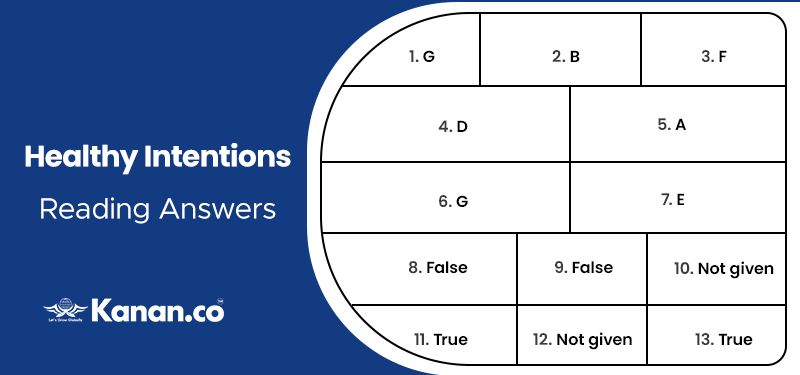
Here we have given Healthy Intentions reading practice and answers with explanations. It has 13 questions in 2 different questions types- 7 questions as locating information, and 6 questions as true, false or not given questions form.
Check out our YouTube Channel to Practice Full-Length IELTS Reading Tests Daily

Table of contents:
- Solution for Healthy Intentions
- Healthy Intentions IELTS reading practice test
- Passage
- Questions
- Answers with explanations
Solution for Healthy Intentions
We have given Healthy Intentions reading answers, in the table given below.

Answer Table
| 1. G | 4. D | 7. E | 10. Not given | 13. True |
| 2. B | 5. A | 8. False | 11. True | |
| 3. F | 6. G | 9. False | 12. Not given |
Healthy Intentions IELTS reading practice test- Exam Review
Here we have given Healthy Intentions IELTS reading answers. This article will help to be excellent in the IELTS reading practice to challenge your reading skill and read the given passage to answer the questions.
Passage
We have given Healthy Intentions reading answers with location. Go through the given passage carefully and answer the questions.
Healthy Intentions reading answers
Most of us have healthy intentions when it comes to the food we eat. But it can be tough. Especially when you consider that our bodies have not properly adapted to our highly processed fast-food diets.
- One hundred years ago, the leading causes of death in the industrial world were infectious diseases such as tuberculosis, influenza, and pneumonia. Since then the emergence of antibiotics, vaccines, and public health controls has reduced the impact of infectious disease. Today, the top killers are non-infectious illnesses related essentially to lifestyle (diet smoking, and lack of exercise). The main causes of death in the United States in 1997 were heart disease, cancer, and stroke. Chronic health problems, such as obesity, non insulin-dependent diabetes, and osteoporosis, which are not necessarily lethal but nonetheless debilitating, are steadily increasing. It is clear that economic and technical progress is no assurance of good health.
- Humans are quantitatively different from other animals because we manipulate the flow of energy and resources through the ecosystem to our advantage, and consequently to the detriment of other organisms. That is why we compete so successfully with other species. But with this success come some inherent failings, particularly in terms of our health.
- According to physician Boyd Eaton and his anthropologist colleagues, despite all our technological wizardry and intellectual advances, modern humans are seriously malnourished. The human body evolved to eat a very different diet from that which most of us consume today. Before the advent of agriculture, about ten thousand years ago, people were hunter-gatherers, the food varied with the seasons and climate, and all were obtained from local sources. Our ancestors rarely, if ever, ate grains or drank the milk of other animals.
- Although ten thousand years seems a long time ago, 99.99 percent of our genetic material was already formed. Thus we are not well adapted to an agriculturally based diet of cereals and dairy products. At least 100,000 generations of people were hunter-gatherers, only 500 generations have depended on agriculture, only ten generations have lived since the onset of the industrial age and only two generations have grown up with highly processed fast foods. Physicians Randolph Nesse and George Williams write: ‘Our bodies were designed over the course of millions of years of lives spent in small groups hunting and gathering on the plains of Africa. Natural selection has not had time to revise our bodies for coping with fatty diets, automobiles, drugs, artificial lights, and central heating. From this mismatch between our design and our environment arises much, perhaps most, preventable modern disease.’
- Do we really want to eat like prehistoric humans’? Surely cavemen were not healthy? Surely their life was hard and short? Apparently not. Archaeological evidence indicates that these hunter- gatherer ancestors were robust, strong, and lean with no sign of osteoporosis or arthritis —- even at more advanced ages. Paleolithic humans ate a diet similar to that of wild chimpanzees and gorillas today: raw fruit, nuts, seeds, vegetation, fresh untreated water, insects, and wild-game meat low in saturated fats. Much of their food was hard and bitter. Most important, like chimpanzees and gorillas, prehistoric humans ate a wide variety of plants — an estimated 100 to 300 different types in one year. Nowadays, even health-conscious, rich westerners seldom consume more than twenty to thirty different species of plants.
- The early human diet is estimated to have included more than 100 grams of fiber a day. Today, the recommended level of 30 grams is rarely achieved by most of us. Humans and lowland gorillas share similar digestive tracts — in particular, the colon — but, while gorillas derive up to 60 percent of their total energy from fiber fermentation in the colon, modern humans get only about 4 percent. When gorillas are brought into captivity and fed on lower-fiber diets containing meat and eggs, they suffer from many common human disorders: cardiovascular disease, ulcerative colitis, and high cholesterol. Their natural diet, rich in antioxidants and fiber apparently prevents these diseases in the wild, suggesting that such a diet may have serious implications for our own health.
- Not all agricultural societies have taken the same road. Many traditional agriculturalists maintain the diversity of their diet by eating a variety of herbs and other plant compounds, along with meat and grain. The Hausa people of northern Nigeria, for example, traditionally include up to twenty wild medicinal plants in their grain-based soups, and peoples who have become heavily reliant on animal products have found ways of countering the negative effects of such a diet. While the Masai of Africa eat meat and drink blood, milk, and animal fat as their only sources of protein, they suffer less heart trouble than Westerners. One reason is that they always combine theiranimal products with strong, bitter antioxidant herbs. In other words, the Masai have balanced the intake of oxidizing and anti-oxidizing compounds. According to Timothy Johns, it is not the high intake of animal fat or the low intake of antioxidants that creates so many health problems in industrial countries; it is the lack of balance between the two.
- Eating the right foods and natural medicines requires sensitivity to subtle changes in appetite. Do | fancy something sweet, sour, salty, stimulating, or sedating? What sort of hunger is it? And after consumption, has the need been satisfied? Such subtleties are easily overridden by artificially created super-stimuli in processed foods that leave us unable to select a healthy diet. We need to listen more carefully to our bodies’ cravings and take an intentional role in maintaining our health before disease sets in.
Questions
Questions 1-7
- The reading passage has seven paragraph A-G. which paragraph contains the following information. You may use any letter more than once.
1. A reference to systems for neutralizing some harmful features of modem diets
2. A suggestion as to why mankind has prospered
3. An example of what happens if a balanced, plant-based diet is abandoned
4. A chronological outline of the different types of diet mankind has lived on
5. Details of which main factors now threaten human life
6. A reference to one person’s theory about the cause of some of today’s Illnesses
7. Detail of the varied intake of early humans
Question 8-13
- Do the following statements agree with the claims of the writer in reading passage
- True if the statement agrees with the information
- False if the statement contradicts the information
- Not given if there is no information on this.
8. An increase in material resources leads to improved physical health.
9. Cereals were unknown to our hunter-gathering ancestors
10. In the future, human bodies will adapt to take account of changes in diet.
11. Many people in developed countries have a less balanced diet than early humans.
12. Gorillas that live in the wild avoid most infectious diseases.
13. Food additives can prevent people from eating what their bodies need.
Answers for Healthy Intentions with explanation
We have given Healthy Intentions flows reading answers with explanation, this will help you to identify your mistakes in the answering process.
1. Answer: G
Explanation: “Not all agricultural societies have taken the same road. Many traditional agriculturalists maintain the diversity of their diet by eating a variety of herbs and other plant compounds, along with meat and grain”. These lines explain a system that not all agricultural societies have taken the same food, and what are all the compounds that they take along with their foods. Hence the given answer is located in the paragraph G.
2. Answer: B
Explanation: “Humans are quantitatively different from other animals because we manipulate the flow of energy and resources through the ecosystem to our advantage, and consequently to the detriment of other organisms. That is why we compete so successfully with other species. But with this success come some inherent failings, particularly in terms of our health”. In these lines it is clear that it is a suggestion as to why mankind has prospered. Hence the given answer is located in paragraph B.
3. Answer: F
Explanation: “When gorillas are brought into captivity and fed on lower-fiber diets containing meat and eggs, they suffer from many common human disorders: cardiovascular disease, ulcerative colitis, and high cholesterol. Their natural diet, rich in antioxidants and fiber apparently prevents these diseases in the wild, suggesting that such a diet may have serious implications for our own health.” These lines explain how natural diet is abandoned with an example. Hence the given answer is located in the last 6 lines of paragraph F.
4. Answer: D
Explanation: “Although ten thousand years seems a long time ago, 99.99 percent of our genetic material was already formed. Thus we are not well adapted to an agriculturally based diet of cereals and dairy products. At least 100,000 generations of people were hunter-gatherers, only 500 generations have depended on agriculture, only ten generations have lived since the onset of the industrial age and only two generations have grown up with highly processed fast foods”. These lines explain what all the different types of diets mankind has lived on. Hence the given answer is located in the 1-6 lines of paragraph D.
5. Answer: A
Explanation: “The leading causes of death in the industrial world were infectious diseases such as tuberculosis, influenza, and pneumonia. Since then the emergence of antibiotics, vaccines, and public health controls has reduced the impact of infectious disease. Today, the top killers are non-infectious illnesses related essentially to lifestyle (diet smoking, and lack of exercise)” These lines explain what are the main factors that threaten human life. Hence the given answer is located in the 1-5 lines of paragraph A.
6. Answer: G
Explanation: “According to Timothy Johns, it is not the high intake of animal fat or the low intake of antioxidants that creates so many health problems in industrial countries; it is the lack of balance between the two” These line we can see the a person’s theory about the cause of some of today’s Illnesses. Hence the given answer is located in the last 3 lines of paragraph G.
7. Answer: E
Explanation: “Archaeological evidence indicates that these hunter- gatherer ancestors were robust, strong, and lean with no sign of osteoporosis or arthritis —- even at more advanced ages. Paleolithic humans ate a diet similar to that of wild chimpanzees and gorillas today: raw fruit, nuts, seeds, vegetation, fresh untreated water, insects, and wild-game meat low in saturated fats. Much of their food was hard and bitter. Most important, like chimpanzees and gorillas, prehistoric humans ate a wide variety of plants — an estimated 100 to 300 different types in one year. Nowadays, even health-conscious, rich westerners seldom consume more than twenty to thirty different species of plants”. This line explains the various intake of early humans. Hence the given answer is located in the 2-10 lines of paragraph E.
8. Answer: False
Explanation: “The leading causes of death in the industrial world were infectious diseases such as tuberculosis, influenza, and pneumonia. Since then the emergence of antibiotics, vaccines, and public health controls has reduced the impact of infectious disease” and “It is clear that economic and technical progress is no assurance of good health”. The first four lines explain the causes of death and the last two lines show that economics is no assurance of good health. Hece the given answer is located in the first four lines and last lines of paragraph of A.
9. Answer: False
Explanation: “Hunter-gatherers, the food varied with the seasons and climate, and all were obtained from local sources. Our ancestors rarely, if ever, ate grains or drank the milk of other animals” This line explains that our hunter-gatherer ancestors were dependent on cereals. Hence the given answer is located in the last 3 lines of paragraph C.
10. Answer: Not given
11. Answer: True
Explanation: “According to physician Boyd Eaton and his anthropologist colleagues, despite all our technological wizardry and intellectual advances, modern humans are seriously malnourished. The human body evolved to eat a very different diet from that which most of us consume today” this line explains few peoples in developed countries are on a less balanced diet than early humans. Hence the given answer is located in the 1-4 lines of paragraph C.
12. Answer: Not given
13. Answer: True
Explanation: “Such subtleties are easily overridden by artificially created super-stimuli in processed foods that leave us unable to select a healthy diet. We need to listen more carefully to our bodies’ cravings and take an intentional role in maintaining our health before disease sets in.” These lines explain that quality foods are easily overridden by the artificially created super-stimuli in processed foods which are not required for the human body. Hence the given answer is located in the last 4 lines of paragraph H.
Other reading answers

About Author Arivarasi
Arivarasi is an experienced author with expertise in the study abroad industry and preparing test materials for exams like IELTS, TOEFL, GRE, SAT, PTE, etc. She stays up-to-date with university and college requirements for international students which allows her to provide guidance on course selection, documents like SOP, LOR, and scholarship opportunities. She has written numerous articles on study abroad exams, destinations, universities & colleges requirements, admission procedures, and the entire process of studying abroad. Collaborating with industry experts and counselors, she crafts informative articles that make students take the right decisions.
Kanan.co is a trusted study abroad consultancy offering comprehensive services, resources, and solutions for students and education institutions. We support students at every stage of their global education journey, ensuring a smooth and guided experience. Along with test preparation for IELTS, GRE, TOEFL, and SAT, we provide expert services such as SOP writing, visa guidance, accommodation support, scholarship assistance, and education loan support. Our expertise and commitment to excellence make us a reliable partner for students pursuing international education.
Free Online Mock Test 2026
Practice our mock test worth Rs. 25000 for Free and know your IELTS score!








Global Headquarters
Kanan Int EdTech Inc
320 Bay Street, Suite 321 (Spaces), Toronto ON, Canada M5B 1N9
Indian Headquarters
Kanan International Pvt. Ltd.
D-wing, 2nd Floor, Trident Complex, Ellora Park Vadiwadi Road, Vadodara, Gujarat 390007
IT/ Digital Campus
Kanan International Pvt. Ltd
Old, New No 3, 2nd Floor, 1A, Dr Sadasivam Rd, T. Nagar, Chennai, Tamil Nadu 600017
Our branches
- Bardoli
- Bharuch
- Chennai
- Dehradun
- Gurugram
- Himatnagar
- Karnal
- Nadiad
- Navsari
- Palanpur
- Rajkot
- Vadodara
- Valsad
- Vallabh Vidyanagar
- Vapi
Study Abroad
Test Prep
Top Universities
Consultants
IELTS Centers
GRE Centers
TOEFL Centers
SAT Centers
Language Courses in Vadodara
Study Abroad Calculators
Featured Blogs
Study Abroad Consultants in Chennai
Study Abroad Consultants in Surat
Study Abroad Consultants in Navsari
Study Abroad Consultants in Bardoli
Study Abroad Consultants in Ahmedabad
Study Abroad Consultants in Anand
Study Abroad Consultants in Khanna
Study Abroad Consultants in Nadiad
Study Abroad Consultants in Vadodara
Study abroad consultants in Valsad
Copyright © 2026 KANAN.CO All rights reserved.