- Study Abroad
- / ielts
- / neanderthals and modern humans reading answers
Neanderthals and Modern Humans Reading Answers


Author
17-09-2025

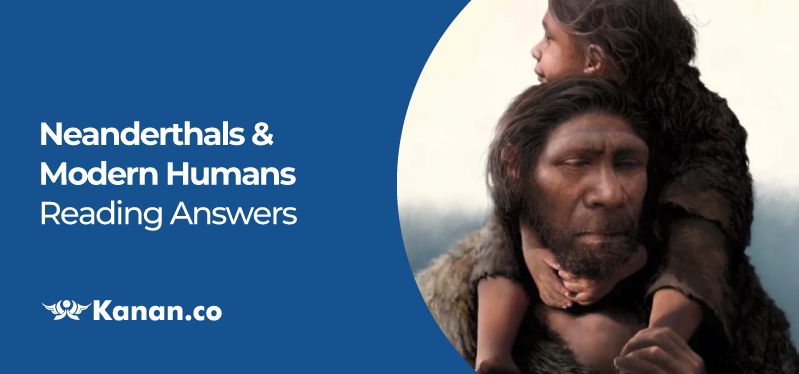
Neanderthals and modern humans reading answers are listed in tabular form. Check your answers to make sure they are accurate and to look for any mistakes.
Solution for: Neanderthals and Modern Humans
| 1. C | 5. A | 9. A | 13. Little-Finger bone |
| 2. B | 6. D | 10. E | |
| 3. A | 7. B | 11. Inter breeding | |
| 4.Ci | 8. G | 12. Growth |

To evaluate your performance on the IELTS reading test, consult "Neanderthals and modern humans reading answers." Make sure you have a firm grasp of the synonyms for the question's key terms and concentrate on them. It is also suggested that one can find the correct answers more quickly if they concentrate more on the key terms from the questions themselves and are familiar with outstanding synonyms.
On the completion of the passage "Neanderthals and modern humans reading answers," you can practise all IELTS reading question types. If you skim and scan, you'll be able to move more quickly and better manage your time. Consult the section of answers with explanations to find the proper location for the answers. This reading response includes the following supporting questions.
IELTS Reading Summary Completion
IELTS Reading Matching features
IELTS Reading Matching heading questions
Check out our YouTube Channel to Practice Full-Length IELTS Reading Tests Daily

IELTS Reading Passage: Neanderthals and modern humans
These are 13 questions based on the information provided; you should set aside 20 minutes to complete them. Neanderthals and modern humans IELTS reading answers with locations are accessible for review once the test has been completed.
Neanderthals and modern humans
A. Without the ability to examine human species that have not attained similar things, it is difficult to determine the evolutionary processes that have separated modern humans from other animals. However, Svante Paabo and his colleagues from the Leipzig-based Max Planck Institute for Evolutionary Anthropology have created a scientific masterpiece that makes it possible for such a comparison. They made a genome analysis of Neanderthal man public in 2009 at an American Association for the Advancement of Science meeting.
B. Between 400,000 and 30,000 years ago, Homo neanderthalensis, to use its correct name, lived in Europe and some regions of Asia. At the end of this time, Homo sapiens, who were migrating from Africa, invaded its territory and coexisted with it. The two species, however, were unable to establish a long-term cohabitation. Neanderthals always vanished in a region shortly after Homo sapiens arrived there, for reasons that are still unknown.
C. Prior to 2009, Dr. Paabo and his group had only superficially compared the DNA of Neanderthals and contemporary humans. They have since conducted a more in-depth study, which has helped to illuminate the two species' intertwined history in an intriguing way. It turns out that history is more interconnected than many people initially thought.
D. Dr. Paabo and his colleagues compared the genomes of five living people from different regions of Africa and Eurasia with their Neanderthal genome, which had been painstakingly reconstructed from three bone samples found in a cave in Croatia. There was no evidence of interbreeding between Neanderthals and modern humans in earlier genetic studies, which only looked at DNA passed from mother to child in cellular structures called mitochondria. This conclusion is incorrect, according to a newer, more thorough investigation that looks at DNA in the cell nucleus rather than the mitochondria. Dr. Paabo has demonstrated that between one and four percent of Eurasians are Neanderthals by comparing the DNA in the cell nuclei of various Eurasians and Africans, whose ancestors could have interbred with Neanderthals but did not because of their lack of overlap.
E. That's interesting. It demonstrates that the two species were inter-fertile despite living many hundred thousand years apart. However, it is puzzling that no Neanderthal mitochondrial DNA has been discovered in modern humans. Historically, invasions typically followed a pattern where the invaders' males mated with the invaded females. So, one thing to know about oneself, at least for non-Africans, is that they have a little Neanderthal in them. But Dr. Paabo's research also sheds light on how different the species are. Modern humans, Neanderthals, and chimpanzees can be used to compare genetic changes that several species of humans have shared as they have evolved away from the great ape lineage from those that are specific to Homo sapiens.
F. Neanderthals share more than 90% of the "human accelerated regions" [3] that have been found in modern humans. The others are not, though. Since the species split, 212 regions of the genome have apparently undergone significant evolution, according to Dr. Paabo. It is frequently unclear what a specific piece of DNA is actually doing because genome science is still in an extremely early stage. However, a closer look at the 20 largest DNA regions that have changed in this way reveals that they contain a number of genes linked to cognition and whose dysfunction can result in severe mental health issues. Therefore, it appears that the search for the essence of modern humanity should begin with these genes.
G. Another gene called RUNX2, which regulates bone growth, is also present in the recently evolved DNA regions. That could explain why the two species' rib cages and skulls differ in appearance. In contrast, a previous stage of the research had already demonstrated that Neanderthals and modern humans share the same variation of the FOXP2 gene, which is involved in speech and differs in chimpanzees. So everything looks very promising and represents Dr. Paabo's second quick success. Using mitochondrial DNA from a little-finger bone, one of his teams has proven the existence of a previously unknown species of humans. Humanity would be able to learn more about itself if that species' genome could also be fully read.
Neanderthals and modern humans Reading Questions
Questions 1-3
Complete the summary below.
Choose NO MORE THAN THREE WORDS from the passage for each answer.
The nature of modern humans:
Recent work in the field of evolutionary anthropology has made it possible to compare modern humans with other related species. Genetic analysis resulted in several new findings. First, despite the gap in time between the evolution of Homo sapiens and Homo Neanderthalensis, 1.________ did occur. Second, genes that emerged after modern humans diverged from Neanderthals are linked to intelligence and skeletal 2.________. When examination of a 3.__________ resulted in the identification of a new human species, the potential for this field of study to shed light on the nature of modern humans was strengthened.
Click to know more about IELTS reading Summary completion
Questions 4-8
Look at the following characteristics (Questions 14-18) and the list of species below.
Match each feature with the correct species, A, B or C.
Write the correct letter, A, B or C.
NB You may use any letter more than once.
4. Lived in Europe and Asia in the past.
5. Originated in Africa.
6. Did not last long after immigrants arrived.
7. Mated with a different species.
8. Appears to have prevented another species from receiving mitochondrial DNA.
List of species
A Homo neanderthalensis
B Homo sapiens
C both Homo neanderthalensis and Homo sapiens
Click to know more about IELTS reading Matching features
Questions 9-13
Reading Passage 2 has seven paragraphs, A-G.
Which paragraph contains the following information?
Write the correct letter, A-G.
9. An explanation of why a theory was rejected
10. A mention of an illogical connection between two events
11. The discovery of a skill-related gene shared by modern humans and Neanderthals
12. The declaration of a scientific discovery
13. There is an intriguing knowledge gap
Click to know more about IELTS reading Matching Heading Questions
Neanderthals and modern humans Reading answers with Explanation
Neanderthals and modern humans Reading answers with explanations can help you correct errors and identify the information needed for your answer.
(Note: The text in italics from the reading passage shows the location from where the answer is taken or inferred.)
1. Solution for 1: Inter breeding
Explanation: In the first line of paragraph E, “inter-fertile”.
2. Solution for 2: Growth
Explanation: In the first line of paragraph G, “growth”.
3. Solution for 3: Little-finger bone
Explanation: In the seventh line of paragraph G, “little-finger bone”.
4. Solution for 4: C
Explanation: In the second line of paragraph B, “lived in Europe and some regions of Asia”.
5. Solution for 5: B
Explanation: In the second and third line of paragraph B, “Homo sapiens, who were migrating from Africa”.
6. Solution for 6: A
Explanation: IN the last two lines of paragraph B, “Neanderthals always vanished in a region shortly after Homo sapiens arrived there, for reasons that are still unknown”.
7. Solution for 7: C
Explanation: In the first two lines of paragraph E, “It demonstrates that the two species were inter-fertile despite living many hundred thousand years apart”.
8. Solution for 8: A
Explanation: In the second and third line of paragraph E, “no Neanderthal mitochondrial DNA has been discovered in modern humans”.
9. Solution for 9: D
Explanation: In the fourth and fifth line of paragraph D, “interbreeding between Neanderthals and modern humans in earlier genetic studies, which only looked at DNA passed from mother to child in cellular structures called mitochondria”.
10. Solution for 10: B
Explanation: In the last line of paragraph B, “for reasons that are still unknown”.
11. Solution for 11: G
Explanation: In the fourth and fifth line of paragraph G, “Neanderthals and modern humans share the same variation of the FOXP2 gene, which is involved in speech and differs in chimpanzees”.
12. Solution for 12: A
Explanation: In the third, fourth and fifth line of paragraph A, “However, Svante Paabo and his colleagues from the Leipzig-based Max Planck Institute for Evolutionary Anthropology have created a scientific masterpiece that makes it possible for such a comparison”.
13. Solution for 13: E
Explanation: In the third and fourth line of paragraph E, “Historically, invasions typically followed a pattern where the invaders' males mated with the invaded females”.
Check the other reading passages
- Issues affecting the southern resident orcas reading answers
- New zealand seaweed reading answer
- Motivational factors and the hospitality industry reading answers (Solution)
Conclusion
The article "Neanderthals and modern humans Reading Answers" is an excellent IELTS reading resource. You can use the materials and sample tests available at the aforementioned locations to prepare for the IELTS. As a result, this page was created as a resource for those studying for the IELTS reading exam.

About Author Abishek Babu M
Abishek is a seasoned expert in the study abroad processes and IELTS, GRE, TOEFL, and SAT subjects. With over 2.5 years of experience in helping students achieve their foreign education goals, he has become a trusted individual in the industry. His extensive knowledge and authority in the IELTS test have earned him a reputation as a go-to resource for students seeking to excel in their exams. Abishek's exceptional track record has earned him the trust of countless students who rely on his resources to achieve their study abroad dreams.
Kanan International is a study abroad consultancy that offers reliable services, products, and solutions for students and education institutions. We support students throughout their study abroad journey, ensuring a hassle-free experience. Our expertise and commitment to excellence make us the go-to partner for expanding global horizons. The company provides coaching for IELTS, GRE, TOEFL, and SAT exams and services like visa consultation, accommodation, scholarship assistance, and education loans.
Free Online Mock Test 2026
Practice our mock test worth Rs. 25000 for Free and know your IELTS score!








Global Headquarters
Kanan Int EdTech Inc
320 Bay Street, Suite 321 (Spaces), Toronto ON, Canada M5B 1N9
Indian Headquarters
Kanan International Pvt. Ltd.
D-wing, 2nd Floor, Trident Complex, Ellora Park Vadiwadi Road, Vadodara, Gujarat 390007
IT/ Digital Campus
Kanan International Pvt. Ltd
Old, New No 3, 2nd Floor, 1A, Dr Sadasivam Rd, T. Nagar, Chennai, Tamil Nadu 600017
Our branches
- Bardoli
- Bharuch
- Chennai
- Dehradun
- Gurugram
- Himatnagar
- Karnal
- Nadiad
- Navsari
- Palanpur
- Rajkot
- Vadodara
- Valsad
- Vallabh Vidyanagar
- Vapi
Study Abroad
Test Prep
Top Universities
Consultants
IELTS Centers
GRE Centers
TOEFL Centers
SAT Centers
Language Courses in Vadodara
Study Abroad Calculators
Featured Blogs
Study Abroad Consultants in Chennai
Study Abroad Consultants in Surat
Study Abroad Consultants in Navsari
Study Abroad Consultants in Bardoli
Study Abroad Consultants in Ahmedabad
Study Abroad Consultants in Anand
Study Abroad Consultants in Khanna
Study Abroad Consultants in Nadiad
Study Abroad Consultants in Vadodara
Study abroad consultants in Valsad
Copyright © 2026 KANAN.CO All rights reserved.