- Study Abroad
- / ielts
- / issues affecting the southern resident orcas reading answers
Issues Affecting the Southern Resident Orcas Reading Answers


Author
16-09-2025

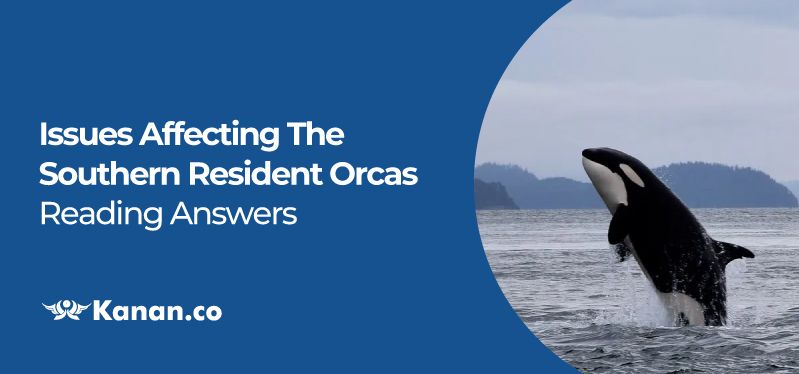
The answer table for the topic of issues affecting the southern resident orcas reading answers is given below.
Answer Table
| 1. iii | 5. B | 9. pollution | 13. exhaust fumes |
| 2. ii | 6. A | 10. popular | 14. communicating (with others) |
| 3. vii | 7. (on) bottom fish | 11. numerous boats/ vessels | |
| 4. v | 8. less | 12. quiet |

Practicing beforehand for your exams will help you to prepare yourself for exams as well as it helps to score good marks easily. Here the article for issues affecting the southern resident orcas reading answers is given with the altered version of the practice test.
The IELTS reading test is just like paraphrasing, which is a lengthy passage about any topic along with some questions which are taken from the given passage. The IELTS reading was given with 40 questions in 3 various sections. Here the given article consists of the IELTS reading passage about the issues affecting the southern resident orcas reading answers with practice tests.
Those 3 sections contain a maximum of 13-15 questions, which are divided into different question types into various sections. Here the given topic consists of 14 questions in 3 various question types of IELTS reading questions types, read the given thoughts for the topic of issues affecting the southern resident orcas reading answers.
Check out the issues affecting the southern resident orcas reading answers IELTS reading tips
Check out our YouTube Channel to Practice Full-Length IELTS Reading Tests Daily

IELTS Reading Passage: issues affecting the southern resident orcas
Here we have given the passage for our practice test. Going through the passage thoroughly helps you to find some important points and keywords which are useful while answering.
Issues Affecting the Southern Orcas
A
Orcas, also called as killer whales, are aggressive feeders, which means they will take a multiplicity of various prey species. J, K, and L pods (specific groups of orcas found in the region) are nearly solely fish eaters. Some analyses show that up to 90 percent of their diet is salmon, with Chinook salmon being by far their favorite. During the last 50 years, hundreds of wild runs of salmon have vanished due to environmental loss and overfishing of wild stocks. Many of the vanished salmon stocks are the winter runs of Chinook and coho. While the live stocks have probably been enough to comfort the resident pods, numerous runs that have been lost were doubtless traditional resources favored by the resident orcas. This may be affecting the whales’ nourishment in the winter and may need them to swap their motif of movement in order to search for food.
Other analyses with tagged whales have shown that they usually dive up to 800 feet in this area.
Analysts are inclined to think that during bottomless dives the whales may be feeding on bottomfish. Bottomfish species in this area would cover flatfish, bullfish, Ophiodon, and greenling. Researchers assess that today’s Ophiodon population in northern Puget sound and the strait of Georgia is only 2 percent of what it was in 1950. The norm size of bull fish in the recreational catch has also decreased by some inches since the 1970s, which is symptomatic of overfishing. In a few locations, certain bull fish species have vanished completely. So even if bottomfish are not a main food resource for the whales, the present low numbers of obtainable fish increases the pressure on orcas and all oceanic animals to find food. (for more details on bottomfish see the San Juan Country Bottomfish Recovery Program).
B
Poisonous stuff gather in lofty concentrations as they move up the food chain. Due to orcas are the top vampire in the ocean and are at the top of some various food chains in the habitat, they are conducive to be more affected by pollutants than other sea animals. Scrutiny of helpless killer whales have shown some exceedingly high levels of lead, mercury and PCBS. Deserted oceanic poisonous waste dumps and present levels of firm and human waste pollution of the inland waters probably presents the most serious threat to the continuous survival of this orca population. Adversely, the total treatment to this huge issue would be broad societal changes on numerous fronts. However because of the fact that orcas are so famous, they may be the best type to use as a center in bringing about the numerous swaps that are required to be made in order to keep the oceanic habitat as a whole from further noxious poisoning’.
C
The water around the San Juan Island is exceedingly busy because of international trading shipping, fishing, whale watching, and cruisers. On a busy weekend day in the summer, it is not unusual to see many vessels in the neighborhood of the whales as they travel through the area. The possible collision from all this boat traffic with consideration to the whales and other oceanic animals in the area could be huge.
The surfacing and breathing space of oceanic birds and mammals is a censorious aspect of their environment, which the animals must deliberately deal with on a moment-to moment basis all over their lifespan. With all the sailing activity in the neighborhood, there are three ways in which surface collisions are most likely to affect oceanic animals:(a) impact, (b) impact avoidance, and (c) exhaust emission in breathing pockets.
The first two collisions are very clear and don’t just apply to boats with motors. Canoes even present an issue here due to they’re so quiet, oceanic animals, busy hunting and feeding under the surface of the water, may not be conscious of the fact that there is a canoe above them and literally hit the bottom of it as they surface to breathe.
The third collision is one most people don’t even think of. When there are many boats in the area, particularly loafing boats, there is ample carbon monoxide gas being erected out on the surface of the water. When the whale comes up to a nice huge breath of “pure” air, it alternatively gets a nice big breath of carbon monoxide gas. It’s difficult to tell how highly this affects the animals, but think how breathing polluted air affects us (i.e., smoke in large cities like Los Angeles, breathing the disgusting air while sitting in traffic jams, etc).
D
Alike to surface collisions, a prime origin of acoustic pollution for this population of orcas would also be obtained from the accumulating underwater noise of vessel traffic. For beluga, the sub-aquatic sound habitat is may be the most censorious part of their sensory and observable lives. Orcas liaise with each other over short and long gaps with a diversity of clicks, tweet, creak, and whoosh, along with using bio sonar to locate prey and to navigate. They may also rely on submissive listening as a prime sensory source. The incessant collisions from noise pollution would not likely show perceptible behavioral changes in the environment use, but rather as sensorial damage or decreasing in population health. A new analyst at The Whale Museum called the SeaSound Remote Sensing Network has begun studying sub-aquatic acoustics and its relationship to orca communication.
IELTS Reading Questions: issues affecting the southern resident orcas
Questions 1-4
- Reading Passage 3 has four sections (A-D). Choose the most suitable heading for each section from the list of headings below.
- Write the appropriate numbers (i-vii) in boxes 1-4 on your Answer Sheet
- There are more headings than sections, so you will not use all of them.
List of Headings
1 Section A i Top Ocean Predators
2 Section B ii Toxic Exposure
3 Section C iii Declining Fish Populations
4 Section D iv Pleasure Boating in the San Juan Islands
v Underwater Noise
vi Smog in Large Cities vii Impact of Boat Traffic
vii Impact of Boat Traffic
Check out the IELTS reading matching headings
Questions 5-6
For each question, choose the appropriate letter A-D and write it in boxes 5 and 6 on your Answer Sheet
5 Killer whales (orcas) in the J, K, and L pods prefer to eat
A halibut.
B a type of salmon.
C a variety of animals.
D fish living at the bottom of the sea.
6 Some groups of salmon have become extinct because
A they have lost places to live.
B whales have eaten them.
C they don't get good nutrition.
D the winters in the area are too cold.
Read the IELTS reading multiple choice questions.
Questions 7-14
Complete the chart below.
Choose NO MORE THAN THREE WORDS for each answer.
Write your answers in boxes 7-14 on your Answer Sheet.
| Cause | Effect |
| Scientists believe some whales feed 7 _______ | These whales dive very deep. |
| Scientists believe that the area is being overfished | Rockfish caught today are 8 _____ than rockfish caught in the past. |
| Orcas are at the top of the ocean food chain. | 9_______ affects orcas more than it does other sea animals. |
| Orcas are a 10_________ species. | We can use orcas to make society aware of the problem of marine pollution. |
| People enjoy boating, fishing, and whale watching in the San Juan Islands. | On weekends there are 11_______ near the whales. |
| Kayaks are 12 ___________ | Marine animals hit them when they come up for air. |
| A lot of boats beep their motors running. | Whales breathe 13 ___________ |
| Boats are noisy. | Whales have difficulty 14________ |
Go through the IELTS reading flow chart completion.
Issues affecting the southern resident orcas Reading Answers with Explanation
The given passage for issues affecting the southern resident orcas reading answers, along with keywords. Examine it to estimate your answers.
1. Answer: iii
Explanation: During the last 50 years, hundreds of wild runs of salmon have vanished due to environmental loss and overfishing of wild stocks. The given answer is located in the 4-6 lines of paragraph A
2. Answer: ii
Explanation: Poisonous stuff gather in lofty concentrations as they move up the food chain.The given answer is located in the first line of paragraph B.
3. Answer: vii
Explanation: When there are many boats in the area, particularly loafing boats, there is ample carbon monoxide gas being erected out on the surface of the water. The given answer is located in the first 3 lines in the 4th stanza of paragraph C.
4. Answer: v
Explanation: Alike to surface collisions, a prime origin of acoustic pollution for this population of orcas would also be obtained from the accumulating underwater noise of vessel traffic. For beluga, the sub-aquatic sound habitat is may be the most censorious part of their sensory and observable lives.The given answer is located in the first 4 lines of paragraph C.
5. Answer: B
Explanation: Orcas, also called as killer whales, are aggressive feeders, which means they will take a multiplicity of various prey species. J, K, and L pods (specific groups of orcas found in the region) are nearly solely fish eaters. Some analyses show that up to 90 percent of their diet is salmon, with Chinook salmon being by far their favorite. The given answer is located in the first 4 lines of paragraph A.
6. Answer: A
Explanation: During the last 50 years, hundreds of wild runs of salmon have vanished due to environmental loss and overfishing of wild stocks. The given answer is located in the 4-6 lines of paragraph A.
7. Answer: (on) bottomfish
Explanation: Analysts are inclined to think that during bottomless dives the whales may be feeding on bottomfish. The given answer is located in the 1st line in the 2nd stanza of paragraph A.
8. Answer: less
Explanation: The norm size of bull fish in the recreational catch has also decreased by some inches since the 1970s, which is symptomatic of overfishing. The given answer is located in the 4-6 lines in the 2nd stanza of paragraph A.
9. Answer: pollution
Explanation: Due to orcas are the top vampire in the ocean and are at the top of some various food chains in the habitat, they are conducive to be more affected by pollutants than other sea animals. The given answer is located in the 1-4 lines of paragraph B.
10. Answer: popular
Explanation: However because of the fact that orcas are so famous, they may be the best type to use as a center in bringing about the numerous swaps that are required to be made in order to keep the oceanic habitat as a whole from further noxious poisoning’. The given answer is located in the last 3 lines of paragraph B.
11. Answer: numerous boats/vessels
Explanation: On a busy weekend day in the summer, it is not unusual to see many vessels in the neighborhood of the whales as they travel through the area. The given answer is located in the 2-4 lines of paragraph C.
12. Answer: quiet
Explanation: Canoes even present an issue here due to they’re so quiet. The given answer is located in the 2nd line in the 3th stanza of paragraph C.
13. Answer: exhaust fumes
Explanation: When there are many boats in the area, particularly loafing boats, there is ample carbon monoxide gas being erected out on the surface of the water. When the whale comes up to a nice huge breath of “pure” air, it alternatively gets a nice big breath of carbon monoxide gas.The given answer is located in the first 4 lines in the 4th stanza of paragraph C.
14. Answer: communicating(with others)
Explanation: Orcas liaise with each other over short and long gaps with a diversity of clicks, tweet, creak, and whoosh, along with using bio sonar to locate prey and to navigate. They may also rely on submissive listening as a prime sensory source. The incessant collisions from noise pollution would not likely show perceptible behavioral changes in the environment use, but rather as sensorial damage or decreasing in population health. The given answer is located in the 4-9 lines of paragraph D.
Check the Other Reading Passages
Click to get the other reading passages and answers.

About Author Roshan Sunthar
Roshan Sunthar is a study abroad expert as well as a renowned writer and author in international education. His academic excellence and 5+ years of work experience give him in-depth knowledge of international standardised exams and test preparation in IELTS, TOEFL, GRE, PTE, SAT, etc. The study materials he prepares incorporate exam-like questions. He’s also an expert in writing Statement of Purposes (SOPs) and Letter of Recommendations (LORs) for college admissions. He usually spends his leisure time watching English classics and documentaries, travelling, etc.
Kanan.co is a trusted study abroad consultancy offering comprehensive services, resources, and solutions for students and education institutions. We support students at every stage of their global education journey, ensuring a smooth and guided experience. Along with test preparation for IELTS, GRE, TOEFL, and SAT, we provide expert services such as SOP writing, visa guidance, accommodation support, scholarship assistance, and education loan support. Our expertise and commitment to excellence make us a reliable partner for students pursuing international education.
Free Online Mock Test 2026
Practice our mock test worth Rs. 25000 for Free and know your IELTS score!








Global Headquarters
Kanan Int EdTech Inc
320 Bay Street, Suite 321 (Spaces), Toronto ON, Canada M5B 1N9
Indian Headquarters
Kanan International Pvt. Ltd.
D-wing, 2nd Floor, Trident Complex, Ellora Park Vadiwadi Road, Vadodara, Gujarat 390007
IT/ Digital Campus
Kanan International Pvt. Ltd
Old, New No 3, 2nd Floor, 1A, Dr Sadasivam Rd, T. Nagar, Chennai, Tamil Nadu 600017
Our branches
- Bardoli
- Bharuch
- Chennai
- Dehradun
- Gurugram
- Himatnagar
- Karnal
- Nadiad
- Navsari
- Palanpur
- Rajkot
- Vadodara
- Valsad
- Vallabh Vidyanagar
- Vapi
Study Abroad
Test Prep
Top Universities
Consultants
IELTS Centers
GRE Centers
TOEFL Centers
SAT Centers
Language Courses in Vadodara
Study Abroad Calculators
Featured Blogs
Study Abroad Consultants in Chennai
Study Abroad Consultants in Surat
Study Abroad Consultants in Navsari
Study Abroad Consultants in Bardoli
Study Abroad Consultants in Ahmedabad
Study Abroad Consultants in Anand
Study Abroad Consultants in Khanna
Study Abroad Consultants in Nadiad
Study Abroad Consultants in Vadodara
Study abroad consultants in Valsad
Copyright © 2026 KANAN.CO All rights reserved.