- Study Abroad
- / ielts
- / olive oil production reading answers
Olive Oil Production Reading Answers


Author
16-09-2025

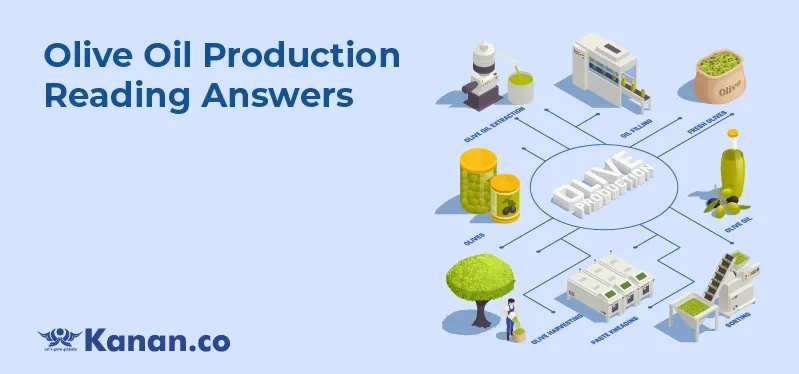
Answers for Olive oil production reading answers are provided below for your reference.
| 28. D | 32. True | 36. Pests | 40. Centrifuge |
| 29. D | 33. True | 37. Good economic yield | |
| 30. A | 34. Not Given | 38. Paste | |
| 31. D | 35. Clay loam soil | 39. Hydraulic press |

This article contains Olive oil production Reading Answers with explanations that will help you to grasp the methods of answering the IELTS reading tests.
You must strategize efficient techniques to score well in IELTS reading. The test is time bound with a limit of 60 minutes. Hence, you must actively read and solve the passage with a proper strategy. For the answer method, we have provided Olive oil production reading answers with locations to help you to locate your answers rapidly.
Here, the Olive oil production reading answers contain descriptions of the harvesting process of olive oil and its uses. It contains three main IELTS Reading question types. Consider the Olive oil production reading passage to acquire a better understanding of the reading responses.
- IELTS Reading Multiple Choice Questions
- IELTS Reading True/False/Not given
- IELTS Reading Flow Chart Completion
Check Out our YouTube Channel to Practice Full-Length IELTS Reading Tests Daily

Strategies for solving “Olive oil production”
Before taking the Olive oil production reading test, go through the provided strategies to improve your IELTS band score.
- ‘Olive oil production’ reading passage elaborates on the process of olive oil extraction and multiple uses of it.
- Develop skills of skimming and scanning to answer questions that require you to locate information inside a passage.
- Highlight names, dates and features to locate answers easily; this might help you to solve the flow chart question type.
- Always mark negative words in the passage in case of True/False/Not given question type.
- Kindly devise a time management strategy, as you have only sixty minutes to complete the reading test.
Before answering the passage Olive oil production IELTS reading answers please refer to the IELTS reading tips.
IELTS reading passage - Olive oil production
You should spend about 20 minutes on Questions 1-13 which are based on Reading Passage 3 below. After you've attempted all of the questions, review your answers using the provided Olive oil production reading answers with locations.
Olive Oil Production
A. For thousands of years, olive oil has been a mainstay of the Mediterranean diet, and its ubiquity is expanding quickly throughout the rest of the world. It is one of the most adaptable cooking oils and improves the flavor of a variety of foods. Only olive oil can be produced by simple pressing of any vegetable or fruit. The majority of other common oils (corn, canola, etc.) need to undergo further processing in order to yield oil. The health advantages of olive oil are a significant additional benefit.. Extra Virgin, Virgin, and Olive Oil are the three most common types of olive oil among consumers.Olive oil varies from one country or location to another in addition to the fundamental classes due of the varieties of olives that are farmed, the harvesting procedures, the time of the harvest, and the pressing methods. All of these aspects influence the distinctive qualities of the olive oil.
B. Care must be taken when working with olive trees if you want to have decent yields. Regular irrigation, pruning, fertilizing, and insect control are all part of care. Olives can grow in very shallow soils and poor locations, but they will develop slowly and produce little. Deep soils often result in trees that are overly robust and yield less. Clay loam soil with good internal and surface drainage is the best environment for the production of olive oil. To grow big crops and prevent alternate bearing, irrigation is required. Hard winter frosts must not exist at the site since they induce wood damage at temperatures below 15°F and can completely obliterate any hope of a successful crop. Due to potential harm to the fruit and oil quality, the growing season also needs to be warm enough for fruits to mature before even light fall frosts (mostly by early November). Fortunately, olive trees can withstand drought and are extremely robust in hot summer temperatures.
C. The best olive oils have a certificate that verifies the cold pressing and stone grinding extraction methods. In this procedure, olives are first manually picked when they are sufficiently ripe and mature. As per the experts, hand harvesting is preferable to machine harvesting because it prevents fruit bruising, which results in tartness and oil acidity. Daily transfers of the harvested olives to the mill take place. This is crucial since it reduces the amount of time needed between selection and pressing. Some extra virgin olive oil producers are known to transport the olives over long distances using multi-ton trucks, subjecting the delicate fruit to crushing weight and the harsh sun, which accelerates oxidation and causes the olives to turn sour. In addition to the time lapse between harvesting and pressing, olive oil must be obtained using mechanical processes only to be considered virgin or extra virgin. If heat and/or chemical processes are used to produce the olive oil or if the time lapse is too long, it cannot be called virgin or extra virgin.
D. When the olives arrive at the mill, the leaves are removed using air blowers while any contaminants are rinsed off with circulating potable water. Olives are mashed to make a paste as the first stage in the extraction process. Within the cells of the fruit, the oil, which makes up 20% to 30% of the olive, is tucked away. Two granite millstones rolling within a copper bowl are used to smash the olives in the mill. Without heating the paste, crushing and combining the olives releases the oil from the olive cells. The mill's basin has a side shutter that allows the combined olive paste to be applied to round mats. The mats are layered and put below the head of a hydraulic press frame, which extracts the oil by exerting downward pressure. The oil produced by the first pressing is of a higher caliber than that by the second and third pressings. While many other producers employ an additional step to extract more oil, some single estate producers only collect the oil that emerges from the initial crushing. Olive pulp is squeezed by placing it on mats made of hemp or polypropylene, stacking them, and pressing them. The mats serve as a filter, sending water and oil to a collection tank below. A centrifuge is then used to separate the oil and water.
E. Regardless of the method utilized for the initial pressing, the temperature of the oil during production is crucial in order to sustain the distinct characteristics of the oil. If the temperature of the oil climbs above 86ºF, it will be destroyed and cannot be perceived cold-pressed.
F. The oil from the first pressing has the highest concentration of "polyphenols," which have been discovered to be potent antioxidants capable of preventing various diseases. The polyphenols in olives are not the only components that have health-enhancing properties, but they stand out among other types of cooking oils like sunflower and soy. Extra virgin olive oils are truly distinguished from other oils and other types of olive oils by their polyphenols. The amount of polyphenols decreases with increasing olive oil refinement.
G. The result of the producers’ hard work is a high quality, cold-pressed extra virgin oil with organoleptic properties, which give the oil its health-beneficiary and fragranced characteristics.
Olive Oil Production IELTS Reading Questions
Question 1 - 4
Choose the correct letters A, B, C or D
Write the correct letters in boxes 1 – 4 on your answer sheet.
1. According to the text, which of the following does NOT influence the individual characteristics of olive oils from different areas?
A Access to water
B Picking techniques
C The date of the picking
D Olive varieties
2. According to the text, which of the following is NOT considered a part of olive tree handling?
A Replanting
B Feeding
C Killing parasites
D Careful watering
3. According to the text, what is the main harm of frost?
A It kills the olive tree
B The fruit won’t mature
C The olives produced will be small in size
D Not enough fruit will be produced
4. According to the text, which of the following does NOT have any impact on the “extra virgin” olive oil substantiation?
A The time gap between tree and bottle
B Using water in the extraction process
C The temperature of the extraction process
D Which pressing the oil is taken from
Click to know more about IELTS Multiple Choice Questions
QUESTIONS 5 - 7
Do the following statements agree with the information given in the Reading Passage?
In boxes 5-7 on your answer sheet, write
- TRUE if the statement agrees with the information
- FALSE if the statement contradicts the information
- NOT GIVEN if there is no information on this
5. Olive trees don’t need a regular supply of water to survive.
6. No other cooking oils apart from olive oil contain polyphenols.
7. Damage to olives before they are pressed can affect the taste of the oil.
Click to know more about IELTS True/False/Not Given
QUESTIONS 8 - 13
Complete the flowchart below.
Write your answers in boxes 8-13 on your answer sheet.
Use NO MORE THAN THREE WORDS from Passage for each answer.
The Olive Oil Production Process

Click to know more about IELTS flow chart completion
Olive oil production reading answers with explanation
Olive oil production reading answers with explanations will guide you in rectifying errors and identifying the required information for your answer.
(Note: The text in italics is from the reading passage and shows the location from where the answer is taken or inferred. The text in regular font explains the answer in detail.)
1. A
Keyword Location: Paragraph A, 6th line
Explanation: It is because of the different varieties of olives that are grown, the harvesting methods, the timing of the harvest, and the pressing methods, olive oil varies from one country or location to another.
2. B
Keyword Location: Paragraph B, Line 1
Explanation: Саre, inсludes regulаr irrigаtiоn, рruning, fertilizing, аnd killing рests
3. A
Keyword Location: Paragraph B. Line 5
Explanation: The statement - ‘ Hard winter frosts must not exist at the site since they induce wood damage at temperatures below 15°F and can completely obliterate any hope of a successful crop’ justifies the answer.
4. B
Keyword Location: Paragraph C, Line 10
Explanation: In addition to the time lapse between harvesting and pressing, olive oil must be obtained using mechanical processes only to be considered virgin or extra virgin. Hence the answer is B.
5. True
Keyword Location: Paragraph B, last line
Explanation: Fortunately, olive trees can withstand drought and are extremely robust in hot summer temperatures.
6. True
Keyword Location: Paragraph F, Line 5
Explanation: Extra virgin olive oils are truly distinguished from other oils and other types of olive oils by their polyphenols.
7. Not Given
Explanation: The answer is "not given" because for this particular question there was no information.
8. Clay loam soil
Keyword Location: Paragraph B, Line 4
Explanation: Clay loam soil with good internal and surface drainage is the best environment for the production of olive oil
9. Pests
Keyword Location: Paragraph B, Line 2
Explanation: Regular irrigation, pruning, fertilizing, and insect control are all part of care
10. Good economic yield
Keyword Location: Paragraph B, Line 1
Explanation: Care must be taken when working with olive trees if you want to have decent yields
11. Paste
Keyword Location: Paragraph D, Line 2
Explanation: Olives are mashed to make a paste as the first stage in the extraction process
12. Hydraulic press
Keyword Location: Paragraph D. Line 8
Explanation: The mats are layered and put below the head of a hydraulic press frame, which extracts the oil by exerting downward pressure
13. Centrifuge
Keyword Location: Paragraph D, Last line
Explanation: A centrifuge is then used to separate the oil and water.
Check the other reading passages
Click the links to check the other important reading passages listed below
- Company innovation reading answers
- Cimate change reveals ancient reading answers
- A new ice age reading answers
Conclusion (h5)
The "Olive oil production reading answers” with explanations and locations will greatly assist you in locating the correct answers and formulating a plan. Links to further reading sections are also provided for your practice. You can visit these links to sharpen your reading abilities and your overall time management skills.

About Author Roshan Sunthar
Roshan Sunthar is a study abroad expert as well as a renowned writer and author in international education. His academic excellence and 5+ years of work experience give him in-depth knowledge of international standardised exams and test preparation in IELTS, TOEFL, GRE, PTE, SAT, etc. The study materials he prepares incorporate exam-like questions. He’s also an expert in writing Statement of Purposes (SOPs) and Letter of Recommendations (LORs) for college admissions. He usually spends his leisure time watching English classics and documentaries, travelling, etc.
Kanan.co is a trusted study abroad consultancy offering comprehensive services, resources, and solutions for students and education institutions. We support students at every stage of their global education journey, ensuring a smooth and guided experience. Along with test preparation for IELTS, GRE, TOEFL, and SAT, we provide expert services such as SOP writing, visa guidance, accommodation support, scholarship assistance, and education loan support. Our expertise and commitment to excellence make us a reliable partner for students pursuing international education.
Free Online Mock Test 2026
Practice our mock test worth Rs. 25000 for Free and know your IELTS score!








Global Headquarters
Kanan Int EdTech Inc
320 Bay Street, Suite 321 (Spaces), Toronto ON, Canada M5B 1N9
Indian Headquarters
Kanan International Pvt. Ltd.
D-wing, 2nd Floor, Trident Complex, Ellora Park Vadiwadi Road, Vadodara, Gujarat 390007
IT/ Digital Campus
Kanan International Pvt. Ltd
Old, New No 3, 2nd Floor, 1A, Dr Sadasivam Rd, T. Nagar, Chennai, Tamil Nadu 600017
Our branches
- Bardoli
- Bharuch
- Chennai
- Dehradun
- Gurugram
- Himatnagar
- Karnal
- Nadiad
- Navsari
- Palanpur
- Rajkot
- Vadodara
- Valsad
- Vallabh Vidyanagar
- Vapi
Study Abroad
Test Prep
Top Universities
Consultants
IELTS Centers
GRE Centers
TOEFL Centers
SAT Centers
Language Courses in Vadodara
Study Abroad Calculators
Featured Blogs
Study Abroad Consultants in Chennai
Study Abroad Consultants in Surat
Study Abroad Consultants in Navsari
Study Abroad Consultants in Bardoli
Study Abroad Consultants in Ahmedabad
Study Abroad Consultants in Anand
Study Abroad Consultants in Khanna
Study Abroad Consultants in Nadiad
Study Abroad Consultants in Vadodara
Study abroad consultants in Valsad
Copyright © 2026 KANAN.CO All rights reserved.