- Study Abroad
- / ielts
- / one hundred days of reform reading answers
One Hundred Days of Reform Reading Answers


Author
16-09-2025

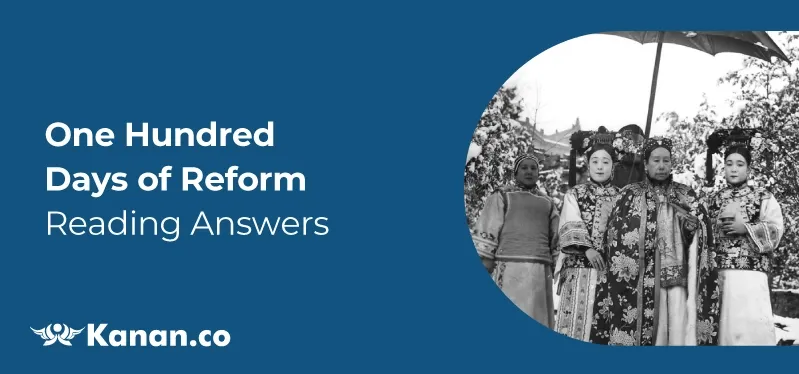
In the table given below, you have One hundred days of reform reading answers. Use them to evaluate your performance.
| 1. A | 2. B | 3. D | 4. F |
| 5. F | 6. B | 7. L | 8. M |
| 9. A | 10. E | 11. H | 12. K |
| 13. N |

The English Heritage blue plaques reading answers with explanations are given here to help you understand your mistakes.
The One Hundred Days of Reform reading passage gives information about the original period of hundred days when the reforms were first introduced. In this article, we have included three IELTS reading question types; namely,
- IELTS Reading Multiple Choice Questions
- IELTS Reading Sentence Completion
- IELTS Reading True/False/Not Given
Check out our YouTube Channel to Practice Full-Length IELTS Reading Tests Daily

IELTS Reading Passage - One Hundred Days of Reform
You must spend about 20 minutes on this reading passage. Before answering the questions, carefully read the passage and mark the keywords.
One Hundred Days of Reform
- The term "one hundred days" has been used in politics to indicate a short period of intense political reform since the early 1800s. This phase typically begins when a new leader obtains power in a country. When Napoleon fled Elba and King Louis XVIII reclaimed his throne, the first Hundred Days happened between March and June 1815. This was one of the outcomes of the Battle of Waterloo. The Hundred Days of Reform of China (also referred to as the Wuxu Reform) was influenced by a similar event. Emperor Guangxu found his nation in a tough situation following the defeat of the Sino-Japanese War. Desperate for change, the emperor recruited help from a young political activist called Kang Yu-Wei. K'ang graduated with the highest qualification (chin-shih), published two books on reform, and started many of his own political reform projects at the age of 27. K'ang impressed the court and persuaded the king that China, similar to Japan, ought to establish a constitutional government and remove the monarchy.
- Emperor Guwangu handed the reform work to Kang on June 11, 1898, and placed a progressive scholar-reformer in the control of the government. K'ang started working immediately to transform China into a more modern nation with the help of some other reformers. In a brief amount of time, the imperial court issued several statutes related to the country's social and political structure. K'ang first intended to reform China's educational system. Instead of the Neo-Confucian orthodoxy, the edicts proposed a universal educational system that prioritized practical and Western studies. The new government also aimed to modernize the country's examination methods as well as send more students abroad to learn firsthand how technology was evolving in other countries. Another demand made by K'ang was the establishment of a national parliamentary government with elected officials and ministries. Modernization of agriculture and medicine was also on the agenda, along with military reform and the establishment of a new defense system.
- These edicts created a threat to Chinese institutions and ideologies, particularly the army, that at the time had been controlled by a small group of governors-general. At every level of society, there was strong opposition to the reform, and only one out of fifteen provinces attempted to implement the edicts. The Manchus recommended more gradual adjustments since they thought the reform was a radical and unrealistic proposal. Three months into the reform, Yuan Shikai and Empress Dowager Cixi organized a coup d'état to remove Guangxu and the youthful reformers from power and confine them in seclusion. Some of the reformers' top advocates that refused to quit were executed. The new edicts were abolished after September 21st, and the conservatives reclaimed power.
- Many Chinese citizens believed that the consequences of the One Hundred Days of Reform were worse for their country than the reform attempts' short but failed rule. Anti-foreign, as well as anti-Christian secret societies, ripped through northern China immediately after the conservative takeover, attacking foreign concessions and missionary establishments. The brutality of these "Boxer bands" provoked revenge from the offended nations, compelling the government to declare war on the invaders. By the end of August, a group of Allied forces consisting of armies from nine different European countries, the United States, and Japan had arrived in Peking. North China had been conquered with little effort, and foreign troops had established themselves within the border. Under the Protocol of 1901, the court was ordered to either kill or punish several of its prominent officials. The Allies decided on an "open door" trade plan rather than dividing the conquered area among the countries. Numerous of these original reform plans, such as the modernization of educational and military systems, were ordered by the court within a decade.
- Empress Dowager Cixi, who refused to reform despite the reality that change was inevitable was portrayed as the villain in the traditional depiction of the One Hundred Days of Reform, while Emperor Guwangxu and K'ang Yu-wei were portrayed as heroes. However, as the One Hundred Days became a symbol of political failures, historians of the 20th century often symbolizes the Wuxu Reform as an impractical dream. The conservative elites might have been more hostile to the immediacy of the planned edicts than the changes themselves, which can be seen by the fact that the reforms were implemented in the span of decades rather than months.
One Hundred Days of Reform Reading Questions
Questions 1 - 4
What were some of the reforms planned during the One Hundred Days of Reform in China? Choose four answers from the list below, and write the correct letters, A-G, in boxes 1 - 4 on your Answer Sheet.
- Modernization of the school system
- Establishment of a parliament
- Focus on the study of Confucianism
- Reorganization of the military
- Abolition of elections
- Improvement of farming & initiation of foreign trade
Questions 5 - 9
Complete the sentences below about the reading passage. Choose your answers from the box below, and write them in boxes 5 - 9 on your Answer Sheet. There are more choices than spaces, so you will not use them all.
- overthrew the government after the reforms were introduced
- in charge of the reform movement
- were voted in
- in prison
- were abolished
- lost a war
- began trade
- foreigners in China
- were executed
- reform supporters
- occupied China
- were initiated
- opposed the reforms
- were re-established
5. China ______ with Japan.
6. After June 11, 1898, the reforms _______.
7. Emperor Guangxu put K'ang Yu-wei _________.
8. Yuan Shikai and Empress Dowager Cixi ___________.
9. Secret societies attacked _________.
Click here to learn more about IELTS Reading Sentence Completion
Questions 10 - 13
Do the following statements agree with the information in Reading Passage? Write
TRUE: if the statement agrees with the information
FALSE: if the statement contradicts the information
NOT GIVEN: if there is no information about the statement
10. K'ang published five books at the mere age of 27.
11. Many people were in opposition to the reforms.
12. Britishers formed an alliance with European countries to conquer China.
13. Empress Dowager Cixi is regarded as a villain, in the traditional perspective of the story of ‘One Hundred Days of Reform’.
Click here to learn more about IELTS Reading True/False/Not Given
One Hundred Days of Reforms Reading Answers with Explanations
Here you have given One hundred days of reforms reading answers with explanations, for your assistance. Use them to evaluate your score.
(Note: The text in italics is from the reading passage and shows the location from where the answer is taken or inferred. The text in regular font explains the answer in detail.)
1. A
Answer Location: Paragraph 2, 8th Line.
Explanation: The new government also aimed to modernize the country's examination methods as well as send more students abroad to learn firsthand how technology was evolving in other countries. This line states that the modernization of examination which indicates change and modernizing the school system.
2. B
Answer Location: Paragraph 2, 11th Line.
Explanation: Another demand made by K'ang was the establishment of a national parliamentary government with elected officials and ministries. As the line clearly states, K’ang wanted to establish a parliament government for the country.
3. D
Answer Location: Paragraph 2, 13th Line.
Explanation: Modernization of agriculture and medicine was also on the agenda, along with military reform and the establishment of a new defense system. The author has mentioned, K’ang wanted to bring about new military reforms along with establishing a new system.
4. F
Answer Location: Paragraph 2, 13th Line.
Explanation: Modernization of agriculture and medicine was also on the agenda, along with military reform and the establishment of a new defense system. K’ang wanted to modernize the agricultural practices and its system. Hence, the answer is option F.
5. F
Answer Location: Paragraph 1, 7th Line.
Explanation: Emperor Guangxu found his nation in a tough situation following the defeat of the Sino-Japanese War. The ruler lost the Sino-Japanese War, meaning he lost against Japan.
6. L
Answer Location: Paragraph 2, 1st line.
Explanation: Emperor Guwangu handed the reform work to K’ang on June 11, 1898, and placed a progressive scholar-reformer in the control of the government. K’ang had the authority of doing the reform work, hence, he started to initiate reforms from then itself.
7. B
Answer Location: Paragraph 2, 4th line.
Explanation: Emperor Guwangu handed the reform work to Kang on June 11, 1898, and placed a progressive scholar-reformer in the control of the government.
8. A
Answer Location: Paragraph 3, 6th line.
Explanation: Three months into the reform, Yuan Shikai and Empress Dowager Cixi organized a coup d'état to remove Guangxu and the youthful reformers from power and confine them in seclusion. Empress was against the reforms, hence, to stop them from being implemented, she alongside Yuan Shikai overthrew the court and planned against the king to dethrone him.
9. H
Answer Location: Paragraph 4, 3rd line.
Explanation: Anti-foreign, as well as anti-Christian secret societies, ripped through northern China immediately after the conservative takeover, attacking foreign concessions and missionary establishments.
10. False
Answer Location: Paragraph 1, 10th line.
Explanation: K'ang graduated with the highest qualification (chin-shih), published two books on reform, and started many of his own political reform projects at the age of 27. The line states that he has written only two books.
11. True
Answer Location: Paragraph 3, 3rd Line.
Explanation: At every level of society, there was strong opposition to the reform, and only one out of fifteen provinces attempted to implement the edicts. There was a lot of opposition to the reforms by people of every community, which caused trouble in the implementation of the reforms.
12. Not Given
Answer Location: Not available.
Explanation: No relevant information is given in the passage regarding the Britishers forming an alliance or conquering China.
13. True
Answer Location: Paragraph 5, 1st Line.
Explanation: Empress Dowager Cixi, who refused to reform despite the reality that change was inevitable was portrayed as the villain in the traditional depiction of the One Hundred Days of Reform, while Emperor Guwangxu and K'ang Yu-wei were portrayed as heroes.
Check the other reading passages
Check the links to the other important reading passages listed below:
- The addiction to tv reading answers
- Locked doors open access reading answers
- Monkeys and forests reading answers
Conclusion
In the article above, you have “One Hundred Days of Reform Reading Answers”, along with 3 different question types and answers for the same. Practise them and go through the links given above to improve your overall reading skills.

About Author Roshan Sunthar
Roshan Sunthar is a study abroad expert as well as a renowned writer and author in international education. His academic excellence and 5+ years of work experience give him in-depth knowledge of international standardised exams and test preparation in IELTS, TOEFL, GRE, PTE, SAT, etc. The study materials he prepares incorporate exam-like questions. He’s also an expert in writing Statement of Purposes (SOPs) and Letter of Recommendations (LORs) for college admissions. He usually spends his leisure time watching English classics and documentaries, travelling, etc.
Kanan.co is a trusted study abroad consultancy offering comprehensive services, resources, and solutions for students and education institutions. We support students at every stage of their global education journey, ensuring a smooth and guided experience. Along with test preparation for IELTS, GRE, TOEFL, and SAT, we provide expert services such as SOP writing, visa guidance, accommodation support, scholarship assistance, and education loan support. Our expertise and commitment to excellence make us a reliable partner for students pursuing international education.
Free Online Mock Test 2026
Practice our mock test worth Rs. 25000 for Free and know your IELTS score!








Global Headquarters
Kanan Int EdTech Inc
320 Bay Street, Suite 321 (Spaces), Toronto ON, Canada M5B 1N9
Indian Headquarters
Kanan International Pvt. Ltd.
D-wing, 2nd Floor, Trident Complex, Ellora Park Vadiwadi Road, Vadodara, Gujarat 390007
IT/ Digital Campus
Kanan International Pvt. Ltd
Old, New No 3, 2nd Floor, 1A, Dr Sadasivam Rd, T. Nagar, Chennai, Tamil Nadu 600017
Our branches
- Bardoli
- Bharuch
- Chennai
- Dehradun
- Gurugram
- Himatnagar
- Karnal
- Nadiad
- Navsari
- Palanpur
- Rajkot
- Vadodara
- Valsad
- Vallabh Vidyanagar
- Vapi
Study Abroad
Test Prep
Top Universities
Consultants
IELTS Centers
GRE Centers
TOEFL Centers
SAT Centers
Language Courses in Vadodara
Study Abroad Calculators
Featured Blogs
Study Abroad Consultants in Chennai
Study Abroad Consultants in Surat
Study Abroad Consultants in Navsari
Study Abroad Consultants in Bardoli
Study Abroad Consultants in Ahmedabad
Study Abroad Consultants in Anand
Study Abroad Consultants in Khanna
Study Abroad Consultants in Nadiad
Study Abroad Consultants in Vadodara
Study abroad consultants in Valsad
Copyright © 2026 KANAN.CO All rights reserved.