- Study Abroad
- / ielts
- / prehistoric cave paintings reading answers
Prehistoric Cave Paintings Reading Answers


Author
17-09-2025

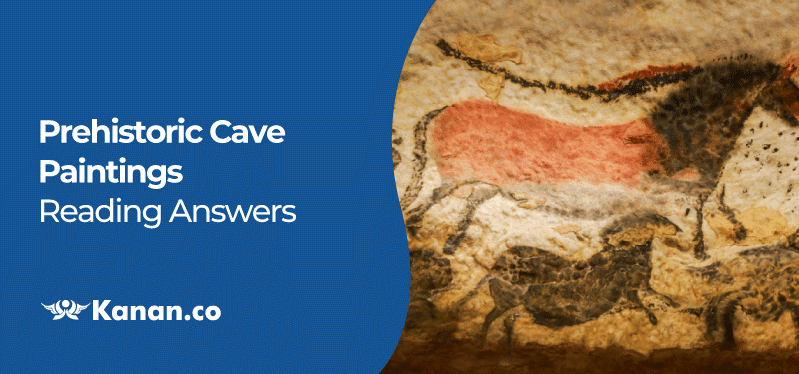
Below we have given the answer table for the topic of prehistoric cave paintings reading answers, To rectify your errors.
Answer Table
| 1. NOT GIVEN | 8. B |
| 2. FALSE | 9. D |
| 3. FALSE | 10. A |
| 4. TRUE | 11. G |
| 5. NOT GIVEN | 12. C |
| 6. C | 13. H |
| 7. A | 14. E |

Practicing beforehand for your exams will help you to enhance your scores. Here we have given an altered version of the practice test along with the prehistoric cave paintings reading answers passage.
The IELTS reading test consists of brief passages about a general topic, which may be taken from various sites for example, journals, magazines, newspapers, etc. This article of IELTS reading answers is given about the topic of prehistoric cave paintings reading answers with a reworked practice test section.
The IELTS reading test consists of 40 questions with 3 various sections, each section contains up to 14 or 15 questions. Those 14 or 15 questions were also divided into some sections, which had different question types. Here this article has 14 questions in 3 different question types of IELTS reading questions types, check out the given thoughts
for the topic of prehistoric cave paintings reading answers.
Check out the prehistoric cave paintings reading answers IELTS reading tips
Check out our YouTube Channel to Practice Full-Length IELTS Reading Tests Daily

IELTS Reading Passage: Prehistoric cave paintings
The given passage is for our practice test. Go through the entire passage with full attention. It may help you to get some keywords and major points, you can use it while answering.
Prehistoric Cave Paintings
It may have taken Michelangelo 4 long years to paint his mural on the roof of the Basilica of San Francesco, but his earliest forerunner spent much longer finishing their own masterwork. Analysts have detected that prehistoric cave paintings took up to 20,000 years to finish. Rather than being generated in one assembly, as paleontologists formerly thought, many of the works detected over Europe were manufactured above hundreds of peer groups, who added to, reinvigorate and painted over the original bit of art.
Till now it has been very tough to spot when prehistoric cave paintings and carvings were generated, but a developed methodology is allowing analysts to date cave art correctly for the first time and show how the works were bespoke over 1000s of years. Specialists now hope the methodology will give a valuable intuition into how early human culture grew and swapped as the first modern humans moved over Europe around 40,000 years ago.
Dr Alistair Pike, an paleontologist at Bristol University who is best in analysis said: the art gives us a close window into the minds of the individuals who assembled it, but what we don’t know is precisely which individuals they were as we don’t know precisely when the art was made. If we can date the art then we can date the art then we can relate that to the fossil we find in the ground and start to connect the figurative thoughts of these individuals to where, when and how they were living’.
Hundreds of caves have been found over Europe with complicated prehistoric paintings and carvings on their walls. It is thought the designs, which frequently portray scenes of animals, were made up to 40,000 years ago- sometime after humans began moving from southern Europe into northern Europe during the last glacial age.
Conventional dating methodology has depended on carbon dating the charcoal and other dye used in the paintings, but this can be inexact as it only gives the date the charcoal was made, not when the work was bespoken.’ When you go into these caves today there is still charcoal untruthful on the ground, so the artisan at the time could have been using old charcoal rather than making it fresh themselves,’ describes Dr Pike.
‘If this was the case, then the date for the painting would be very incorrect. Taking illustrations for carbon dating also means demolishing a piece of these valuable paintings because you need to remove a piece of the dye. For carvings, it is in effect not possible to date them as there is no biotic pigment containing carbon at ail.’
The analysts have used their methodology to date a series of popular cave dweller paintings in Altamira cave, northern Spain. Called the ‘Sistine Chapel of the Palaeolithic’, the complicated works were thought to date from around 14,000 years ago.
But in an analysis issued by the Natural Environment Research Council’s new website Planet Earth, Dr Pike found some of the paintings were between 25,000 and 35,000 years old. The youngest paintings in the cave were 11,000 years old. Dr Pike said:’ we have found that most of these caves were not painted in one go, but the painting bridged up to 20,000 years. This goes opposed to what the paleontologists who dig out the caves found. It is probably the case that people did not live in the caves they painted. It looks like the cave they lived in was elsewhere and there was something special about the painted caves.’
Dr Pike and his crew were able to date the paintings using a methodology called uranium series dating, which was at first grown by geologists to date rock formations such as stalactites and stalagmites in caves. As water seeps through a cave it contains very low levels of liquefy contaminated uranium along with the mineral calcium carbonate. Over time small amounts of calcium carbonate are placed to form a hard layer over the paintings and this layer also traps the uranium. Because of its radioactive properties, the uranium slowly decomposes to become another element called thorium. By contrast the ratio of uranium to thorium in the thin layers on top of the cave art, the analysts were able to calculate the age of the paintings.
The analysts have also used their methodology to etching found in rocks around Creswell crags in Derbyshire, which was Britain’s only samples of glacial age cave art. They showed the etching was made at least 12,000 years ago. Professor Pablo Arias, an expert on Palaeolithic cave art at the University of Cantabria, Spain, said: ‘until about 10 years ago it was only feasible to date cave art by using the style of the figures, but this new methodology grew by Bristol University allows that date to be correctly compared. We want to study how the people of the time behaved and how they felt and cave dweller art gives us a way of looking at the kind of symbols that were main to them. So we need to know when the people who were making the art actually lived.’
IELTS Reading Questions: prehistoric cave paintings
Questions 1-5
- Do the following statements agree with the information given in Reading Passage 1? Write
- TRUE if the statement agrees with the information
- FALSE if the statement contradicts the information
- NOT GIVEN if there is no information on this
1 Cave paintings inspired Michelangelo to paint the ceiling of the Sistine Chapel.
2 It now seems that cave paintings were painted in one go and then left untouched.
3 Dr Pike is focusing on dating artifacts found on the ground in the caves.
4 There are a number of disadvantages to using carbon dating to date paintings and carvings.
5 The Altamira cave contains more cave paintings than any other cave in Europe.
Go through the IELTS reading true false not given
Questions 6-8
- Choose the correct letter, A, B, C or D.
6 Dr Pike believes that
A Most caves remained undiscovered for thousands of years.
B archaeologists should not have excavated the caves at all.
C the caves were uninhabited but were treated as important.
D the paintings were painted by the people living in the caves.
7 Uranium series dating
A was previously used for other purposes.
B is a technique which was invented by Dr Pike.
C relies on the presence of stalactites in the caves.
D only works with caves which are underwater.
8 Professor Pablo Arias
A is skeptical about the benefits of the new dating technique.
B is enthusiastic about what the new technique will achieve.
C used the technique to successfully date Creswell Crags.
D believes it is necessary only to study the symbols in the art.
Read the IELTS reading multiple choice questions
Questions 9-14
- What is said about each of these things found in the caves?
- Choose your answers from the box and write the letters A-H next to Questions 9-14.
|
A When this is removed, it damages the painting. |
9 charcoal
10 pigment
11 carving
12 uranium
13 calcium carbonate
14 thorium
Check out the IELTS reading matching features
Prehistoric cave paintings Reading Answers with Explanation
Here the passage for prehistoric cave paintings reading answers with keywords is given. Check it out to evaluate your answers.
1. Not given
2. False
Explanations: Rather than being generated in one assembly, as paleontologists formerly thought, many of the works detected over Europe were manufactured above hundreds of peer groups, who added to, reinvigorate and painted over the original bit of art. The given answer is located in the last 4 lines of paragraph 1.
3. False
Explanations: If we can date the art then we can relate that to the fossil we find in the ground. The given answer is located in the 4-5 lines of the 3rd paragraph.
4. True
Explanations: ‘If this was the case, then the date for the painting would be very incorrect. Taking illustrations for carbon dating also means demolishing a piece of these valuable paintings because you need to remove a piece of the dye. For carvings, it is in effect not possible to date them as there is no biotic pigment containing carbon at ail.’ The given answer is located in the last 4 lines of 5th paragraph.
5. Not given
6. C
Explanations: It is probably the case that people did not live in the caves they painted. It looks like the cave they lived in was elsewhere and there was something special about the painted caves.’ The given answer is located in the last 3 lines of the 6th paragraph.
7. A
Explanations: uranium series dating, which was at first grown by geologists to date rock formations. The given answer is located in the 2nd line of the 7th paragraph.
8. B
Explanations: but this new methodology grew by Bristol University allows that date to be correctly compared. The given answer is located in the 6-7 lines of the 8th paragraph.
9. D
Explanations: it only gives the date the charcoal was made, not when the work was bespoken. The given answer is located in the 2-3 lines of the 5th paragraph.
10. A
Explanations: demolishing a piece of these valuable paintings because you need to remove a piece of the dye. The given answer is located in the 7-8 lines of the 5th paragraph.
11. G
Explanations: For carvings, it is in effect not possible to date them as there is no biotic pigment containing carbon at ail.’ The given answer is located in the last 2 lines of the 5th paragraph.
12. C
Explanations: uranium slowly decomposes to become another element called thorium. The given answer is located in the 7th line of the 7th paragraph.
13. H
Explanations: small amounts of calcium carbonate are placed to form a hard layer over the paintings. The given answer is located in the 5-6 lines of the 7th paragraph.
14. E
Explanations: uranium slowly decomposes to become another element called thorium. The given answer is located in the 7th line of the 7th paragraph.
Other Reading Answers
Conclusion
The given blog is about the topic of “prehistoric cave paintings reading answers” with key answers, explanations, and the reworked version of the practice test. Use the given practice test to prepare yourself beforehand for the exam, It will definitely help you to grab good scores in major exams.

About Author Abishek Babu M
Abishek is a seasoned expert in the study abroad processes and IELTS, GRE, TOEFL, and SAT subjects. With over 2.5 years of experience in helping students achieve their foreign education goals, he has become a trusted individual in the industry. His extensive knowledge and authority in the IELTS test have earned him a reputation as a go-to resource for students seeking to excel in their exams. Abishek's exceptional track record has earned him the trust of countless students who rely on his resources to achieve their study abroad dreams.
Kanan International is a study abroad consultancy that offers reliable services, products, and solutions for students and education institutions. We support students throughout their study abroad journey, ensuring a hassle-free experience. Our expertise and commitment to excellence make us the go-to partner for expanding global horizons. The company provides coaching for IELTS, GRE, TOEFL, and SAT exams and services like visa consultation, accommodation, scholarship assistance, and education loans.
Free Online Mock Test 2026
Practice our mock test worth Rs. 25000 for Free and know your IELTS score!








Global Headquarters
Kanan Int EdTech Inc
320 Bay Street, Suite 321 (Spaces), Toronto ON, Canada M5B 1N9
Indian Headquarters
Kanan International Pvt. Ltd.
D-wing, 2nd Floor, Trident Complex, Ellora Park Vadiwadi Road, Vadodara, Gujarat 390007
IT/ Digital Campus
Kanan International Pvt. Ltd
Old, New No 3, 2nd Floor, 1A, Dr Sadasivam Rd, T. Nagar, Chennai, Tamil Nadu 600017
Our branches
- Bardoli
- Bharuch
- Chennai
- Dehradun
- Gurugram
- Himatnagar
- Karnal
- Nadiad
- Navsari
- Palanpur
- Rajkot
- Vadodara
- Valsad
- Vallabh Vidyanagar
- Vapi
Study Abroad
Test Prep
Top Universities
Consultants
IELTS Centers
GRE Centers
TOEFL Centers
SAT Centers
Language Courses in Vadodara
Study Abroad Calculators
Featured Blogs
Study Abroad Consultants in Chennai
Study Abroad Consultants in Surat
Study Abroad Consultants in Navsari
Study Abroad Consultants in Bardoli
Study Abroad Consultants in Ahmedabad
Study Abroad Consultants in Anand
Study Abroad Consultants in Khanna
Study Abroad Consultants in Nadiad
Study Abroad Consultants in Vadodara
Study abroad consultants in Valsad
Copyright © 2026 KANAN.CO All rights reserved.