- Study Abroad
- / ielts
- / right whales reading answers
Right Whales Reading Answers


Author
17-09-2025

In this article we have given the Right Whales reading practice test along with questions, answers and explanation. This article has 14 questions in 2 different types namely- 6 questions as locating information and 8 questions as summary completion.
Check out our YouTube Channel to Practice Full-Length IELTS Reading Tests Daily

Table of content
- Solution for Right Whales
- Right Whales IELTS reading practice test
- Passage
- Questions
- Answers with explanation
Solution for Right Whales
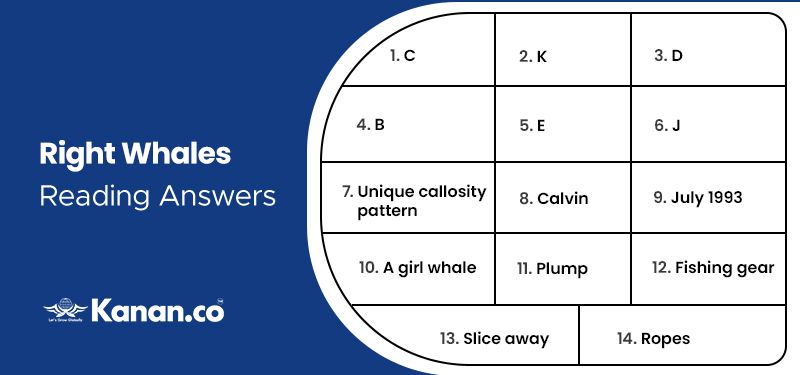
Below the answers for Right Whales reading answers is given in the table form.

Answer Table
| 1. C | 4. B | 7. Unique callosity pattern | 10. A girl whale | 13. Slice away |
| 2. K | 5. E | 8. Calvin | 11. Plump | 14. Ropes |
| 3. D | 6. J | 9. July 1993 | 12. Fishing gear |
Right Whales IELTS reading practice test - Exam Review
We have given the Right Whales IELTS reading answers along with questions, answers and explanations. Use this article to crack your exams with band scores.
Passage
Here, we have given the Right Whales reading answers with location, go through the given passage entirely and answer your questions.
Right Whales reading answers
A. They dive 600 feet, brushing their heads along the seafloor with raised, wartlike patches of skin, something swimming upside down, big as sunken galleons, hot-blooded and holding their breath in cold and utter darkness while the greatest tides on Earth surge by. Then they open their cavernous maws to let the currents sweep food straight in. This is one way North Atlantic right whales feed in the Bay of Fundy between Maine, New Brunswick, and Nova Scotia. Or so the experts suspect, having watched the 40-to 80-ton animals surface with mud on their crowns. Mind you, they say, that could result from another activity-one nobody can imagine yet.
B. science calls these animals Eubalaena glacialis, “good, or true, a whale of the ice.” The heavy irony is embedded in the common name, right whale, given by whalers who declared them the right whales to kill. favoring shallow coastal waters, they passed close to ports, swam slowly, and often lingered on the surface. Such traits made them easy to harpoon, and they tended to conveniently float after they died, thanks to their exceptionally thick blubber layer, which whalers rendered into oil. The first of the great whales to be hunted commercially, E. glacialis lit the lamps of the Old World from the Dark Ages through the Renaissance. By the 16th century, Europeans had exhausted the eastern North Atlantic population and turned to North America’s coast. Their whalers set up stations in Labrador and took 25,000 to 40,000 related bowhead whalers along with an unknown number of rights ( records seldom distinguished between these two similar-looking titans).
C. By the time New Englanders got into the right-whale-killing business, they were chasing leftovers. The Yankees hunted down another 5,000 or so, partly because whales became even more prized for their baleen than for oil. Hundreds of strips of this tough yet flexible material, each six to nine feet long and finely fringed, drape from the upper jaw. They form a colossal sieve that allows the giants to strain tiny crustaceans from the water for food-a a billion flea-size copepods a day to supply the minimum 4,00,000 calories an adult whale needs (the ratio of a whale body mass to its preys is 50 billion to one). Society, however, thought baleen was best used for corset stays, stiffeners in fashionable gowns, umbrella ribs, and (consider; “I’m going to whale on you!” ) horsewhips.
D. As the 20th century began, the number of whales left in this species was possibly in the low dozens. About 350 to 400 North Atlantic right whales exist today. The survivors migrate along North America’s East Coast between feeding grounds in the Gulf of Maine and wintering sites farther south roughly 1400 miles one way for pregnant females that journey to traditional calving areas off Georgia and Florida. They travel through an intensely urban stretch of ocean.
E. A research team from Boston’s New England Aquarium spends the summer stationed in Lubec, Maine, studying the whales that gather to feed and socialize in the Bay of Fundy and nearby Roseway Basin, Off Nova Scotia’s southern tip. The scientists, who whale in the population by its unique callosity pattern|( those wartlike patches on their heads), along with scars and other irregularities, and, increasingly, DNA samples. One of their favorites is #2223, first seen in these waters in 1992. It was a baby, and so fond of cavorting around boats that they named it Calvin after the mischief-loving cartoon kid., That same year a fisherman reported a calf circling its dying mother, and when the team recovered the carcass of the female, they identified her as #1223- Delilah, Calvin’s mom. The eight-month-old calf’s prospects looked grim, for it should have been nursing Delilah’s rich, warm milk for several more months.
F. In July 1993 researchers poring over fresh photos from the bay found images that looked like a match for Calvin’s baby pictures. Yes! The orphan had somehow made it alone. DNA from a skin sample taken in 1994 showed that curious, hardy Calvin was, in fact, a girl whale. Fertile adult females are the most valuable segment of the population. They number fewer than a hundred. Calvin seemed on the verge of adding one more to their ranks.
G. For three years running, the researchers gauged the young female’s blubber thickness with ultrasound. It’s a tricky operation. “One whaler’s reaction jolted the skiff hard enough to send me flying overboard,” Amy Knowlton of the research team recalled. Nevertheless, the researchers found Calvin growing pleasingly plump, a prime measure of health. On New Year’s Eve of 1999, she was recorded for the first time in the Georgia Bight, an expanse of shallow coastal waters off Georgia and Florida, where right whales give birth. In the summer of 2000 Calvin was once again in the Bay of Fundy, but this time she was snarled in fishing gear. Unbreakable polyblend ropes wrapped around her body, cut into the skin, and trailed in her wake, slowing her down. Then researchers lost sight of the young female.
H. Two to six right whales are found dead in a typical year, at least half of them killed by ship strikes or entanglement. Additional animals simply disappear. Since more than three-quarters of North Atlantic right whales bear scars from encounters with fishing gear, scientists wonder: How many of those missing are weighted down by ropes, nets, or crab and lobster pots for months or even years, the fat reserve that help keep them buoyant dwindling as they starve, fighting harder to reach the surface for each breath, until they finally give in to pain and exhaustion and sink?
I. Months dragged by. Someone finally spotted Calvin in Cape Cod Bay during her hobbled journey back south. a disentanglement team from nearby Provincetown, Massachusetts, raced for the site and made two attempts to slice away her bindings. They couldn’t get them all, but when Calvin was seen during 2001, she had worked free of the remnants.
J. The corridor traveled by Calvin and the other North Atlantic right whales has grown ever more crowded with fishing activities and busy shipping lanes. Plumes of contaminants flow from river mouths. and the underwater din of ship traffic probably makes it increasingly difficult for the whales to communicate and keep track of one another. Though not as visible as wounds from boat prows and propeller blades or fishing gear webbed around struggling bodies, heavy chemical and noise pollution may take a gradual toll.
K. During the 1980s the number of babies born annually was around 12. The total twice fell sharply in the 1990s until just a single calf appeared in 2000. Since then, the average has risen to more than 20 calves a year. Yet this remains 30 percent below the whales’ potential rate of reproduction. Why? If scientists are to guide the species’ salvation, they need more data and more answers. Fast.
Questions
Questions 1-6
- Which paragraph contains the following information?
- Write the correct letter A-K, in boxes 1-6 on your answer sheet.
- NB you may use any letter more than once
1. A new and more profitable commercial finding of the right whales.
2. The change of birth rate.
3. The migratory route of right whales.
4. The reason why right whales are easy to catch.
5. The methods to distinguish each right whale.
6. Right whales living environment at present.
Questions 7-14
The scientists have studied right whales by setting up a(n)……7……… One of their interests is a whale named …….8……. who lost its mum when it was very young. Scientists were worried about the baby whale’s future until it appeared again in ……9………. later, it was found to be …..….10……… being precious in the species. It was quite ………11………., which was the main symbol of health. Unfortunately, in the summer of 2000, it was discovered to be twisted in ……….12…….. like Polyblend ropes and then disappeared. When it was seven months later, people tried to ………13……. parts of ………..14……….. wrapping around its body, which were cleared during the next year.
Answers for Right Whales with Explanation
Here the answers for Right Whales reading answers with explanation is given. Use this portion to rectify your mistakes in the answering process.
1. Answer: C
Explanation: “By the time New Englanders got into the right-whale-killing business, they were chasing leftovers. The Yankees hunted down another 5,000 or so, partly because whales became even more prized for their baleen than for oil. Hundreds of strips of this tough yet flexible material, each six to nine feet long and finely fringed, drape from the upper jaw. They form a colossal sieve that allows the giants to strain tiny crustaceans from the water for food-a a billion flea-size copepods a day to supply the minimum 4,00,000 calories an adult whale needs (the ratio of a whale body mass to its preys is 50 billion to one)”. With this line it is clear that paragraph C states about a new and more profitable commercial finding of the right whales. Hence the given answer is located in the 1-8 lines of paragraph C.
2. Answer: K
Explanation: “During the 1980s the number of babies born annually was around 12. The total twice fell sharply in the 1990s until just a single calf appeared in 2000. Since then, the average has risen to more than 20 calves a year. Yet this remains 30 percent below the whales’ potential rate of reproduction”. With this line it is clear that paragraph K states about the change of birth rate. Hence the given answer is located in the 1-4 lines of paragraph K.
3. Answer: D
Explanation: “As the 20th century began, the number of whales left in this species was possibly in the low dozens. About 350 to 400 North Atlantic right whales exist today. The survivors migrate along North America’s East Coast between feeding grounds in the Gulf of Maine and wintering sites farther south roughly 1400 miles one way for pregnant females that journey to traditional calving areas off Georgia and Florida. They travel through an intensely urban stretch of ocean”. With these lines it is clear that paragraph D states about the migratory route of right whales. Hence the given answer is located in paragraph D.
4. Answer: B
Explanation: “The heavy irony is embedded in the common name, right whale, given by whalers who declared them the right whales to kill. favoring shallow coastal waters, they passed close to ports, swam slowly, and often lingered on the surface. Such traits made them easy to harpoon, and they tended to conveniently float after they died, thanks to their exceptionally thick blubber layer, which whalers rendered into oil”. With this line it is clear that paragraph B states about the reason why right whales are easy to catch. Hence the given answer is located in the 2-6 lines of paragraph B.
5. Answer: E
Explanation: “The scientists, who whale in the population by its unique callosity pattern|( those wartlike patches on their heads), along with scars and other irregularities, and, increasingly, DNA samples. One of their favorites is #2223, first seen in these waters in 1992. It was a baby, and so fond of cavorting around boats that they named it Calvin after the mischief-loving cartoon kid., That same year a fisherman reported a calf circling its dying mother, and when the team recovered the carcass of the female, they identified her as #1223- Delilah, Calvin’s mom. The eight-month-old calf’s prospects looked grim, for it should have been nursing Delilah’s rich, warm milk for several more months”. With this line it is clear that paragraph E states about the methods to distinguish each right whale. Hence the given answer is located in the 4-11 lines of paragraph E.
6. Answer: J
Explanation: “The corridor traveled by Calvin and the other North Atlantic right whales has grown ever more crowded with fishing activities and busy shipping lanes. Plumes of contaminants flow from river mouths. and the underwater din of ship traffic probably makes it increasingly difficult for the whales to communicate and keep track of one another. Though not as visible as wounds from boat prows and propeller blades or fishing gear webbed around struggling bodies, heavy chemical and noise pollution may take a gradual toll”. With this line it is clear that paragraph J states about right whales' living environment at present. Hence the given answer is located in paragraph J
7. Answer: unique callosity pattern
Explanation: “The scientists, who whale in the population by its unique callosity pattern ( those wartlike patches on their heads), along with scars and other irregularities, and, increasingly, DNA samples”. With this line it is clear that the scientists have studied right whales by setting up a(n)unique callosity pattern. Hence the given answer is located in the 3-6 lines of paragraph E.
8. Answer: Calvin
Explanation: “It was a baby, and so fond of cavorting around boats that they named it Calvin after the mischief-loving cartoon kid”. With this line it is clear that one of their interests is a whale named Calvin who lost its mum when it was very young. Hence the given answer is located in the 6-8 lines of paragraph E.
9. Answer: July 1993
Explanation: “In July 1993 researchers poring over fresh photos from the bay found images that looked like a match for Calvin’s baby pictures”. With this line it is clear that scientists were worried about the baby whale’s future until it appeared again in July 1993. Hence the given answer is located in the first 2 lines of paragraph F.
10. Answer: A girl whale
Explanation: “In July 1993 researchers poring over fresh photos from the bay found images that looked like a match for Calvin’s baby pictures. Yes! The orphan had somehow made it alone. DNA from a skin sample taken in 1994 showed that curious, hardy Calvin was, in fact, a girl whale”. With this line it is clear that in July 1993 later, it was found to be a girl whale being precious in the species. Hence the given answer is located in the first 4 lines of paragraph F.
11. Answer: Plump
Explanation: “For three years running, the researchers gauged the young female’s blubber thickness with ultrasound. It’s a tricky operation. “One whaler’s reaction jolted the skiff hard enough to send me flying overboard,” Amy Knowlton of the research team recalled. Nevertheless, the researchers found Calvin growing pleasingly plump, a prime measure of health”. With this line it is clear that It was quite plump which was the main symbol of health. Hence the given answer is located in the 1-5 lines of paragraph G.
12. Answer: Fishing Gear
Explanation: “In the summer of 2000 Calvin was once again in the Bay of Fundy, but this time she was snarled in fishing gear”. With this line it is clear that Unfortunately, in the summer of 2000, it was discovered to be twisted in fishing gear like Polyblend ropes and then disappeared. Hence the given answer is located in the 7-8 lines of paragraph G.
13. Answer: Slice Away
Explanation: “In the summer of 2000 Calvin was once again in the Bay of Fundy, but this time she was snarled in fishing gear. Unbreakable polyblend ropes wrapped around her body, cut into the skin, and trailed in her wake, slowing her down”. With this line it is clear that when it was seven months later, people tried to slice away. parts of ropes wrapping around its body, which were cleared during the next year. Hence the given answer is located in the last 3 lines of paragraph G.
14. Answer: Ropes
Explanation: “In the summer of 2000 Calvin was once again in the Bay of Fundy, but this time she was snarled in fishing gear. Unbreakable polyblend ropes wrapped around her body, cut into the skin, and trailed in her wake, slowing her down”. With this line it is clear that when it was seven months later, people tried to slice away. parts of ropes wrapping around its body, which were cleared during the next year. Hence the given answer is located in the last 3 lines of paragraph G.
Other reading answers

About Author Gayathri Nagarajan
Gayathri, a trusted study-abroad expert, with expertise in standardized tests like IELTS, TOEFL, PTE, GRE, and GMAT. With a strong tech background from SASTRA University, she excels in software testing and has a passion for content writing and digital marketing. She aids students in finding the perfect academic fit, offering guidance on course selection, LOR and SOP writing. She remains up-to-date with the latest trends in higher education, delivering credible, accurate information on international education, including courses and test prep materials. As a trusted Study abroad expert at Kanan International, explore her latest blogs and articles for comprehensive insights into studying abroad and realizing your academic aspirations.
Kanan.co is a trusted study abroad consultancy offering comprehensive services, resources, and solutions for students and education institutions. We support students at every stage of their global education journey, ensuring a smooth and guided experience. Along with test preparation for IELTS, GRE, TOEFL, and SAT, we provide expert services such as SOP writing, visa guidance, accommodation support, scholarship assistance, and education loan support. Our expertise and commitment to excellence make us a reliable partner for students pursuing international education.
Free Online Mock Test 2026
Practice our mock test worth Rs. 25000 for Free and know your IELTS score!








Global Headquarters
Kanan Int EdTech Inc
320 Bay Street, Suite 321 (Spaces), Toronto ON, Canada M5B 1N9
Indian Headquarters
Kanan International Pvt. Ltd.
D-wing, 2nd Floor, Trident Complex, Ellora Park Vadiwadi Road, Vadodara, Gujarat 390007
IT/ Digital Campus
Kanan International Pvt. Ltd
Old, New No 3, 2nd Floor, 1A, Dr Sadasivam Rd, T. Nagar, Chennai, Tamil Nadu 600017
Our branches
- Bardoli
- Bharuch
- Chennai
- Dehradun
- Gurugram
- Himatnagar
- Karnal
- Nadiad
- Navsari
- Palanpur
- Rajkot
- Vadodara
- Valsad
- Vallabh Vidyanagar
- Vapi
Study Abroad
Test Prep
Top Universities
Consultants
IELTS Centers
GRE Centers
TOEFL Centers
SAT Centers
Language Courses in Vadodara
Study Abroad Calculators
Featured Blogs
Study Abroad Consultants in Chennai
Study Abroad Consultants in Surat
Study Abroad Consultants in Navsari
Study Abroad Consultants in Bardoli
Study Abroad Consultants in Ahmedabad
Study Abroad Consultants in Anand
Study Abroad Consultants in Khanna
Study Abroad Consultants in Nadiad
Study Abroad Consultants in Vadodara
Study abroad consultants in Valsad
Copyright © 2026 KANAN.CO All rights reserved.