Describe an occasion when you got incorrect information IELTS Cue Card


Author
24-06-2025

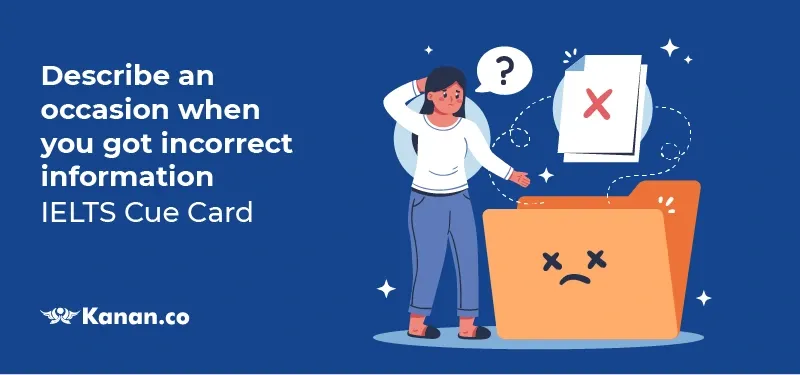
This article contains the IELTS speaking cue card “Describe an occasion when you got incorrect information” along with model answers and follow up questions. The IELTS speaking test has 3 sections that include an introduction, an individual long turn, and a two-way discussion. In the individual long turn session, you’ll be given a cue card topic to speak on for 2 to 3 minutes. Followed by the discussion session where you are required to answer follow up questions based on the same topic.

Describe an occasion when you got incorrect information
Check Out our YouTube Channel to Practice Full-Length IELTS Listening Tests Daily
You should say:
- When you got it?
- How you got it?
- How you found it was incorrect?
- And how you felt about it?
Model answer 1
Introduction
I once received incorrect information regarding the results of some state level championship matches. This incident took place a few months ago during the championship season. I was excited to learn about the most recent results because I am an avid sports fan, especially when it comes to state level competitions.
When you got it
I got this false information from a sports app that I often used to keep track of the scores and current matches.
How you got it
The app offered up-to-date information on scores, summaries, and matches from a variety of sports events. Because of its accurate and consistent reporting, I had trusted this source for a considerable amount of time.
How you found it was incorrect
I was taken aback by the surprising result when I learned the conclusion of a pivotal match in the state championship. But later that day, I came across an item that refuted the earlier information while perusing through a different sports news website. The article gave the accurate score for the match and gave an alternative winner to the one that the app had originally given.
And how you felt about it
I was disappointed and a little annoyed to learn that there was a difference between the data from the sports app and the real results. It was discouraging to learn that the material I had depended upon was erroneous because I respect accuracy, especially when it comes to sports reporting. In addition, given my confidence in the app's dependability, I couldn't help but feel duped.
Conclusion
I learned a great lesson from this event about how important it is to double-check information before taking it at face value from several reliable sources. Though disappointing, it served as a reminder of the value of critical thinking and information cross-referencing, particularly in the field of sports reporting where errors can frequently occur in real-time updates.
Model answer 2
Introduction
- During my senior year of high school, I looked forward to going to a college fair. It was a chance to visit several universities, talk to representatives, and get important details about programs and scholarships. But in the midst of all the enthusiasm, something happened to me that confused and saddened me—I was told the wrong information regarding a scholarship.
When you got it
- The incident happened at a college expo that was arranged by many universities with the intention of advising potential students on their options for postsecondary education. There were representatives from several universities who gave information about their academic offerings and available financial help, including scholarships. I came across false information about a specific scholarship possibility throughout these conversations.
How you got it
- I was looking around a prominent university's booth that was well-known for its extensive scholarship offerings. I asked a representative of theirs about the requirements for qualifying and the application procedure for a particular scholarship they were marketing. The salesperson gave me thorough information that fit my goals and academic profile, emphasizing the requirements and the application deadlines.
How you found it was incorrect
- Following the fair, I made the decision to learn more about the scholarships available by going to the university's official website and getting in touch with the scholarship office. I was surprised to learn that the official guidelines on the university's website did not match the information I was given by the representative at the fair. From what I was initially told, the dates, eligibility requirements, and even the existence of the scholarship were completely different.
And how you felt about it
- When I realized there was a mismatch in the scholarship information, I was disappointed and angry. The inaccurate information distributed at the fair gave rise to erroneous expectations and wasted time that could have been better spent looking into other legitimate scholarship opportunities. It also made me doubt the veracity of the information university representatives gave at such gatherings.
Conclusion
- I learned from this experience to gather information carefully and critically, especially when dealing with high-stakes situations like college preparation. It emphasized how crucial it is to double-check information obtained from official sources rather than depending only on verbal cues, in order to prevent disappointments and miscommunications. Even though it was depressing, it was an important lesson in how to recognize trustworthy information while making critical decisions.
Model answer 3
Introduction
My 12th board exam results were going to have a big impact on my future academic career, so the time afterward was filled with nervousness and excitement. I was given false information about the date of the result announcement during this crucial period, which led to needless anxiety and uncertainty.
When you got it
A few weeks had passed since my board exams ended when I began to anxiously await the results. To be sure I wouldn't miss the result declaration date, I was actively looking for precise information about it. In the process of gathering information, I came upon an internet forum where a number of people were debating when the findings should be released.
How you got it
A user shared the result date information, claiming to be connected to or have intimate knowledge of the educational board that is in charge of announcing the results. This person boldly stated that they knew precisely when the results would be officially announced. I didn't verify this information with any official sources; instead, I took it at face value given the uncertainty surrounding the outcome.
How you found it was incorrect
I mentally prepared myself for the result, anticipating the release as the alleged result date drew near. However, there was no formal notification or update regarding the findings on the day that the online forum had specified. I decided to get in touch with the school board personally because I was confused and worried, and I also visited their official website for any changes. I was shocked to learn that, contrary to what was said on the forum, the real result release date was a few days later.
And how you felt about it
I was nervous and upset to realize that I had depended on false information about such a significant event. The anxiety of waiting for test results was compounded by the extra tension brought on by the false information. I was disappointed and frustrated by the false information that caused unnecessary fear and confusion.
Conclusion
This episode made it clear how important it is to double-check important information, particularly when it relates to momentous life events. It gave me the important lesson to never blindly believe unreliable sources, no matter how convincing or reliable they seem. It is nevertheless necessary to confirm information from official sources, especially in urgent cases where precision is vital. This experience made it clear how crucial it is to look for information from trustworthy and legitimate sources, particularly when significant events like exam results are approaching.
Model answer 4
Introduction
- I will always cherish the memory of my cousin's engagement because it was a happy occasion that was eagerly anticipated. But in the midst of all the excitement, there was an episode when some misinformation during the planning stage led to some confusion and unexpected turns.
When you got it
- A few weeks prior to the anticipated engagement ceremony, there was disinformation. The guest list, venue selection, and other elements were all planned by our family as we organized the celebration. There was a misunderstanding over the engagement date during this planning stage.
How you got it
- One of our family's group chat messages was misread, which led to the misrepresentation. While talking about the engagement arrangements, one of our relatives made a mistake and gave a different date. I, along with a few other family members, unintentionally accepted this wrong date because text discussions move quickly and we were eager to have everything finalized.
How you found it was incorrect
- With the engagement date drawing near, family members were becoming increasingly perplexed by the contradicting information. After looking over the original invitation again and asking the immediate relatives to confirm, we discovered that the date shared in the group chat was not correct. The formal invitation's confirmed date ran counter to the false information that had previously been circulating.
And how you felt about it
- A range of emotions were evoked when it was realized that inaccurate information had caused misunderstanding regarding the engagement date. At first, they were worried and concerned about how this false information could affect the event. But when the right date was established, there was relief—as well as a tinge of annoyance at the confusion and needless confirmation.
Conclusion
- This episode provided as a helpful reminder of the value of precise communication and double-checking important information, particularly for important occasions like family gatherings.
IELTS speaking part 3 - Describe an occasion when you got incorrect information follow up questions
Follow-up questions for “Describe an occasion when you got incorrect informationt” are given below. In the actual exam, The IELTS speaking part 3 - follow up question session is conducted for 4-5 minutes where you have to discuss questions about a general topic or question on your cue card.
Question 1:- What kinds of professions are related to giving information to others?
Answer:-Public relations specialists, journalists, tour guides, librarians, instructors, academics, researchers, and public speakers are among the occupations in which providing information to others is a daily task.
Question 2:- What is the difference between giving information by phone and email?
Answer:-While providing information via email creates a written record that may be consulted at a later time, providing information over the phone allows for instant communication and clarification. Email allows for more organized and precise information sharing, but phone talks are more intimate and allow for non-verbal indications and tone of voice.
Question 3:- How can people check whether a piece of information is correct or not?
Answer:-By cross-referencing information, fact-checking websites, talking to subject-matter experts, confirming information from several trustworthy sources, and critically evaluating the reliability and bias of the source, people can ascertain the accuracy of information.
Question 4:- Do people trust the information online?
Answer:-Online information can be trusted or not depends on whether the material on the internet is confirmed by others or comes from reliable sources, some people are more likely to believe it. But because false information and fake news are so common online, there are also times when individuals are wary and cautious.
Question 5:- Does an individual provide inappropriate information to someone in your country?
Answer:-Inappropriate information may occasionally be given by people in my nation, whether on purpose or accidentally. It's crucial to remember, though, that giving incorrect information is uncommon and usually frowned upon.
Question 6:- Do you ever get any kind of incorrect information on a phone call?
Answer:-It is true that misinformation can be received over the phone. During a phone call, inaccurate information may be shared due to miscommunication, misconceptions, or even intentional misinformation.
Question 7:- What kinds of wrong information are provided on social media in the contemporary era?
Answer:In the modern day, false information has been spread on social media platforms by a variety of means, such as conspiracy theories, fake news, deceptive ads, false information on current affairs, politics, or health, photoshopped or altered content, and biased or manipulated content. Information should always be thoroughly examined and verified before being taken at face value.
Question 8:- is online information appropriate for school and college assignments ?
Since social media platforms contain inaccurate and unreliable information, students are left with no other choice than to gather information for their projects from these sources. However, since online platforms compile all relevant information on a single page, it is still advisable to gather information for projects but double-check it for accuracy.
IELTS cue card topics
Check out the other IELTS cue card topics to practise

About Author Gayathri Nagarajan
Gayathri, a trusted study-abroad expert, with expertise in standardized tests like IELTS, TOEFL, PTE, GRE, and GMAT. With a strong tech background from SASTRA University, she excels in software testing and has a passion for content writing and digital marketing. She aids students in finding the perfect academic fit, offering guidance on course selection, LOR and SOP writing. She remains up-to-date with the latest trends in higher education, delivering credible, accurate information on international education, including courses and test prep materials. As a trusted Study abroad expert at Kanan International, explore her latest blogs and articles for comprehensive insights into studying abroad and realizing your academic aspirations.
Kanan.co is a trusted study abroad consultancy offering comprehensive services, resources, and solutions for students and education institutions. We support students at every stage of their global education journey, ensuring a smooth and guided experience. Along with test preparation for IELTS, GRE, TOEFL, and SAT, we provide expert services such as SOP writing, visa guidance, accommodation support, scholarship assistance, and education loan support. Our expertise and commitment to excellence make us a reliable partner for students pursuing international education.
Free Online Mock Test 2026
Practice our mock test worth Rs. 25000 for Free and know your IELTS score!








Global Headquarters
Kanan Int EdTech Inc
320 Bay Street, Suite 321 (Spaces), Toronto ON, Canada M5B 1N9
Indian Headquarters
Kanan International Pvt. Ltd.
D-wing, 2nd Floor, Trident Complex, Ellora Park Vadiwadi Road, Vadodara, Gujarat 390007
IT/ Digital Campus
Kanan International Pvt. Ltd
Old, New No 3, 2nd Floor, 1A, Dr Sadasivam Rd, T. Nagar, Chennai, Tamil Nadu 600017
Our branches
- Bardoli
- Bharuch
- Chennai
- Dehradun
- Gurugram
- Himatnagar
- Karnal
- Nadiad
- Navsari
- Palanpur
- Rajkot
- Vadodara
- Valsad
- Vallabh Vidyanagar
- Vapi
Study Abroad
Test Prep
Top Universities
Consultants
IELTS Centers
GRE Centers
TOEFL Centers
SAT Centers
Language Courses in Vadodara
Study Abroad Calculators
Featured Blogs
Study Abroad Consultants in Chennai
Study Abroad Consultants in Surat
Study Abroad Consultants in Navsari
Study Abroad Consultants in Bardoli
Study Abroad Consultants in Ahmedabad
Study Abroad Consultants in Anand
Study Abroad Consultants in Khanna
Study Abroad Consultants in Nadiad
Study Abroad Consultants in Vadodara
Study abroad consultants in Valsad
Copyright © 2026 KANAN.CO All rights reserved.