- Study Abroad
- / ielts
- / the good enough mother reading answers
The Good Enough Mother Reading Answers


Author
17-09-2025

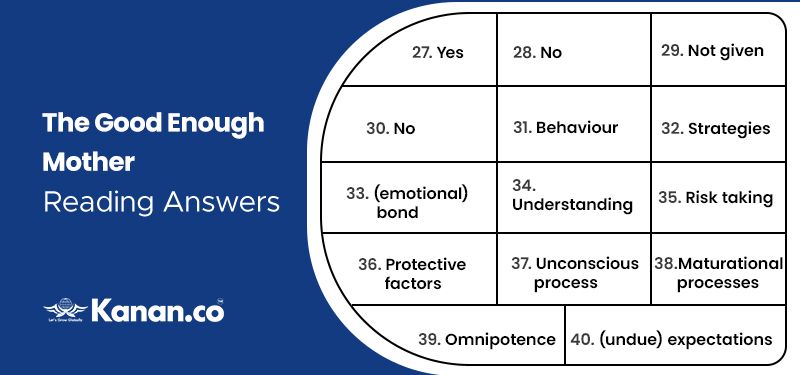
Here you can find the good enough mother reading answers as a practice test along with answers and explanation. This article contains 14 questions in 3 different types namely - 4 questions as yes, no or not given, 5 questions as table completion and 4 questions as summary completion. Before answering your questions, read the given passage thoroughly.
Check out our YouTube Channel to Practice Full-Length IELTS Reading Tests Daily

Table of contents:
- Solution for the good enough mother
- The good enough mother IELTS reading practice test
- Passage
- Questions
- Answers with explanations
Solution for The Good Enough Mother
Answers for the good enough mother reading answers, are given here in the table form below.

Answer Table
| 27. yes | 30. No | 33. (emotional) bond | 36. Protective factors | 39. Omnipotence |
| 28. No | 31. Behaviour | 34. Understanding | 37. Unconscious process | 40. (undue) expectations |
| 29. Not given | 32. Strategies | 35. Risk- taking | 38. Maturational processes |
The Good Enough Mother IELTS Reading Practice Test- Exam Review
We have given the good enough mother IELTS reading answers, as a sample article for the IELTS reading practice test. Use this article while practicing for your major exam, it will aid you to crack your exams with band scores. Go through the given passage and answer the questions.
Passage
We have given the good enough mother reading answers with location. Be careful while reading the passage and answer the questions.
The good enough mother reading answers
- Throughout history, new parents have experienced the pressures and responsibilities that come with rearing a child. The mother in particular, for biological and societal reasons, is under stress to fulfill the expectations that she and society puts on her. Donald Winnicott, a British paediatrician and psychoanalyst, broke ground and shocked those around him with his original views on the relationship between children and their mothers. Winnicott challenged the traditional and idealised view of parenting and provided theory and guidance that was more grounded in the reality of parenthood. Winnicott’s notions of the ‘good-enough’ mother and the facilitating environment that he described remain important in the study of child development.
- It would not be an exaggeration to say that most parents try to provide the best for their children, and many feel guilty when they are not able to do so, especially when many women and men in the modern world try to balance personal and professional lives with perfect parenthood. This key role for adults in today’s world has led to this subject being intensively examined and various theories of parenting being created. While a variety of models have informed the development of parenting programmes, four core theories underpin the majority of them.
- Social learning theory is based on the assumption that children’s behaviour will improve when appropriately reinforced; good behaviour is rewarded and bad behaviour is either ignored or appropriately sanctioned. Social learning theory-based programmes teach parents strategies for punishing child misconduct and rewarding positive behaviour.
- Attachment theory is based on the notion that an infant’s ability to form a strong emotional bond with their primary caregiver is a natural part of its development. The security of this bond, also known as attachment security, is largely determined by the parents’ ability to respond sensitively and appropriately to their infant’s bids for attention. Programmes based on attachment theory therefore aim to improve parental sensitivity by increasing parents’ understanding of their children’s requirements and attachment related conduct.
- Parenting styles theory is based on research that suggests children’s behaviour is directly related to their parent’s child-rearing practices. Parents who combine high levels of parental warmth with high levels of supervision are likely to have children who are more confident, more autonomous and more socially responsible. This parenting style is often referred to as an authoritative style of parenting, as it recognises the child as an individual in his or her own right. For this reason, many parenting programmes include elements that encourage parents to allow their children to experience risk-taking amidst high levels of supervision.The model of human ecology assumes that a child’s development is determined by his or her interaction within the environments of the individual, family, school, community and culture. Each of these environments contains elements that can either improve a child’s life outcomes or place them at risk for adversity. Every family is unique in terms of these risk and protective factors influencing it. Programmes based on this model consider ways to strengthen protective factors in order to manage any on-going risks.
- Winnicott’s idea of a facilitating environment created for a child by a ‘good-enough mother’, who is supported by the adults around her, rests easily alongside the theory of attachment. Winnicott’s facilitating environment is provided by an unconscious process within an ordinary mother who is fond of her baby. Winnicott suggests that during pregnancy, a mother develops a state of heightened sensitivity, which continues to be maintained for some weeks after the baby’s birth. When this heightened state passes, the mother has what Winnicott calls a ‘flight into sanity’, and she begins to be aware of the world that exists outside of her state of primary maternal preoccupation with her infant.
- The good-enough mother then continues to provide an environment that facilitates healthy maturational processes in her baby. She achieves this by being the person who wards off the unpredictable and who actively provides care in the holding, handling and in the general management of the child. The good-enough mother provides physical care and meets her baby’s need for emotional warmth and love. She also protects her baby against those parts of her from which murderous feelings are brought forth when, for example, her baby screams, yells and cries continuously. By containing her own hateful feelings about her baby, and using them to intuit the baby’s terror and hate, the good-enough mother facilitates her baby’s thoughts and expressions of omnipotence by adapting to his needs until such time as he gradually begins to feel safe enough to relinquish these feelings. At this stage, the process of integration can start and the baby begins to develop a sense of ‘me’ and ‘not me’. To achieve this shift in the baby, the good-enough mother must, by a gradual process, fail to adapt to her baby’s needs in order that the baby can begin to learn to tolerate the frustrations of the world outside of himself and his mother.
- Winnicott intended to take the pressure off women who became mothers, but critics have argued that Winnicott’s idea of the good-enough mother has placed the undue expectations upon the ‘real’ mother that she must shoulder most of the responsibility for the care of her baby. Furthermore, she is held responsible for how well her baby flourishes.
- Like many social theories of child development, it is clear to outsiders that real life practice exhibits characteristics of all theory and most parents show parts of each theory in order to adapt naturally to whatever situations arise. Nevertheless, Winnicott’s ideas have been a source of comfort and hope to many mothers who have naturally struggled with the challenge of motherhood.
Questions
Questions 27-30
- Do the following statements agree with the views of the writer of the text?
- In boxes 27-30 on your answer sheet write:
- YES if the statement agrees with the writer’s views
- NO if the statement doesn’t agree with the writer’s views
- NOT GIVEN if it is impossible to say what the writer thinks about this
27. Mothers are under pressure from themselves and society’s expectations to be good mothers.
28. Today, the field of child development is not influenced much by Winnicott’s theories.
29. A man’s traditional role as the breadwinner means that he has less pressure to be an excellent parent.
30. Parenting has not been a subject that has been widely studied.
Questions 31-36
- Complete the table below.
- Write NO MORE THAN TWO WORDS from the text for each answer.
- Write your answers in boxes 31-36 on your answer sheet.
Four Core Theories of Parenting
| Social Learning Theory |
|
| Attachment Theory |
|
| Parenting Styles Theory |
|
| Human Ecology |
|
Questions 37-40
- Complete the summary below.
- Write NO MORE THAN TWO WORDS from the text for each answer.
- Write your answers in boxes 37-40 on your answer sheet.
The Good-Enough Mother
Winnicott’s theories are linked to the theory of attachment – a 37 ________ on the part of the mother builds the relationship between mother and child. A mother’s heightened sensitivity before and after birth soon changes and allows her to realise how life carries on away from her child. The good-enough mother manages her child to develop his/her healthy 38________ She provides care and love and deals with the natural negative feelings produced by the pressure of caring for a baby. By doing so, the baby slowly realises he/she is safe and must abandon its feelings of 39 ________In order to succeed, a good-enough mother must fail to fulfil some of the baby’s needs, so the baby learns the realities and independence of life.
Critics say Winnicott did not alleviate pressure from mothers but increased 40 ________ that she must be solely responsible for rearing the child successfully.
Answers for the good enough mother with explanation
Here we have given the answers for the good enough mother reading answers with explanation. This section will assist you while answering.
27. Answer: Yes
Explanation: “New parents have experienced the pressures and responsibilities that come with rearing a child. The mother in particular, for biological and societal reasons, is under stress to fulfill the expectations that she and society puts on her”. With this line it is clear that Mothers are under pressure from themselves and society’s expectations to be good mothers. Hence the given answer is located in the first 4 lines of paragraph A.
28. Answer: No
Explanation: “Winnicott’s notions of the ‘good-enough’ mother and the facilitating environment that he described remain important in the study of child development”. With this line it is clear that the given statement contradicts the given information. Hence the given answer is located in the last 3 lines of paragraph A.
29. Answer: Not given
30. Answer: No
Explanation: “This key role for adults in today’s world has led to this subject being intensively examined and various theories of parenting being created”. With this line it is clear that the given statement contradicts the given information. Hence the given answer is located in the 5-7 lines of paragraph B.
31. Answer: Behaviour
Explanation: “Social learning theory is based on the assumption that children’s behaviour will improve when appropriately reinforced”. With this line it is clear that social learning theory is based on how reactions to children’s behaviour are reinforced. Hence the given answer is located in the first 2 lines of paragraph C.
32. Answer: Strategies
Explanation: “Social learning theory-based programmes teach parents strategies for punishing child misconduct and rewarding positive behaviour”. With this line it is clear that parents can be taught strategies. Hence the given answer is located in the last 3 lines of paragraph C.
33. Answer: (emotional) bond
Explanation: “Attachment theory is based on the notion that an infant’s ability to form a strong emotional bond with their primary caregiver is a natural part of its development”. With this line it is clear that attachment theory is based on the powerful emotional bond between an infant and it’s for the above caregiver and how this is created by how parents deal with their children’s needs. Hence the given answer is located in the 1-2 lines of paragraph D.
34. Answer: Understanding
Explanation: “Programmes based on attachment theory therefore aim to improve parental sensitivity by increasing parents’ understanding of their children’s requirements and attachment related conduct”. With this line it is clear that attachment theory parents can be taught a better sensitivity and understanding of children’s needs and behaviour. Hence the given answer is located in the last 3 lines of paragraph D.
35. Answer: Risk-taking
Explanation: “This parenting style is often referred to as an authoritative style of parenting, as it recognises the child as an individual in his or her own right. For this reason, many parenting programmes include elements that encourage parents to allow their children to experience risk-taking amidst high levels of supervision”. With this line it is clear that parents are taught to encourage appropriate risk-taking. Hence the given answer is located in the 5-8 lines of paragraph E.
36. Answer: Protective factors
Explanation: “Every family is unique in terms of these risk and protective factors influencing it. Programmes based on this model consider ways to strengthen protective factors in order to manage any on-going risks”. With this line it is clear that based on a child’s relationship with its environment and the risks Protective factors within it. Hence the given answer is located in the last 3 lines of paragraph E.
37. Answer: Unconscious process
Explanation: “Winnicott’s facilitating environment is provided by an unconscious process within an ordinary mother who is fond of her baby”. With this line it is clear that Winnicott’s theories are linked to the theory of attachment – an Unconscious process on the part of the mother builds the relationship between mother and child. Hence the given answer is located in the 3-5 lines of paragraph F.
38. Answer: Maturational processes
Explanation: “The good-enough mother then continues to provide an environment that facilitates healthy maturational processes in her baby”. With this line it is clear that the good-enough mother manages her child to develop his/her healthy maturational processes She provides care and love and deals with the natural negative feelings produced by the pressure of caring for a baby. Hence the given answer is located in the first 2 lines of paragraph G.
39. Answer: Omnipotence
Explanation: “By containing her own hateful feelings about her baby, and using them to intuit the baby’s terror and hate, the good-enough mother facilitates her baby’s thoughts and expressions of omnipotence by adapting to his needs until such time as he gradually begins to feel safe enough to relinquish these feelings”. With this line it is clear that by doing so, the baby slowly realises he/she is safe and must abandon its feelings of omnipotence. Hence the given answer is located in the 8-12 lines of paragraph G.
40. Answer: (undue) expectations
Explanation: “Winnicott intended to take the pressure off women who became mothers, but critics have argued that Winnicott’s idea of the good-enough mother has placed the undue expectations upon the ‘real’ mother that she must shoulder most of the responsibility for the care of her baby”. With this line it is clear that critics say Winnicott did not alleviate pressure from mothers but increased undue expectations that she must be solely responsible for rearing the child successfully. Hence the given answer is located in the first 4 lines of paragraph H.
Other reading answers

About Author Roshan Sunthar
Roshan Sunthar is a study abroad expert as well as a renowned writer and author in international education. His academic excellence and 5+ years of work experience give him in-depth knowledge of international standardised exams and test preparation in IELTS, TOEFL, GRE, PTE, SAT, etc. The study materials he prepares incorporate exam-like questions. He’s also an expert in writing Statement of Purposes (SOPs) and Letter of Recommendations (LORs) for college admissions. He usually spends his leisure time watching English classics and documentaries, travelling, etc.
Kanan.co is a trusted study abroad consultancy offering comprehensive services, resources, and solutions for students and education institutions. We support students at every stage of their global education journey, ensuring a smooth and guided experience. Along with test preparation for IELTS, GRE, TOEFL, and SAT, we provide expert services such as SOP writing, visa guidance, accommodation support, scholarship assistance, and education loan support. Our expertise and commitment to excellence make us a reliable partner for students pursuing international education.
Free Online Mock Test 2026
Practice our mock test worth Rs. 25000 for Free and know your IELTS score!








Global Headquarters
Kanan Int EdTech Inc
320 Bay Street, Suite 321 (Spaces), Toronto ON, Canada M5B 1N9
Indian Headquarters
Kanan International Pvt. Ltd.
D-wing, 2nd Floor, Trident Complex, Ellora Park Vadiwadi Road, Vadodara, Gujarat 390007
IT/ Digital Campus
Kanan International Pvt. Ltd
Old, New No 3, 2nd Floor, 1A, Dr Sadasivam Rd, T. Nagar, Chennai, Tamil Nadu 600017
Our branches
- Bardoli
- Bharuch
- Chennai
- Dehradun
- Gurugram
- Himatnagar
- Karnal
- Nadiad
- Navsari
- Palanpur
- Rajkot
- Vadodara
- Valsad
- Vallabh Vidyanagar
- Vapi
Study Abroad
Test Prep
Top Universities
Consultants
IELTS Centers
GRE Centers
TOEFL Centers
SAT Centers
Language Courses in Vadodara
Study Abroad Calculators
Featured Blogs
Study Abroad Consultants in Chennai
Study Abroad Consultants in Surat
Study Abroad Consultants in Navsari
Study Abroad Consultants in Bardoli
Study Abroad Consultants in Ahmedabad
Study Abroad Consultants in Anand
Study Abroad Consultants in Khanna
Study Abroad Consultants in Nadiad
Study Abroad Consultants in Vadodara
Study abroad consultants in Valsad
Copyright © 2026 KANAN.CO All rights reserved.