- Study Abroad
- / ielts
- / william gilbert and magnetism reading answers
William Gilbert and Magnetism Reading Answers


Author
19-09-2025

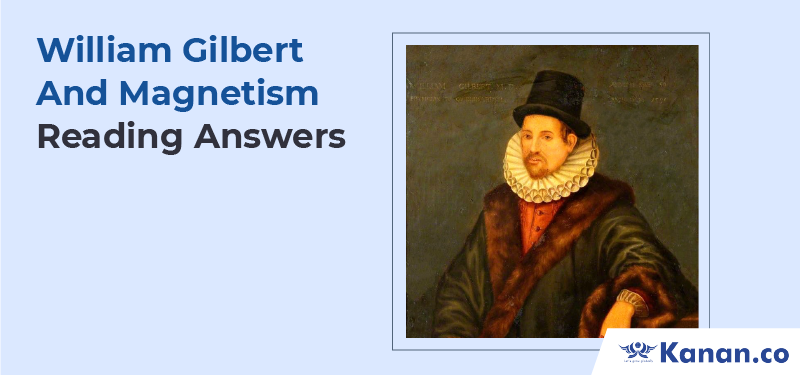
You can view all the William Gilbert and Magnetism Reading Answers below. Cross check your answers with the solutions given below.
| 1. v | 5. ix | 9. True | 13. E |
| 2. i | 6. iv | 10. Not Given | |
| 3. vi | 7. ii | 11. C | |
| 4. x | 8. True | 12. D |

For more question types with answers and explanations, you can check out William Gilbert and Magnetism Reading Answers article. You can make use of the article to prepare for the IELTS reading test.
Check your reading skills before attempting the IELTS test. Challenge your skills with the William Gilbert and Magnetism Reading Answers blog. This passage will help you learn about 3 IELTS reading question types.
The IELTS reading question types will test your abilities in reading, understanding and finding important information from a passage. You can start attempting the William Gilbert and Magnetism Reading Answers for the following question types:
- IELTS Reading Table Completion
- IELTS Reading Locating Information
- IELTS Reading Summary Completion
Check out our YouTube Channel to Practice Full-Length IELTS Reading Tests Daily

6 thoughts on “William Gilbert and Magnetism”
In this section, read on importance and significance of the William Gilbert and Magnetism Reading Answers passage.
- The William Gilbert and Magnetism Reading Answers passage assesses your ability to read and answer the questions.
- William Gilbert and Magnetism is a writing about the contribution of Gilbert in the field of electricity and magnetism.
- William Gilbert is a physician and philosopher who lived in the 16th century.
- You have to collect important information or mark the answers as you read the passage.
- You can read through the questions before reading the passage so that you can locate the answers easily.
- This passage will prepare you to attempt 3 IELTS question types. You should have a good vocabulary and an eye for detail to successfully complete the test.
Before attempting to write the William Gilbert and Magnetism Reading Answers, check the IELTS reading tips.
IELTS reading passage - William Gilbert and Magnetism
Read the following passage for writing the William Gilbert and Magnetism Reading Answers.
William Gilbert and Magnetism
- The sixteenth and seventeenth centuries saw 2 great pioneers of modern science: Gilbert and Galileo. Their eminent findings made a big impact. Gilbert was the accredited father of the science of electricity and magnetism, the first modern scientist, a physician at the court of Elizabeth and an Englishman of learning. Before him, the things known about electricity and magnetism was what the ancients knew, and nothing more than that. Lodestone had magnetic properties and when amber and jet were rubbed, it would attract bits of paper or other substances of small specific gravity. However, he wasn't given the recognition he deserves.
- Gilbert was born before Galileo. He was born on 24 May 1544 in an esteemed family in UK’s Colchester county. After going to grammar school, he went to study medicine at St. John’s College, Cambridge. He graduated in 1573 and then travelled to the continent and later settled down in London.
- He was a very eminent and successful doctor and was elected as the president of the Royal Science Society. He was appointed to serve the Queen (Elizabeth I) as her personal physician, and was later knighted by the Queen. He served her faithfully until her death. But soon after the Queen's death he died on 10th December, 1603. It was only a few months after his appointment as a personal physician to King James.
- Although Gilbert was interested in chemistry first he later changed his work because of a large portion of the mysticism of alchemy involved (such as the transmutation of metal). Slowly he became interested in physics after the great minds of the ancient, particularly about the knowledge the ancient Greeks had about lodestones, strange minerals with the power to attract iron. Meanwhile, in 1588 when the Spanish Armada was defeated, Britain had become a major seafaring nation, paving the way to the British settlement of America. British ships relied on the magnetic compass, yet no one knew why it worked. Was there a magnetic mountain at the pole, as described in Odyssey’ which ships would never approach or as Columbus said, did the pole star attract it? William Gilbert conducted ingenious experiments from 1580 to understand magnetism for almost 20 years.
- Gilbert’s discoveries were so important to modern physics. He investigated the nature of electricity and magnetism. He was the one who coined the word “electric”. Ultimately the beliefs of magnetism were also twisted with superstitions like rubbing garlic on lodestone can remove its magnetism. Even Sailors believed the smell of garlic would even interfere with the action of the compass, which is why the steerers were forbidden to eat it near a ship’s compass. Gilbert also found that metals can be magnetised by rubbing materials such as plastic, fur, etc. on them. He named the magnets “north and south pole”. Depending on its polarity magnets can attract or repel. In addition, however, a magnet always attracts an ordinary iron. Though he started to study the relationship between electricity and magnetism, he did not finish it. His research of static electricity using jet and amber only showed that objects with electrical charges can work like magnets that attract small pieces of paper and stuff. du Fay, a French guy discovered that there are actually two electrical charges, negative and positive.
- He also questioned the traditional astronomical beliefs. He didn’t express in his quintessential beliefs whether the earth is at the centre of the universe or in orbit around the sun though he was a Copernican. He believed that stars have their own earth-like planets orbiting around them and are not equidistant from the earth. Compasses always point north because the earth is like a giant magnet. The earth’s polarity and the axis they spin on is aligned. He built an entire magnetic philosophy on this analogy. He even equated the polarity of the earth to that of magnets. He explained that magnetism was the soul of the earth and a perfectly spherical lodestone, when aligned with the earth’s poles, would keep moving by itself in 24 hours. He further believed that suns and other stars wobble just like the earth does around a crystal core, and theorised that the moon might also be a magnet that orbits due to its attraction towards earth. Maybe this was the first proposal saying that a force might cause a heavenly orbit.
- In his revolutionary research methods he used experiments instead of reasoning and pure logic like the ancient Greek philosophers did. It was new in the scientific investigation. Scientific experiments were not in fashion till then. Because of this scientific attitude and his contribution to the field of magnetism, the unit of magnetomotive force, also known as magnetic potential, was named Gilbert in his honour. He carefully approached it, observed and experimented it rather than the authoritative or deductive philosophy of others that had laid the very foundation for modern science.
William Gilbert and Magnetism IELTS Reading questions
IELTS Reading Table Completion Questions 1-5
Complete the table below.
Choose NO MORE THAN THREE WORDS from the reading passage for each answer.
| Year | Event |
| 1 ________ | Gilbert was born |
| 2 ________ | Queen Elizabeth died |
| 3 ________ | Spanish Armada was defeated |
| 4 ________ | Gilbert graduated from St. John’s College |
| 1580 | William Gilbert conducted 5________. ingenious experiments |
Also check: IELTS Reading Table Completion
IELTS Reading Locating Information Questions 6-10
This reading passage has eight paragraphs, A–G.
Which paragraph contains the following information?
Write the correct letter, A - G, as your answer to each question.
6. Gilbert was the accredited father of the science of electricity and magnetism.
7. He used experiments instead of reasoning and pure logic.
8. Gilbert coined the word “electric”.
9. He believed that stars have their own earth-like planets.
10. Gilbert was interested in chemistry first.
Also check: IELTS Reading Locating Information
IELTS Reading Summary Completion Questions 11-14
Complete the summary below.
Write NO MORE THAN TWO WORDS from the passage for each answer.
The eminent findings of Gilbert made a big impact. He was born on 24 May 1544 in an esteemed family in UK’s 11_____ county. He investigated the nature of electricity and 12____. Because of his scientific attitude and contribution to the field of magnetism, the unit of magnetomotive force, also known as 13________, was named Gilbert in his honour. He died on 10th December, 1603 after a few months of his appointment as a personal physician to 14______.
Also check: IELTS Reading Summary Completion
William Gilbert and Magnetism IELTS Reading Answers with explanation
Find all the William Gilbert and Magnetism Reading Answers with explanation here.
Answers for IELTS Reading Table Completion Questions
(Note: The text in italics is from the reading passage and shows the location from where the answer is taken or inferred. The text in regular font explains the answer in detail.)
1. 1544
Explanation: He was born on 24 May 1544 in an esteemed family in UK’s Colchester county.
2. 1603
Explanation: But soon after the Queen's death he died on 10th December, 1603.
3. 1588
Explanation: Meanwhile, in 1588 when the Spanish Armada was defeated, Britain had become a major seafaring nation, paving the way to the British settlement of America.
4. 1573
Explanation: He graduated in 1573 and then travelled to the continent and later settled down in London.
5. ingenious experiments
Explanation: William Gilbert conducted ingenious experiments from 1580 to understand magnetism for almost 20 years.
Answers for IELTS Reading Locating Information Questions
6. Paragraph A
Explanation: Gilbert was the accredited father of the science of electricity and magnetism, the first modern scientist, a physician at the court of Elizabeth and an Englishman of learning.
7. Paragraph G
Explanation: In his revolutionary research methods he used experiments instead of reasoning and pure logic like the ancient Greek philosophers did.
8. Paragraph E
Explanation: He was the one who coined the word “electric”.
9. Paragraph F
Explanation: He believed that stars have their own earth-like planets orbiting around them and are not equidistant from the earth.
10. Paragraph D
Explanation: Although Gilbert was interested in chemistry first he later changed his work because of a large portion of the mysticism of alchemy involved (such as the transmutation of metal).
Answers for IELTS Reading Summary Completion Questions
11. Colchester
Explanation: He was born on 24 May 1544 in an esteemed family in UK’s Colchester county.
12. Magnetism
Explanation: He investigated the nature of electricity and magnetism.
13. magnetomotive force
Explanation: Because of this scientific attitude and his contribution to the field of magnetism, the unit of magnetomotive force, also known as magnetic potential, was named Gilbert in his honour.
14. King James
Explanation: he died on 10th December, 1603. It was only a few months after his appointment as a personal physician to King James.
Check the other reading passages
Click to check the other important Reading answers passages listed below,
Conclusion
With this guiding article we are sure you will be able to attempt the IELTS Reading section with confidence. After you have written the “William Gilbert and Magnetism Reading Answers” please do check out the other Reading passages too.

About Author Abishek Babu M
Abishek is a seasoned expert in the study abroad processes and IELTS, GRE, TOEFL, and SAT subjects. With over 2.5 years of experience in helping students achieve their foreign education goals, he has become a trusted individual in the industry. His extensive knowledge and authority in the IELTS test have earned him a reputation as a go-to resource for students seeking to excel in their exams. Abishek's exceptional track record has earned him the trust of countless students who rely on his resources to achieve their study abroad dreams.
Kanan International is a study abroad consultancy that offers reliable services, products, and solutions for students and education institutions. We support students throughout their study abroad journey, ensuring a hassle-free experience. Our expertise and commitment to excellence make us the go-to partner for expanding global horizons. The company provides coaching for IELTS, GRE, TOEFL, and SAT exams and services like visa consultation, accommodation, scholarship assistance, and education loans.
Free Online Mock Test 2026
Practice our mock test worth Rs. 25000 for Free and know your IELTS score!








Global Headquarters
Kanan Int EdTech Inc
320 Bay Street, Suite 321 (Spaces), Toronto ON, Canada M5B 1N9
Indian Headquarters
Kanan International Pvt. Ltd.
D-wing, 2nd Floor, Trident Complex, Ellora Park Vadiwadi Road, Vadodara, Gujarat 390007
IT/ Digital Campus
Kanan International Pvt. Ltd
Old, New No 3, 2nd Floor, 1A, Dr Sadasivam Rd, T. Nagar, Chennai, Tamil Nadu 600017
Our branches
- Bardoli
- Bharuch
- Chennai
- Dehradun
- Gurugram
- Himatnagar
- Karnal
- Nadiad
- Navsari
- Palanpur
- Rajkot
- Vadodara
- Valsad
- Vallabh Vidyanagar
- Vapi
Study Abroad
Test Prep
Top Universities
Consultants
IELTS Centers
GRE Centers
TOEFL Centers
SAT Centers
Language Courses in Vadodara
Study Abroad Calculators
Featured Blogs
Study Abroad Consultants in Chennai
Study Abroad Consultants in Surat
Study Abroad Consultants in Navsari
Study Abroad Consultants in Bardoli
Study Abroad Consultants in Ahmedabad
Study Abroad Consultants in Anand
Study Abroad Consultants in Khanna
Study Abroad Consultants in Nadiad
Study Abroad Consultants in Vadodara
Study abroad consultants in Valsad
Copyright © 2026 KANAN.CO All rights reserved.