- Study Abroad
- / ielts
- / working in the movies reading answers
Working In The Movies Reading Answers


Author
16-09-2025

In the table below, you are provided with Working in the movies reading answers. You can compare your answers with the table and evaluate your performance.
Solution for the Working In The Movies
| 1. Timing | 2. insert, delete | 3. Manual review | 4. synchronization |
| 5. spotting test | 6. True | 7. True | 8. Not Given |
| 9. Not Given | 10. False | 11. the source language | 12. reformat the timing |
| 13. thin black border | 14. the hearing impaired |

IELTS Reading is considered to be the most difficult of the four test categories. There are three portions to the reading test, and you only have 60 minutes to complete them. Make good use of your time to finish the exam swiftly and answer all questions. For your convenience, we have included Working in the Movies Reading answers with explanations in this article.
Working in the movies reading answers describes a subtitler’s role in movies. A translator Virginie Verdier in her discussion with Melanie mentioned various techniques and methods of the subtitling process. This article comprises 3 IELTS reading question types. They are:
- IELTS Reading Flow Chart Completion
- IELTS Reading True/False/Not Given
- IELTS Reading Sentence Completion
Check out our YouTube Channel to Practice Full-Length IELTS Reading Tests Daily

Strategies for solving “Working in the movies”
Refer to the following strategies, before attempting the Working in the movie reading test to improve your IELTS band score.
- Working in the movies reading answers with explanations will help you recognize your mistakes and correct them.
- This reading passage has a description of how subtitlers work. How they insert the subtitles in movies.
- Read the passage carefully and underline or highlight the keywords for your convenience. Understand the central idea of the passage.
- Pay attention to the question instructions, and phrases like, “NO MORE THAN TWO WORDS” or “ONE WORD ONLY”; be aware of the word limit.
- Plan your time properly to complete the three passages and 40 questions in the stipulated time limit.
- For the flowchart completion, the questions may not be in chronological order. Hence, focus on the keywords.
- When answering the questions, refrain from sharing your knowledge and experience. To answer the question, you just need to depend on the information given in the excerpt.
Refer to IELTS Reading tips by our experts, before solving the Working in the movies reading passage.
IELTS Reading Passage - Working in the movies
The reading exam lasts for an hour and has three passages. You should spend around 20 minutes on this passage and solve questions 1-14. Scan through the passage carefully, before moving on to the questions. Evaluate your performance using the Working in the movies reading answers.
Working in the movies
Subtitling is an intriguing element in the translation industry. Melanie Leyshon discusses the glitz and bustle with Virginie Verdier of the London translation company VSI.
- Virginie Verdier, a French translator, surely finds it enticing to answer enigmatically when people ask her what she does for a living by saying, "Oh, me? I participate in movies. Certainly true, but she plays the lead role behind the scenes. Nothing is more exciting or glamorous in terms of translation than subtitling movies. If you're truly fortunate, you might have the opportunity to work on brand-new blockbuster movies before they are released in theatres, and if you're just plain lucky, you might have the opportunity to work on blockbuster movies that will be issued on video or DVD.
- The procedure begins when you receive the original script and a recording. "We would usually start by interpreting and modifying the script." The next phase is what we refer to as "timing," which consists of syncing the speech and pictures well with subtitles. Discipline is needed for this work. The film is played, the voice is heard, and the captions are displayed on the screen, ready to be synchronized. Once the appropriate sentence begins, you add the subtitle and remove it when it has finished. The videotape is labeled with a time code in hours, minutes, seconds, and frames. Consider it to be a clock. The subtitle system includes an insert key that you can use to record the time code for the target position of the subtitle. The time code at which you want the subtitle to vanish is recorded once you click the delete key. Hence, every subtitle would constitute a particular feature of the translation industry. Melanie Leyshon discusses the glamour and hardship with Virginie Verdier of the London translation company VSI. Virginie is eager to emphasize that this requires the same level of accuracy as any translation task. You put in a lot of effort. As you translate, you will discover that it is not entertaining. You require the abilities of both a leading editor and a proficient translator. Unlike the usual translation tasks, you must be relatively brief and accurate.
- The exact time that a subtitle appears and disappears is represented by an "in" point and an "out" point. A manual evaluation of the process is then performed, with each subtitle being inspected individually. Time codes are therefore updated to improve synchronization and consider alterations. To ensure that the subtitles comply with the visual rhythm of the movie, this method involves playing the movie frame by frame. Different subtitlers employ different methods. I frequently watch the film once, translate it, and then go back to the beginning to finish the timings. But you could do it in sections, translating, maybe, 20 minutes of the film, then timing and translating the subsequent 20 minutes, and so on. It's merely a different technique." For multilingual assignments, timing is done first to develop a "spotting list," or subtitle template, which is a list of English subtitles that have been pre-timed and adjusted for translation. This is then translated, and, with the translator's assistance, the time is corrected to the target language for quality control.
- According to Virginie, the subtitling process, like any other translation endeavor, cannot be rushed. It is obvious that if subtitles are translated and organized in a hurry, the quality will suffer. The majority of mistakes are made by the translator misinterpreting the actual dialogue because they are not fluent in the source language. As part of our responsibilities, we also examine and rewrite subtitles when a translation is insufficient. However, there are other factors involved in the requirement to redo the subtitles in addition to poor translation. A new version of the movie could need the subtitles altered because of a potential change in the time code. It's possible that the movie was altered or that the subtitles were written for the cinema instead of the video. If subtitles were made for movies on 35mm, the timing would have to be reformated for video since they could be out of sync or go too quickly. Naturally, we would appreciate the original translator's effort if the translation is accurate.
- According to Virginie, on a more pragmatic level, there seem to be basic subtitling principles that must be followed. Subtitles should ideally be displayed in the center and at the bottom of the screen, she says, noting that different countries follow different standards and regulations. For instance, subtitles are typically left-justified in Scandinavian countries and Holland. To make them easier to read against a white or light background, characters are generally displayed in white with a thin black border. When subtitles are being provided for the hearing impaired, we could utilize different colors for different individuals. There should only be two lines in a subtitle, with a maximum of 32 to 39 characters for each line. The criteria for our firm are 37 characters (standards vary among different organizations and nations).
- It's common for translators to have a favorite category, whether it be corporate shows, comedies, musicals, war movies, or comedies (one of the trickiest owing to the variations in comedy across nations and its complexities). Each demands a particular tone and manner. Because many of the films we subtitle are American, the fact that VSI seeks American subtitlers is quite advantageous, explains Virginie. It would be hard for an English person to recognize the meaning of a typical American remark, and vice-versa.
Working In The Movies IELTS Reading Questions
Questions 1 - 5
Complete the flowchart below.
NO MORE THAN THREE WORDS from the passage for each answer.
Write your answers in boxes 1-5 in your answer sheet.
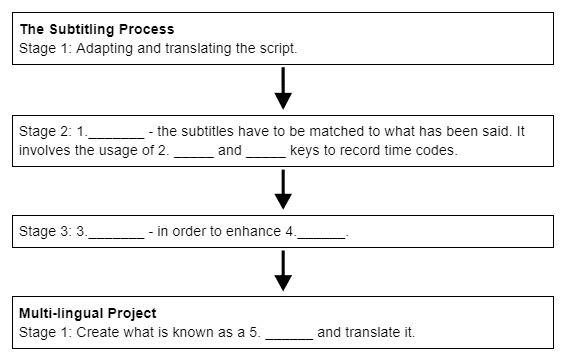
Click here to know more about IELTS Reading flow chart completion questions.
Questions 6 - 10
Do the following statements agree with the information given in the Reading Passage?
In boxes 6 - 10, on your answer sheet write
TRUE if the statement agrees with the information
FALSE if the statement contradicts the information
NOT GIVEN if there is no information on this.
6. Few methods of subtitling are more efficient compared to others.
7. All film subtitling jobs are attractive to translators.
8. The tone and aesthetics of every single film are the same.
9. There is a prerequisite for subtitling work that does not apply to other translation work.
10. Few individuals are proficient when it comes to subtitling comedy.
Click here to know more about IELTS Reading True/False/Not Given.
Questions 11 - 14
Complete the sentences below with the words from Reading Passage.
Use NO MORE THAN THREE WORDS for each answer.
Write your answers in boxes 11 - 14 on your answer sheet.
11. Normally, there is a _______ surrounding the subtitles.
12. The translator’s lack of proficiency in _________, results in poor subtitling.
13. To help _________, speakers can be differentiated among themselves.
14. It may be required to _________, to create captions for a video version of a movie.
Click here to know more about IELTS Reading sentence completion questions.
Working in the movies reading answers with explanations
The Working in the movies reading answers with explanations consists of the correct answers along with the information to find them in the passage. Evaluate your performance using it.
(Note: The text in italics is from the reading passage and shows the location from where the answer is taken or inferred. The text in regular font explains the answer in detail.)
1. Timing
Key Location: Paragraph B, Lines 2- 3.
Explanation: The next phase is what we refer to as "timing," which consists of syncing the speech and pictures well with subtitles. The second step of subtitling is timing the captions with the dialogues and pictures. The translator in this stage of the process times the subtitles with the appropriate conversational dialogue that is being spoken in the video.
2. insert, delete
Key Location: Paragraph B, Lines 9 - 11.
Explanation: The subtitle system includes an insert key that you can use to record the time code for the target position of the subtitle. The time code at which you want the subtitle to vanish is recorded once you click the delete key. These two keys are used to add and remove the captions at the correct time in the movies.
3. Manual review
Key Location: Paragraph C. Lines 2 - 3.
Explanation: A manual evaluation of the process is then performed, with each subtitle being inspected individually. The translators, who are doing this subtitling process perform a manual evaluation of the whole process they did. This is done frame by frame to ensure that the subtitles are set correctly in the film.
4. synchronization
Key Location: Paragraph C, Lines 2 - 6.
Explanation: A manual evaluation of the process is then performed, with each subtitle being inspected individually. Time codes are therefore updated to improve synchronization and consider alterations. To ensure that the subtitles comply with the visual rhythm of the movie, this method involves playing the movie frame by frame. With the help of manual scrutiny of the entire process, the time codes can be adjusted and synchronized well.
5. spotting list
Key Location: Paragraph C, Lines 11 - 12.
Explanation: For multilingual assignments, timing is done first to develop a "spotting list," or subtitle template, which is a list of English subtitles that have been pre-timed and adjusted for translation. This list will aid the subtitlers in translating American or another language easily to English.
6. Not Given
Explanation: Although the passage has mentioned that there are different methods of subtitling, they have not provided any relevant information regarding some of these methods being better than others.
7. True
Key Location: Paragraph A, Lines 4 - 8.
Explanation: Nothing is more exciting or glamorous in terms of translation than subtitling movies. If you're truly fortunate, you might have the opportunity to work on brand-new blockbuster movies before they are released in theatres, and if you're just plain lucky, you might have the opportunity to work on blockbuster movies that will be issued on video or DVD. They consider themselves very fortunate if they can subtitle movies.
8. False
Key Location: Paragraph F, Lines 1 - 4.
Explanation: It's common for translators to have a favorite category, whether it be corporate shows, comedies, musicals, war movies, or comedies (one of the trickiest owing to the variations in comedy across nations and its complexities). Each demands a particular tone and manner. Virginia has noted that every subtitler has their favorite genre of movie, and they enjoy translating. And every genre of movie demands a different tone and style.
9. True
Key Location: Paragraph B, Lines 2 - 4, 18.
Explanation: "We would usually start by interpreting and modifying the script." The next phase is what we refer to as "timing," which consists of syncing the speech and pictures well with subtitles. Discipline is needed for this work. The film is played, the voice is heard, and the captions are displayed on the screen, ready to be synchronized. This work requires discipline and accuracy. Along with these, they also require precision, unlike other translating jobs.
10. Not Given
Explanation: Even though they have mentioned the subtitling of comedy movies is difficult. There is no mention of any translator being proficient in that. Hence, the answer is not given.
11. thin black border
Key Location: Paragraph E, Lines 5 - 6.
Explanation: To make them easier to read against a white or light background, characters are generally displayed in white with a thin black border.
12. the source language
Key Location: Paragraph D, Line 4 - 5.
Explanation: The line has mentioned that if a subtitler does not have a proper understanding of the source language to avoid mistakes, that occur in the absence of proficiency in the same.
13. the hearing impaired
Key Location: Paragraph E, Line 7 - 8.
Explanation: When subtitles are being provided for the hearing impaired, we could utilize different colours for different individuals. For the deaf people to distinguish between which is speaking during the movie, they provided different colored subtitles to differentiate the speakers.
14. reformat the timing
Key Location: Paragraph D, Lines 11 - 12.
Explanation: If subtitles were made for movies on 35mm, the timing would have to be reformated for video since they could be out of sync or go too quickly. When the subtitles of movies are transferred for video, the time codes may need reformatting because they could be unsynced or may go away quickly.
Check the other reading passages
Check the links to the other important reading passages listed below:
Conclusion
The “Working in the movies reading answers” post contains a reading passage, 3 question types and answers with explanations as well as locations for your assistance. Along with that, you can access the links provided which will help you improve your skills. This will help you be time efficient as well as excel in the reading exam.

About Author Roshan Sunthar
Roshan Sunthar is a study abroad expert as well as a renowned writer and author in international education. His academic excellence and 5+ years of work experience give him in-depth knowledge of international standardised exams and test preparation in IELTS, TOEFL, GRE, PTE, SAT, etc. The study materials he prepares incorporate exam-like questions. He’s also an expert in writing Statement of Purposes (SOPs) and Letter of Recommendations (LORs) for college admissions. He usually spends his leisure time watching English classics and documentaries, travelling, etc.
Kanan.co is a trusted study abroad consultancy offering comprehensive services, resources, and solutions for students and education institutions. We support students at every stage of their global education journey, ensuring a smooth and guided experience. Along with test preparation for IELTS, GRE, TOEFL, and SAT, we provide expert services such as SOP writing, visa guidance, accommodation support, scholarship assistance, and education loan support. Our expertise and commitment to excellence make us a reliable partner for students pursuing international education.
Free Online Mock Test 2026
Practice our mock test worth Rs. 25000 for Free and know your IELTS score!








Global Headquarters
Kanan Int EdTech Inc
320 Bay Street, Suite 321 (Spaces), Toronto ON, Canada M5B 1N9
Indian Headquarters
Kanan International Pvt. Ltd.
D-wing, 2nd Floor, Trident Complex, Ellora Park Vadiwadi Road, Vadodara, Gujarat 390007
IT/ Digital Campus
Kanan International Pvt. Ltd
Old, New No 3, 2nd Floor, 1A, Dr Sadasivam Rd, T. Nagar, Chennai, Tamil Nadu 600017
Our branches
- Bardoli
- Bharuch
- Chennai
- Dehradun
- Gurugram
- Himatnagar
- Karnal
- Nadiad
- Navsari
- Palanpur
- Rajkot
- Vadodara
- Valsad
- Vallabh Vidyanagar
- Vapi
Study Abroad
Test Prep
Top Universities
Consultants
IELTS Centers
GRE Centers
TOEFL Centers
SAT Centers
Language Courses in Vadodara
Study Abroad Calculators
Featured Blogs
Study Abroad Consultants in Chennai
Study Abroad Consultants in Surat
Study Abroad Consultants in Navsari
Study Abroad Consultants in Bardoli
Study Abroad Consultants in Ahmedabad
Study Abroad Consultants in Anand
Study Abroad Consultants in Khanna
Study Abroad Consultants in Nadiad
Study Abroad Consultants in Vadodara
Study abroad consultants in Valsad
Copyright © 2026 KANAN.CO All rights reserved.