- Study Abroad
- / ielts
- / a chronicle of timekeeping reading answers
A Chronicle of Timekeeping Reading Answers


Author
16-09-2025

This section contains a tabular representation of 'A chronicle of timekeeping reading answers'. By referring to this page, you may compare and evaluate your responses.
| 1. D | 2. B | 3. F | 4. E |
| 5. B | 6. F | 7. D | 8. A |
|
9. (ship’s) anchor/(an/the) anchor |
10. (escape) wheel |
11. tooth |
12. (long) pendulum |
|
13.second |

By comparing these answers, you will be able to fix any errors you may have made and have a deeper understanding of the material you have been reading.
View this sample response to get a sense of the format and the types of questions you will be asked. If you do better on the IELTS reading part of the test, your overall band score may improve significantly.
This article on a chronicle of timekeeping reading passage features three distinct types of IELTS reading questions types that might be asked during the IELTS exam. The three question types are as follows:
- IELTS Reading Locating Information Questions
- IELTS Reading Short Answer Questions
- IELTS Reading Diagram Labelling Questions
Check Out our YouTube Channel to Practice Full-Length IELTS Reading Tests Daily

5 thought on the topic “a Chronicle of timekeeping reading answers”
The relevance of the passage, the skills that will be examined, and instructions for writing your answers on the answer sheet are provided below for your perusal. Here, you have been given “A Chronicle of timekeeping IELTS reading answers” for your convenience.
- When searching the information in the passages with the help of keywords, you will not find the same keywords. Possibly, you will find the synonyms and paraphrased version of the keywords.
- A chronicle of timekeeping answers with location will help you understand and answer all questions as there are no negative marks. If you do not find the answer, read the text twice to make sense of it.
- For short answer reading questions, the questions will be in the same order as it is in the passage. It is referred to as “Progressive order of questions”.
- Highlight the keywords and locate the part in the passage with the help of keywords, where the required information is present.Here, A chronicle of timekeeping answers with explanation will help you find the correct solutions in reading passage.
- In note completion, you will be given a set of incomplete notes derived from the reading passages. Most probably, you will not find exact words in the passages, which you have found in the question notes. So, think of possible synonyms of the keywords in the passages and look for the related portion in the passage.
Check the IELTS reading tips before attempting to write A Chronicle of timekeeping IELTS reading answers.
IELTS Reading Passage - A Chronicle of timekeeping
Read the IELTS reading passage below and respond to the questions (1-13). Verify your responses with the A chronicle of timekeeping reading answers with explanations provided subsequently.
A Chronicle of Timekeeping
- Before the Roman Empire even existed, at least 5,000 years ago, according to archaeological evidence, the Babylonians invented calendars to coordinate social activities, arrange the transportation of products, and, in particular, to control planting and harvesting. Their calendars were based on three natural cycles: the solar day, which corresponds to the alternation of periods of light and darkness as the earth rotates on its axis; the lunar month, which tracks the phases of the moon as it orbits the earth; and the solar year, which is determined by the varying seasons that coincide with our planet's rotation around the sun.
- The moon had a bigger social impact before the development of artificial light. And its growing and fading was more obvious to people who lived close to the equator than the change of the seasons. As a result, the moon cycle rather than the solar year had a greater impact on the calendars that were created in lower latitudes. The solar year, however, became more important in northern climates where seasonal agriculture was practised. The solar year served as the primary organising principle for the Roman Empire's activity chart as it grew northward.
- Egyptians developed a municipal calendar with 12 months of 30 days and five extra days to resemble the solar year centuries before the Roman Empire. Decans, distinctive constellations of stars, appeared every ten days to indicate a ten-day period. 12 decans may be seen sweeping the heavens at the rising of the star Sirius immediately before daybreak, which took place around the crucial yearly flooding of the Nile. The Egyptians developed a system in which each interval of darkness (and later, each interval of daylight) was divided into a dozen equal pieces due to the cosmic significance they attached to the 12 decans. These intervals, which varied in length in accordance with the length of the days and nights as the seasons changed, came to be known as temporal hours. Only at the spring and fall equinoxes were the lengths of daylight and nighttime equal. Summer hours were long, winter hours were short. Temporal hours were used for more than 2,500 years after being initially accepted by the Greeks and later the Romans, who spread them throughout Europe.
- Sundials, which tell the time by the length or direction of the sun's shadow, were invented by inventors to keep track of the temporal hours throughout the day. The water clock, the sundial's inverse, was made to count the hours of the night. One of the original water clocks consisted of a basin with a tiny hole towards the bottom through which water leaked. As the water level dropped below the hour lines etched on the inner surface, it indicated the passing hour. Although these gadgets worked well around the Mediterranean, it was difficult to rely on them in northern Europe's overcast, frequently chilly weather.
- When the mechanical clock was invented, it was ideally suited to retaining equal hours even though it could be changed to preserve temporal ones. However, the issue of when to start counting arose with them, leading to the development of other systems in the early 14th century. Depending on the time of the count, different systems were used to divide the day into 24 equal parts: Italian time started at dusk, Babylonian time at dawn, astronomical time at noon, and the "big clock" time, which is used for some very large public clocks in Germany, at midnight. These eventually gave way to "little clock" or French hours, which divided the day into two 12-hour blocks beginning at midnight.
- In Bedfordshire, England, a weight-driven mechanical clock was constructed in 1283. Its escapement, which had been around for at least 1,300 years, was what made this new timepiece remarkable, not the descending weight that produced its driving force or the gear wheels that conveyed the power. The coiled spring, also known as a fusee, was created in the early 1400s and kept the gear wheels of a timekeeper turning steadily despite changes in the mainspring's tension. A pendulum clock was invented in the 16th century, but it was ineffective since the pendulum swung in a wide arc.
- In order to solve this, an alternative to the original escapement was created in England in 1670. It was a lever-driven tool with the shape of an anchor for a ship and was known as the anchor escapement. This apparatus is rocked by a pendulum such that each escape wheel tooth is caught and then released, allowing the escape wheel to turn precisely. The anchor escapement allowed the pendulum to swing in a far smaller arc than the original design found in early pendulum clocks. Additionally, this innovation made it possible to utilise a long pendulum that could beat once per second, which encouraged the creation of a new floor-standing case style that came to be known as the grandfather clock.
- Today, the majority of electronic devices are timed by extremely precise clocks. A quartz-crystal clock is almost always present in computers to control their operation. Furthermore, time signals transmitted by GPS satellites calibrate the operations of high-precision navigational equipment as well as mobile phones, real-time stock trading platforms, and national power grids. These time-based devices have gotten so ingrained in daily life that we only realize how dependent we are on them when they stop functioning.
A chronicle of timekeeping IELTS reading questions
Question 1-4
Reading Passage has eight paragraphs, A-H.
Which paragraph contains the following information?
Write the correct letter, A-H, in boxes 1-4 on your answer sheet.
1. An explanation of an early device for keeping time that was impacted by cold temperatures
2. A justification of the significance of location in farming communities' calendar development
3. An explanation of the pendulum clock's historical background
4. Specifics on how several societies simultaneously tried to compute time using consistent hours
Click here to know more about IELTS Reading Locating Information
Question 5-8
Look at the following events (Questions 5-8) and the list of nationalities below.
Match each event with the correct nationality, A-F.
Write the correct letter, A-F, in boxes 5-8 on your answer sheet.
List of Nationalities
- Babylonians
- Egyptians
- Greeks
- English
- Germans
- French
5. They created a civil calendar with equivalence between the lengths of the months.
6. They split the day in two equally long halves.
7. For a particular kind of timekeeper, they created a novel cabinet shape.
8. To organise public events and work schedules, they devised a calendar.
Click here to know more about IELTS Reading Matching Features.
Question 9-13
Label the diagram below.
Choose NO MORE THAN TWO WORDS from the passage for each answer.
Write your answers in boxes 9-13 on your answer sheet.
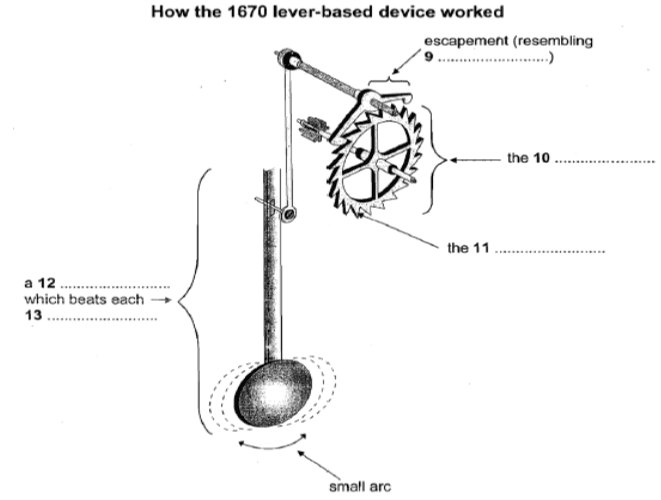
Click here to know more about IELTS Reading Diagram Labelling.
A Chronicle of Timekeeping Reading Answers with Explanations
Find the “A chronicle of timekeeping IELTS reading answers with explanations” given below that guarantees a clear understanding.
(Note: The text in italics is from the reading passage and shows the location from where the answer is taken or inferred. The text in regular font style explains the answer in detail.)
1. D
Explanation:Last Line of paragraph D states, “it was difficult to rely on them in northern Europe's overcast, frequently chilly weather.”
2. B
Explanation: Line 4-6 of paragraph B states, “The solar year, however, became more important in northern climates where seasonal agriculture was practised.”
3. F
Explanation: Line 6-8 of paragraph F states, “A pendulum clock was invented in the 16th century, but it was ineffective since the pendulum swung in a wide arc.”
4. E
Explanation: Line 2-4 of paragraph E states, “However, the issue of when to start counting arose with them, leading to the development of other systems in the early 14th century.”
5. B
Explanation: Line 1-2 of paragraph C states, “Egyptians developed a municipal calendar with 12 months of 30 days and five extra days to resemble the solar year centuries before the Roman Empire.”
6. F
Explanation: Line 7-9 of paragraph E states, “These eventually gave way to "little clock" or French hours, which divided the day into two 12-hour blocks beginning at midnight.”
7. D
Explanation: Line 6-9 of paragraph G states, “Additionally, this innovation made it possible to utilise a long pendulum that could beat once per second, which encouraged the creation of a new floor-standing case style that came to be known as the grandfather clock.”
8. A
Explanation: Line 1-4 of paragraph A states, “Before the Roman Empire even existed, at least 5,000 years ago, according to archaeological evidence, the Babylonians invented calendars to coordinate social activities, arrange the transportation of products, and, in particular, to control planting and harvesting.”
9. (ship’s) anchor/(an/the) anchor
Explanation: Line 2-3 of paragraph G states, “It was a lever-driven tool with the shape of an anchor for a ship and was known as the anchor escapement.”
10. (escape) wheel (h6
Explanation: Line 3-4 of paragraph G states, “This apparatus is rocked by a pendulum such that each escape wheel tooth is caught and then released”
11. tooth
Explanation: Line 3-4 of paragraph G states, “This apparatus is rocked by a pendulum such that each escape wheel tooth is caught and then released”
12. (long) pendulum
Explanation: Line 6-9 of paragraph G states,“Additionally, this innovation made it possible to utilise a long pendulum that could beat once per second, which encouraged the creation of a new floor-standing case style that came to be known as the grandfather clock.”
13. Second
Explanation: Line 6-9 of paragraph G states, “Additionally, this innovation made it possible to utilise a long pendulum that could beat once per second, which encouraged the creation of a new floor-standing case style that came to be known as the grandfather clock.”
Check the other reading passages
- Electroreception Reading Answers
- Fashion and Society Reading Answers
- Raising the Mary Rose Reading Answers
Conclusion (h5)
We are certain that if you use this article as a guide, you will be able to confidently take the IELTS Reading section. In addition to "A chronicle of timekeeping IELTS reading answers," please practise the other reading samples as well.

About Author Roshan Sunthar
Roshan Sunthar is a study abroad expert as well as a renowned writer and author in international education. His academic excellence and 5+ years of work experience give him in-depth knowledge of international standardised exams and test preparation in IELTS, TOEFL, GRE, PTE, SAT, etc. The study materials he prepares incorporate exam-like questions. He’s also an expert in writing Statement of Purposes (SOPs) and Letter of Recommendations (LORs) for college admissions. He usually spends his leisure time watching English classics and documentaries, travelling, etc.
Kanan.co is a trusted study abroad consultancy offering comprehensive services, resources, and solutions for students and education institutions. We support students at every stage of their global education journey, ensuring a smooth and guided experience. Along with test preparation for IELTS, GRE, TOEFL, and SAT, we provide expert services such as SOP writing, visa guidance, accommodation support, scholarship assistance, and education loan support. Our expertise and commitment to excellence make us a reliable partner for students pursuing international education.
Free Online Mock Test 2026
Practice our mock test worth Rs. 25000 for Free and know your IELTS score!








Global Headquarters
Kanan Int EdTech Inc
320 Bay Street, Suite 321 (Spaces), Toronto ON, Canada M5B 1N9
Indian Headquarters
Kanan International Pvt. Ltd.
D-wing, 2nd Floor, Trident Complex, Ellora Park Vadiwadi Road, Vadodara, Gujarat 390007
IT/ Digital Campus
Kanan International Pvt. Ltd
Old, New No 3, 2nd Floor, 1A, Dr Sadasivam Rd, T. Nagar, Chennai, Tamil Nadu 600017
Our branches
- Bardoli
- Bharuch
- Chennai
- Dehradun
- Gurugram
- Himatnagar
- Karnal
- Nadiad
- Navsari
- Palanpur
- Rajkot
- Vadodara
- Valsad
- Vallabh Vidyanagar
- Vapi
Study Abroad
Test Prep
Top Universities
Consultants
IELTS Centers
GRE Centers
TOEFL Centers
SAT Centers
Language Courses in Vadodara
Study Abroad Calculators
Featured Blogs
Study Abroad Consultants in Chennai
Study Abroad Consultants in Surat
Study Abroad Consultants in Navsari
Study Abroad Consultants in Bardoli
Study Abroad Consultants in Ahmedabad
Study Abroad Consultants in Anand
Study Abroad Consultants in Khanna
Study Abroad Consultants in Nadiad
Study Abroad Consultants in Vadodara
Study abroad consultants in Valsad
Copyright © 2026 KANAN.CO All rights reserved.