IELTS Listening Map Labelling Practice Questions


Author
20-06-2025

The IELTS listening test involves listening to the four recordings based on the academic and social context. There are 40 questions involved in the IELTS listening test which needs to be completed in 30 minutes. The IELTS listening question types involved in the test are multiple-choice, matching questions, plan, map, diagram labelling, form, note, table, flow chart, summary, and sentence completion. In this article, we’re going to look at the IELTS listening map (plan labelling) question type in detail.
The IELTS listening map is the task where you need to label the map with the correct letter for the question by listening to the audio. Also, there will be questions where you need to label the unnamed area by hearing the recordings. The pattern of the map and plan labelling questions will be similar, where in the plan you need to label the building, and in the map you’re asked to map the town. To give you a clear understanding, we’ve given samples of the listening map and plan labelling questions.
Check Out our YouTube Channel to Practice Full-Length IELTS Listening Tests Daily

IELTS Listening Map and Plan Labelling Questions
Before practising the IELTS listening map, you need to first understand how the question of map and plan labelling varies. The following samples will help you to develop a better understanding of map and plan labelling questions and we’ve included a pro-tip to answer the different types of questions.
IELTS Listening Map Questions
Below are some of the IELTS listening map questions taken from the previous sample papers.
IELTS Map Listening Practice 1
Questions 1- 6
Label the map below.
Write the correct letter, A-K, next to Questions 1-6.
WALKING TOUR MAP OF THE NATIONAL BOTANICAL GARDEN

1. Nursery --------------
2. Native tree zone --------------
3. Exotic forest zone--------------
4. Exhibition --------------
5. Shamiana --------------
6. Topiary display -------------
You need to write only the letters from A-K for this type of listening map question. This question type is related to garden, so you need to come up with words relevant to that.
IELTS Map Listening Practice 2
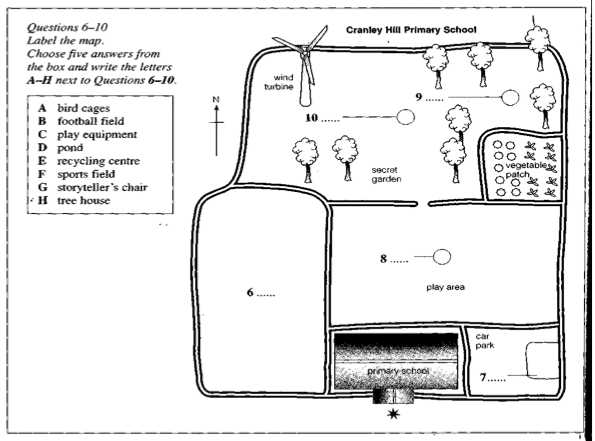
To respond to this question, you need to give the letters A-I only by choosing the words given in the box. There might be chances that you may have misunderstood this question. For this question type, you only need to give the letters not the words.
IELTS Map Listening Practice 3
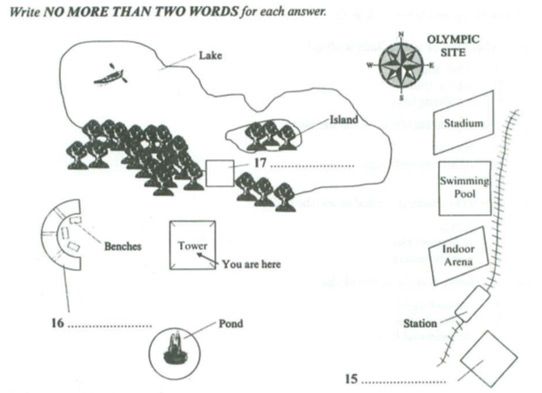
For this listening map question type, you need to give the words by listening to the audio. The words need to be within two words, make sure you write the correct spelling while answering this type of question.
IELTS Listening Plan Labelling Questions
IELTS Plan Listening Practice 1

Note, that this is the form of listening plan labelling question type, where you need to select the letters based on the words given from the box. The speaker involved in the recording is a librarian who is explaining about the departments of the library to the group of people visiting it.
You also need to practise the IELTS listening diagram labelling, as this question type also requires you to label the answer.
IELTS Listening Map Practice
Keeping in mind all of the tips that are given above, start your IELTS listening map practice test with the below-given question.
Questions 1- 6
Label the map below.
Write the correct letter, A-K, next to Questions 1-6.
WALKING TOUR MAP OF THE NATIONAL BOTANICAL GARDEN

1. Nursery ---------------
2. Native tree zone ---------------
3. Exotic forest zone --------------
4. Exhibition --------------
5. Shamiana --------------
6. Topiary display --------------
Transcript
Good morning and welcome to the National Botanical Gardens. I am your guide, Lisa, for the garden tour. This garden is a step closer towards the conservation of indigenous trees that are essential to the regional vegetation. Since it is a planned project, it also becomes a useful centre for research on the conservation of plant species. Actually, this region is too big to be called a garden. It covers about 30 hectares of land which is protected by the Central Forest Service Management of the country.
As you can see in this map, there are no concrete structures anywhere in this area, you’ll see only landscapes and narrow paths lightly cleared for walking. These special pathways are called the Garden Walks. We are here at the Botanical Garden Office and there’s an L-shape garden walk from here right up to the Forest Zone. The first square section on the left is the (Q1) Nursery with saplings of some of the most exotic plants and trees. You can buy everything you like when we complete the tour. From here we'll be walking the track to the two forest areas that have the native trees and smaller plants that are used for landscaping the local urban areas. The (Q2) Native Tree Zone is here, immediately behind the Nursery, and next to it is the Nonnative Trees Zone. We are now looking at the huge fenced area on the west. You can see an area with fencing; this is the (Q3) Exotic Forest Zone. Several species of vegetation and insects that breed in this land will be destroyed or lose their habitat due to trampling by visitors. So entry is allowed for researchers only. There’s a smaller garden walk, going up north beyond the fencing. It leads to the Research Centre, which is built of eco-friendly construction material, has natural heating and cooling technology and uses solar energy. This building is not open to visitors. But we will visit the (Q4) Exhibition in the smaller extension of this building, not the larger one. It has a separate entrance within the research centre. We will see a short documentary on the importance of forest conservation followed by a talk by an expert on how you can contribute to tree conservation. After we tour the nursery and the exhibition in the research centre, we will gather in the (Q5) Shamiana for lunch. It’s on the left as we head back to the garden office. Meals in the open are a unique experience, and I am sure you will enjoy it. After lunch, we will head to the main entrance. To the left, you will see a circular garden with a display of colourful ornamental plants. On the other side of this garden walk, there is a beautiful (Q6) Topiary Display. You’ll get to see the topiarists at work trimming plants into various shapes of birds, animals and other objects. This garden walk connects the botanical garden to the village nearby. Most workers are local and use this pathway. But it is also open for morning walkers or visitors who want to have a glimpse of the rural life around. You will be paying for your purchases here at the garden office as we exit the premises (fade).
Answers
1. C
2. D
3. G
4. J
5. K
6. B
Check our IELTS listening practice test to achieve the desired band score.
IELTS Listening Map Labelling Tips
Understanding the IELTS listening map labelling question type clearly itself will help you to achieve the high band score. To ace the listening section, you need to check out our IELTS listening tips. The following tips are suggested by the IELTS experts which will help you to label the map and plan in a correct way.
1. Instructions are key
You need to first identify the way you’re going to respond to the listening map question by reading the instructions carefully. From the instructions, you’ll clearly understand how many words and what kind of words you need to answer.
For eg: Write the correct letter, A-K, next to Questions 1-6.
In this case, you need to label the questions with the letters A-K not with the answers that you’ve heard in the audio.
2. Predict the answer
In the IELTS listening test, you’ll be given some time to go through the question before playing the recording. This time is crucial, so you need to use it wisely. First understand the question, whether you’re going to label the map or plan. Look at the map or plan and try to predict the labels based on the position they are in.
3. Focus on the labelled parts
Title and the labelled parts in the map and plan question is the key aspect to respond to the answer wisely. Looking at the title will help you to know what basis of audio you're going to hear. And, knowing the labelled parts will help you to focus on the other information while listening.
4. Put yourself in that map or plan
Imagine that you’re in the place and try to figure out what are all the places that can be located nearby. You can start by predicting where the person will start from, and what can be the places that are in the right, left, front and behind. Relate your prediction with the question that is given for you.
5. Focus on the answer
In the IELTS listening test, the recordings will carry information where you can identify the answers in the order of the questions given to you. In simpler terms, you’ll listen to the answer for question 1 and then for question 2.
6. Neglect distractors
There is no such thing that you’ll get the answer so directly in the recordings. Sometimes, you might get the answer you’re looking for, but the speaker might use the distractor word and continue the sentence with some other information. Words like ‘but’, ‘however’, ‘no’, ‘sorry’ are the distracting words which you need to carefully listen to in the audio.
7. Note-taking
For the listening test, you’re allowed to take notes on the question paper. Jot down the key points that are relevant to the question. Make your notes understandable by avoiding scribbling. Avoid using lengthier sentences to describe. Practise the note-taking skills while preparing for the IELTS listening test.
8. Transferring answers
The time given for you to transfer the answers is the vital part of the IELTS listening map test. Make sure you write the correct spelling of the words, directions, and locations. If you need to give the answer as a letter, make sure you’re aware of that.
9. Learn synonyms
After predicting the possible answers for the questions, you need to not only focus on the exact answers in the audio instead you need to focus on the synonyms also. If the answer you’re looking for is books, the speaker might use the words study resource/material. Try to learn the synonyms that have more possibilities to use while speaking.
10. Vocabulary
Vocabulary is one of the marking criteria that are assessed in the listening test. To score high in the IELTS test, you need to understand the IELTS listening band score first.
There are some map-related vocabulary that you really need to learn to attempt listening to the recordings. To locate the places or to describe the directions, the speakers will not always use direct words like right, left, nearby, or behind. Check the below IELTS listening map vocabulary to perform the map questions better.
- at the top/at the bottom
- on the left/on the right/on the far side
- North/South/East/West
- between
- Facing
- to the north/to the west
- slightly west of
- heading east
- just southeast of
- in the southwest/in the northeast
- in the middle of/in the centre of
- above/below
- inside/outside
- opposite/in front of
- junction
- dead end
- leads off
- left-hand side/ right-hand side
- clockwise/anticlockwise
- a little beyond
- just past
- before you get to
- adjoining
- enter via
- runs alongside
- Next to/next by
- turn right
- to your right
- pass through
- on the other side
- beyond
- along
- corner
- go straight
To learn the vocabulary related to the listening test, check our IELTS listening vocabulary here.
Summary
Hope this article will help you to understand the question pattern of the IELTS listening map (plan labelling) and how to label the answer by listening to the audio. Use our IELTS listening map practice question to perform better.
Also, Check
FAQ
1. How can I improve my IELTS listening map?
1. Notice the title and the labelled parts
2. Predict the words for the unlabelled parts
3. Think about the words describing the place in map
4. Take notes while listening the audio
5. Focus on the vocabulary related to directions, locations
2. How do I answer the IELTS listening map?
1. First read the instruction carefully
2. Concentrate the words given in the map
3. Notice the directions that unlabelled parts are located
4. Avoid the distractors in the audio
5. Note down all the relevant words you hear in the audio
6. Write the correct spelling while transferring the answers
3. Do maps always come in IELTS listening?
In the IELTS listening test, maps are the most commonly asked question. Section 2 of the IELTS listening involves map question type as this section involves the monologue speech in the social context.
4. What is map labelling in IELTS listening?
Map labelling in IELTS listening is labelling the parts with the information given by the speaker in the recording. The map labelling question type is to test your understanding of the directions, locations, concentration, note-taking skill, language ability and time management.
5. What are the 4 sections of the listening test in IELTS?
The 4 sections of the IELTS listening test are:
- Section 1: A recording of conversation between 2 people based on the social context.
- Section 2: A monologue speech on the everyday context.
- Section 3: Conversation of a group of people or between 4 people in an educational context
- Section 4: A monologue on an academic basis.
6. Is spelling important in IELTS listening?
Yes, spelling is an important marking factor. IELTS listening is a test that not only tests your listening, understanding, concentration, but also your language skills including spelling.

About Author Arivarasi
Arivarasi is an experienced author with expertise in the study abroad industry and preparing test materials for exams like IELTS, TOEFL, GRE, SAT, PTE, etc. She stays up-to-date with university and college requirements for international students which allows her to provide guidance on course selection, documents like SOP, LOR, and scholarship opportunities. She has written numerous articles on study abroad exams, destinations, universities & colleges requirements, admission procedures, and the entire process of studying abroad. Collaborating with industry experts and counselors, she crafts informative articles that make students take the right decisions.
Kanan.co is a trusted study abroad consultancy offering comprehensive services, resources, and solutions for students and education institutions. We support students at every stage of their global education journey, ensuring a smooth and guided experience. Along with test preparation for IELTS, GRE, TOEFL, and SAT, we provide expert services such as SOP writing, visa guidance, accommodation support, scholarship assistance, and education loan support. Our expertise and commitment to excellence make us a reliable partner for students pursuing international education.
Free Online Mock Test 2026
Practice our mock test worth Rs. 25000 for Free and know your IELTS score!








Global Headquarters
Kanan Int EdTech Inc
320 Bay Street, Suite 321 (Spaces), Toronto ON, Canada M5B 1N9
Indian Headquarters
Kanan International Pvt. Ltd.
D-wing, 2nd Floor, Trident Complex, Ellora Park Vadiwadi Road, Vadodara, Gujarat 390007
IT/ Digital Campus
Kanan International Pvt. Ltd
Old, New No 3, 2nd Floor, 1A, Dr Sadasivam Rd, T. Nagar, Chennai, Tamil Nadu 600017
Our branches
- Bardoli
- Bharuch
- Chennai
- Dehradun
- Gurugram
- Himatnagar
- Karnal
- Nadiad
- Navsari
- Palanpur
- Rajkot
- Vadodara
- Valsad
- Vallabh Vidyanagar
- Vapi
Study Abroad
Test Prep
Top Universities
Consultants
IELTS Centers
GRE Centers
TOEFL Centers
SAT Centers
Language Courses in Vadodara
Study Abroad Calculators
Featured Blogs
Study Abroad Consultants in Chennai
Study Abroad Consultants in Surat
Study Abroad Consultants in Navsari
Study Abroad Consultants in Bardoli
Study Abroad Consultants in Ahmedabad
Study Abroad Consultants in Anand
Study Abroad Consultants in Khanna
Study Abroad Consultants in Nadiad
Study Abroad Consultants in Vadodara
Study abroad consultants in Valsad
Copyright © 2026 KANAN.CO All rights reserved.