- Study Abroad
- / ielts
- / listening
- / matching questions
IELTS Listening Matching Questions


Author
20-06-2025

In IELTS Listening Matching Questions you will be listening to an audio recording and match a list of items from the question to a set of options given. (pictures/words/phrases/sentences). For each correct answer, 1 mark will be given. Out of 11 IELTS listening question types, ‘matching questions’ comes in sections 1 or 3. The number of questions varies based on the section. For a better band score in IELTS listening, you must understand the answering strategy for this question type.
Since this question type is seen often in the IELTS listening exam, you can anticipate at least one in your test. Here, you will get all information regarding the IELTS Listening Matching Questions, including sample questions, tips & strategies, etc., This will guide you in enhancing your listening comprehension and overall preparation.
Check Out our YouTube Channel to Practice Full-Length IELTS Listening Tests Daily
What is IELTS Listening Matching Questions?
IELTS Listening Matching Questions requires you to listen to the audio to assess your ability to follow a conversation between two people. You mainly need to recognise relationships between facts & ideas in the listening text and write the answers.
Please note that in the IELTS listening test, the recordings are heard only once in one of the accents, like British, American, Australian, etc. If you couldn’t hear the exact words but a synonym or a paraphrase, don’t worry. Write only the words that match the correct answer in the answer book.
How to answer listening matching questions?
To answer listening matching questions, you must follow the below steps carefully.
Step 1: Listen to the audio
When you listen to the audio, make sure there are no distractions. Since the audio recordings for each section is played only once, you must hear them carefully and understand its main ideas and factual information. You don’t have to memorise the exact words, but recollect them or synonyms while answering the questions.
Step 2: Read the questions
In IELTS Listening, you will get approximately 30 minutes (and 10 minutes for transferring answers), so take your time and quickly read the questions. For matching information IELTS listening, you don’t need time to read a lot of information. All you have to do is understand the question’s intent.
Step 3: Note down the keywords
Since the examiner looks for main key words and detailed information like the speaker’s opinions, attitudes, etc., you must note down the important keywords. You can find them out by knowing the purpose of an utterance. For example: In the matching questions IELTS listening, if two people talk about different types of hotel or guest house accommodation, listen to the hotel name, address, directions, timings (morning, noon, evening) and so on.
Step 4: Make use of lexical resources (vocabulary)
Lexical resources are one of the scoring factors in the IELTS listening exam, so update your vocabulary with less common words. When you make use of lexical resources appropriately without too many linking words/connectors, you are sure to impress the evaluators. In addition to that, don’t try to use the exact key words.
Step 5: Make a solid chart
Since the information in the matching question type comes in an orderly fashion, make a chart and write the keywords to avoid side-tracking or miss information. While practising the IELTS matching questions, if you've missed the flow, continue from where you left off.
IELTS Listening Matching Practice Tests
To know how questions appear on the question paper and how to respond, practise the below samples that will help you improve your listening skills and attention to detail.
IELTS Listening Matching Questions - Sample 1
Choose the correct letter A, B, C or D.
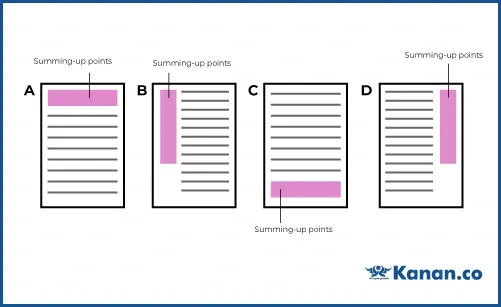
Where does Carlos write summing up points on his notes?
A
B
C
D
Correct Answer is B.
IELTS Listening Matching Questions - Sample 2
Match the correct letters from A-C.
At the start of her talk Rebacca points out that new graduates might find it difficult to
A - get the right work
B - take enough break times
C - motivating themselves
Correct Answer is C.
IELTS Listening Matching Questions - Sample 3
Questions 26 - 30
What decision do the students make about each of the following parts of their presentation?
Choose FIVE answers from the box and write the correct letter, A-G, next to Questions 26-30.
Decisions
A use visuals
B keep it short
C involve other students
D check the information is accurate
E provide a handout
F focus on one example
G do online research
Parts of the presentation
26 Historical background
_______________
27 Geographical factors
_______________
28 Past mistakes
_______________
29 Future risks
_______________
30 International implications
_______________
Correct Answers are
26. B
27. A
28. F
29. G
30. C
IELTS Listening Matching Questions Tips and Strategy
To tackle the difficulty level, time management and accuracy in matching questions, follow our IELTS Listening matching tips and strategies given here. These IELTS Listening matching tips are purely based on feedback given by toppers and trainers.
1.Analyse the question
Before attempting to answer, first, analyse the question. Since matching questions are confused with other question types like multiple choice, plan/map/diagram labelling, etc., you need to analyse the question and understand its context. One simple trick is looking for the word ‘match’ in the question.
2.Answer order
In the IELTS matching listening, the list of questions and the information in the listening text have the same order. So when you answer, follow that order. For example: while answering, you must first answer question 1 and then question 2. And not like answering question 1 and immediately question 4.
3.Synonyms and paraphrasing
Synonyms and paraphrasing are widely used in the recording text. So, instead of memorising them while listening, use your own words and phrases while writing the answer. It grabs the examiner’s attention towards new words and phrases describing the same meaning.
4.Mind the distractors
To distract your mind, the audio would contain information that is irrelevant to the topic. So mind those distractors and give attention to the main key words and phrases. While practising, you must listen to the same audio more than once to identify the relevant keywords.
5.Writing the answer
In the IELTS Listening test, you will get 10 minutes to transfer answers to the answer book. Here you must write only a letter for the answer (not words or phrases from the recording). So while taking sample matching questions, write only the letters and not the (exact) words.
6.Predicting the correct answer
Before writing, you must be sure of eliminating the wrong answers. To do that, you can use synonyms that match the exact words from the recording. However, you can’t predict the correct answer to some questions.
7.Guess if necessary
The last tip is to never leave any questions unanswered. Whether you are sure or not, take a wild guess with the set of options and answer. Since there are no negative marks, you can guess the answer without much confusion.
By following these IELTS listening tips, you can catapult your performance to another level.
Practice Session
We have brought to you two sample questions to gain experience in the IELTS listening matching questions. Since their difficulty level is hard, you must take these IELTS listening matching practice questions and learn how to tackle them. Actually, this IELTS listening practice test is proven successful for many IELTS aspirants.
Answers
From the above given IELTS listening matching exercise, we will discuss the answer for one of the sample questions, followed by easy tricks to use.
Here, we have taken the Sample-2 and explained the answers as follows.
Match the correct letters from A-C.
At the start of her talk Rebacca points out that new graduates might find it difficult to
A - get the right work
B - take enough break times
C - motivating yourselves
Rebacca - However, when you leave college you find yourself saying things like I will have one more cup of coffee and then I will sit to work. I hate to admit it but I say it to myself. Suddenly, it isn’t finding the inspiration or getting the right paper is a problem, it’s you.
The correct answer is C.
At first, Rebacca said, "have one more cup of coffee, and then I will sit to work. I hate to admit it." Here, she is not considering it a difficult thing for new graduates. But, she immediately said that "it isn’t finding the inspiration or getting the right paper is a problem, it’s you," which clearly describes how new grads face challenges after college due to lack of motivation. And that’s how the answer is chosen.
IELTS Listening Matching Questions Vocabulary
Here are some of the leading IELTS listening matching questions vocabulary, and phrases available to rescue you from the word crunch. Since the audio files don’t follow the same sentence structure and vocabulary usage, you should be able to understand them and answer questions using various synonyms.
Subjects: law, geography, architecture, agriculture, business management, geology, philosophy, humanities, psychology, literature, statistics, mathematics, archaeology
Studying at college/university: module, written task, work, group discussion, guidelines, guidance, advance, students, dissertation, certificate, advisor, dictionary, laptop, international, leaflet, school reunion, intermediate, media, room, feedback, pencil, pupils, foreign students, schedule, higher education, overseas education, bachelor’s degree, stationery, retention, publication, supervisor, extra background
Days in a week: Sunday, Monday, Tuesday, Wednesday, Thursday, Friday, Saturday, weekday, weekend
Months of the year: January, February, March, April, May, June, July, August, September, October, November, December
Nature: river, mountain, ranges, village, environment, waterfall, coast, volcano, disaster, tornado, typhoon, hill, cliff, pond, catastrophe, erosion, jungle, oasis, dam, canyon, avalanche, peninsula, landslides, desertification
Name of the hobbies: painting, drawing, cycling, trekking, snowboarding, snorkelling, archery, pottery, woodcarving, chess, darts, golf, billiards, photography
Continents: Asia, Africa, Australia, Antarctica, North America, South America, Europe
Adjectives: social, ancient, fantastic, active, fabulous, dull, comfortable, permanent, immense, vast, salty, extinct, vulnerable, realistic, intact, various, spectacular, tranquil, knowledgeable
Use these IELTS listening words and get your desired band score.
Also Read:
Here are the other IELTS Listening question types usually asked in the test.
- IELTS listening multiple choice questions
- IELTS listening note completion
- IELTS listening form completion
- IELTS listening table completion
- IELTS listening sentence completion
- IELTS listening summary completion
- IELTS listening short answer questions
- IELTS listening map & plan labelling
- IELTS listening diagram labelling
- IELTS listening flow chart completion
Conclusion
By now, you must know everything about the "IELTS Listening Matching Questions", how it can be answered, tips and strategies, etc. If you follow them religiously, you are sure to become an expert in this type of question and achieve a good listening band score.
FAQs
How do you answer the listening matching question in IELTS?
To answer the listening matching questions in IELTS, you must follow the steps below.
Step 1: Listen to the audio closely
Step 2: Analyse the given questions
Step 3: Note the key words and phrases
Step 4: Predict the correct answer
Step 5: Answer all the questions
2.Are Listening questions repeated in IELTS?
No. Questions do not repeat in the IELTS Listening test.
3.How can I get 9 in IELTS listening?
To get a band score of 9 in IELTS listening, you need to practise all question types thoroughly. As per IELTS, only 11 types of questions are available in the listening exam. If you learn them and supplement them with difficult question papers, you can achieve mastery in the IELTS listening module in a short time.
4.In the listening test, can I get a second chance to hear the recording if I don’t hear it the first time?
In the listening test, you can listen to the audio only once. There is no second chance given to hear the recording.
5.Any effective tips or tricks to get full marks in the last section of the Listening test?
The best tip to get full marks in the last section of the Listening test is to understand the main theme rather than focusing on keywords. As the last section is about a monologue on an academic subject (university lecture), you need to pay attention to the overall context of the audio text.

About Author Roshan Sunthar
Roshan Sunthar is a study abroad expert as well as a renowned writer and author in international education. His academic excellence and 5+ years of work experience give him in-depth knowledge of international standardised exams and test preparation in IELTS, TOEFL, GRE, PTE, SAT, etc. The study materials he prepares incorporate exam-like questions. He’s also an expert in writing Statement of Purposes (SOPs) and Letter of Recommendations (LORs) for college admissions. He usually spends his leisure time watching English classics and documentaries, travelling, etc.
Kanan.co is a trusted study abroad consultancy offering comprehensive services, resources, and solutions for students and education institutions. We support students at every stage of their global education journey, ensuring a smooth and guided experience. Along with test preparation for IELTS, GRE, TOEFL, and SAT, we provide expert services such as SOP writing, visa guidance, accommodation support, scholarship assistance, and education loan support. Our expertise and commitment to excellence make us a reliable partner for students pursuing international education.
Free Online Mock Test 2026
Practice our mock test worth Rs. 25000 for Free and know your IELTS score!








Global Headquarters
Kanan Int EdTech Inc
320 Bay Street, Suite 321 (Spaces), Toronto ON, Canada M5B 1N9
Indian Headquarters
Kanan International Pvt. Ltd.
D-wing, 2nd Floor, Trident Complex, Ellora Park Vadiwadi Road, Vadodara, Gujarat 390007
IT/ Digital Campus
Kanan International Pvt. Ltd
Old, New No 3, 2nd Floor, 1A, Dr Sadasivam Rd, T. Nagar, Chennai, Tamil Nadu 600017
Our branches
- Bardoli
- Bharuch
- Chennai
- Dehradun
- Gurugram
- Himatnagar
- Karnal
- Nadiad
- Navsari
- Palanpur
- Rajkot
- Vadodara
- Valsad
- Vallabh Vidyanagar
- Vapi
Study Abroad
Test Prep
Top Universities
Consultants
IELTS Centers
GRE Centers
TOEFL Centers
SAT Centers
Language Courses in Vadodara
Study Abroad Calculators
Featured Blogs
Study Abroad Consultants in Chennai
Study Abroad Consultants in Surat
Study Abroad Consultants in Navsari
Study Abroad Consultants in Bardoli
Study Abroad Consultants in Ahmedabad
Study Abroad Consultants in Anand
Study Abroad Consultants in Khanna
Study Abroad Consultants in Nadiad
Study Abroad Consultants in Vadodara
Study abroad consultants in Valsad
Copyright © 2026 KANAN.CO All rights reserved.