- Study Abroad
- / ielts
- / listening
- / note completion
IELTS Listening Note Completion


Author
28-09-2026

IELTS listening note completion is one of the important question types, that is commonly appearing in the IELTS listening test. In this task, you are asked to listen to the audio recordings and complete the gaps with the missing words. The way of answering is similar for the form, table, and IELTS listening note completion question types.
Academic and general candidates will take the same listening test as there is only one listening test for all IELTS test takers. The listening test consists of 40 questions and four sections, each section having 10 questions. The IELTS listening note completion test is conducted in computer-delivered format.
In the computer-based test, 30 minutes will be given to answer and 2 minutes to review as the answers are already in the computer. The IELTS listening band score will be scored on a 9-band scale based on the number of correct answers provided.
Check Out our YouTube Channel to Practice Full-Length IELTS Listening Tests Daily

What are notes?
Listing down necessary points of particular information is called notes. Note-taking is an important practice that helps individuals to actively engage and learn quickly. While taking notes, some key facts are crucial to recall the specific information. They are as follows,
- Keywords
- Abbreviations
- Phrases
- Heading
- Names
- Numbers
- Places
- Price
- Year
- Time
- Addresses
- Levels
- Numbered/ bulleted points
- Phone numbers and more
When considering the IELTS Listening module, note completion is one of the question types that contain a set of notes with blanks taken from specific audio recordings like individual speech or telephonic conversations of native speakers. Here you will be identifying the answers from the audio to fill the answers.
Click to know some interesting IELTS listening words
Tips & strategies to solve the IELTS listening note completion task
Learn some professional tips and strategies to complete the IELTS Listening Note Completion task effortlessly. Because even if you are confident in your language proficiency and other abilities, you need some techniques to utilize the provided time wisely and score better on the listening test.
1.Pay attention to the instructions
Do not forget to read the instructions. Instructions are something you must follow throughout your exam. So, read the instructions carefully like how many words or a number should be written in the given blanks.
In the listening note completion test, you will see the following mention,
- Write NO MORE THAN ONE WORD and/or a NUMBER for each answer
- Write NO MORE THAN TWO WORD and/or a NUMBER for each answer
- Write NO MORE THAN THREE WORDS and/or a NUMBER for each answer
If you fail to read the instruction, chances are high that the answers will exceed the word limit. Thus the instructions are very essential.
2.Read the given title and questions
Before the recording begins, you will be given some minutes to look over the title and questions. Utilize the given time by skimming the title and the given questions thoroughly. This will help you to understand what the recording is about. Then you will get an idea and can prepare yourself to listen to the audio recording.
3.Predict the possible answers
While reading the question sentences, try to predict the missing word logically. Yes, it is hard to predict the exact missing word, But, still, you will be able to understand what will be the correct one to fill in the blanks like,
- Name /surname
- Address
- Mobile/ telephone number
- Year
- Date
- Place name
- Cost
- Percentage
- Noun
- Verb
- Adjectives and so on.
4. Highlight keywords and synonyms
Identifying keywords and synonyms will be highly beneficial to spot the answers quickly. Roughly you will get a 20 seconds prior audio section to look over the questions, make use of that time by highlighting the major keywords. Using keywords, you can easily relate the speech or conversation with the given questions.
5.Be all ears
100% concentration and involvement are essential here to get all the answers right. Be focused when the audio is ON. Don't let your mind get diverted or you will lose the flow. Also, remember that the audio will not be repeated, only played once.
6.Stay focused on key data
Since the recording will be played once, be attentive to each word spoken by the native speaker. The key data are called names, dates, numbers, addresses, etc. In the audio, the pronunciation of some letters like B, D, P, T, V, etc may confuse you. In this case, relate the word to the question logically to find the perfect word.
7.Watch out for distractors
When the audio begins, listen closely to get the correct answers. However, don’t be quick in writing the answer once you hear it. Keep listening to confirm the answer. Because speakers in the recordings may have the chance of changing the answer.
8.Multitasking
You have to multitask while appearing for the listening test. This implies that you have to listen to the audio, understand the information, read the question and relate it to the audio information, and finally write the answer. Thus, practice more sample answers to optimize your multitasking skill.
9.Blank spaces never help
Never leave blanks without an answer. If you are not sure about the answer, guess something and fill in the blanks. Sometimes, chances are that the guessed answer is the correct answer. If you can't figure out the answer, try to understand the context and give a logically guessed answer.
10.Time management
The IELTS Listening test takes approximately 30 minutes. If you are taking IELTS on computer, manage your time carefully while listening to the recordings and answering the questions. Type your answers directly into the answer boxes on the screen and follow the word limit given in each question. You will get 2 extra minutes at the end to check your answers. Make sure your answers are complete and correctly spelled before the test ends.
11.Be accurate
Accuracy is very crucial and it has a great chance of boosting your band score. Type your answers carefully and check your spelling. Follow the word limit given in the instructions.
12.Double-check your answers
In the computer-based test, you will have 2 minutes to review the answers. Quickly review once within the time limit. Remember that your answers should be correct in spelling, grammar, meaning, and logic.
Remember all the tips and strategies listed above when attempting the IELTS listening note completion question type to improve your final band score on the listening module.
Click here to learn more IELTS listening tips
How to solve note completion IELTS listening?
In the actual test, you will have to answer different IELTS listening question types based on the provided recordings. Get some ideas to solve the IELTS Listening Note Completion task here.
Andrea is feeling happy because listening answers

Step 1:
Read the title, instructions, and the given listed incomplete notes. Going through the title and instructions is vital in the initial stage. Because by reading the title, you can learn the situation, context, etc. and the instructions will tell you how many words to write in the blanks.
Step 2:
Read the given incomplete notes and underline the main keywords which will be helpful for you to identify the answers. Try to predict the words that fit the gaps logically. Now prepare yourself to listen to the audio.
Step 3:
Before the audio starts, you will be given some time to read the questions listed. Use the time given and go through the questions quickly. After the audio starts, listen carefully to the conversation or speech. Try to relate the audio to the questions, identify the keywords, and finally write the correct word that fits the gaps.
Step 4:
Before writing the answer, remember that the words must be correct in grammar and logic. Moreover, don't write answers in a hurry. Wait a moment to confirm the answer, as the speaker in the audio has a chance to change their answers.
Step 5:
Finally, double-check your answers for spelling and grammar errors. Check that you have filled in all the gaps. If any, guess and write the answer in a logical way. Do not leave empty spaces for any reason.
Answers
- Advertise
- Donate
- Quote
- Charity
- Sell
Practice test
Get one more sample note completion question for practice purposes. Try to solve the question given below,
Apartment for rent listening answers
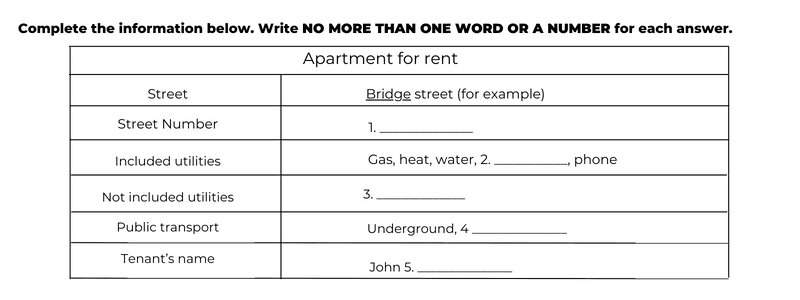
Answers:
- 32
- Electricity
- Internet
- Bus
- Hooper
Click to check out the IELTS Listening practice test
Do’s and don'ts
Dos
- In the computer-based test before you begin, check that your headphones are working and if not, seek help.
- Make use of the prior audio section effectively to read the instructions, title, and questions.
- Highlight the keyword you think is important. Because when the audio starts playing, you may have difficulty relating the speech to the questions. At that point, underlining keywords can be a great help here.
- While reading the question, understand the logic and try to predict the possible answer that fits the gaps.
- Fill in your gaps in order as the questions and speech are in the same order. After answering each question, you can proceed directly to the following questions.
- Remember not to exceed the word limit. Be precise using capital letters for a better presentation to score high.
Don’ts
- Don’t look for the exact word that presents in the questions. You will not get the exact word from the speaker. Look for synonyms and paraphrasing.
- Avoid focusing on every single word. Try to relate the keyword you marked and listen for the answers.
- Don't rush to decide your answer, keep listening to the audio until you get the right answer. Because speakers on the recording may change their answers.
- Don’t leave blanks without answers. Try to answer all the questions. If you don’t know the answer, guess and write something.
- Don't waste the time you are given. To review the answers once finally, plan well and use every minute properly.
- Don’t forget to check the answers once before completing the test. It should be correct in grammar, spelling, and meaning.
Other IELTS Listening Question types
Here are the other IELTS Listening Question types usually asked in the test.
- IELTS listening matching questions
- IELTS listening multiple choice questions
- IELTS listening note completion
- IELTS listening table completion
- IELTS listening sentence completion
- IELTS listening summary completion
- IELTS listening short answer questions
- IELTS listening map
- Diagram completion IELTS listening
- IELTS listening flow chart completion
Conclusion
To wind up, the IELTS listening note completion is a frequently asked question type. Thus, practice samples to familiarize yourself with the task. Remember all the tips and strategies provided here.
Faq
1.Can we listen to the recording again in IELTS listening?
Unfortunately, NO. The recordings are only played once in the actual IELTS listening test.
2.Can we pause audio in IELTS listening?
This is one of the major myths. Remember that there is no pausing or restarting of the recordings in the listening test. The recordings are played once with no pauses. You should answer the questions as you listen to the recordings.
3.Can I write in capital letters in IELTS listening?
Yes, you can. In fact, candidates are recommended to write answers in capital letters for better presentation.
4.Does everyone take the same test or a different listening test?
There is no segregation between academic and general in the listening tests. In the IELTS exam, academic and general candidates take the same listening test.
5.Do spelling mistakes matter in IELTS listening?
Yes. Spelling is important in the IELTS listening test. Even If you write a correct answer, your answer will be marked wrong when the spelling is incorrect. Thus, make sure that you don't make any spelling or grammar mistakes in the final exam.

About Author Manimegalai Samidurai
Manimegalai is a multifaceted professional, excelling as an author, writer, and study-abroad expert. Her vast knowledge of English proficiency exams, including IELTS, GRE, SAT, and PTE, and exceptional content writing skills make her a go-to resource for students seeking guidance and support in their foreign education journey. She is a trusted authority in writing content related to these test-prep exams, making her an invaluable resource for those seeking guidance. With her well-researched and informative blogs, articles, and study materials, Manimegalai has helped countless students achieve their desired band scores and get admissions to top-notch colleges & universities in countries like Canada, USA, UK, Australia, Ireland, etc.
Kanan.co is a trusted study abroad consultancy offering comprehensive services, resources, and solutions for students and education institutions. We support students at every stage of their global education journey, ensuring a smooth and guided experience. Along with test preparation for IELTS, GRE, TOEFL, and SAT, we provide expert services such as SOP writing, visa guidance, accommodation support, scholarship assistance, and education loan support. Our expertise and commitment to excellence make us a reliable partner for students pursuing international education.
Free Online Mock Test 2026
Practice our mock test worth Rs. 25000 for Free and know your IELTS score!








Global Headquarters
Kanan Int EdTech Inc
320 Bay Street, Suite 321 (Spaces), Toronto ON, Canada M5B 1N9
Indian Headquarters
Kanan International Pvt. Ltd.
D-wing, 2nd Floor, Trident Complex, Ellora Park Vadiwadi Road, Vadodara, Gujarat 390007
IT/ Digital Campus
Kanan International Pvt. Ltd
Old, New No 3, 2nd Floor, 1A, Dr Sadasivam Rd, T. Nagar, Chennai, Tamil Nadu 600017
Our branches
- Bardoli
- Bharuch
- Chennai
- Dehradun
- Gurugram
- Himatnagar
- Karnal
- Nadiad
- Navsari
- Palanpur
- Rajkot
- Vadodara
- Valsad
- Vallabh Vidyanagar
- Vapi
Study Abroad
Test Prep
Top Universities
Consultants
IELTS Centers
GRE Centers
TOEFL Centers
SAT Centers
Language Courses in Vadodara
Study Abroad Calculators
Featured Blogs
Study Abroad Consultants in Chennai
Study Abroad Consultants in Surat
Study Abroad Consultants in Navsari
Study Abroad Consultants in Bardoli
Study Abroad Consultants in Ahmedabad
Study Abroad Consultants in Anand
Study Abroad Consultants in Khanna
Study Abroad Consultants in Nadiad
Study Abroad Consultants in Vadodara
Study abroad consultants in Valsad
Copyright © 2026 KANAN.CO All rights reserved.