- Study Abroad
- / ielts
- / solution for freeganism reading passage
Solution for Freeganism Reading Passage


Author
19-09-2025

In this article we have provided the questions, answers and explanation for the below reading passage. It is given for your practise and it consists of 14 questions, in which 6 are of Matching Heading, 4 are of True/False/Not Given, and 4 are of Sentence Completion types.
Answer Table
| 1. ii | 5. i | 9. False | 13. D |
| 2. vi | 6. iii | 10. Not given | 14. E |
| 3. viii | 7. False | 11. G | |
| 4. v | 8. True | 12. B |

Check out our YouTube Channel to Practice Full-Length IELTS Reading Tests Daily

Reading Passage
Freeganism
A. Freeganism is a lifestyle in which people try to use less. Freegans find free food, or grow their own in community gardens. They recycle and help each other fix things instead of throwing them away. They might live in houses which are empty so as not to pay rent. Often, they ride bicycles or rely on public transport. As a result, they are able to work fewer hours because they do not need so much money. A few freegans even try to avoid money.
B. Freegan is a new word, made up of the two words: 'free' and 'vegan'. A vegan is someone who does not eat or use any animal products. However, not all freegans are vegans. Some are vegetarians; others enjoy meat.
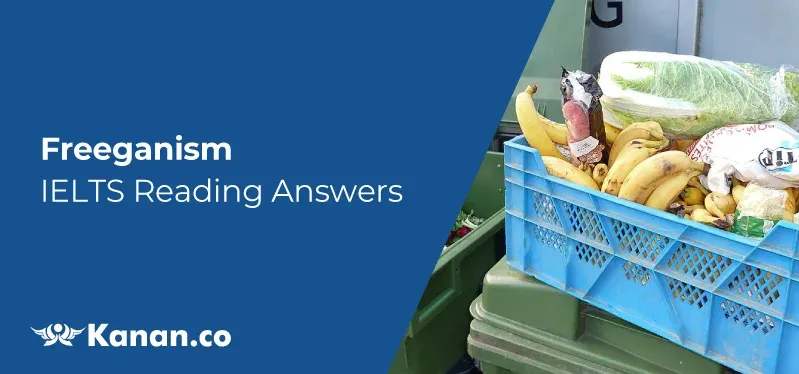
C. Freeganism started in the 1960s in the US. It arose from environmental and anti-globalisation movements. It did not grow much until the mid-90s. A famous booklet called 'Why Freegan', written in 1999, by Warren Oakes, a musician, describes common things freegans do or believe. For example: to get food, freegans may go 'dumpster diving', 'plate scraping', wild foraging, or they may garden, or barter. A dumpster is an American word for a very large rubbish bin like the one in the illustration. 'Plate scraping' is taking leftover food from restaurants. Wild foraging is looking for food that is not grown on farms, but in parks or wild places. Of course, gardening is growing one's own food. Bartering is the process whereby people swap things that they both want without using money.
D. People become freegans for different reasons. Perhaps they think it is better for the world environment to consume less; or they think people should spend more time with their friends and families,and less time working for money. Certainly, they do not like useful items being put into rubbish or landfill. A large area outside the city where large amounts of rubbish are buried is called landfill. Due to all the rubbish in landfills, the sites remain unusable for farming or housing for many years, which upsets freegans.
E. Reports on television and in magazines have shown how weird dumpster-diving freegans are: how desperate and antisocial pulling food out of the rubbish like homeless or very poor people. After all, this practice is dirty, smelly, and illegal. What journalists do not say is that the UK and Australia currently consume and discard equal amounts of good food. In the US, even more good food is destroyed. Meanwhile, one billion people worldwide are unable to eat the World Health Organisation's recommended daily intake of nutrients, and these people exist in both rich and poor countries. Freegans hope to change this. Despite bad press, the number of freegans worldwide is growing: a recent estimate by a Swedish organization suggested more than 500,000 in 50 countries.
F. Not all freegan dumpster divers search for food; not all freegans are dumpster divers. Many dumpster divers search for anything that can be recycled or reused, from clothes, to furniture, to tools in need of small repairs. An alternative source of inexpensive food exists in the form of co-operatives. These are shops which are owned by groups of local people. They do not aim to make a large profit, but to sell food at reasonable prices, and to provide what is in season and grown locally. Imported food may be forbidden as it is costly to the environment to transport it great distances.
G. Some freegans plant their own crops at home or in community gardens. They may also take small amounts of food from the wild, particularly things which are not sold commercially. They feel they are fighting against a huge army of farmers and consumers because freegans believe large-scale farming, as currently practiced, is bad for the environment. They also do not support the giant multinational companies that control large amounts of land worldwide. Methods such as factory farming, where animals are kept in very small areas inside, freegans hate. Many crops are sprayed with chemicals, or have things added to them like color or wax, which freegans think are dangerous and wasteful. They support organic farming if they buy from farms at all. Freeganism may not be a movement that ever becomes mainstream, but its central concerns may encourage people to modify their wasteful behavior.
Questions
Question 1-6
The Read Passage which has seven sections A-G.
Choose the correct heading for sections B-G from the list of heading.
Write the correct number, i-ix, in boxes 1- 6 on your answer sheet.
List of Heading:
i. Buy it all the co-op
ii. A composite word
iii. A different kind of farming
iv. The dream of Warren Oakes
v. Media v Freegans
vi. Origins and activities
vii. What is Freeganism
viii. Useless; waste less
ix. The UK is OK for freegans
1. Section B
2.Section C
3.Section D
4.Section E
5.Section F
6.Section G
Question 7-10
Do the following statements agree with the information in the text on the previous pages?
In boxes 7-10 on your answer sheet, write:
True if the statement agrees with the information.
False if the statement contradicts the information.
Not given if there is no information on this.
7. Although freeganism began more than 40 years ago, it did not take off until the late 1990s.
8. Rubbish dumps or landfill sites are quite disturbing to freegans.
9. In developed countries, barely any food is thrown away.
10. It is predicted that freeganism will grow significantly in the next decade.
Question 11-14
Complete each sentence with the correct ending A-H below.
Write the correct letter A-H, in boxes 11-14 on your answer sheet.
A. dumpster dive.
B. transporting it long distance is another environmental cost.
C. the media.
D. agriculture.
E. challenges patterns of consumption and employment.
F. is probably hard to follow.
G. recycle.
H. grown locally is less expensive
11. Freegans always.
12. Freegans generally do not buy imported food because.
13. Freegans have a special interest in
14. As a way of living, Freeganism
Answers with explanation
Here we have given the explanation for each answer along with the location.
(Note: The text in italics mentions the location and referring lines written in the reading passage)
1. Answer: ii
Explanation: In Paragraph B, “Freegan is a new word, made up of the two words: ‘free’ and ‘vegan’”. This indicates that it is a composite word and hence the answer is ii.
2. Answer: vi
Explanation: In paragraph C, “Freeganism started in the 1960s in the US” and “For example: to get food, freegans may go 'dumpster diving', 'plate scraping', wild foraging, or they may garden, or barter”. These lines explains when the movement started and the other lines explain their activities. So that answer is “Origins and Activities”.
3. Answer: viii
Explanation: In paragraph D, “People become freegans for different reasons. Perhaps they think it is better for the world environment to consume less”. With this line we can conclude that it is “Useless; waste less”
4. Answer: v
Explanation: In the paragraph E, "Despite the bad press, the number of freegans worldwide is growing", this line indicates that inspite of medias continuous reports about freegans, they are growing constantly. Hence the answer is “Media v Freegans”
5. Answer: i
Explanation: In the paragraph F, “An alternative source of inexpensive food exists in the form of co-operatives.” This indicates that freegans need not always search for food in trash and they can buy it from co-operatives or small shops.
6. Answer: iii
Explanation: In paragraph G, They support organic farming if they buy from farms at all. This indicates that they follow a different kind of farming and hence the answer.
7. Answer: False
Explanation: Freeganism started in the 1960s in the US. It arose from environmental and anti-globalization movements. From the above lines it is clear that the movement started 60 years ago, So the answer is False.
8. Answer: True
Explanation: Due to all the rubbish in landfills, the sites remain unusable for farming or housing for many years, which upsets freegans. These lines clearly supports that Rubbish dumps or landfill sites are quite disturbing to freegans. So the answer is True
9. Answer: False
Explanation: In the US, even more good food is destroyed. This clearly indicates that in the US good food is wasted. So it contradicts the statement “In developed countries, barely any food is thrown away” and hence false.
10. Answer: Not Given
11. Answer: G
Explanation: In paragraph A, They recycle and help each other fix things instead of throwing them away, this line clearly indicates that freegans recycle. So the answer is recycle.
12. Answer: B
Explanation: In paragraph F, Imported food may be forbidden as it is costly to the environment to transport it great distances. This line indicates that transporting it long distance is another environmental cost. So the answer is B.
13. Answer: D
Explanation: In paragraph G, Some freegans plant their crops at home or in community gardens. This line indicates that Freegans have a special interest in farming.
14. Answer: E
Explanation: In paragraph D, writer has told “Perhaps they think the world environment should consume less, or they think people should spend more time with their friends and families, and less time working for money.” These lines indicates that how should be the material consumption. Thus it supports “As a way of living, Freeganism”.
Other Reading Passages

About Author Gayathri Nagarajan
Gayathri, a trusted study-abroad expert, with expertise in standardized tests like IELTS, TOEFL, PTE, GRE, and GMAT. With a strong tech background from SASTRA University, she excels in software testing and has a passion for content writing and digital marketing. She aids students in finding the perfect academic fit, offering guidance on course selection, LOR and SOP writing. She remains up-to-date with the latest trends in higher education, delivering credible, accurate information on international education, including courses and test prep materials. As a trusted Study abroad expert at Kanan International, explore her latest blogs and articles for comprehensive insights into studying abroad and realizing your academic aspirations.
Kanan.co is a trusted study abroad consultancy offering comprehensive services, resources, and solutions for students and education institutions. We support students at every stage of their global education journey, ensuring a smooth and guided experience. Along with test preparation for IELTS, GRE, TOEFL, and SAT, we provide expert services such as SOP writing, visa guidance, accommodation support, scholarship assistance, and education loan support. Our expertise and commitment to excellence make us a reliable partner for students pursuing international education.
Free Online Mock Test 2026
Practice our mock test worth Rs. 25000 for Free and know your IELTS score!








Global Headquarters
Kanan Int EdTech Inc
320 Bay Street, Suite 321 (Spaces), Toronto ON, Canada M5B 1N9
Indian Headquarters
Kanan International Pvt. Ltd.
D-wing, 2nd Floor, Trident Complex, Ellora Park Vadiwadi Road, Vadodara, Gujarat 390007
IT/ Digital Campus
Kanan International Pvt. Ltd
Old, New No 3, 2nd Floor, 1A, Dr Sadasivam Rd, T. Nagar, Chennai, Tamil Nadu 600017
Our branches
- Bardoli
- Bharuch
- Chennai
- Dehradun
- Gurugram
- Himatnagar
- Karnal
- Nadiad
- Navsari
- Palanpur
- Rajkot
- Vadodara
- Valsad
- Vallabh Vidyanagar
- Vapi
Study Abroad
Test Prep
Top Universities
Consultants
IELTS Centers
GRE Centers
TOEFL Centers
SAT Centers
Language Courses in Vadodara
Study Abroad Calculators
Featured Blogs
Study Abroad Consultants in Chennai
Study Abroad Consultants in Surat
Study Abroad Consultants in Navsari
Study Abroad Consultants in Bardoli
Study Abroad Consultants in Ahmedabad
Study Abroad Consultants in Anand
Study Abroad Consultants in Khanna
Study Abroad Consultants in Nadiad
Study Abroad Consultants in Vadodara
Study abroad consultants in Valsad
Copyright © 2026 KANAN.CO All rights reserved.