- Study Abroad /
- blog /
- PTE Score Chart 2026: PTE Exam Scoring System & Score Calculation
PTE Score Chart 2026: PTE Exam Scoring System & Score Calculation


Author
02-01-2026

The PTE Score chart gives complete information about the candidate’s abilities in English reading, writing, listening, and speaking skills. It also provides an overall assessment of grammar, oral fluency, pronunciation, spelling, vocabulary, writing abilities, and communication skills. Candidates receive the PTE band score chart within 2 days after taking the test, and they can view or download the report by logging into their Pearson account.
More than 3,300 universities worldwide accept PTE score chart for higher studies and also countries like Australia, the UK, Canada, and New Zealand accept PTE (Pearson Test of English) for visa purposes. PTE band score chart ranges between 10 and 90 levels,calculated based on the Global Scale of English (GSE). A good average PTE Score falls under the range of 75 - 90 and is accepted by most globally top-ranked universities. The scoring system of PTE is automated and is transparent and logical. The PTE scorecard is valid for 2 years and one can send their scores free of cost to up to five universities abroad.
Read this article, as we walk you through the PTE scoring system and calculation, PTE score charts for each section and PTE, TOEFL, and IELTS score comparison charts, and the PTE score range breakdown. You will understand how scores displayed on your PTE score chart are calculated.
Table of Contents
- PTE Score Report
- PTE Score Chart 2026: What does your PTE score mean?
- Understanding PTE Scoring Comparison with IELTS and TOEFL
- What is PTE Scoring System?
- PTE Score Chart for Reading Section
- PTE Score Chart for Listening Section
- PTE Score Chart for Speaking and Writing section
- How PTE Overall Score is Calculated?
- PTE Academic Score Range - Breakdown
- Which countries are accepting PTE Scores?
- How can students check their PTE scores?
- FAQ
PTE Score Report
The score report of the PTE Academic contains two types of scoring: 1. 'overall score' and 2. 'communicative skills scores' in listening, reading, speaking and writing.
- Overall Score: The overall score, ranging from 10-90 points, is given based on the candidate's performance across the test. Keep in mind, that it is not an average calculation of the communicative skills scores.
- Communicative skills scores: These are the scores that the candidate received from four communicative skills, i.e. listening, reading, writing, and speaking. The score range for each skill is 10-90 points.
PTE Academic contains three different sections of the test: Speaking & Writing, Reading and Listening. It assesses the English language proficiency of the candidates with a certain standard of excellence. The PTE total score is credited based on the excellence level achieved in each PTE section.
Have a look at our sample PTE score report card. It contains all the elements that you can find in the official PTE Score Report,

The contents of PTE score report is given below:
- Test taker name
- Test taker's ID and Photo
- Registration ID
- Test Date
- Validity of the Score report
- Report Issue date
- Test Center ID
- Test Center Country
- Date of Birth
- Citizenship
- Country of Residence
- Gender
- Candidate's mail ID
- Overall score followed by the breakdown of communicative skills and enabling skills
PTE Score Chart 2026: What does your PTE score mean?

Although the Pearson Test of English provides detailed feedback to every study abroad aspirant through their PTE scorecard, the table below presents the PTE score chart alongside the Common European Framework of Reference for Languages (CEFR) and the corresponding proficiency level.
| PTE Academic Scores | CEFR Level | Excellence Level |
| 85 - 90 | C2 | Expert |
| 76- 84 | C1 | Advanced |
| 59 - 75 | B2 | Upper-Intermediate |
| 43 - 58 | B1 | Intermediate |
| 30 - 42 | A2 | Elementary |
| 10 - 29 | A1 | Beginner |
CEFR- Common European Framework of Reference for Languages
Understanding PTE Scoring Comparison with IELTS and TOEFL
Candidates aiming to go abroad for academic or professional purposes often appear for various exams other than PTE like IELTS, TOEFL iBT etc. Accordingly, it is important to find out how PTE scores can relate to other popular English proficiency tests. Here are the details:
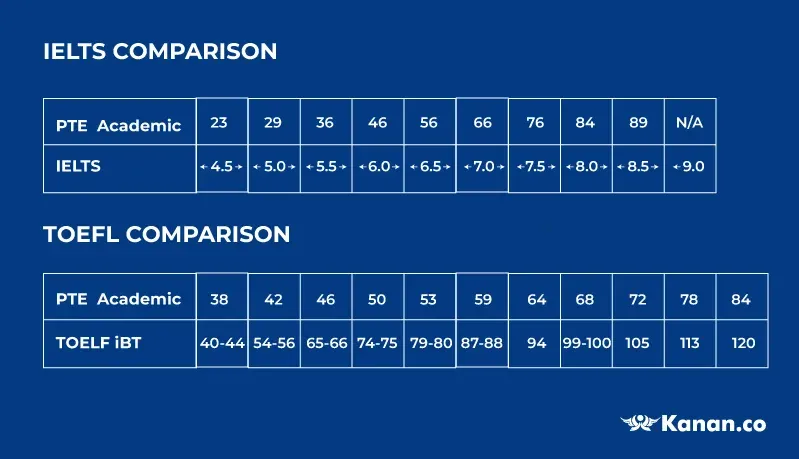
Compared to PTE, other English language tests has different question types and scoring systems to measure English language abilities. If you want to convert the PTE Academic scores (10-90) to TOEFL iBT (0-120) and IELTS score (0-9) , you can find a detailed score comparison table below:
|
PTE Academic Score |
TOEFL iBT score |
IELTS Band score | Excellence Level |
| 86 to 90 | 118 to 120 | 9 | Expert |
| 83 to 85 | 115 to 117 | 8.5 | Very Good |
| 78 to 82 | 110 to 114 | 8 | Very Good |
| 73 to 77 | 102 to 109 | 7.5 | Good |
| 64 to 72 | 94 to 101 | 7 | Good |
| 58 to 63 | 79 to 93 | 6.5 | Competent |
| 50 to 57 | 60 to 78 | 6 | Competent |
| 42 to 49 | 46 to 59 | 5.5 | Modest |
| 35 to 41 | 35 to 45 | 5 | Modest |
| 30 to 34 | 32 to 34 | 4.5 | Limited |
| 0 to 30 | 0 to 31 | 0 to 4 | Extremely Limited |
PTE employs a granular scale of 10 - 90 points, while TOEFL dedicates 30 marks for all 4 sections, which amounts to an overall score of 120. In the following sections, you will find the PTE score charts for all three parts - speaking & writing, listening, and reading.
Knowing PTE Scoring Comparision with IELTS
Below table mentions PTE score into bands. According to new proposal released by Pearson, here is comparing PTE-A results against leading IELTS Band Scores. These are not implemented by Australian and New Zealand immigration departments.
| IELTS Bands | PTE Scores | PTE Scores (Proposed) | OET Grade |
| 9 | 86-90 | N/A | A |
| 8.5 | 83-85 | 89 | A |
| 8 | 79-82 | 84-88 | A |
| 7.5 | 73-78 | 76-83 | B |
| 7.0 | 65-72 | 66-75 | B |
| 6.5 | 58-64 | 56-65 | C+ |
| 6.0 | 50-57 | 46-55 | C |
| 5.5 | 42-49 | 36-45 | C |
| 5.0 | 36-41 | 29-35 | C |
| 4.5 | 29-35 | 23-28 | D |
For a better understanding of scoring conversion, refer PTE to IELTS Score conversion.
What is the PTE Scoring System?
The PTE scoring system is designed based on automated scoring technologies where several answers are rated on the basis of their correctness and incorrectness, and other answers will be measured based on the formal aspects (e.g. word limit of the task) and quality of the response, i.e accuracy, relevance, and appropriateness of the responses. There are two scoring methods used in the PTE exam score calculator:
- Correct/Incorrect Scoring Method: The candidates will get full credit for the correct answers and no credit for the incorrect answers.
- Partial Credit Scoring Method: Question types under this method are evaluated on the basis of correct, partially correct or incorrect. If the candidates’ response is correct, then full credit will be given, if the response is partly correct, then partial credit will be awarded, and if the answer is incorrect, then no credit will be given.
To have a better understanding of the PTE scoring system, we have provided a detailed breakdown of the marks candidates obtained in the reading, listening and speaking & writing sections.
PTE Score Chart for Reading Section
The PTE Reading test lasts for 29 - 30 minutes and includes 5 different question types. This test is designed to evaluate candidate's overall comprehension and writing skills:
| Task Type | Number of tasks |
Prompt Length |
Scoring Method |
Communicative skills, enabling skills, and other traits scored | Subskills Tested |
|
Multiple-choice, choose single answer |
2-3 |
Up to 300 words |
Correct/ incorrect |
Reading |
Identifying the topic, theme or main ideas; identifying the relationships between sentences and paragraphs; evaluating the quality and usefulness of texts |
|
Multiple-choice, choose multiple answers |
2-3 |
Up to 300 words |
Partial credit (for each correct response. Points deducted for incorrect options chosen) |
Reading |
identifying a writer’s purpose, style, tone or attitude; identifying supporting points or examples; reading for overall organization and connections between pieces of information |
|
Re-order paragraphs |
2-3 |
Up to 150 words |
Partial credit (for each correctly ordered, adjacent pair) |
Reading |
Identifying the topic, theme or main ideas; identifying supporting points or examples; identifying the relationships between sentences and paragraphs |
|
Reading: Fill in the blanks |
4-5 |
Up to 80 words |
Partial credit (for each correctly completed blank) |
Reading |
Understanding the difference between connotation and denotation; inferring the meaning of unfamiliar words; comprehending explicit and implicit information |
|
Reading and writing: Fill in the blanks |
5-6 | Up to 300 words | Partial credit (for each correctly completed blank) |
Reading and writing |
Identifying the topic, theme or main ideas; identifying words and phrases appropriate to the context; following a logical or chronological sequence of events |
PTE Score Chart for Listening Section
The PTE Listening section takes 30 - 43 minutes, and evaluates a candidates' listening ability using 8 different question types. The questions are based on audio or video clips that play on the screen, and students can listen to them only once before answering.
|
Task Type |
Number of tasks |
Prompt Length |
Scoring Method |
Communicative skills, enabling skills, and other traits scored |
Subskills Tested |
|
Summarise spoken text
|
2-3 | 30-90 seconds | Partial credit |
Listening and writing Grammar, vocabulary, spelling Content, form
|
Identifying the topic, theme or main ideas; summarizing the main idea; identifying supporting points or examples
|
|
Multiple choice Multiple Correct answer
|
2-3 |
40-90 seconds |
Partial credit (for each correct response. Points deducted for incorrect options chosen) |
Listening |
Identifying the topic, theme or main ideas; identifying supporting points or examples; Identifying specific details, facts, opinions, definitions or sequences of events |
|
Fill in the blanks |
2-3 |
30-60 seconds |
Partial credit (each correct word spelt correctly) |
Listening and writing |
Identifying words and phrases appropriate to the context; understanding academic vocabulary; following an oral sequencing of information |
|
Highlight correct summary |
2-3 |
30-90 seconds |
Correct/ incorrect |
Listening and reading |
Comprehending concrete and abstract information; classifying and categorizing information; comprehending variations in tone, speed and accent |
|
Multiple-choice, choose single answer |
2-3 |
30-90 seconds |
Correct/ incorrect |
Listening |
Inferring the context, purpose or tone; inferring the meaning of unfamiliar words; predicting how a speaker may continue |
|
Select missing word |
2-3 | 20-70 seconds | Correct/ incorrect | Listening |
Identifying the topic, theme or main ideas; identifying words and phrases appropriate to the context; understanding academic vocabulary |
|
Highlight incorrect words |
2-3 | 15-50 seconds | Partial credit (for each word. Points deducted for incorrect options chosen) | Listening and reading |
Identifying errors in a transcription; understanding academic vocabulary; following an oral sequencing of information |
|
Write from dictation |
3-4 |
3-5 seconds |
Partial credit (for each word spelt correctly) |
Listening and writing |
Understanding academic vocabulary; comprehending variations in tone, speed and accent; writing from dictation; using correct spelling
|
PTE Score Chart for Speaking and Writing Section
The duration of the speaking and writing test is approximately 54 - 67 minutes and is the longest section in the PTE. The section comprises of seven different question types designed to assess student's communicative ability. There is also a short PTE personal introduction round to familiarise students with test technology; this round doesn't affect the score of student and is only for practice.
|
Task Type |
Number of tasks |
Prompt Length |
Scoring Method |
Communicative skills, enabling skills, and other traits scored |
Subskills Tested |
| Read aloud | 6-7 | Up to 60 words | Partial credit |
Reading and speaking Oral fluency, pronunciation Content |
Identifying a writer’s purpose, style, tone or attitude; understanding academic vocabulary; reading a text under timed conditions |
| Repeat sentence | 10-12 | 3-9 seconds | Partial credit |
Listening and speaking Oral fluency, pronunciation Content |
Understanding academic vocabulary; inferring the meaning of unfamiliar words; comprehending variations in tone, speed and accent |
| Describe image | 6-7 | N/A | Partial credit |
Speaking Oral fluency, pronunciation Content |
Speaking for a purpose (to repeat, inform, explain); supporting an opinion with details, examples and explanations; organizing an oral presentation in a logical way |
| Re-tell lecture | 3-4 | Up to 90 seconds | Partial credit |
Listening and speaking Oral fluency, pronunciation, and content |
Identifying the topic, theme or main ideas; identifying supporting points or examples; identifying a speaker’s purpose, style, tone or attitude |
| Answer short question | 10-12 | 3-9 seconds | Correct/ incorrect |
Listening and speaking Vocabulary |
Identifying the topic, theme or main ideas; understanding academic vocabulary; inferring the meaning of unfamiliar words |
| Summarise written text | 2-3 | Up to 300 words | Partial credit |
Reading and writing Grammar, vocabulary Content, form |
Reading a passage under timed conditions; identifying a writer’s purpose, style, tone or attitude |
| Write essay | 1-2 | 2-3 sentences | Partial credit | Writing Grammar, vocabulary, spelling, written discourse Content; development, structure and coherence; form, general linguistic range |
Writing for a purpose (to learn, to inform, to persuade); supporting an opinion with details, examples and explanations. |
Which countries are accepting PTE Scores?
Below is the list of countries that accept PTE scores,
| Australia | New Zealand | China | Austria |
| Canada | USA | South Korea | South Africa |
| Bulgaria | Indonesia | Estonia | Singapore |
| Hong Kong | Taiwan | Japan | Finland |
| Vietnam | Ireland | Egypt | France |
| Spain | Sri Lanka | Thailand | Saudi Arabia |
| Germany | Turkey | Greece | Norway |
| UAE | Sweden | Oman | Iraq |
| Jordan | Bangladesh | Nepal | Israel |
click here to check out list of universities and countries accepting PTE Academic scores.
How PTE Overall Score is Calculated?
The enabling skill score ranges between 10 and 90 points. To get overall PTE score, all scores under enabling skills are added, and then the total is divided by 6. This obtained average score is added along with the four communicative skill scores. Finally, the average of these 5 parts together is taken as the overall PTE score.
To know more about it refer: PTE score calculator
Also Download PTE Score Report Guide pdf
Source: PTE
PTE Academic Score Ranges - Breakdown
In the table below, we have given a detailed breakdown for each PTE score range. Candidates can structure their preparation mode based on their requirements and the skills.
| CEFR Level | PTE Score Range | Required for | Skills Evaluated |
| C2 | 85 - 90 | Mostly, no governments or universities require this much of a score. |
|
| C1 | 76 - 84 | Australian Skilled Migration Visas |
|
| B2 | 59 - 75 | This level of score shows that you are able to follow the academic level instructions and are suitable for undergraduate and postgraduate entry requirements. This score level is also required for professional registration and employment, as well as, for Australian Skilled Migration Visas. |
|
| B1 | 43 - 58 | Usually, this score level is required for undergraduate level study. |
|
| A2 | 30 - 42 | Usually, this level of score is too low to participate in academic coursework. But, it could be suitable for Foundation Year courses. |
|
| A1 | 10 - 29 | This score level is very low for both academic coursework and Foundation Year courses. |
|
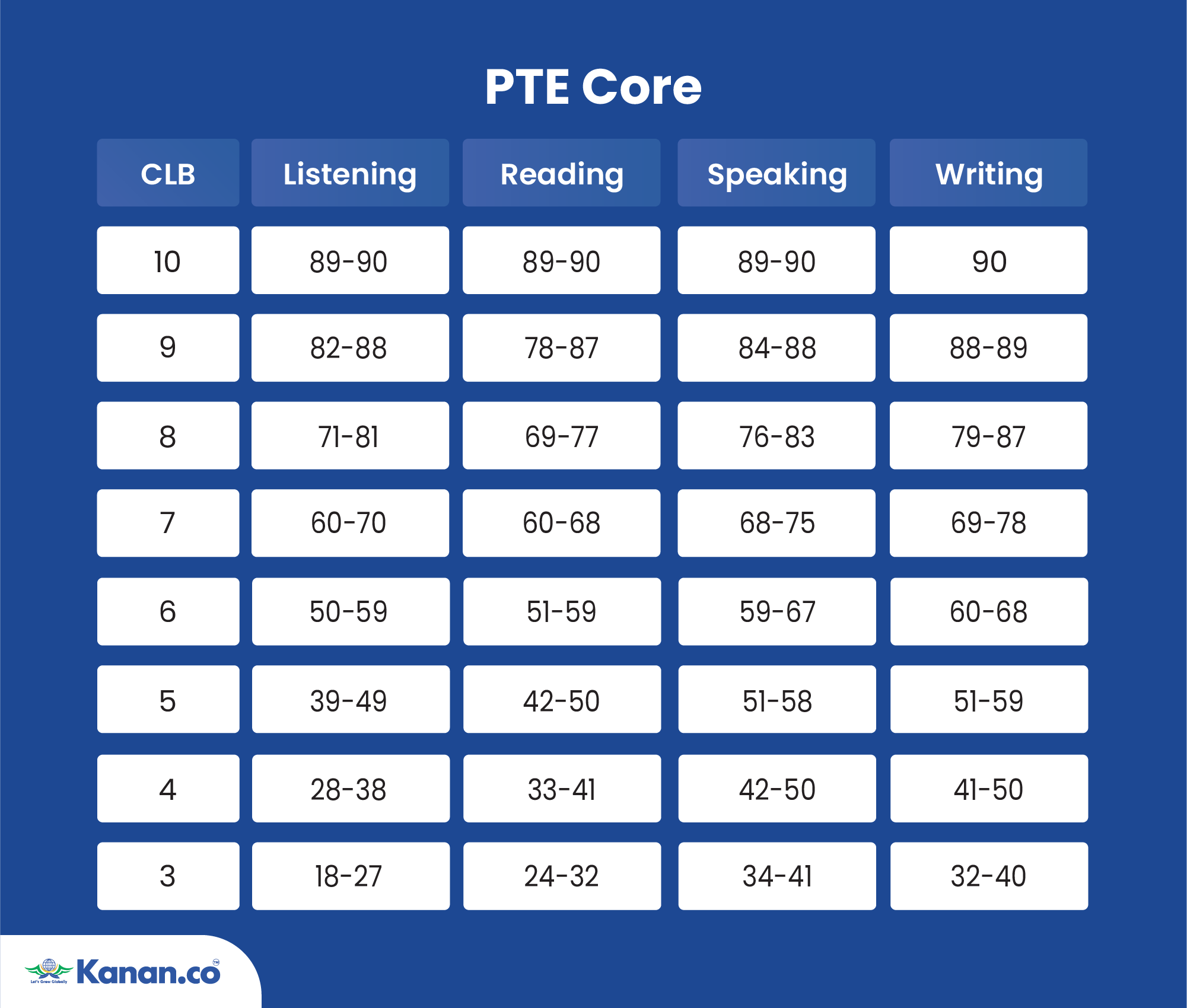
Understand score you need for PTE Core Exam
How can students check their PTE scores?
PTE scores can be accessed through the myPTE account created by the students when they booked the test. They will receive an email if their scores are ready. Candidates can sign in to their ‘myPTE’ account and check their digital score report.
Steps to Access the PTE Score Report
- Visit the official PTE website (www.pearsonpte.com).
- Sign in to your 'mypte' account.
- Go to ‘My Activity’ and select the ‘View score’ button given alongside it.
- If you want, download the score report in PDF format to save or print it.
How to Send PTE Scores to Universities?
Universities do not accept paper or PDF versions of PTE score reports. So, candidates can send their report to their respective universities through an online secure portal set up by PTE. Sending the score reports to universities is free, with no additional cost. Check the steps below to send scores online:
Steps to Send the PTE Score Report
- Sign in to your myPTE account
- Click the ‘View report’ section
- Select the ‘Send Scores’ next to the relevant test
- Type the chosen university name in the field (Institution/ Organization/ Department/ School) and click Search.
- Tick the box given next to the university’s name appearing on the list. You send the score up to seven institutions at once.
- Review the details for accuracy, scroll down the page and click ‘Next’ and then ‘Next’ again to confirm.
- You will get the confirmation mail after the scores have been sent to the respective universities.
Check other links
FAQ
How many types are there in PTE exams?
There are ‘three types’ of PTE Exams,
- PTE Academic: It can be taken if you want to study at a university abroad.
- PTE General: it is for migrating to another country to work.
- PTE Young Learner: It is for children whose age falls between 12 and 16, moving to another country with their parents and resuming their studies.
You can check PTE Exam Pattern to know the complete information regarding the structure and pattern of the PTE exam.
What are some effective tips to score well on the PTE Academic Test?
- Develop a strong vocabulary: PTE candidates can build a good level of vocabulary by reading informative articles and books.
- Improve listening skills: PTE test takers need to improve their ability to understand spoken text and lectures. So, listen to podcasts, or videos to train listening and comprehension skills.
- Refer to Different Subjects: Just focusing on language-based texts is not enough, they need to read and listen to different varieties of subjects to score well in PTE text.
- Understand the rules and regulations: Candidates need to be well-informed about PTE rules and regulations before attempting the test.
How to check the PTE Result?
PTE candidates can access their exam results online. Candidates will be notified through the mail after the results are out. They can log into the PTE Academic student account after they get the mail. The validity of the PTE exam certificate will be two years from the actual test date.
What PTE score is required for Australia PR?
To get permanent residency in Australia on a work-related visa, you need to have a minimum score of 65 points in the PTE exam. It means you are able to understand the main ideas of the complex text and interact with native speakers with a good degree of fluency and spontaneously.
How many days will it take to receive the results of the PTE exam?
As PTE tests are marked in an automated way rather than human examiners, you will get your results usually within 48 - 72 hours.
What should I do to register as a nurse in Australia?
To be a practising nurse in Australia, it is necessary to take the IELTS or PTE test in order to register as Enrolled Nurse (EN) or Registered Nurse (RN). The minimum score required for AHPRA for all four sections - reading, listening, writing, and speaking - is 65.
How do I calculate my PTE score?
To calculate the PTE Overall score, add all the scores given under Enabling Skills section and divide the total score by 6. This average score will be the 'fifth' contributor along with the 'four' communicative skills. The average of these 5 parts will be taken as a PTE Overall score.
How much is the PTE exam fee?
The PTE exam fee in India for the PTE Academic test is ₹17,000 (inclusive of 18% tax). For the PTE Home exam, the fee is ₹ 14,435 INR. The base PTE exam fee for PTE Academic is INR 14,406.78, with an additional 18% tax of INR 2,593.22, making the total PTE test price to INR 17,000.
About Author Dinesh Pandiyan
Dinesh is a highly experienced content writer who specializes in language proficiency tests like IELTS, GRE, PTE, TOEFL, and study abroad. He provides valuable insights and tips to students on various modules of these tests, including reading, writing, speaking, and listening. His articles are well-researched, informative, and engaging, offering practical guidance to students looking to succeed in their academic pursuits. Additionally, Dinesh has coordinated with IELTS trainers to prepare test preparation materials, guides, practice tests, and mock tests, and worked closely with counsellors for study abroad consultancy, providing guidance on choosing the right institution, preparing for interviews, and writing effective statements of purpose (SOP) and letters of recommendation (LOR). Students can benefit from Dinesh's comprehensive knowledge and experience by checking out his articles.

Kanan International is a study abroad consultancy that offers reliable services, products, and solutions for students and education institutions. We support students throughout their study abroad journey, ensuring a hassle-free experience. Our expertise and commitment to excellence make us the go-to partner for expanding global horizons. The company provides coaching for IELTS, GRE, TOEFL, and SAT exams and services like visa consultation, accommodation, scholarship assistance, and education loans.
Ace the PTE Exam: Try a FREE Demo Today!
More Posts from Dinesh Pandiyan


Dinesh Pandiyan
PTE Exam Pattern & Syllabus: Section-Wise PTE Test Pattern


04-05-2023
Dinesh Pandiyan
PTE Exam Fees 2026
23-03-2023








Global Headquarters
Kanan Int EdTech Inc
320 Bay Street, Suite 321 (Spaces), Toronto ON, Canada M5B 1N9
Indian Headquarters
Kanan International Pvt. Ltd.
D-wing, 2nd Floor, Trident Complex, Ellora Park Vadiwadi Road, Vadodara, Gujarat 390007
IT/ Digital Campus
Kanan International Pvt. Ltd
Old, New No 3, 2nd Floor, 1A, Dr Sadasivam Rd, T. Nagar, Chennai, Tamil Nadu 600017
Our branches
- Bardoli
- Bharuch
- Chennai
- Dehradun
- Gurugram
- Himatnagar
- Karnal
- Nadiad
- Navsari
- Palanpur
- Rajkot
- Vadodara
- Valsad
- Vallabh Vidyanagar
- Vapi
Study Abroad
Test Prep
Top Universities
Consultants
IELTS Centers
GRE Centers
TOEFL Centers
SAT Centers
Language Courses in Vadodara
SOP Blogs
Featured Blogs
Study Abroad Consultants in Chennai
Study Abroad Consultants in Surat
Study Abroad Consultants in Navsari
Study Abroad Consultants in Bardoli
Study Abroad Consultants in Ahmedabad
Study Abroad Consultants in Anand
Study Abroad Consultants in Khanna
Study Abroad Consultants in Nadiad
Study Abroad Consultants in Vadodara
Study abroad consultants in Valsad
Copyright © 2026 KANAN.CO All rights reserved.