- Study Abroad
- / ielts
- / andrea palladio italian architect reading answers
Andrea Palladio: Italian Architect Reading Answers


Author
19-09-2025

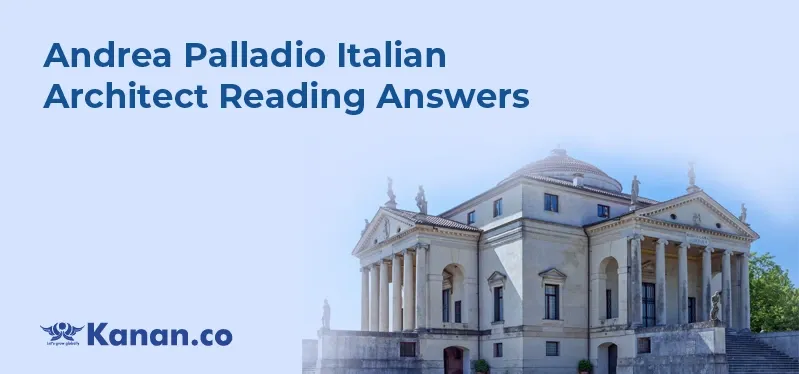
Find Andrea Palladio: Italian Architect reading answers in the table given below. This table of answers will help in measuring your performance and avoiding mistakes in the future.
| 1. NOT GIVEN | 2. TRUE | 3. FALSE | 4. NOT GIVEN |
| 5. FALSE | 6. TRUE | 7. TRUE | 8. Stonemason |
| 9. Gian Giorgio Trissino | 10. Inigo Jones | 11. Temple | 12. Quattro Libridell' Architettura |
| 13. Benevolent Calm |

The IELTS exam consists of four modules, the most challenging of these is IELTS Reading. To do well on the test, you should diligently and repeatedly practice this module. It has a 60-minute time restriction and three sections to solve. Plan carefully so that you can use your time effectively and respond to all 40 questions. We have provided Andrea Palladio: Italian Architect IELTS reading answers with explanations to make it easier to understand
The passage of Andrea Palladio: Italian Architect reading answers describes the renowned Italian architect, Andrea Palladio’s work. His designs were displayed in the exhibition to celebrate the 500th anniversary of his work. In this academic reading passage test, you can practice three IELTS reading question types. It includes:
- IELTS Reading True/False/Not Given
- IELTS Reading Short Answer Questions
- IELTS Reading Locating Information
Check Out our YouTube Channel to Practice Full-Length IELTS Reading Tests Daily

Thoughts on “Andrea Palladio: Italian Architect”
Please go through the below-given points, before trying to solve the questions.
- Andrea Palladio: Italian Architect reading answers gives the description of his work and how the exhibition displayed it across a few countries to celebrate it.
- The passage has several names and dates, highlight them for ease when solving the questions.
- To increase your speed in reading, practice reading several articles and passages. This will not only improve your skill but help in widening your vocabulary.
- When responding to the questions, refrain from sharing your knowledge. To answer the question, you simply need to depend on the details given in the text.
- Read the instructions given properly and answer accordingly, such as “True/False/Not Given” and “No more than one word or number”.
- While finding the paragraph that contains the information, be aware that you are supposed to search for a specific description, reason, or example and not the gist of the paragraph.
- Andrea Palladio: Italian Architect reading answers with explanations are provided to help you understand your errors.
- Andrea Palladio: Italian Architect reading answers with locations is given to assist in finding the correct place and justifications for the answers.
Refer to IELTS reading tips given by our IELTS experts.
IELTS Reading Passage - Andrea Palladio: Italian Architect
The IELTS reading test lasts for 60 minutes, spend 20 minutes out of the total time on this passage. Scan through the passage carefully before solving the questions. Andrea Palladio: Italian Architect reading answers are provided to you so that you can measure your performance.
Andrea Palladio: Italian Architect
A new exhibition celebrates Palladio's architecture 500 years on
- 60 km west of Venice, in Veneto, lies a beautiful and affluent city, Vicenza. Since the 16th century, aristocratic families have settled and conducted agricultural activities in the area. However, Andrea Palladio, an architect so prominent that a neoclassical style known as Palladian, is the city's main claim to fame. The International Centre for the Study of Palladio's Architecture has a legitimate motive for putting on "la grande mostra," the great show, as the city is a permanent display of some of his best works. He was born 500 years ago, in Padua, to be exact.
- The exhibition seems to have the special benefit of being hosted in Palazzo Barbaran da Porto, one of Palladio's creations. Its striking front is a blend of rustication and embellishment positioned between two rows of exquisite columns. The pediments on the second level alternately curve or point, which is a Palladian hallmark. The atrium's balanced proportions at the entry open up to a dramatic interior with gorgeous fireplaces and painted ceilings. Palladio's concept is basic, clean, and still not overcrowded. According to co-curator and architectural historian Howard Bums, the exhibition was planned using the same standards.
- Palladio’s family settled in Vicenza, where he apprenticed to become a skilled stonemason; his father was a miller. How miller's kid ended up becoming a well-known architect was now the question. The exhibition itself has the solution to this. Palladio, as a young man, was a master carver of beautiful and elegant stonework on pillars, doorways, and fireplaces. He was clever, and he was fortunate to find an affluent patron, Gian Giorgio Trissino, a landowner and scholar, who arranged his education, bringing him to Rome in the 1540s to learn the masterpieces of traditional Roman and Greek architecture, as well as the work of other prominent architects of the time such as Donato Bramante and Raphael.
- Social mobility was also essential, according to Burns. Entrepreneurs in the Veneto, who benefited financially from agriculture, hired the young local architect to construct both their rural mansions and their urban palaces. The nobility in Venice was eager to hire outstanding artists, thus Palladio was granted the opportunity to design the churches of San Giorgio Maggiore and the Redentore, both of which are visible from the town's historic center across a water body and have been emblems of his glory.
- He attempted to build bridges; his incomplete design for the Rialto Bridge had a massive pediment and columns from a temple. Following a fire at the Ducal Palace, he suggested an alternate design that has a striking similarity to the Banqueting House in Whitehall, London. This is not as unexpected as it seems since Inigo Jones, Palladio's first pupil from outside Italy, created it.
- When Jones traveled to Italy in 1614, he bought a trunk full of the master's blueprints. These designs then came into the possession of the Dukes of Devonshire and Burlington before being handed over to the Royal Institute of British Architects in 1894. Many of these are presently on exhibit in the Palazzo Barbaran. They show how Palladio used ancient Rome's architecture as inspiration for his works. Temple architecture, with a prominent peaked roof reinforced by columns and accessible by broad stairs, was the central theme of both his rural and urban projects.
- Palladio's work for a wealthy landowner offends unreconstructed critics on the Italian left, but the exhibition also includes ideas for affordable accommodation in Venice. "Quattro Libri dell'Architettura," a book that Palladio authored and illustrated, has contributed to his popularity on a global basis. His impact was evident in St. Petersburg and Charlottesville, Virginia, where Thomas Jefferson built a Palladian mansion that he named Monticello.
- Vicenza's exhibition has miniatures of the major structures along with paintings of Palladio's patrons and professors by Titian, Veronese, and Tintoretto; the drawings of his Venetia structures are all by Canaletto, no less. This is an austere exhibition; most of the paintings are minuscule and faded, and there are no kid-friendly sideshows. However, the effect of the exhibition's symmetrical lines and pleasing proportions is to instill a sense of benevolent calm in spectators. Palladio is regarded as history's greatest therapeutic architect.
The exhibition "Palladio, 500 Anni: La Grande Mostra" is on display in Vicenza's Palazzo Barbaran da Porto until January 6th, 2009. From January 31 to April 13, the collection continues its exhibition at the Royal Academy of Arts in London before heading on to Barcelona and Madrid.
Andrea Palladio: Italian Architect IELTS Reading Questions
Questions 1-5
Do the following statements agree with the information given in the Reading Passage?
In boxes, 1-5 on your answer sheet, write,
TRUE if the statement agrees with the information
FALSE if the statement contradicts the information
NOT GIVEN if the information is not given in passage
- The exhibition is being held in a building that has been renovated recently.
- Palladio's father was an architect.
- Palladio designed structures for both affluent as well as poor people.
- The exhibition had paintings and portraits of various individuals done by renowned painters.
- The alternative design for Ducal Palace in Venice created by Palladio was based on the English structure, the Banqueting House.
Click here to know more about IELTS Reading True/False/Not Given questions.
Questions 6-9
Answer the questions below
Choose NO MORE THAN THREE WORDS from the passage for each answer.
Write your answers in boxes 6-9 on your answer sheet.
6. Before becoming an architect, Andrea Palladio was training for which profession?
7. Palladio’s work was massively influenced by which kind of Ancient Roman structures?
8. According to the writer, what should the audience feel while visiting the exhibition?
9. Palladio’s education in the architectural field was organized by whom?
Click here to know more about IELTS Reading short answer questions.
Questions 10-13
This reading passage has eight paragraphs, A-H.
Which paragraph contains the following information?
Write the correct letter A-H, in boxes 10-13, in your answer sheet.
NB You may use any letter more than once.
10. Paintings by famous artists were hung in the exhibition hall.
11. Palladio’s design had a striking resemblance with another building situated in London.
12. Andrea Palladio wrote a book, which contributed to his popularity.
13. The exhibition was held in the building designed by Andrea Palladio himself.
Click here to know more about IELTS Reading locating information questions.
Andrea Palladio: Italian Architect reading answers with explanations
Andrea Palladio: Italian Architect reading answers with explanations are provided to you below. Find the correct answer along with the precise locations and clarification for each here.
(Note: The text in italics is from the reading passage and shows the location from where the answer is taken or inferred. The text in the regular font explains the answer in detail.)
1. NOT GIVEN
Explanation: There is no relevant information regarding the building in which the exhibition is being held being renovated. Hence, the answer is not given.
2. FALSE
Key Location: Paragraph C, 1st Line.
Explanation: Palladio’s family settled in Vicenza, where he apprenticed to become a skilled stonemason; his father was a miller. Here the line is evidence contradicting the information in the passage, as the passage states that Palladio’s father worked in a mill. Hence, the answer is false.
3. TRUE
Key Location: Paragraph G, 1st Line.
Explanation: Palladio's work for a wealthy landowner offends unreconstructed critics on the Italian left, but the exhibition also includes ideas for affordable accommodation in Venice. This information justifies that Palladio worked for both classes of people. He created magnificent mansions and villas for the wealthy as well as affordable dwellings for the poor. Therefore, the answer is true.
4. TRUE
Key Location: Paragraph H, 1st Line.
Explanation: This line of the passage states that the exhibition had miniature detailed models of prominent buildings designed by Palladio as well as portraits of his teachers and clients, which were painted by well-known artists like Titian, Veronese, and Tintoretto. Thus, the statement agrees with the information given in the passage. So the answer is true.
5. FALSE
Key Location: Paragraph E, 2nd Line.
Explanation: Following a fire at the Ducal Palace, he suggested an alternate design that has a striking similarity to the Banqueting House in Whitehall, London. This is not as unexpected as it seems since Inigo Jones, Palladio's first pupil from outside Italy, created it. The design had an uncanny resemblance with the Banqueting House located in Whitehall, London which was designed by Palladio’s foreign pupil itself. However, he did not base his blueprint on the latter. Therefore, the answer is false.
6. Stonemason
Key Location: Paragraph C, 1st Line.
Explanation: Palladio’s family settled in Vicenza, where he apprenticed to become a skilled stonemason; his father was a miller. He apprenticed to be a stonemason.
7. Temple
Key Location: Paragraph F, 5th Line.
Explanation: They show how Palladio used ancient Rome's architecture as inspiration for his works. Temple architecture, with a prominent peaked roof reinforced by columns and accessible by broad stairs, was the central theme of both his rural and urban projects. He took inspiration from the temples of ancient Roman architecture.
8. Benevolent calm
Key Location: Paragraph H, 4th Line.
Explanation: This is an austere exhibition; most of the paintings are minuscule and faded, and there are no kid-friendly sideshows. However, the effect of the exhibition's symmetrical lines and pleasing proportions is to instill a sense of benevolent calm in spectators. Even though the replicas were small and faint, the ultimate goal of the display was to let the audience feel a sense of benevolent calm.
9. Gian Giorgio Trissino
Key Location: Paragraph C, 5th Line.
Explanation: The writer has explained that Palladio was evidently very intelligent and he was fortunate enough that he met a wealthy man, who was a landowner and scholar. This man was Gian Giorgio Trissino. He was the one who arranged Palladio's further education and also took him to Rome to study the magnificent architecture of Rome and Greek.
10. H
Key Location: Paragraph H, 1st Line.
Explanation: Vicenza's exhibition has miniatures of the major structures along with paintings of Palladio's patrons and professors by Titian, Veronese, and Tintoretto; the drawings of his Venetia structures are all by Canaletto, no less. The portraits of Palladio’s teachers and clients were painted by famous painters and hung in the exhibition hall.
11. E
Key Location: Paragraph E, 2nd Line.
Explanation: Following a fire at the Ducal Palace, he suggested an alternate design that has a striking similarity to the Banqueting House in Whitehall, London. This is not as unexpected as it seems since Inigo Jones, Palladio's first pupil from outside Italy, created it.
12. G
Key Location: Paragraph G, 3rd Line.
Explanation: "Quattro Libri dell'Architettura," a book that Palladio authored and illustrated, has contributed to his popularity on a global basis. This book was the reason he embraced global recognition.
13. B
Key Location: Paragraph B, 1st Line.
Explanation: The exhibition seems to have the special benefit of being hosted in Palazzo Barbaran da Porto, one of Palladio's creations. The writer states in this line that the exhibition had an advantage because it was held in the building designed by Palladio himself.
Check the other reading passages
Check the links to the other important reading passages listed below:
- A Chronicle of Timekeeping Reading Answers
- The Life Cycle of a Star Reading Answers
- Some Facts and Theories about flu Reading Answers
Conclusion
The “Andrea Palladio: Italian Architect reading answers” comprises a reading passage, 3 types of questions, the correct answers with explanations and locations for the same. You will be able to measure your performance and rectify your mistakes, as well as strategize on how to use your time efficiently.

About Author Roshan Sunthar
Roshan Sunthar is a study abroad expert as well as a renowned writer and author in international education. His academic excellence and 5+ years of work experience give him in-depth knowledge of international standardised exams and test preparation in IELTS, TOEFL, GRE, PTE, SAT, etc. The study materials he prepares incorporate exam-like questions. He’s also an expert in writing Statement of Purposes (SOPs) and Letter of Recommendations (LORs) for college admissions. He usually spends his leisure time watching English classics and documentaries, travelling, etc.
Kanan.co is a trusted study abroad consultancy offering comprehensive services, resources, and solutions for students and education institutions. We support students at every stage of their global education journey, ensuring a smooth and guided experience. Along with test preparation for IELTS, GRE, TOEFL, and SAT, we provide expert services such as SOP writing, visa guidance, accommodation support, scholarship assistance, and education loan support. Our expertise and commitment to excellence make us a reliable partner for students pursuing international education.
Free Online Mock Test 2026
Practice our mock test worth Rs. 25000 for Free and know your IELTS score!








Global Headquarters
Kanan Int EdTech Inc
320 Bay Street, Suite 321 (Spaces), Toronto ON, Canada M5B 1N9
Indian Headquarters
Kanan International Pvt. Ltd.
D-wing, 2nd Floor, Trident Complex, Ellora Park Vadiwadi Road, Vadodara, Gujarat 390007
IT/ Digital Campus
Kanan International Pvt. Ltd
Old, New No 3, 2nd Floor, 1A, Dr Sadasivam Rd, T. Nagar, Chennai, Tamil Nadu 600017
Our branches
- Bardoli
- Bharuch
- Chennai
- Dehradun
- Gurugram
- Himatnagar
- Karnal
- Nadiad
- Navsari
- Palanpur
- Rajkot
- Vadodara
- Valsad
- Vallabh Vidyanagar
- Vapi
Study Abroad
Test Prep
Top Universities
Consultants
IELTS Centers
GRE Centers
TOEFL Centers
SAT Centers
Language Courses in Vadodara
Study Abroad Calculators
Featured Blogs
Study Abroad Consultants in Chennai
Study Abroad Consultants in Surat
Study Abroad Consultants in Navsari
Study Abroad Consultants in Bardoli
Study Abroad Consultants in Ahmedabad
Study Abroad Consultants in Anand
Study Abroad Consultants in Khanna
Study Abroad Consultants in Nadiad
Study Abroad Consultants in Vadodara
Study abroad consultants in Valsad
Copyright © 2026 KANAN.CO All rights reserved.