- Study Abroad
- / gre
- / how hard is gre
How hard is the GRE?


Author
31-12-2025


The GRE, or Graduate Record Examination, is a standardized test required for admission to many master's programs abroad. Indian students often wonder, "Is GRE hard?" The answer depends on factors like your strengths, preparation, and familiarity with the test. While the GRE exam is harder than high school exams and tests like the SAT, it’s easier than graduate-level exams like the GMAT or MCAT. With its focus on challenging vocabulary, analytical questions, critical thinking skills, and time management, it can feel tough, but the right preparation makes success entirely possible. This article will guide you through understanding How Hard is the GRE, its difficulty level compared to other tests, and expert tips and strategies to help you succeed.
A Closer Look at the GRE Exam and Its Difficulty
The GRE exam is one of the most popular tests for admission into master’s programs at top universities worldwide. Accepted in over 160 countries and by more than 1,300 institutions, it is a crucial step for students pursuing higher education. But how tough is the GRE to crack?
The GRE isn’t inherently difficult but can feel challenging due to its adaptive nature and the preparation it demands. Your performance directly influences the difficulty level of the test, especially in the Quantitative and Verbal sections, making it a fair yet competitive exam.
The GRE uses a Multi-Stage Testing format to assess your abilities:
- Everyone begins with a "medium" difficulty Quantitative section, which includes questions ranging from the 25th to 75th percentile. This means the section has a mix of questions that some find manageable and others more challenging.
- If you perform well on the first section, the second Quantitative section becomes harder, featuring questions aimed at distinguishing test-takers in the 95th to 98th percentile range.
- If your performance is average or below, the second section adapts to become easier.
The Verbal sections follow the same adaptive approach, ensuring the test evaluates your critical reasoning and critical thinking skills effectively.
Is the GRE Hard?
The GRE can feel challenging because it tests a wide range of skills, including critical thinking, problem-solving, and analytical reasoning. The GRE has a total of 54 questions—27 in Math and 27 in Verbal—along with 1 essay to write. It covers diverse topics like advanced vocabulary, data interpretation, maths, algebra, and reading comprehension, making it tough for those unfamiliar with these areas. The length of the exam is 1 hour and 58 minutes. Time constraints add to the difficulty, requiring quick thinking and efficient time management to complete each section on time.
For non-native English speakers, the Verbal Reasoning section can be especially hard due to its focus on complex vocabulary and context-based questions. Similarly, students who haven’t practiced math recently may struggle with the Quantitative section. However, with a focused study plan, consistent practice, and targeted improvement on weak areas, the GRE becomes manageable. Success lies in preparation and persistence!
How Tough is the GRE Exam for Indian Students?
For many Indian students, the GRE exam brings unique challenges, especially in adapting to its structure and content. Unlike Indian exams or tests like the SAT or ACT, the GRE is more complex and mainly focuses on critical thinking, analytical reasoning, and problem-solving skills. The Verbal Reasoning section can be tough for students, as it tests advanced vocabulary, sentence equivalence, and text completion. For those not used to reading complex English texts, this section often requires extra practice and effort. Notably, India's growing prominence in GRE test-taking is evident, as more Indians than Americans write GRE tests for the first time in 80 years, with 62,498 Indian test-takers in 2023-2024, according to ETS.
The Quantitative section, while covering familiar topics like algebra, geometry, and arithmetic, tests your ability to understand and solve real-world problems. Questions are designed to involve multi-step solutions and require logical reasoning instead of simple calculations. Indian students, who are generally strong in math, may find this approach different from traditional methods. With proper preparation, focused practice, and consistent mock tests, students can overcome these challenges and perform well on the GRE.
After understanding how hard the GRE is for Indian students, let's compare its difficulty with other exams like the SAT, ACT, or even national-level exams in India.
Toughness of GRE in Comparison to Other Exams
When preparing for the GRE, many students wonder how it compares to other standardized tests like the SAT, GMAT, IELTS, and TOEFL. While the difficulty of each exam varies depending on the test taker's strengths and preparation, here's a breakdown of how the GRE measures up to these exams, particularly for Indian students aspiring for higher education abroad.
GRE vs SAT
The GRE and SAT serve different purposes and, as a result, have different structures. The SAT focuses primarily on basic math skills, reading comprehension, and writing, making it a relatively straightforward test. On the other hand, the GRE is more logic oriented and requires a higher level of reasoning, especially with its tricky verbal and analytical questions. The GRE also includes more complex concepts in both mathematics and vocabulary, demanding critical thinking skills rather than simple calculations. While the SAT is easier for those who have a solid foundation in high school-level academics, the GRE tests more advanced skills that are applicable for graduate-level studies.
GRE vs IELTS
For Indian students who are fluent in English, the IELTS is typically easier as it focuses primarily on listening, speaking, reading, and writing skills. In contrast, the GRE is much more challenging because it includes higher-level reasoning tasks, particularly in the quantitative and verbal sections. The GRE Verbal Reasoning section tests not just vocabulary but also your ability to understand complex written material, which requires a deeper level of interpretation compared to IELTS. While IELTS assesses your general English proficiency, the GRE measures your ability to think critically and reason logically in an academic context.
GRE vs TOEFL
When comparing the GRE and TOEFL, the GRE is undeniably tougher. The TOEFL is designed to test your English language proficiency for academic purposes, with a focus on listening, speaking, reading, and writing. While TOEFL requires a good command of English, the GRE goes a step further by testing your ability to apply this knowledge in solving complex problems. The GRE's quantitative reasoning section is more advanced, involving higher-level math and problem-solving skills, while TOEFL’s focus is more on basic communication and comprehension.
GRE vs GMAT
The GRE and GMAT are both entrance exams for graduate programs, but they differ in terms of difficulty and structure. The GMAT includes an additional section called Integrated Reasoning, which assesses your ability to analyze data and solve problems in real-time. The GRE, however, does not have this section. In terms of quantitative reasoning, the GMAT tends to be more difficult, with more challenging questions focused on logic and data interpretation. However, the GRE is not far behind, as it includes challenging geometry and algebra questions. For students who are stronger in mathematics, the GMAT might be a better choice, while those who excel in verbal reasoning might find the GRE more suitable.
GRE vs ACT
The ACT and GRE serve different purposes, with the ACT designed for undergraduate admissions and the GRE for graduate programs. The ACT focuses on high school-level content in English, math, reading, and science, while the GRE focuses more on advanced reasoning and problem-solving skills. GRE math questions are more analytical and complex compared to the ACT’s straightforward calculations. Additionally, the GRE verbal section tests higher-level vocabulary and critical reading, which is not as rigorous in the ACT.
GRE vs LSAT
The LSAT is designed for law school admissions, whereas the GRE is broader and caters to various graduate programs. The LSAT focuses on logical reasoning, argument analysis, and reading comprehension, while the GRE includes a wider range of skills, such as quantitative reasoning and analytical writing. LSAT questions are often more abstract and logic-based, while the GRE includes practical mathematical problems and data interpretation.
GRE vs MCAT
The MCAT is specifically for medical school admissions and tests your knowledge of biology, chemistry, and physics, along with critical analysis and reasoning. Unlike the GRE, which covers general skills like math, vocabulary, and writing, the MCAT examines subject-specific knowledge in the sciences. The GRE is considered less challenging in terms of preparation since the MCAT requires detailed study of scientific concepts.
GRE vs PTE
The PTE (Pearson Test of English) is an English proficiency test aimed at assessing listening, speaking, reading, and writing skills for non-native English speakers. The GRE, in contrast, tests a broader range of academic skills, including quantitative reasoning and analytical writing. The PTE is generally easier for Indian students with good English skills, while the GRE demands stronger vocabulary, reasoning, and problem-solving abilities.
In summary, the GRE is generally considered more difficult than tests like the SAT, IELTS, TOEFL, ACT, and PTE due to its focus on higher-level reasoning, critical thinking, and advanced vocabulary. However, it is less specialized and challenging than exams like the GMAT, LSAT, or MCAT, especially for those who excel in specific fields like logical reasoning, law, or medical sciences.
What Makes the GRE Hard? Key Factors and Strategies
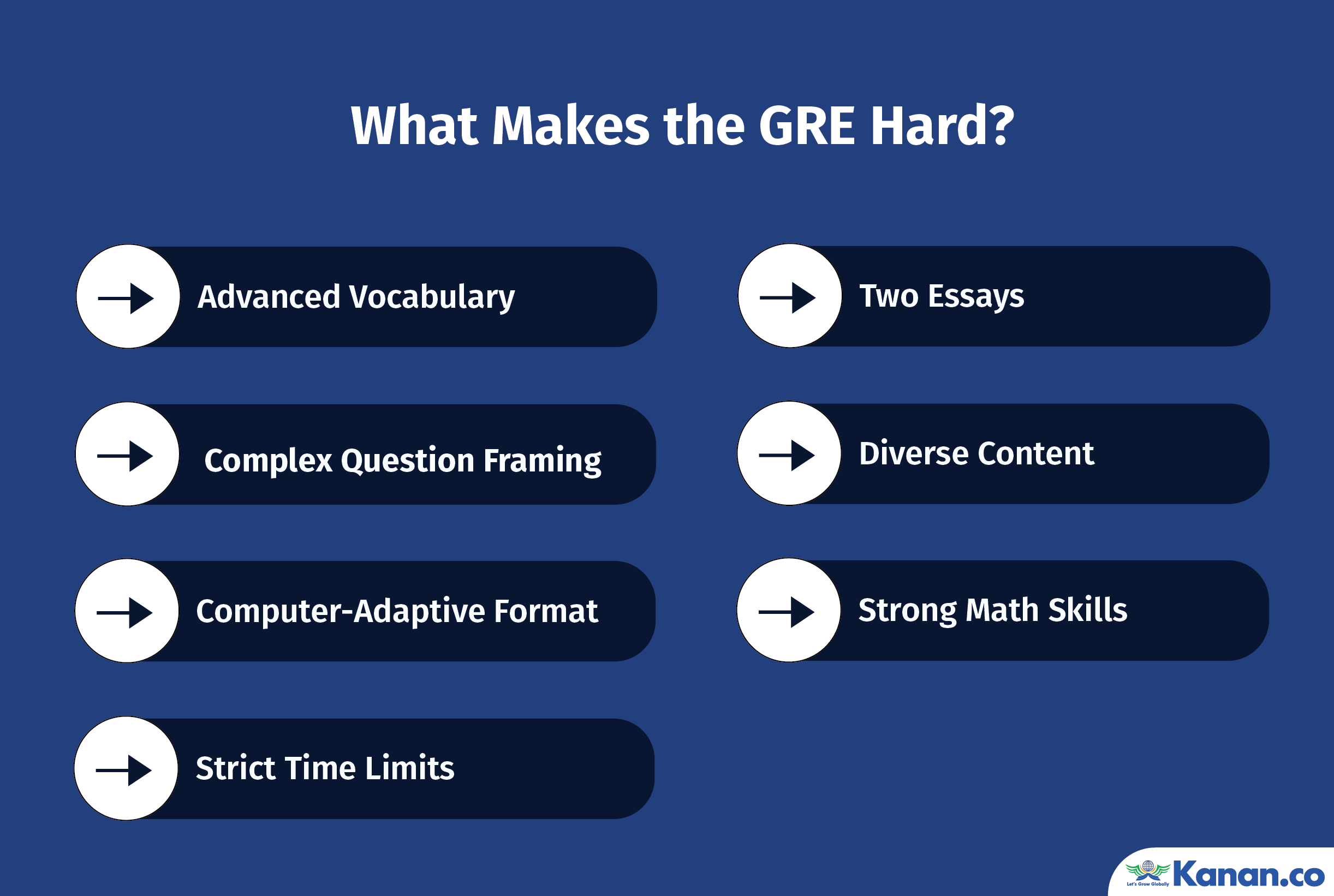
Preparing for the GRE can feel like a daunting task for many students aiming to enter top graduate programs. What exactly makes this test challenging? Let’s break down the key factors that contribute to the test's difficulty and share tips and strategies to help you tackle these challenges and overcome your GRE stress.
Advanced Vocabulary
The GRE is famous for its high-level and difficult vocabulary. Words like “obfuscate” or “grandiloquent” aren’t just thrown in for flair—they are central to the test. These words often appear in Text Completion or Sentence Equivalence questions, where understanding subtle differences in meaning is crucial. You might also encounter these words in reading passages, making it even harder to understand.
To tackle this challenge, you’ll need a structured approach. Start by using GRE word lists and flashcards. Our articles such as Common English Words, listening words can help you learn and review vocabulary every day. Reading books, academic articles, and newspapers like The Hindu, The Economist can also improve your understanding of advanced words in context.
Also read: Best books for GRE Verbal
Complex Question Framing
The GRE questions are designed to assess your reasoning, not just your knowledge. Many questions use tricky wordings that force you to rely on logical analysis and critical thinking. For instance, Quantitative Comparison questions may include confusing phrases to mislead you. Similarly, verbal questions often use complex sentence structures to test your understanding of the material.
To tackle this challenge, practice regularly with official GRE practice tests. Focus on understanding the logic behind the questions instead of just memorizing answers. Break each question into smaller parts to figure out what it’s really asking. This approach will help you decode the tricky wordings and improve your problem-solving skills.
Also read: Best books for GRE Quant
Computer-Adaptive Format
The computer-adaptive nature of the GRE adds another layer of difficulty. In simple terms, the test adjusts its difficulty based on how well you perform. If you do well in one section, the next section will contain harder questions. This means your final score doesn’t just depend on the number of correct answers but also on the difficulty level of those questions.
This unpredictability can be stressful, but with the right preparation, you can handle it. Take plenty of computer-based mock tests to simulate the real test environment. Get comfortable with adapting your strategies based on the difficulty of the questions, and remember not to panic if a section feels particularly hard—it might mean you’re doing well!
Strict Time Limits
Time management is one of the biggest hurdles in the GRE. Each section has a fixed time limit, giving you less than two minutes per question. This means you don’t just need knowledge—you also need speed. Even students who know the answers often struggle to finish within the time limits.
To improve your speed, practice solving questions with a timer. Learn shortcuts and strategies, like eliminating wrong answer choices quickly. In Quantitative Reasoning, practice mental math to save precious seconds. The more you practice under timed conditions, the more comfortable you’ll become with the pace of the test.
Two Essays
Unlike many other standardized tests, the GRE Analytical Writing section includes two essays: the Issue essay and the Argument essay. Writing two essays back-to-back in just 60 minutes can be intimidating, especially if you’re not a fast writer. These essays require you to express your thoughts clearly, support them with examples, and organize them logically—all under time pressure.
To prepare, practice writing essays regularly. Focus on structuring your arguments effectively and using relevant examples. Use templates to save time, but make sure they’re flexible enough to fit different topics. Reviewing sample essays with high scores can also give you insights into what test graders are looking for.
Also read : Best books for GRE Analytical Writing
Diverse Content
The GRE covers a wide range of topics, from high school-level algebra to reading comprehension and data analysis. While the content itself might seem familiar, the questions are designed to test your ability to apply your knowledge in unexpected ways. For example, a math question might seem straightforward but include a twist that requires critical thinking.
To succeed, don’t just study the basics—focus on understanding how they are tested. For verbal sections, improve your reading speed and understanding. For quantitative sections, practice solving problems that combine multiple concepts. The more versatile your preparation, the better you’ll perform on test day.
Strong Math Skills
The GRE Quantitative section requires a solid understanding of high school-level math, but don’t be fooled—it’s not as straightforward as it seems. The test focuses more on your ability to apply mathematical concepts to solve real-world problems rather than just solving equations. Topics like algebra, geometry, and data analysis are presented in ways that require critical reasoning and problem-solving skills. Even students with strong math backgrounds can find these questions tricky due to their unique framing.
To excel, it’s essential to not just know the formulas but also understand how to use them creatively. For instance, you might be asked to compare two quantities where the relationship isn’t immediately obvious. Regular practice with GRE-style questions and mock tests is key. Additionally, learning shortcuts for calculations and refining your number sense can help you save time and boost accuracy during the test.
In conclusion, the answer to Is GRE hard depends on your preparation and understanding of the test format. While it is a challenging exam, a well-structured study plan and consistent practice can make it easier to tackle. Remember, How hard is the GRE varies from person to person, but with Kanan's expert guidance and resources, you can achieve a good GRE score. Contact our counsellors and combine your GRE success with a strong application to secure admission to your desired graduate program.
FAQs
1. Is the GRE exam hard?
GRE is considered difficult when compared to exams like SAT or ACT, as it has a lot of maths MCQs, analytical problems, and difficult vocabulary words. You can ace the GRE test if you have advanced reasoning abilities to answer the majority of the questions.
2. How long does it take to prepare for the GRE?
Most people dedicate a few hours per week for a few months to studying for the GRE. As a result, the time needed to prepare for the GRE could be 10 hours each week for 12 weeks.
3. What makes GRE easy?
GRE is much easier based on the below three factors
- All the questions are multiple-choice with no negative marks
- Reading Comprehension questions are easier since the paragraph itself contains the answer, which is backed up by relevant evidence.
- No knowledge of advanced mathematics is necessary.
4. Is it easy to get a 300 on the GRE?
The most recent statistics from ETS show that the mean GRE score for the Verbal Reasoning component is around 150, and the mean score for the Quantitative Reasoning section is around 154. So, scoring a 300 on the GRE makes students an average-scorer.
5. How many hours does the GRE last?
The GRE takes 1 hour, 58 minutes to complete.

About Author Swathi Krishnan
Swathi Krishnan, an MBA graduate with an unwavering passion for writing and reading, is a distinguished expert in Study Abroad Services. With extensive experience in the overseas education industry, Swathi has become a trusted authority in the field, specializing in the preparation of test materials for exams such as IELTS, TOEFL, GRE, SAT, PTE, and more. Her comprehensive knowledge is evident through her numerous articles, covering a spectrum of topics, from drafting Statements of Purpose (SOPs) and Letters of Recommendation (LORs) to decoding study abroad exams, destinations, university requirements, admission procedures, and the entire process of obtaining an international education. Swathi's dedication to helping study abroad aspirants make informed decisions is reflected in her informative articles, making her a valuable resource for those embarking on their educational journeys.
Kanan.co is a trusted study abroad consultancy offering comprehensive services, resources, and solutions for students and education institutions. We support students at every stage of their global education journey, ensuring a smooth and guided experience. Along with test preparation for IELTS, GRE, TOEFL, and SAT, we provide expert services such as SOP writing, visa guidance, accommodation support, scholarship assistance, and education loan support. Our expertise and commitment to excellence make us a reliable partner for students pursuing international education.
Sign Up for a Free GRE Demo Class!
Ace GRE Quant & Verbal with 320+ Score — Join Us!








Global Headquarters
Kanan Int EdTech Inc
320 Bay Street, Suite 321 (Spaces), Toronto ON, Canada M5B 1N9
Indian Headquarters
Kanan International Pvt. Ltd.
D-wing, 2nd Floor, Trident Complex, Ellora Park Vadiwadi Road, Vadodara, Gujarat 390007
IT/ Digital Campus
Kanan International Pvt. Ltd
Old, New No 3, 2nd Floor, 1A, Dr Sadasivam Rd, T. Nagar, Chennai, Tamil Nadu 600017
Our branches
- Bardoli
- Bharuch
- Chennai
- Dehradun
- Gurugram
- Himatnagar
- Karnal
- Nadiad
- Navsari
- Palanpur
- Rajkot
- Vadodara
- Valsad
- Vallabh Vidyanagar
- Vapi
Study Abroad
Test Prep
Top Universities
Consultants
IELTS Centers
GRE Centers
TOEFL Centers
SAT Centers
Language Courses in Vadodara
Study Abroad Calculators
Featured Blogs
Study Abroad Consultants in Chennai
Study Abroad Consultants in Surat
Study Abroad Consultants in Navsari
Study Abroad Consultants in Bardoli
Study Abroad Consultants in Ahmedabad
Study Abroad Consultants in Anand
Study Abroad Consultants in Khanna
Study Abroad Consultants in Nadiad
Study Abroad Consultants in Vadodara
Study abroad consultants in Valsad
Copyright © 2026 KANAN.CO All rights reserved.