- Study Abroad /
- blog /
- Upcoming Intakes in Canada for Indian Students 2026: Timeline, Universities, Courses & Requirements
Upcoming Intakes in Canada for Indian Students 2026: Timeline, Universities, Courses & Requirements


Author
10-04-2026

Are you an aspiring Indian student planning to study in Canada but not sure which intake to choose? There are three major intakes in Canada: Fall (September), Winter (January), and Summer (May). Among these intakes, Fall is the most preferred intake by Indian students, followed by winter and summer intakes.
| Did you know? According to a Statista report, over 427,000 Indian students are pursuing higher education in Canada. |
Canada, the Great North, is the most popular study abroad destination for Indian students. Canada is known for its world-class education, welcoming environment, research opportunities, and top-ranked universities. Canadian universities are renowned for meeting the diverse academic needs of students through their three main intakes.
In this article, you will find a comprehensive guide on the timeline, universities, pros, and cons of each intake, along with eligibility criteria, scholarships, and part-time job opportunities. By the end of the article, you can decide which intake you can opt for.
Table of Contents
- What are the Intakes in Canada?
- Timeline for Canada Admission Intakes
- September/Fall Intake in Canada: Primary Intake
- September/Fall Intake Timeline
- Top-Ranked Universities for Fall/September Intake in Canada
- What are the Pros & Cons for Fall/September Intake in Canada?
- January/Winter Intake in Canada: Secondary Intake
- January/Winter Intake Timeline
- Top-Ranked Universities for Winter/January Intake in Canada
- What are the Pros & Cons for Winter/January Intake in Canada?
- Spring/Summer/May intake in Canada: Less Competitive Intake
- Summer/May Intake Timeline
- Top-Ranked Universities for Summer/May Intake in Canada
- What are the Pros & Cons for Summer/May Intake in Canada?
- Eligibility Requirements to Study in Canada
- Popular Scholarships to study in Canada universities
- How do International Students Manage Tuition Fees and Living Costs during Semesters?
- Which Intake is right for you?
- Other Popular Country Intakes
- Frequently Asked Questions
What are the Intakes in Canada 2026?
Canadian universities and colleges typically offer three main intakes for international students: Fall intake (September), Winter intake (January), and Summer intake (May).
1. Fall Intake (September) - This is the primary intake in which universities offer a wide range of courses. It starts in September and ends in December.
2. Winter Intake (January) - This is the secondary intake in which universities offer comparatively less programs than the fall intake. It starts in January or February and ends in April or May.
3. Summer Intake (May) - This is the least competitive intake during which universities offer fewer courses, like specialized or vocational programs. It starts in May and ends in August.
An overview of the timeline for each intake is given below.
Timeline for Canada Admission Intakes 2026
According to EduCanada, prospective students are advised to begin preparing their applications a year before their preferred intake. The table shows the optimum duration and deadline to apply for each Canadian admission intake.
| Timeline for Canada Intakes 2026 | ||
| Canada Intakes | Program Duration & Semester Breaks (Varies) | Application Deadline |
| Fall Intake |
September 2026 – December 2026 (Winter Break: Late December 2025 to Early January 2026) |
December 2025 – March 2026 |
| Winter Intake |
January 2026 – April 2026 (Summer Break: Late April 2026 to Early May 2026) |
September 2025 – November 2025 |
| Summer Intake |
May 2026 – August 2026 (Semester Break: Typically 1 week between the end of summer and the start of the fall semester) |
October 2025 – February 2026 |
September/Fall Intake in Canada 2026: Primary Intake
The fall intake in Canada is the most popular admission period among Indian students. Many students prefer the fall semester because universities and colleges in Canada offer more application slots for a wide range of courses compared to the winter and summer intakes.
The fall/September intake is the best intake in Canada to study undergraduate, postgraduate, diploma, doctoral, and co-op programs. This academic session offers scholarships, research, and internship opportunities, aligns well with the hiring season and job market, and also allows ample time to adapt to the academic and social environment.
The fall intake period usually begins in September and coincides with the start of the academic year, which aligns with the global academic calendar. The application deadline for the Fall/September intake in Canada 2025 typically spans from December 2025 to March 2026
September/Fall Intake Timeline 2026
Here’s the timeline for the students planning to study in Canada fall intake.
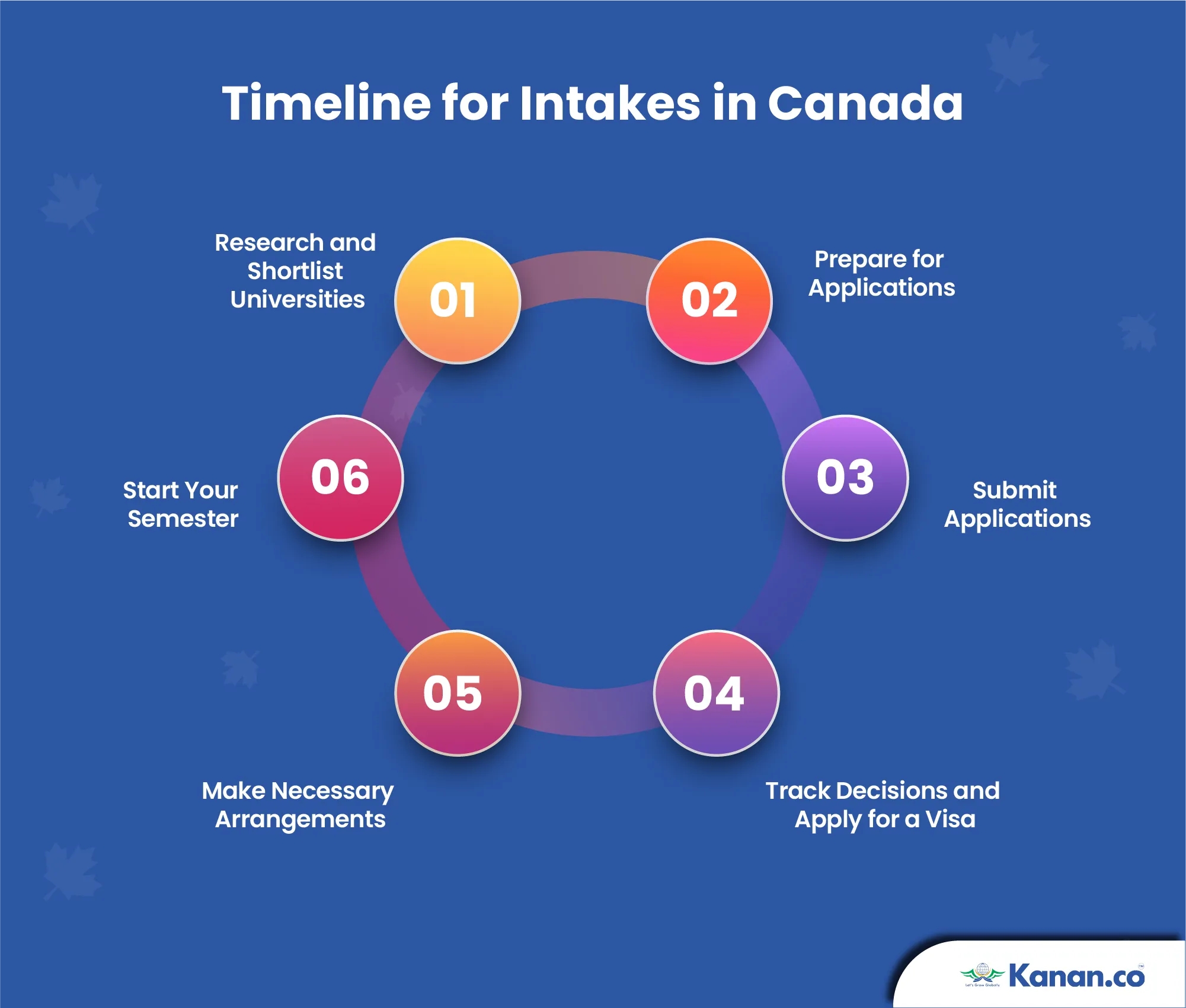
1. August – October 2025
Research and Shortlist Universities: Begin researching how Canada suits you best for the fall intake a year in advance. Shortlist universities and programs (9–8 months ahead) based on QS World University Rankings. Download brochures/viewbooks to review program requirements and application checklists.
2. November 2025 – January 2026
Prepare for Applications: Start the application prep 7–6 months before intake. Take required exams (IELTS/TOEFL/PTE/Duolingo, GRE/GMAT) with buffer time for retakes. Gather academic transcripts (grades 10, 11, 12), SOP, LORs, resume, and application essays.
3. January – March 2026
Submit Applications: Begin submitting applications before deadlines. Upload documents or supplemental applications on the university application portal, pay application fees, and complete any required personal or video interviews.
4. March – May 2026
Track Decisions and Apply for Visa: Monitor email for admission updates. Expect admission decisions within 1-2 months of applying. After acceptance, apply for government, non-government, or university scholarships, financial aid, loans, and Canadian student visa.
5. May – July 2026
Make Necessary Arrangements: Pay tuition fees or non-refundable deposits via bank transfers, online payment systems like CIBC Student Pay and Convera. Book flights, arrange housing, and do the residential application for on-campus accommodation. Prepare essentials: SIM card, international debit/credit card.
6. August – September 2026
Start Your Semester: Arrive in Canada, attend orientation programs, explore the culture, and start your first semester of the fall intake at your dream university!
Top-Ranked Universities for Fall/September Intake in Canada 2026
Here is the list of top universities in Canada, along with the popular programs, tuition, and application fees.
| Top-Ranked Universities to Apply for September Intake in Canada | ||||
| Universities | QS Ranking 2025 | Popular Programs | Tuition Fee & Application Fee | On-Campus Accommodation |
| University of Toronto | 25 |
|
Tuition Fee: $45,800 to $67,370 per year (INR 3,823,300 - INR 5,625,355 per year) Application Fee: CAD 180 for UG (INR 11,070), CAD 125 for PG (INR 7,690) |
Yes |
| McGill University | 29 |
|
Tuition Fee: $ 34,325.12 per year (₹2,865,370.52 per year) Application Fee: $133.41 CAD (INR 8,138.01) (non-refundable). |
Yes |
| University of British Columbia | 38 |
|
Tuition Fee: $47,250 per year (INR 39.43 lakh per year) Application Fee: $173.00 (INR 14,446) |
Yes |
| University of Alberta | 96 |
|
Tuition Fee: $31,089.60 to $45,482.40 per year (₹25.91 lakhs to ₹37.91 lakhs per year) Application Fee: CAD $125 (INR 7,625) |
Yes |
| University of Waterloo | 115 |
|
Tuition Fee: $48,000 to $73,000 per year (₹3,936,000 to ₹5,986,000 per year)
|
Yes |
What are the Pros & Cons for Fall/September Intake in Canada?
The fall intake in Canada offers a wide range of programs and universities with a high acceptance rate. However, it also has challenges like higher competition and tight deadlines. Check the following pros and cons below:
Pros:
- Wider Program Choice: Most universities and colleges offer a range of UG, PG, diploma, PhD, and co-op programs during the fall intake.
- Higher Acceptance Rates: Universities in Canada have higher acceptance rates for the September intake compared to the winter intake, giving students a better chance of admission.
- Summer Break: Students enjoy a longer summer break between semesters, allowing for rest, travel, or exploring internship or job opportunities.
- Comfortable Weather: Starting in the Fall season means arriving in mild and pleasant weather before the harsh winter sets in.
- Timely Graduation: Starting with the main intake ensures students can graduate on time without delays.
Cons:
- High Competition: Higher demand leads to more competition for preferred programs and admission, especially for top-ranking universities.
- Limited Availability: Some programs and courses may have limited spots due to high demand.
- Crowded Campus: Campuses may get overcrowded, resulting in busier classrooms, libraries, and other facilities.
- Strict Deadline: The rigorous deadlines and increased workload for preparing applications (essays, recommendations, standardized tests) can be challenging for some students.
- Higher Costs: Finding suitable on-campus or nearby housing can become difficult, often resulting in higher costs or less ideal options.
January/Winter Intake in Canada 2026: Secondary Intake
Winter intake in Canada, also known as the January intake, is the second-largest admission period. Winter intake opens up undergraduate and postgraduate courses for international students, typically fewer than the primary fall intake.
The winter semester is popular as it presents unique advantages for Indian students, such as ample time to prepare for studying abroad and the opportunity to apply as part of a smaller cohort.
The Winter intake in Canada starts in January/February 2026 and ends in April/May 2026. The deadline to apply for the winter intake at universities typically starts in September 2025 and ends before November 2025.
This Winter/January intake is ideal for students who want more time to make financial arrangements, to get more scores in competitive exams like IELTS, and to avoid a gap year. If you miss the fall intake, you can always catch up with the winter intake.
Below, we have discussed the timeline, popular universities, January intake advantages, and its disadvantages.
January/Winter Intake Timeline 2026
To apply for the winter intake, it is ideal to start the process a year before or at least 8 months before. The below points delineate the time-critical steps necessary for the university applications.
1. May to June 2025
Research Programs Early (8 Months Before): Shortlist the programs and universities based on your academic preferences. Note down the eligibility criteria and admissions requirements for each university.
2. July to September 2025
Prepare Tests & Documents (6-7 Months Before): After shortlisting the university, you should prepare for the standardized tests like IELTS, TOEFL, GRE, SAT, or GMAT. You should also start collecting documents like Academic Transcripts, LOR, and SOP. Start applying to the filtered universities.
3. September to October 2025
Complete Application Submission (4-5 Months Before): Submit the application along with the documents before the stipulated deadline. The earlier the submission, more the chances of getting into your dream university. Keep checking your application status and respond to queries.
4. October to November 2025
Accept Offer & Visa (3-4 Months Before): Once your admission is granted, respond to your acceptance to the university before the stipulated deadline. Pay the deposit amount and confirm the seat in your dream university. By that time, apply for a visa and attend the visa interview.
5. November to December 2025
Pre-Departure Preparations (2-3 Months Before): Once you have the visa approval, book flight tickets. Make a pre-departure checklist and start gathering the necessary things. Try to connect with the students and alumni of the university and join the community.
6. December 2025 to January 2026
Arrive and Begin Your Journey (1-2 Months Before): Arrive in the country and get accustomed to the climate and students. Start your student journey!!
Top-Ranked Universities for Winter/January Intake in Canada 2026
Below we have listed the popular universities in Canada that offer January intake, along with the popular programs, tuition fees, and accommodation details.
| Top-Ranked Universities to Apply for January Intake in Canada | ||||
| Universities | QS Ranking 2025 | Popular Programs | Tuition Fee & Application Fee | On-Campus Accommodation |
| University of Toronto | 25 |
|
Tuition Fee: $45,800 to $67,370 per year (INR 3,823,300 - INR 5,625,355 per year) Application Fee: CAD 180 for UG (INR 11,070), CAD 125 for PG (INR 7,690) |
Yes |
| Western University | =120 |
|
Tuition Fee: CAD 63,845 per year (INR 3,969,006 per year) Application Fee: $150 (INR 9,037.5) |
Yes |
| McMaster University | =176 |
|
Tuition Fee: CAD 35,000 to CAD 40,000 per year (₹21.35 lakhs to ₹24.40 lakhs per year) Application Fee : $110 CAD (INR 6,710) |
Yes |
| University of Ottawa | 189 |
|
Tuition Fee: $3,500 to $31,582.15 per term (₹2.92 lakhs to ₹26.34 lakhs per term) Application Fee: $50 for Undergraduate or $75 for Graduate (₹4,175 to ₹6,263) |
Yes |
| Queen’s University at Kingston | 193 |
|
Tuition Fee: CAD 15,166.25 - CAD 56,961.65 per year (9.46 lakhs - 35.55 lakhs per year) Application Fee: 110 CAD (6,860 INR) |
Yes |
Also Read: Cost of studying in Canada
What are the Pros & Cons for Winter/January Intake in Canada?
As a coin has two sides, January intake also has its pros and cons. Let's see them in detail.
Pros:
- More Time to Prepare: The Jan intake provides you with enough time to prepare for standardized/English Proficiency tests, compared to the fall intake.
- Learn from experience: Starting in January intake allows you to learn from the experiences of the preceding Fall intake students.
- Less Competition: The Winter intake receives fewer applicants compared to the Fall intake, often resulting in less competition and higher acceptance rates.
- More Departmental Attention: With a smaller cohort, January intake students may receive more focused attention from faculty and staff.
- Smaller Class Size: A smaller class size in the January intake can lead to more personalized learning experiences.
- Seamless Transition: Students starting in the January intake experience a smoother academic transition, helping to avoid study gaps.
Cons:
- Limited Program Choice: Program availability can be limited for the January intake, so verify whether your desired course is offered.
- Fewer Internship Opportunities: Fewer internship and job opportunities will be available as they often align with the primary Fall schedule.
- Navigating the Weather Conditions: As an Indian student, starting in January requires you to adapt to the challenging winter weather.
- Smaller Network Opportunities: A smaller January cohort might fewer initial networking opportunities compared to the larger Fall intake.
- Shifted Academic Calendar: Starting in January poses a potentially different academic calendar or course structure.
- Accelerated Study Paths: January intake students might need accelerated study paths, like summer classes, to graduate alongside Fall peers.
Summer/May intake in Canada 2026: Less Competitive Intake
The summer/may intake in Canada is the least popular intake as it falls at the end of the academic year. The summer/may semester has fewer applicants compared to fall and winter intakes, since only a limited number of universities offer a selective range of programs.
Indian students usually opt for the summer/may intake if they missed the first two intakes and don’t want to wait till the next year. The summer/may intake is preferred for its selective focus on vocational programs and short-term courses. Furthermore, summer intake has some significant advantages such as shorter wait time, less crowded campuses, quicker program completion, and extra preparation time.
The summer intake in Canada commences in April/May and lasts till August. Welcoming a smaller cohort of students, this intake offers a slow-paced campus life along with ample opportunities to explore the local events during the warmer months. The summer/may intake is ideal for students who prefer a less competitive admission cycle that offers their desired program.
Summer/May Intake Timeline 2026
Students applying for the summer intake should start at least 8-12 months before the commencement of the semester. Let's take a look at the major timelines and the necessary action you must take:
1. April – August 2025
Research & Shortlist Universities: Do thorough research on your desired course availability, preferred universities, along with their application deadlines, admission requirements, and academic qualifications.
2. September – November 2025
Prepare Documents: Appear for the necessary standardized tests and get your scorecards ready along with all the documents required for the Canada student visa.
3. November 2025 – January 2026
Apply to Universities: Prepare an application for your shortlisted institutes and submit the same.
4. February – March 2026
Check your admission status: Look out for a response from the academic institutes you applied to and confirm your admission if you get shortlisted.
5. April – May 2026
Apply for Student Visa: Start the application process for Canada student visa, scholarship, or education loan.
6. May 2026
Book a Ticket: Plan your travel and accommodation, and reach Canada before the commencement of the summer semester.
Top-Ranked Universities for Summer/May Intake in Canada 2026
Now that you are familiar with the May intake timelines, it is time to explore the top universities for summer/may intake in Canada, along with their popular programs, tuition fees, and application fees.
| Top-Ranked Universities to Apply for May Intake in Canada | ||||
| Universities | QS Ranking 2025 | Popular Programs | Tuition Fee & Application Fee | On-Campus Accommodation |
| McGill University | 29 |
|
Tuition Fee: $ 34,325.12 per year (₹2,865,370.52 per year) Application Fee: $133.41 CAD (INR 8,138.01) (non-refundable). |
Yes |
| University of Calgary | =198 |
|
Tuition Fee: CAD 28,460 to CAD 37,244 per year (INR 17.2 Lacs to INR 23 Lacs per year) Application Fee: $145 CAD (₹8,845) |
Yes |
| Dalhousie University | =275 |
|
Tuition Fee: $30,000 to $40,000 per year (₹25 lakh to ₹33 lakh per year) Application Fee: CAD 70 for undergraduate applicants (INR 4,305) and CAD 115 for graduate applicants (INR 7,072) |
Yes |
| Simon Fraser University | 319 |
|
Tuition Fee: CAD 36,024 (₹2,197,464 per year) Application Fee: $130 CAD (₹7,995 INR) |
Yes |
| University of Manitoba | 661-670 |
|
Tuition Fee: CAD 18,000 to CAD 29,000 per year (INR 1,080,000 to INR 1,740,000 per year) Application Fee: $120 (₹9,996) |
Yes |
What are the Pros & Cons for Summer/May Intake in Canada?
The summer/may intake has its own set of benefits and drawbacks. It could be your ideal intake if it meets your academic needs. Let's have a detailed look:
Pros:
- Less Competition: Only a few students apply for the summer/may intake, making it less competitive than other intakes.
- Shorter Wait Time: Universities process applications much quicker with only a few applicants to assess.
- Smaller Class Size: An ideal environment for more personalised learning due to a smaller class size.
- Availability of Specialised Courses: Specialised courses, postgraduate programs, vocational diplomas, and short-term courses are available.
- Pleasant Weather: The warm and pleasant weather during the summer intake is ideal for Indian students.
Cons:
- Less Programs: Universities only offer a selected set of courses during the summer/may intake.
- Fewer Scholarship Availability: Summer/May intake has lessser scholarship opportunities as compared to other intakes.
- Limited Job/Internship Opportunities: Companies have a lower recruitment rate during the summer/may intake, leading to less job opportunities for students.
- Lower Housing Availability: On-campus housing might be limited during the summer semester.
- Slow Social Life: With fewer students, the scope for social events, club activities, and networking opportunities could be low.
Eligibility Requirements to Study in Canada
Here are the eligibility requirements to study in Canada based on academic qualification, English language proficiency (ELP) requirements, and other requirements.
1. Academic Requirements
- Secondary School/Diploma/Bachelor Certificates: You should submit the high school, diploma, or bachelor's scorecard. Ensure your scores meet the benchmarks set by the international admission specialists of the Canadian universities or by the World Education Services (WES).
- Subject Prerequisites: You are expected to complete five academic subjects that align with your chosen course. For eg, if you choose STEM programs, it requires advanced mathematics, physics, and Chemistry.\
- GPA: The Admission Committee requires a grade point average between 2.5 - 3 out of 4 or equivalent percentage of marks. Make sure you convert your scores to the standard GPA format expected by the universities.
- Standardized Test Scores: You are required to submit the scores of standardized tests like ACT/SAT/GRE/GMAT. Refer to the universities for the specific tests to be taken.
- Work Experience Certificate: Applicants should provide a relevant work experience certificate for postgraduate programs like MBA and a few other professional degrees.
- Doctoral Admission Requirements: A minimum of 75% or equivalent GPA in your previous degree is required. You are also expected to submit the relevant work experience certificate and other research papers.
2. Language Proficiency Requirements
- IELTS Academic: The minimum IELTS band requirement to study UG in Canada is 6.0, and PG is 6.5.
- PTE Academic: The minimum PTE score requirement for undergraduate programs is 58 to 65, and for postgraduate programs is 60 to 80.
- TOEFL iBT: The minimum TOEFL iBT scores for Bachelor programs are 80-100, and for Master programs are 90 and above.
- Duolingo: The minimum Duolingo test score required for Canadian university admissions is 110-120.
- Other Accepted Tests: Non-native English speakers can also provide the test scores of the Cambridge English Qualification (like C1 Advanced or C2 Proficiency)
3. Other Documents Required
- Bank Statement
- Education Loan approval document
- Scholarship grant letters
- Valid Passport
- Medical certificates
- Insurance certificates
- Canada Study visa
- Statement of Purpose (SOP) or Letter of Motivation
- Letter of Recommendation (LOR)
- Academic transcripts in English. If they are in another language, provide certified English translations of the transcripts.
- Resume/CV
- Portfolios for arts and design courses
- Application fee receipt
- Conduct certificate
- Qualify Criminal Record Review Act (CRRA)
- Proof of Citizenship
- Certificates for extra-curricular activities
- Passport-size photographs
Popular Scholarships to Study in Canadian universities
The following are the popular scholarships in Canada available for international students planning to pursue their studies in the upcoming intakes.
Fall intake scholarships:
1. Scholarship Name: Study in Canada Scholarships
Eligible Amount: $10,200 to $12,700
Application Deadline: March 18, 2025 (varies by institution)
Who can Avail: Students from eligible countries (Asia, Europe, Middle East, and North Africa) enrolled in short-term studies or research at Canadian post-secondary institutions.
2. Scholarship Name: Vanier Canada Graduate Scholarships
Eligible Amount: CAD 50,000/year for 3 years
Application Deadline: October 30, 2025
Who can Avail: International doctoral students demonstrating leadership and academic excellence in health, natural sciences, engineering, or social sciences.
3. Scholarship Name: Lester B. Pearson International Scholarship (University of Toronto)
Eligible Amount: Full tuition, books, incidental fees, and residence support for 4 years
Application Deadline: November 8, 2026
Who can Avail: Exceptional international students entering undergraduate programs at the University of Toronto.
4. Scholarship Name: Canada Graduate Scholarships – Master’s Program
Eligible Amount: $27,000 for one year
Application Deadline: December 1, 2025
Who can Avail: International students pursuing master’s degree at a Canadian institution.
5. Scholarship Name: Schulich Leader Scholarships
Eligible Amount: CAD 100,000–120,000 over 4 years
Application Deadline: February 19, 2026
Who can Avail: High school students pursuing undergraduate studies in STEM fields at Canadian universities.
Winter intake scholarships:
1. Scholarship Name: Banting Postdoctoral Fellowships
Eligible Amount: CAD 70,000 along with research for 2 years
Application Deadline: September 17
Who can Avail: International postdoctoral researchers in natural & social sciences or health research.
2. Scholarship Name: Ontario Graduate Scholarship (OGS)
Eligible Amount: CAD 10,000/year for universities with 2 terms, CAD 15,000/year for universities with 3 terms
Application Deadline: Varies by institution; typically in late January or early February
Who can Avail: International students pursuing graduate studies.
3. Scholarship Name: Study in Canada Scholarships
Eligible Amount: $10,200 to $12,700
Application Deadline: March 18, 2026 (varies by institution)
Who can Avail: Students from eligible countries (Asia, Europe, Middle East, and North Africa) enrolled in short-term studies or research at Canadian post-secondary institutions.
4. Scholarship Name: Canada-ASEAN Scholarships and Educational Exchanges for Development (SEED)
Eligible Amount: $10,200 for 4-month study or research period
Application Deadline: March 31, 2026
Who can Avail: Citizens of ASEAN member states pursuing short-term studies or research in Canadian post-secondary institutions.
Summer intake scholarships:
1. Scholarship Name: Surfshark Privacy and Security Scholarship
Eligible Amount: CAD 2,000
Application Deadline: Check the official website
Who can Avail: Undergraduate or graduate students enrolled in Canada; requires an essay submission.
2. Scholarship Name: Pierre Elliott Trudeau Foundation Scholarships
Eligible Amount: Up to CAD 60,000/year for 3 years
Application Deadline: November 2026
Who can Avail: International students pursuing PhD at Canadian universities
How do International Students Manage Tuition Fees and Living Costs during Semesters?
International students can manage their tuition fees and living costs by taking up part-time jobs and paid internships, other than scholarships. According to Canada.ca, international students can work off-campus up to 24 hours per week during regular school terms, and they can work full-time during semester breaks/drops. As per Educanada, you can earn up to $14-$19 per hour, which varies depending on the employer and skills. Check the following part-time jobs in Canada.
- Barista
- Retail Sales Associate
- Teaching Assistant (TA)
- Translator
- Administrative Clerk
- Customer Service Representative
Read More: Cost of living in Canada
Which Intake is right for you?
Choosing the right intakes in Canada depends upon factors like academic goals, the course of your choice, acceptance rate, personal preferences, and many more.
Here we have provided a few recommendations for intakes based on the questions you might have.
| Find your Ideal Intake in Canada | ||
| Your Academic Needs | Recommended Intake | Why? |
| I want a large number of program options to choose from. | Primarily Fall | Fall intake offers the highest number of courses as it's the primary intake. |
| I need more scholarships and funding options. | Consider Fall | Since Fall is the main admission cycle, the funding pool is significantly larger compared to winter and summer intakes. |
| What if my academic transcripts get delayed? | Check Winter | Winter is the next popular intake that allows you to avoid a gap year. So if you've missed the fall intake due to transcript delay, you can catch up with the winter intake. |
| I'm looking for a short-term or a language course. | Choose Summer | Universities typically offer short-term and language courses during the summer intake. |
| I prefer a smaller student batch. | Consider Winter or Summer | Winter and Summer semesters have a smaller batch size compared to the Fall semester. |
| What if I still haven't decided on my exact major? | Consider Fall | Fall intake offers a wide range of programs to choose from. Hence, Fall is the ideal choice for you to explore and select the program best suited to your interests. |
| Which intake is the easiest to get into? | Try Summer | The summer intake is the least competitive intake with fewer applicants, making it the easiest intake to get into among the three intakes. |
| Which intake is suitable for university exchange programs? | Fall or Winter | Both fall and winter are suitable for exchange programs. However, fall is best suited for full academic year exchanges, while winter is suited for single-semester exchanges. |
| Which intake is best if I have a low GPA? | Choose Winter | Try applying for winter intake as it gives you more preparation time to strengthen other factors such as test scores, SOPs, LORs, and work experience. Winter has relatively lower competition, giving you a better chance for admission. |
| I'm an Indian student, can I survive the harsh weather in Canada? | Try Fall or Summer | As Indian students are used to hot and warmer weather conditions, they may find winter extremely cold. Hence, fall or summer would be a better choice. |
| Which US intake is best suited to gain CPT? | Fall or Winter | Enrolling in the Fall or Winter semester allows you to complete a full academic year, thus making you eligible for CPT. |
| As a freshman, which Canadian intake is the ideal choice for me? | Fall | Fall is the ideal intake for a freshman, as it offers a plethora of programs in an array of fields. |
| Which intake has a buzzing campus life and more opportunities to socialise? | Fall or Winter | Fall and Winter, being the first two intakes, have the maximum number of applicants among the three. Hence, you have more opportunities to socialise and make new friends during fall. |
| I want to work part-time immediately after my arrival. Which intake is the best option? | Primarily Fall | Fall is the main intake with ample part-time job opportunities for international students. |
| I am a physically challenged person willing to study in Canada. I am worried about my accommodation. Which intake can I choose? | Fall or Winter | Fall intake is generally the most advantageous intake for the physically challenged persons. This is the time when the disability service office or the accessibility service will be open. You can contact them and explain your disability and the support you need in terms of accommodation and campus accessibility. |
Other Popular Country Intakes
- Intakes in USA
- Intakes in UK
- Intakes in Australia
- Intakes in Germany
- Intakes in Ireland
- Intakes in New Zealand
If you need expert guidance on deciding a suitable intake to study in Canada, you can contact our study abroad counsellors. They will clear all your doubts and guide you through the entire process from choosing the right university till you land in your dream country!!
Frequently Asked Questions (FAQ)
1. How many intakes does Canada have?
Canada has a tri-semester system which is: Fall/September intake, Winter/January intake, Summer/May intake.
2. When should I apply for the intake in Canada?
Students can start the application process for any Canadian intake 12 months before the intake period. The earlier you start the process, the higher the chances of getting admitted into the university.
3. How long does it take to get a student visa for Canada?
The time required to obtain a Canadian student visa typically ranges from 4 to 8 weeks. It usually takes time to submit the documents, clear the visa interview, and get the Canada visa.
4. Can international students work in Canada while studying?
Yes, International students are allowed to work 24 hours per week in Canada while studying.
5. How much gap is acceptable to study in Canada?
The gap year accepted in Canada is up to 2 years for undergraduate and diploma programs and up to 5 years for postgraduate programs.
6. What things should I pack to study in Canada?
The things that you should pack are:
- Clothes
- Thermal wears
- Boots
- Sweaters
- Umbrella
- Passport / Visa
- Toiletaries & Personal Care
- Medicines
- National Identity Proof
- Electronics (Phone/Charger/Laptop/Earphones/Power bank)
- Books
- Cash and credit cards.
7. What should I do if the university has deferred my intake?
If the university has deferred your admission, it means you still have a chance to get admitted to the university for the next intake. You need to wait, follow up with the university, and can strengthen your profile in the meantime.
8. What is the procedure to open a bank account after arriving in Canada?
To open a bank account upon your arrival in Canada, you need to follow the steps below.
- Choose a bank or credit union
- Select account type (chequing/savings)
- Gather required documents such as proof of identity, immigration, and SIN
- Apply online, by phone, or in person
- Sign the account agreement and disclosures
- Set up PIN and online banking
- Receive a debit card and account details
9. Can I carry an Indian SIM card to study in Canada?
Yes, you can carry your Indian SIM card to Canada. However, you need to enable international roaming with your network provider. Alternatively, you can also opt for SIMs from local network providers like Xplore, CIK Telecom, Cogeco, and Videotron.
10. Which is the best province to study in Canada in terms of low expense?
Quebec is the top choice for international students who are looking for an affordable living and quality education in Canada. While other provinces like Newfoundland and Labrador, Saskatchewan, and Manitoba also have universities with competitive tuition fees.
11. Which is the best intake to study a master's in Canada?
The Fall intake is usually considered the best intake to study a master’s in Canada as it offers a wide range of courses, many scholarships, internships, and job opportunities.
12. Can I apply for Canada with a 5.5 band score in IELTS?
Yes, you can apply to many Canadian universities and colleges with an IELTS band score of 5.5.
About Author Arivarasi
Arivarasi is an experienced author with expertise in the study abroad industry and preparing test materials for exams like IELTS, TOEFL, GRE, SAT, PTE, etc. She stays up-to-date with university and college requirements for international students which allows her to provide guidance on course selection, documents like SOP, LOR, and scholarship opportunities. She has written numerous articles on study abroad exams, destinations, universities & colleges requirements, admission procedures, and the entire process of studying abroad. Collaborating with industry experts and counselors, she crafts informative articles that make students take the right decisions.

Kanan.co is a trusted study abroad consultancy offering comprehensive services, resources, and solutions for students and education institutions. We support students at every stage of their global education journey, ensuring a smooth and guided experience. Along with test preparation for IELTS, GRE, TOEFL, and SAT, we provide expert services such as SOP writing, visa guidance, accommodation support, scholarship assistance, and education loan support. Our expertise and commitment to excellence make us a reliable partner for students pursuing international education.
Get Canada Admission Counselling by Experts








Global Headquarters
Kanan Int EdTech Inc
320 Bay Street, Suite 321 (Spaces), Toronto ON, Canada M5B 1N9
Indian Headquarters
Kanan International Pvt. Ltd.
D-wing, 2nd Floor, Trident Complex, Ellora Park Vadiwadi Road, Vadodara, Gujarat 390007
IT/ Digital Campus
Kanan International Pvt. Ltd
Old, New No 3, 2nd Floor, 1A, Dr Sadasivam Rd, T. Nagar, Chennai, Tamil Nadu 600017
Our branches
- Bardoli
- Bharuch
- Chennai
- Dehradun
- Gurugram
- Himatnagar
- Karnal
- Nadiad
- Navsari
- Palanpur
- Rajkot
- Vadodara
- Valsad
- Vallabh Vidyanagar
- Vapi
Study Abroad
Test Prep
Top Universities
Consultants
IELTS Centers
GRE Centers
TOEFL Centers
SAT Centers
Language Courses in Vadodara
Study Abroad Calculators
Featured Blogs
Study Abroad Consultants in Chennai
Study Abroad Consultants in Surat
Study Abroad Consultants in Navsari
Study Abroad Consultants in Bardoli
Study Abroad Consultants in Ahmedabad
Study Abroad Consultants in Anand
Study Abroad Consultants in Khanna
Study Abroad Consultants in Nadiad
Study Abroad Consultants in Vadodara
Study abroad consultants in Valsad
Copyright © 2026 KANAN.CO All rights reserved.