- Study Abroad
- / gre
- / syllabus
What is the GRE Exam Syllabus for 2026?


Author
31-12-2025


The GRE exam syllabus 2026 consists of three sections: GRE Analytical Writing, GRE Verbal Reasoning, and GRE Quantitative Reasoning. Candidates willing to pursue graduate studies abroad are required to take the Graduate Record Examination (GRE) and achieve good scores. The GRE syllabus covers multiple topics to measure the verbal reasoning, quantitative reasoning, critical thinking, and analytical writing skills of individuals. Candidates must be well versed with the latest GRE exam syllabus to begin with the preparation effectively. Read on to learn more about the syllabus of the GRE.
GRE Test Format
The GRE exam has two formats: the GRE General Test and the GRE Subject Test.
- GRE General Test: The GRE General Test is a standard examination that assesses students’ verbal, mathematical, and analytical writing abilities. Students seeking admission to MS courses and a select few MBA courses or professional courses at the graduate level are required to appear for the GRE General Test. The exam pattern for the GRE General Test includes 3 sections, 54 MCQs, and 1 hour 58 minutes of time duration.
- GRE Subject Test: The GRE Subject Test is a subject-specific test that the college or university may require for more specialized courses. It measures a candidate’s expertise in specific disciplines. Generally, the GRE Subject Test is required for getting admission to specialized courses/technical programs. The exam pattern for the GRE Subject Test consists of approximately 144 multiple-choice questions with five options each.
Check out here to know the difference between GRE General Test and Subject Test.
GRE Syllabus for General Test in 2026
The GRE 2024 syllabus for the General test has been designed to measure the test takers’ verbal reasoning, quantitative reasoning, critical thinking, and analytical writing skills—skills that are developed over a long period of time and aren’t related to a specific field of study but are important for all. The GRE syllabus is broadly divided into three sections
1. GRE Analytical Writing
2. GRE Quantitative Reasoning
3. GRE Verbal Reasoning
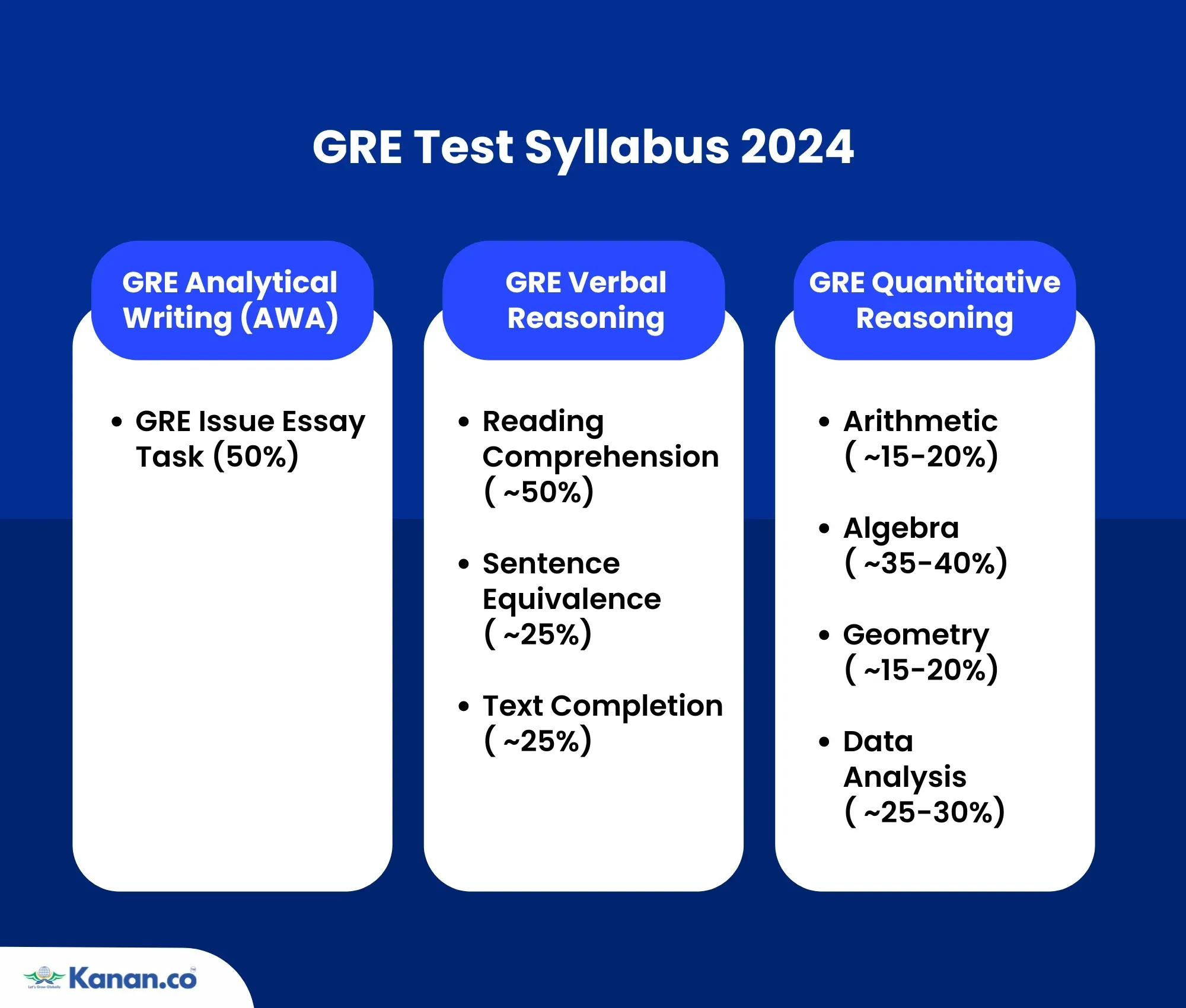
The first two components of the GRE test syllabus, GRE Verbal Reasoning, and GRE Analytical Writing, are well-defined. However, the GRE Quantitative Reasoning syllabus can be confusing. Let's examine what each segment includes to gain a better understanding of the material covered.
GRE Analytical Writing (AWA) Syllabus
The GRE Analytical Writing section measures your ability to articulate and support complex ideas clearly and effectively, construct arguments, and your ability to sustain a well-focused and coherent discussion and control the elements of standard written English. This section comes first when taking the GRE, before any quantitative or verbal sections.
The syllabus of GRE Analytical writing includes a 30 minute “Analyze an Issue” task. It requires you to present an opinion on the issue of general interest according to specific instructions on how to respond to that issue. You need to evaluate the issue, consider its complexities, and develop an argument with reasons and examples to support your views.
The task is related to a wide range of subjects — from fine arts and humanities to social and physical sciences. You do not need knowledge of a specific topic. You will be able to understand this issue task regardless of your field of study or interests.
Refer to the best books for GRE Analytical Writing that offer useful tips and techniques to master your analytical writing and critical thinking skills.
GRE Verbal Reasoning Syllabus
The GRE Verbal Reasoning section tests your ability to understand the meaning of words, entire texts, and sentences. It measures your understanding of relationships among words and concepts and your ability to analyze relationships among component parts of sentences.
You need to analyse and draw conclusions from discourse, have the ability to reason behind incomplete data, identify the author’s assumptions/ perspective, and understand multiple levels of meaning like literal, figurative, and author’s intent. Then, select the important and relevant points, summarise them, and write them.
List of topics covered in GRE Verbal syllabus includes:
- Idioms & Idiomatic Expressions
- Pronoun Agreement
- Subject-Verb Agreement
- Modifiers
- Parallelism
- Verb Tense
- Basic Sentence Structure: Nouns, Pronouns, Adjectives and Adverbs
The questions in the GRE Verbal Reasoning Section are broken down into three parts:
1. Reading Comprehension: It requires you to answer questions from four to five passages based on three different subject areas - humanities, natural science, and social science (Business). Reading comprehension tests your ability to understand what you are reading. The exam contains approximately 10 passages (academic & non-academic) and three question types. You must read and analyse the passage carefully before answering the questions. If you encounter an unfamiliar passage, don’t be discouraged. Do not rely on outside knowledge, but answer the questions based on the information given in the passage. All questions can be answered based on the information provided in the passage.
2. Sentence Equivalence: It assesses your ability to conclude a passage based on incomplete information. You need to choose two ways to complete the sentence that has the same meaning and is grammatically correct. When you select your pair of answer choices, ensure that each one produces a logically, grammatically, and stylistically coherent sentence.
3. Text Completion: It tests your ability to derive a complete picture from the text represented. To ace this section, you need to know the words and be well aware of their meaning. Both Sentence equivalence and text completion assess the candidate’s grasp of vocabulary. Read through the passage to get an overall sense of it.
About half of the questions are from Reading comprehension, and the other half are Test Completion and Sentence Equivalence. Consistent timed practice with reliable materials and taking full-length tests are effective strategies for improving your scores. Check out the best books for GRE Verbal to improve your vocabulary and ability to read and comprehend.
GRE Quantitative Reasoning Syllabus
The GRE Quantitative Reasoning section assesses your ability to solve problems using mathematical models. You need to understand, analyze, and interpret quantitative information. To perform well in this section, you need to apply basic elementary mathematical concepts and skills like arithmetic, geometry, algebra, probability, and data analysis. You can use an on-screen calculator for this GRE math section, however, all the questions will not require you to use the calculator.
The list of topics covered in the GRE quant syllabus is as follows.
| GRE Quant Syllabus Topics | GRE Quant Syllabus Sub-Topics |
| Arithmetic |
|
| Geometry |
|
| Data Analysis |
Note: These topics are taught in high school algebra or introductory statistics courses. |
| Algebra |
|
Amongst the list of topics specified above, Geometry is likely the most difficult subject in the GRE Quants syllabus. Prepare all these topics using the best books for GRE Quant available in PDF and hard copies.
GRE Exam Pattern
The GRE computer-based test has a time limit of 1 hour and 58 minutes. The exam pattern of the GRE is given in the table below. Learning the GRE exam pattern helps you not only manage your time but also understand the exam format, structure, and types of questions covered in the GRE syllabus.
| GRE Exam Pattern | ||||
| Sections | Number of Questions | Question Types | Duration | Score range |
| GRE Analytical Writing Assessment | 1 | Analyse an Issue | 30 minutes | 0-6 with 0.5 increment |
| GRE Verbal Reasoning | Section 1: 12 questions Section 2: 15 questions |
Reading comprehension Text completion Sentence Equivalence |
Section 1: 18 minutes Section 2: 23 minutes |
130-170 with 1 point increment |
| GRE Quantitative Reasoning | Section 1: 12 questions Section 2: 15 questions |
Geometry Algebra Arithmetic Data Analysis |
Section 1: 21 minutes Section 2: 26 minutes |
130-170 with 1 point increment |
| Total | 54 MCQs 1 Descriptive |
- | 1 hour 58 minutes | Total score- 260 to 340 |
Among the three sections in the GRE syllabus, only Quantitative and Verbal reasoning scores will add up to more than your GRE scores.
Did you know: The GRE Analytical Writing section will always be first. The GRE Verbal Reasoning and GRE Quantitative Reasoning sections may be in any order.
GRE Subject Test Syllabus 2026
The GRE Subject Test is offered in a paper-delivered format and conducted thrice a year in September, April, and October worldwide. The test lasts for 2 hours 50 minutes and contains multiple-choice questions. The GRE syllabus for subject test includes the following disciplines that are intended to measure your knowledge in a particular subject:
- Chemistry
- Mathematics
- Physics
- Psychology
The list of topics covered in each subject are as follows
| Topics of GRE Subject Test Syllabus | Sub-Topics of GRE Subject Test Syllabus |
| GRE Chemistry |
Chemistry in the GRE Subject Tests consists of approximately 130 multiple-choice questions. The list of topics are:
|
| GRE Mathematics |
This subject test contains approximately 66 multiple-choice questions drawn from undergraduate courses. The list of topics includes:
|
| GRE Physics Syllabus |
Physics in the GRE Subject Tests’ consists of approximately 100 five-choice questions, categorised based on materials such as graphs, diagrams and experimental data. The list of topics includes:
|
| GRE Psychology |
Psychology is one of the interesting subjects in the GRE Subject Tests. It approximately contains 205 multiple-choice questions. The Psychology topics include:
|
Download GRE Syllabus PDF here
How much time does it take to complete the GRE Syllabus?
Depending on the candidate’s learning abilities, it would take around 2 to 3 months to complete the GRE syllabus. A quick learner would complete the GRE syllabus faster than a slow learner.
How to prepare for the GRE?
As mentioned above, the suggested timeline to prepare for the GRE test would be at least 4 to 12 weeks depending on your commitment to studies. Below are the few tips you can follow to plan your preparation:
1. Check your base score: Take the full-length practice test available online before beginning to check where your performance stands if you take the actual test at that time. This will help you to identify the topics you need to work on.
2. Set your target score: Select the prospective universities you want to study and note the GRE scores you need to apply for. This way, you will have a clear targeted score and can able to work towards it.
3. Plan to Ascend: Achieving your target score requires thorough research and planning. Review online testimonials from successful students and adopt the strategies that work best for you.
4. Focus on Technique: Besides following the result-oriented approach, you should definitely pay attention to the ways to approach each question. Identify the techniques you use to solve the problems and work on improving them.
5. Review your Performance: Take multiple practice tests to analyse your performance, to search for your mistakes and questions you constantly have problems with.
6. Build Vocabulary: Vocabulary is the key to score high. Improve your vocabulary by reading reputed academic journals and publications on the internet.
Want to prepare for GRE? Check out the best institute for GRE Coaching in Chennai.
Also, Check out the upcoming GRE exam dates here.
What should you do after attempting GRE?
Generally, candidates wanting to study abroad, mainly in the USA, take the GRE test. The score obtained after taking the GRE test is valid for 5 years from the date of the test. After getting your GRE results, if you are happy with the score, it’s time to start refining your resume without wasting time as it plays a crucial role in your study abroad admission process. Another important step of the study abroad process is to make a list of major universities you want to apply for and gather information about the necessary documents that the concerned universities require when applying for, as each university can have its own set of requirements.
It is important to note that when you apply to a college or university abroad there are certain documents that you need to submit like the letter of recommendation, statement of purpose, academic qualifications, extracurricular activities, and much more. We are here to help you at every step of the process. Moreover, it is important to be updated with the latest GRE syllabus in order to do well in your GRE General Test. Connect with our subject matter experts to get started on your GRE preparation. We are committed to assisting you in achieving your goals.
Frequently Asked Questions about GRE Exam Syllabus
1. What is the syllabus of GRE?
The GRE exam syllabus consists of three sections - Verbal reasoning, quantitative reasoning, and analytical writing. The exam is designed in such a way that it tests the candidates analytical aptitude, writing skills, and critical thinking skills.
2. Which GRE is required for MS?
Candidates planning to take MS courses and a few MBA courses or professional courses at the graduate level abroad are required to appear for the GRE General Test.
3. Who should take GRE?
Those who want to study professional courses like graduate, business or law abroad should take the GRE exam.
4. What is the GRE syllabus for MBA?
The GRE syllabus for MBA is divided into three sections: quantitative reasoning, verbal reasoning and analytical writing.
5. What is the GRE test score range?
The GRE General Test score range for Quantitative Reasoning and Verbal Reasoning ranges from 130 to 170 in one-point increments. Likewise, the range of scores for the Analytical Writing (awa) section is 0 to 6, in half-point increments.
6. How much does the GRE cost?
The GRE exam fee or cost for the GRE General Test is $205 for all countries except Nigeria, Turkey, China, Australia and India. In India, the GRE General Test’s registration fee is $213 (INR 15,800).
7. Is the GRE a difficult exam?
Yes. The GRE is considered difficult by most people. They agree that the GRE is harder than the ACT and SAT but not as difficult as the MCAT or LSAT. Compared to GMAT, students wonder which is harder as many MBA programs accept both tests.
8. When to give GRE for fall 2026?
If you are looking to secure admission into a university abroad in the fall of 2026, your application deadlines would be somewhere between December 2025 and January 2026. This mean you should plan completing your GRE exam latest by November 2025.

About Author Tejaswini Kota
Tejaswini is an enthusiastic writer, reader and a passionate learner. Additionally, she was a research fellow and holds a grip in English writings and research/paper publications. She holds bachelors and masters degrees in engineering. She spent three years in the education industry and is currently working as a full-time content writer at Kanan International, writing articles for study abroad projects. She is proficient in creating good quality content that helps the students for language proficiency tests like IELTS, GRE, TOEFL etc. and can help in advising you the right choice of college for admission.
Kanan.co is a trusted study abroad consultancy offering comprehensive services, resources, and solutions for students and education institutions. We support students at every stage of their global education journey, ensuring a smooth and guided experience. Along with test preparation for IELTS, GRE, TOEFL, and SAT, we provide expert services such as SOP writing, visa guidance, accommodation support, scholarship assistance, and education loan support. Our expertise and commitment to excellence make us a reliable partner for students pursuing international education.
Sign Up for a Free GRE Demo Class!
Ace GRE Quant & Verbal with 320+ Score — Join Us!








Global Headquarters
Kanan Int EdTech Inc
320 Bay Street, Suite 321 (Spaces), Toronto ON, Canada M5B 1N9
Indian Headquarters
Kanan International Pvt. Ltd.
D-wing, 2nd Floor, Trident Complex, Ellora Park Vadiwadi Road, Vadodara, Gujarat 390007
IT/ Digital Campus
Kanan International Pvt. Ltd
Old, New No 3, 2nd Floor, 1A, Dr Sadasivam Rd, T. Nagar, Chennai, Tamil Nadu 600017
Our branches
- Bardoli
- Bharuch
- Chennai
- Dehradun
- Gurugram
- Himatnagar
- Karnal
- Nadiad
- Navsari
- Palanpur
- Rajkot
- Vadodara
- Valsad
- Vallabh Vidyanagar
- Vapi
Study Abroad
Test Prep
Top Universities
Consultants
IELTS Centers
GRE Centers
TOEFL Centers
SAT Centers
Language Courses in Vadodara
Study Abroad Calculators
Featured Blogs
Study Abroad Consultants in Chennai
Study Abroad Consultants in Surat
Study Abroad Consultants in Navsari
Study Abroad Consultants in Bardoli
Study Abroad Consultants in Ahmedabad
Study Abroad Consultants in Anand
Study Abroad Consultants in Khanna
Study Abroad Consultants in Nadiad
Study Abroad Consultants in Vadodara
Study abroad consultants in Valsad
Copyright © 2026 KANAN.CO All rights reserved.